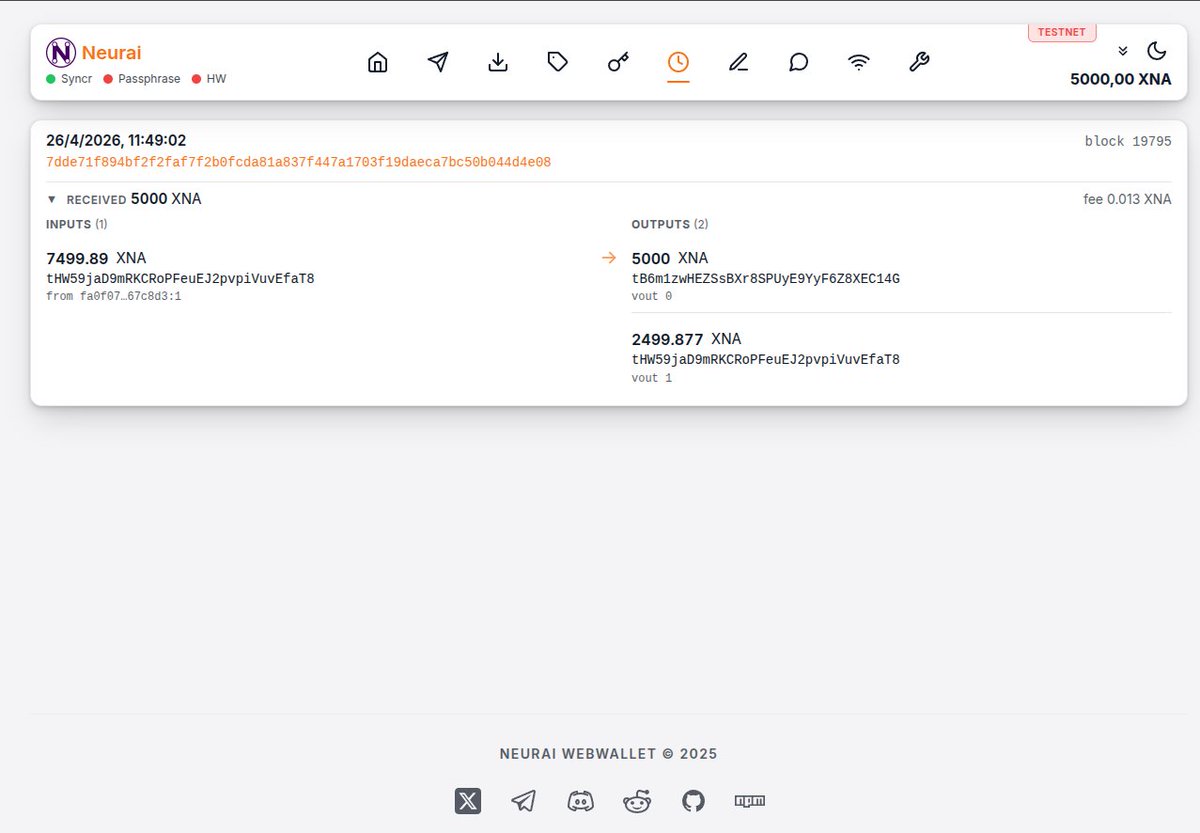
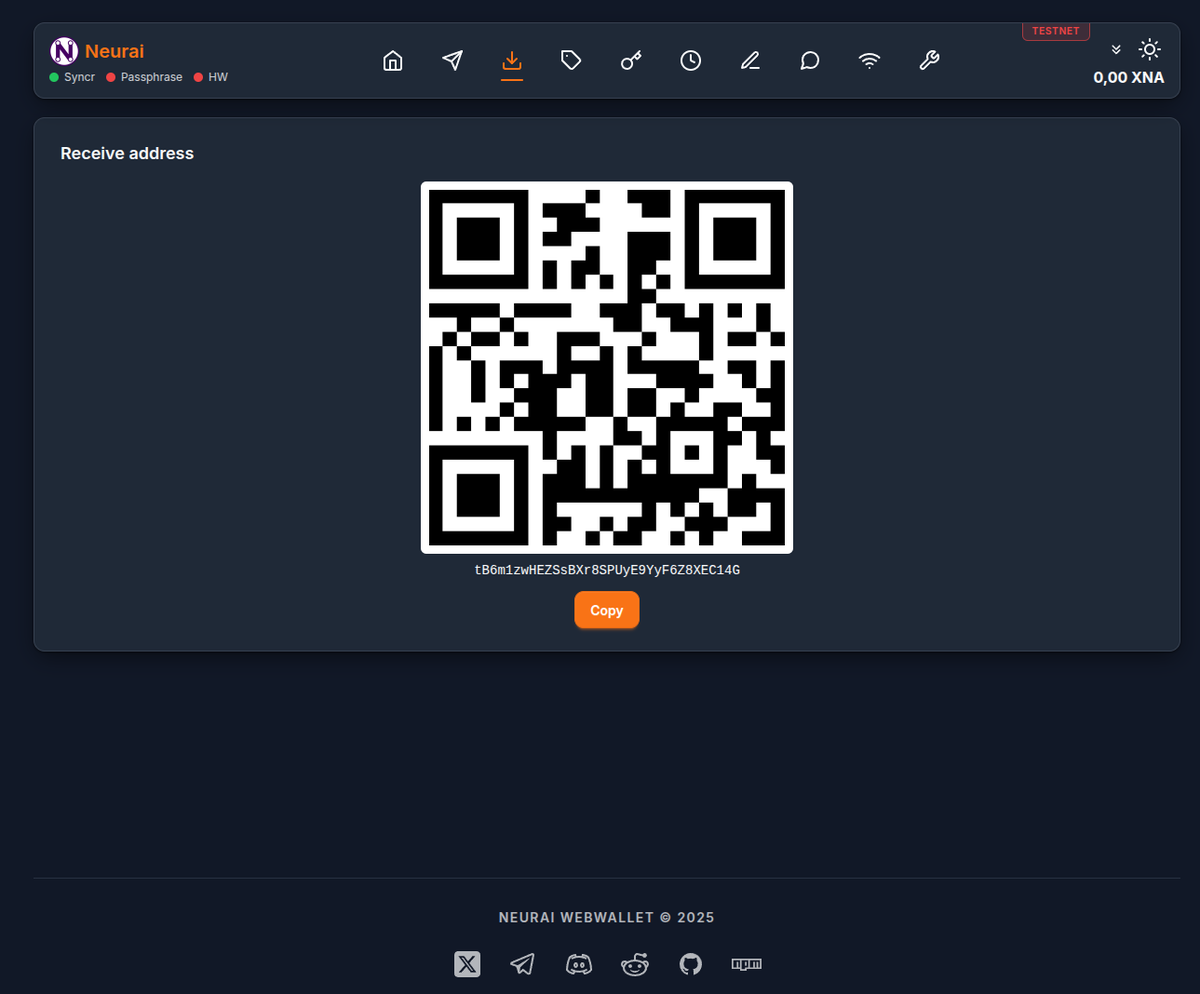
📱Mobile: Small Sneak Peak
Thanks to a user on Telegram, we’ve fixed a minor display issue that occurred when importing a 12-word recovery phrase.
🎯Neurai Hardware Wallet
The Neurai ecosystem relies heavily on the use of ESP32 controllers and similar devices, allowing us to create hardware that is 100% our own design and capable of operating on the Neurai network for a variety of purposes, such as a wallet for securely receiving and sending funds. And that won’t be its only purpose.
We have now added support to the Android wallet to enable connection to an ESP32 via cable, read the public key, and sign transactions without sharing the private key on the mobile device.
We will soon release the first version of the software so that anyone can test it in Experimental mode.
#Neurai #XNA $XNA #PQ #Hardware #ESP32
🎁 Neurai: Android Wallet
We are introducing the first version of our own native wallet for Neurai, available for both Mainnet and Testnet. This initial version is available for Android, with an iOS version to follow.
✅ PQ wallets in Testnet Network.
✅ Send and receive XNA with QR codes.
✅ Multiple wallets in one app.
✅ Each wallet with its own backup.
✅ Local PIN / biometric unlock
✅ Screen-capture protection.
✅ Configurable RPC and WSS endpoints.
✅ Light / dark themes
✅ Multi-language support.
In future versions, we will add asset management, an NFT section, IoT device management, possibly DePIN messaging (pending EU approvals), and airgap signatures with our ESP32 wallet designs.
To download it, visit the following post 👇👇
#Neurai #XNA $XNA #PQ #Android
☀️Sneak Peak: WalletConnect
We are currently awaiting approval for our Android wallet to be published on the Play Store, and one of the new features we will be adding is support for WalletConnect.
Benefits of being part of the WalletConnect ecosystem:
☑️Signing air-gapped transactions via QR code.
☑️Use of the Onekey hardware wallet.
☑️Use of the hardware wallet developed by the Neurai team.
☑️A broad ecosystem of compatibility.
☑️SDK to add support for Neurai.
The biggest benefit will be the ability to sign transactions using our special hardware wallet built with ESP32 and to sign via Wi-Fi, Bluetooth, LoRa, or satellite.
We are awaiting approval from the WalletConnect team, and here are some proofs of concept showing how it works based on a series of tests we’ve conducted.
#Neurai #XNA $XNA #PQ #WalletConnect
🔬Sneak Peak: Mobile Wallet
We are currently working on implementing Neurai for the BlueWallet wallet using the Neurai JSWallet libraries, which we improved a few weeks ago.
With this library and BlueWallet’s MIT-licensed code, we will be able to offer a wallet compatible with Legacy Addresses and PQ Addresses. Additionally, we will add features to integrate with the @OneKeyHQ hardware wallet and also our own 100% custom-built hardware wallet using ESP32 microcontrollers.
The wallet will be available on Android and iOS, and will allow users to interact with assets on Neurai and advanced scripts, as well as sign transactions from their mobile browser via QR code.
More code is on the way ☀️
#Neurai #XNA $XNA #PQ #Mobile #IoT
🤖Positronic: Testing made available
Today we updated the Testnet nodes to incorporate all the new features added to the Neurai code
At this time, the changes made compared to Mainnet are:
✅ Blocks 50% faster.
✅ PQ Addresses (ML-DSA-44)
✅ DePIN Messaging (token gated encrypted)
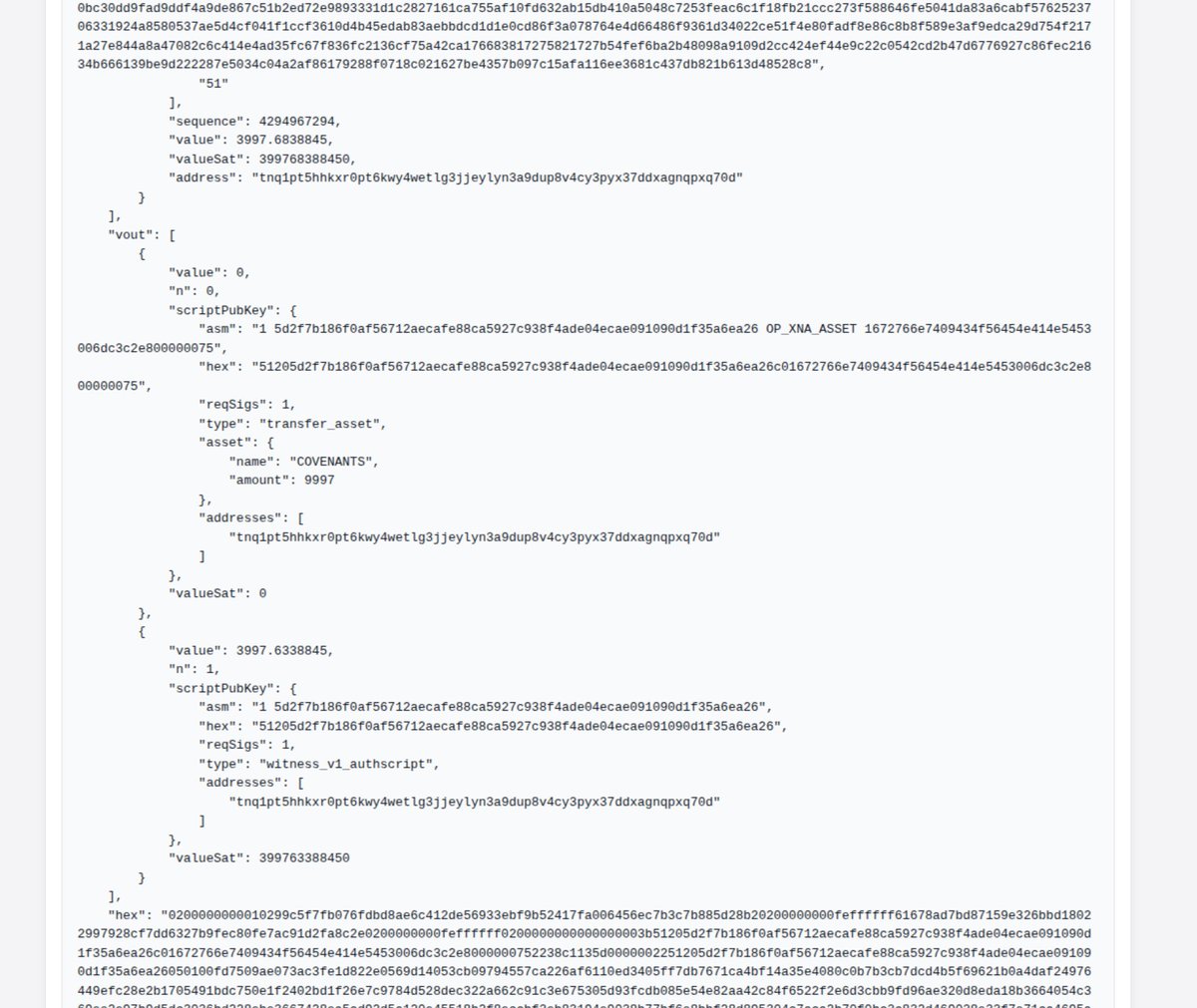
✅ Covenants.
✅ Transaction introspection opcodes.
✅ Native on chain DEX.
✅ AuthScript (new script environment)
✅ 64bit arithmetic opcodes.
✅ OP_CAT, OP_SPLIT enabled.
✅ Reference inputs.
✅ Merkle inclusion proofs.
✅ Poseidon hash (ZK compatible)
You can test these features in the apps designed for this purpose, which are described in the next post 👇
#Nuerai #XNA $XNA #PQ #DePIN
🔬Last updates in Neurai Testnet
The latest changes to the code allow you to create and manage advanced scripts more efficiently, and they support PQ addresses.
📌OP_POSEIDON adds a hash function designed to be cheap inside zero-knowledge proofs. Standard hashes like SHA-256 are fast on a CPU but very expensive in a zk circuit; Poseidon flips that. It's the kind of primitive a light client or a proof-of-inclusion verifier would use on-chain. A building block, not a product.
📌OP_CHECKSIG_ED25519 adds native Ed25519 signature verification in a strict, conservative profile. Ed25519 is the signature scheme used by Solana, Cardano, Stellar, Nostr, SSH and Tor. Verifying it at the consensus layer means scripts can consume signatures from those ecosystems directly, instead of relying on external bridges to translate.
📌OP_CHECKSIGADD is the most strategic of the three. It's a generic signature accumulator that handles both classical secp256k1 keys and post-quantum ML-DSA-44 (Dilithium, the NIST FIPS 204 standard) in the same opcode. That makes it possible to build multisigs that mix classical and post-quantum keys, the only graceful path to a post-quantum future, where users migrate at their own pace instead of facing a forced cutover.
The whole thing reads like a coordinated upgrade package, modern cryptography (zk-friendly hashing + Ed25519 + post-quantum signatures) added at the base layer, rather than bolted on as external sidechains or trusted bridges.
#Neurai #XNA $XNA #PQ #ZK
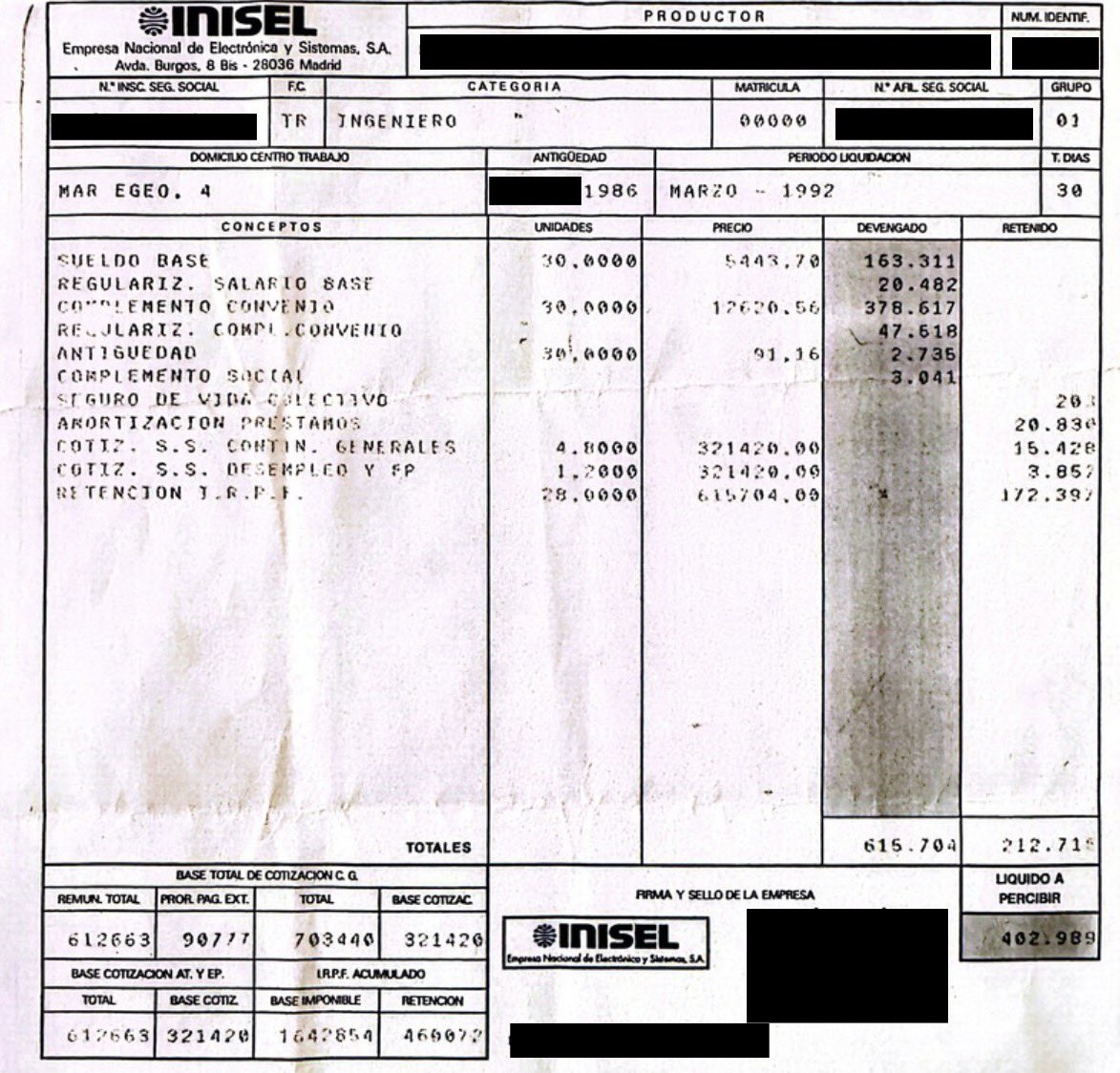
Esta mañana he encontrado una nómina vieja de mi padre revisando papeles de casa.
Marzo de 1992, ingeniero jovencito con 6 años de experiencia. Casado, con dos hijos e hipoteca en Madrid.
Por curiosidad me he puesto a hacer cálculos, y me ha dado permiso para compartirlos.
El bruto del mes eran 615.704 pesetas. Ajustando a IPC, hoy serían 120.000 € brutos al año equivalentes. Un ingeniero con ese mismo perfil cobra ahora entre 35.000 y 45.000 €.
Un tercio. Un puto tercio del sueldo real que tenía mi padre con su edad.
Pero donde la trampa se ve más clara es en la fiscalidad.
Mi padre, sumando IRPF y Seguridad Social, soportaba una carga fiscal efectiva del 27% sobre su bruto (24% IRPF + 2,7% SS, porque cotizaba al tope máximo). Le quedaban netos el equivalente a 87.000 €.
Un ingeniero hoy con 40.000 € brutos soporta una carga total del 22% (16% IRPF + 6,5% SS) y le quedan apenas 31.000 € netos.
Mi padre vivía con casi tres veces más renta disponible.
En el mismo país. En la misma ciudad.
¿Que hoy se paga menos porcentaje? Lógico, ganando un tercio, claro que el porcentaje baja.
Por el camino, eso sí, se cargaron las deducciones que protegían a la clase media como por ejemplo la deducción por vivienda habitual que desapareció para nuevas compras en 2013.
Y si por algún milagro alcanzas hoy los 120k equivalentes que cobraba mi padre, soportarías un 35% de carga fiscal total en vez de su 27%.
Ocho puntos más por el mismo sueldo real.
¿De verdad vivimos mejor?
Los datos dicen una cosa. La narrativa que nos venden, otra.
🌐Neurai Testnet: speedup and swap chains
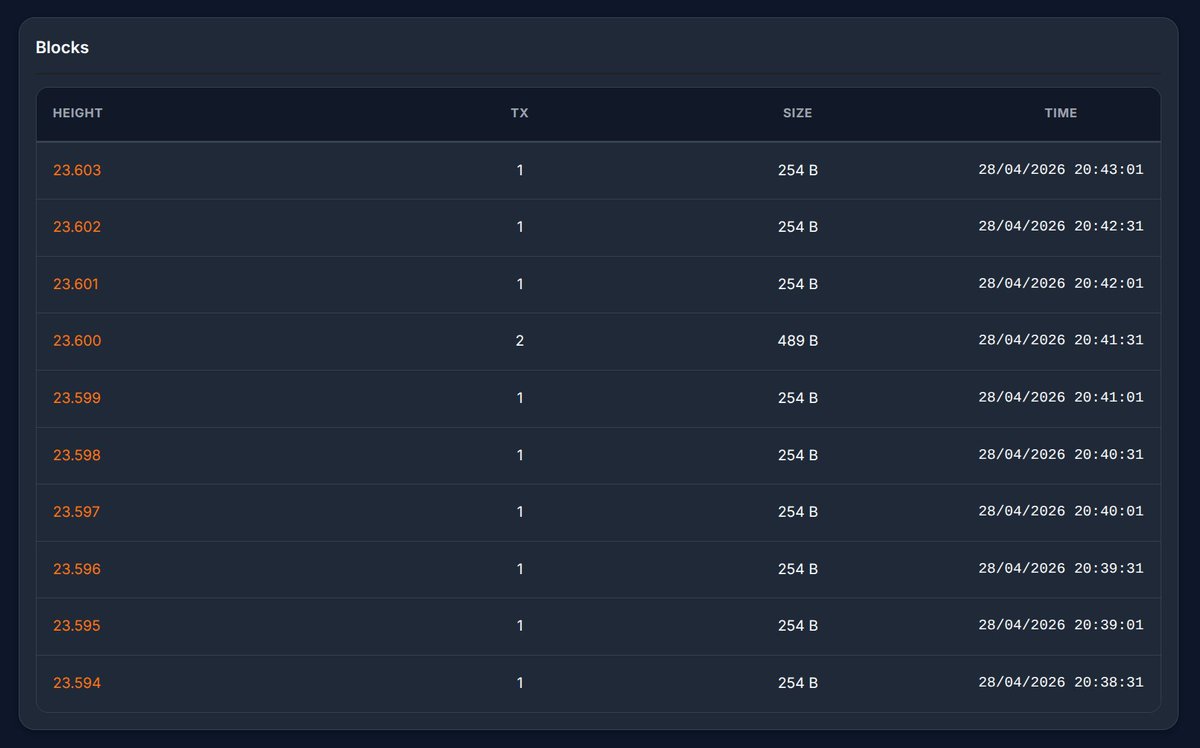
⏩Block SpeedUP: 2X
✅ One block every 30sec.
✅ More transactions per minute.
✅ Faster confirmation times.
✅ Faster swaps.
✅ Optimized to balance speed and security.
⏩Added Keccak-256 & BLAKE2b
✅ Keccak-256: Verify Ethereum data onchain
✅ BLAKE2b: Verify IPFS data.
✅ No federation: Trustless EVM bridges.
✅ Cheaper crosschain swaps.
✅ Crosschain proof of ownership.
With these features active, it will be possible to connect to the Ethereum network without the need for a third party
Currently, all of this is running on the Testnet we have operational.
#Neurai #XNA $XNA #IoT #PQ
🌟Neurai WebWallet: New version
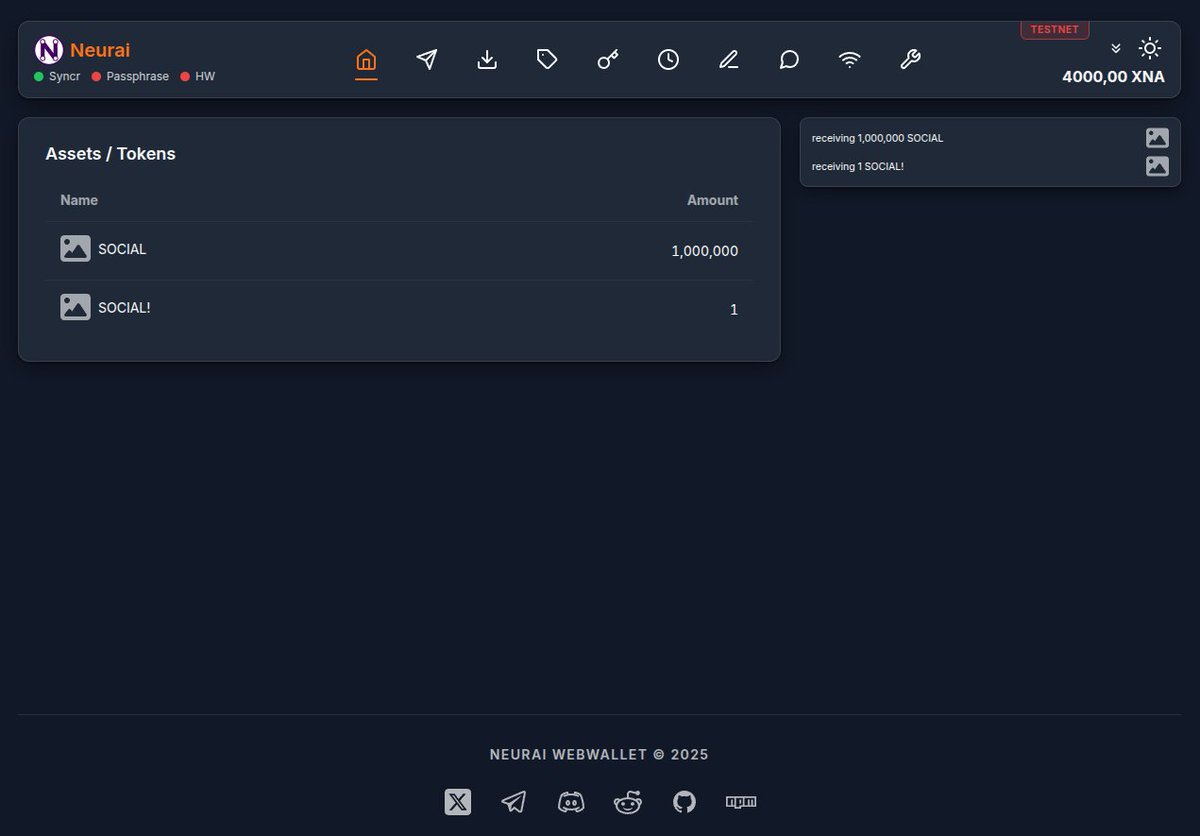
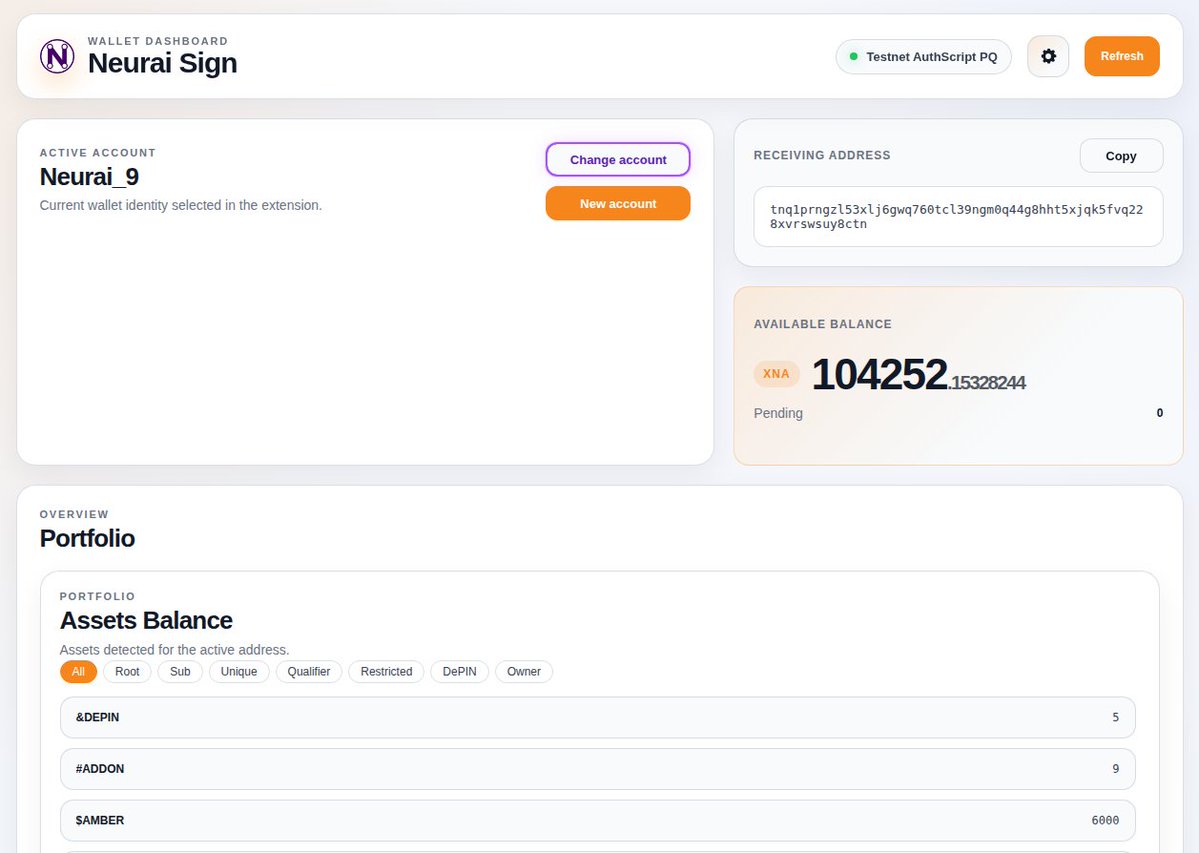
With the changes introduced on the Neurai Testnet (Covenants, PQ Addresses, New Assets), we have updated the official Neurai web wallet to incorporate these new features.
Since we were already working on this integration, we have also redesigned almost the entire interface and code to make it more efficient and added more features.
✅ Create Assets
✅ Modify Assets
✅ Use PQ addresses
✅ New mobile mode
✅ Migrated UI to daisyUI
All these changes will enable a smooth migration to a native Android and iOS app.
In the next post, you’ll find the link to try it out, as well as the faucet to send you some coins so you can test it. You can create Assets using PostQuant addresses.
#Neurai #XNA $XNA #PQ
🛠️Neurai JS Wallet
We have updated our JSWallet library to incorporate all the changes made to the individual libraries, which are now compatible with the Positronic upgrade.
This library makes it easier to create wallets or applications that use the Neurai network.
✅ Create wallets with 12 or 24 words
✅ Manage Legacy and PQ addresses
✅ Create and manage Assets
✅ Send XNA and tokens
✅ Sign Legacy and PQ transactions
✅ Query asset metadata and holders
✅ Sweep external WIF keys
✅ Build covenants and custom scripts
✅ Multisign
✅ Ship for Node, browser and <script>
#Neurai #XNA $XNA #PQ #Covenants
🌐Sneak Peak: Positronic Upgrade
✅ Advanced Scripting
✅ Covenants
✅ DePIN Private Messaging
✅ Specialized DePIN Assets
✅ PQ Addresess with AuthScript
✅ Transaction V3
and more...
The changes made to Neurai will bring it closer to a modern, fast, and robust blockchain capable of powerful and secure scripting.
#Neurai #XNA $XNA #PQ #Covenants #DePIN
🎯Sneak Peak: Covenants + Neurai SWAP
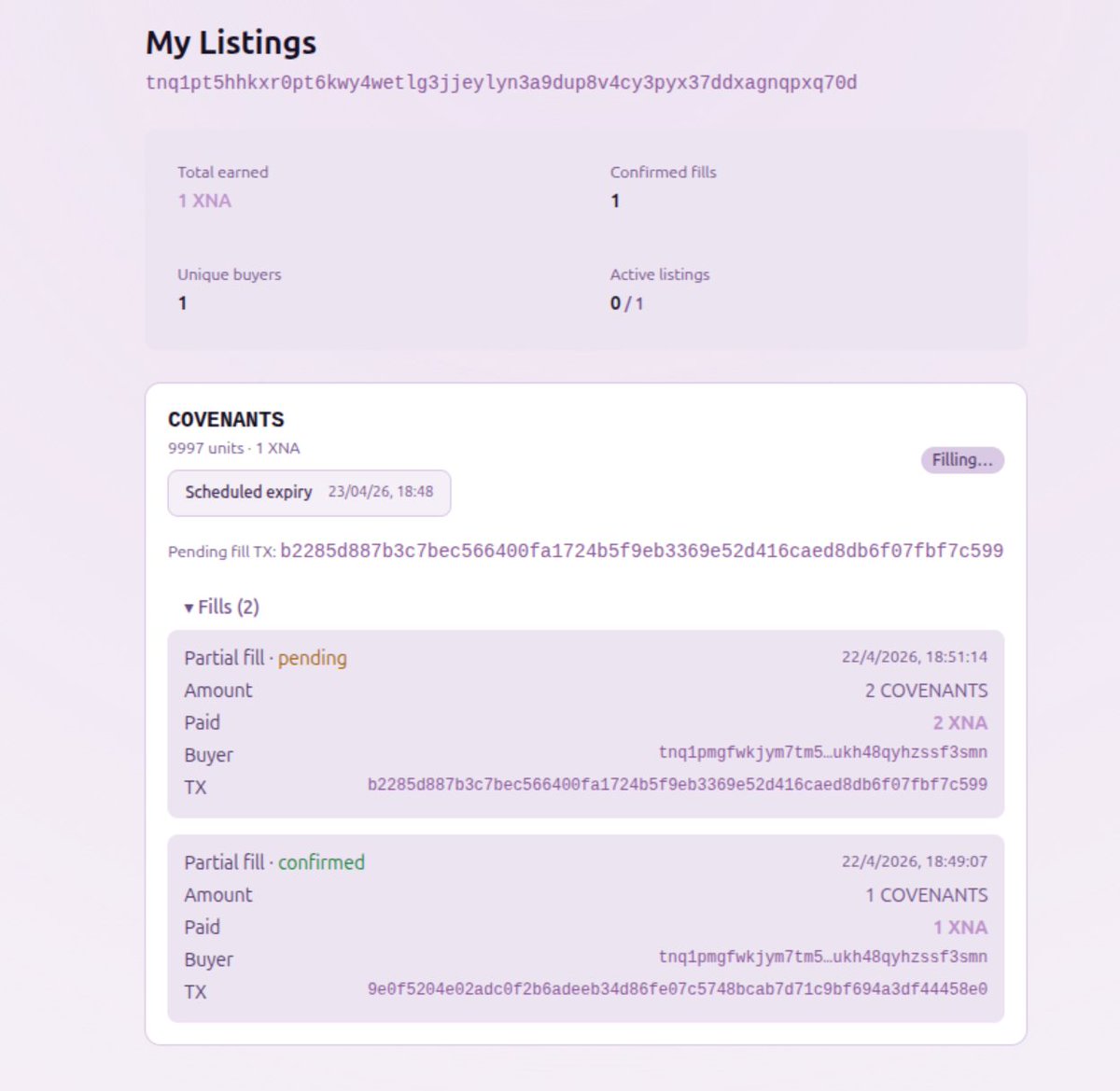
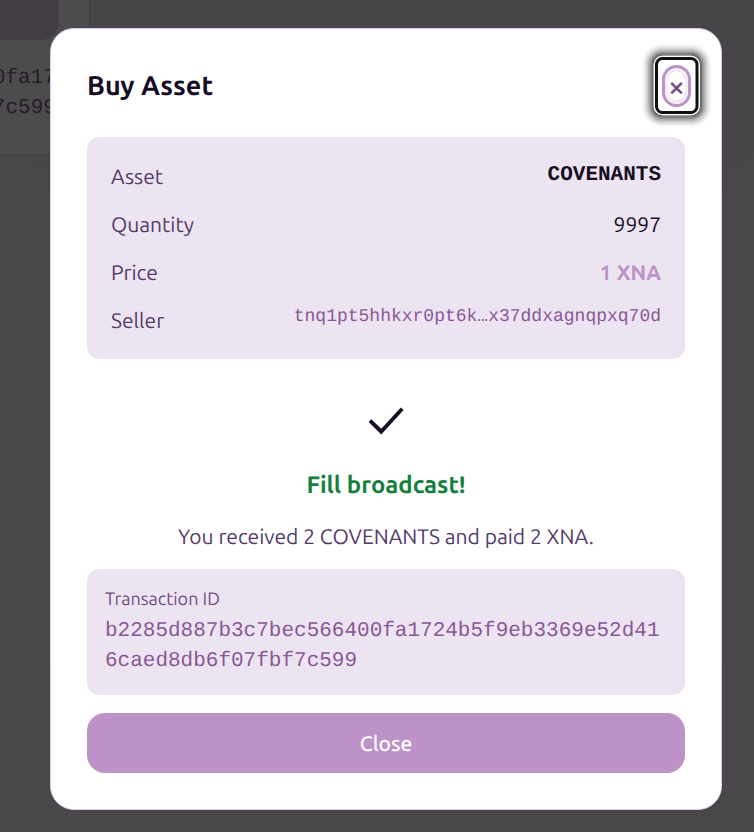
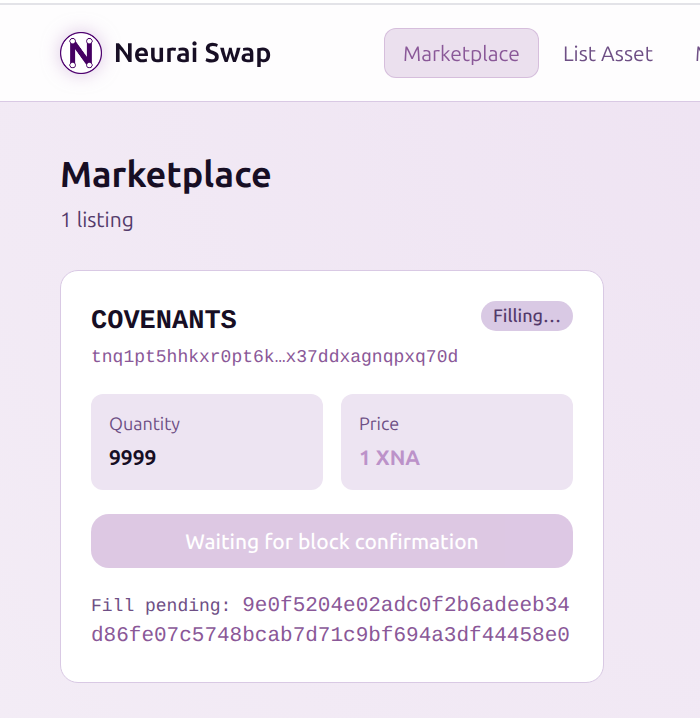
We have adapted Neurai Swap to be 100% decentralized, with onchain transactions and advanced smart contracts using Covenants.
🛠️How does it work?
1⃣Alice lists 1,000 CAT for sale at 1 XNA each in a single transaction.
✅These tokens are not handed over to a thrid party: they are locked in an on-chain contract with publicly defined rules.
2⃣Bob buys 2 CAT for 2 XNA.
The network only accepts the transaction if Alice receives 2 XNA, Bob receives 2 CAT, and the remaining 998 CAT are returned to the same contract.
3⃣Charlie can buy 300 CAT, and the contract is automatically recreated with the remaining balance.
✅This way, the order remains active on-chain without Alice having to sign off on every purchase.
4⃣If Alice wants to close the sale, she can cancel it and recover whatever remains.
✅Everything happens by consensus, without intermediaries and without relying on third parties.
That is a true DEX: orders that live onchain, execute themselves, and settle atomically.
The Neurai Swap website facilitates the creation of scripts, but this could be done 100% offchain via RPC to a Neurai Node.
This is just a small example of the capabilities added to Neurai and is 100% compatible with ⚛️PostQuantum addresses.
#Neurai #XNA $XNA #Covenants #PQ
🌎 Neurai: The Next Step
The Neurai Testnet extends Neurai's scripting engine with a set of specialized opcodes.
The goal is concrete:
✅Scripts that inspect their own transaction and enforce spending rules at the consensus layer.
✅Native asset introspection: covenants that read asset names, amounts, and metadata directly.
✅External state via reference inputs: read on-chain oracle data without consuming it.
✅Implemented and running on testnet today.
🌍New Opcodes add more power
1⃣ Covenant Primitives: OP_CHECKTEMPLATEVERIFY locks a UTXO to an exact transaction template: outputs, amounts, and destinations are fixed at creation time. OP_CHECKSIGFROMSTACK verifies a signature against any arbitrary message on the stack, enabling scripts to consume oracle-signed data. Both support classical ECDSA and post-quantum ML-DSA-44 keys.
2⃣ Transaction Introspection:
Opcodes that push raw transaction data onto the stack: output amounts (OP_OUTPUTVALUE), output scripts (OP_OUTPUTSCRIPT), the spent UTXO's own script or value (OP_TXFIELD), locktime (OP_TXLOCKTIME), input/output counts, and configurable field hashes (OP_TXHASH). The building blocks for covenants that enforce transaction structure.
3⃣ Asset Introspection:
Neurai-native. OP_OUTPUTASSETFIELD and OP_INPUTASSETFIELD read asset fields directly from transaction inputs and outputs: name, amount, decimal units, reissuable flag, IPFS hash, type. Scripts can verify asset properties without parsing serialized data.
4⃣ Reference Input Introspection:
A new vrefin vector carries UTXOs that are read but not spent. OP_REFINPUTFIELD and OP_REFINPUTASSETFIELD expose their value, script, and asset fields to the script engine. Shared onchain state price feeds, device registries, rate limits readable by many transactions simultaneously without being consumed.
5⃣ Byte Manipulation:
OP_CAT (re-enabled) concatenates two stack elements. OP_SPLIT splits a byte array at a given position. OP_REVERSEBYTES reverses byte order. These are the primitives for constructing and parsing data structures on the stack.
6⃣64-Bit Arithmetic:
OP_MUL, OP_DIV, and OP_MOD are re-enabled and operate on 64-bit signed integers with overflow protection. Existing arithmetic opcodes (OP_ADD, OP_SUB, comparisons) are upgraded to the same domain. Required for any covenant that computes amounts, rates, or fees in script.
🌏Use Cases
1) Trustless Limit Order (DEX)
A seller locks ASSET_A in a covenant. Anyone can spend it, but only if the transaction sends the required ASSET_B back to the seller. Atomic swap enforced by consensus — no escrow, no platform.
2) Vault with Spending Cap
Withdrawals are capped at 1 XNA per transaction. The remainder must return to the same covenant. A stolen key can only drain 1 XNA per block. Cold recovery after a 144-block timelock.
3) Recurring Payment Stream
A UTXO funds a scheduled payout. Each settlement is only valid after the next time period, pays the exact defined amount, and returns the remainder to the same covenant. Anyone can trigger it. No operator needed.
4) Asset Reissuance Gate
An oracle signs off-chain approval data. The covenant verifies the signature, caps the reissue amount, and keeps the owner token locked. Supply increases require provable approval enforced by the script.
5) CTV Payout Tree
A single UTXO commits to a tree of future payouts. Each recipient claims their branch independently. Only claimed branches consume block space. No coordination required.
6) OracleFed Covenant via Ref Inputs
An oracle UTXO holds a price or state value. Contracts read it via vrefin without consuming it. The oracle persists and can be referenced by hundreds of transactions simultaneously.
7) IoT Sensor with Conditional Payment
A sensor signs its readings. The covenant verifies the signature, checks the device is registered against a reference input, computes payment from units × rate, and enforces the output. Bad data or unregistered devices, transaction fails.
8) Asset-Gated Encrypted Messaging (DePIN)
Only holders of a specific Neurai asset can query the message pool. Messages are encrypted per-recipient via hybrid ECIES. The access gate is a covenant, OP_INPUTASSETFIELD verifies asset ownership at the consensus layer. No server-side database decides who can read. Supports paginated retrieval for embedded hardware (ESP32 example included in the codebase).
⚛️PostQuantum Addresses
AuthScript supports ML-DSA-44 (FIPS 204) natively. Covenants using AuthType 0x01 require a post-quantum signature before executing. Any vault, order, or governance contract can be quantum-resistant today. Hash-based covenant logic is inherently quantum-resistant by design. When CSFS is active, the stack element cap extends to 3072 bytes to fit PQ keys in standard relay.
We are adding all of this and more to Neurai to make it more powerful and durable for years and decades to come.
Soon we will begin testing on Testnet to unlock the full potential of what we are deploying.
Spoiler:
The new upgrade is called: Positronic
#Neurai #XNA $XNA #PQ #IoT #DePIN #AI
🌀Want to try out the new PQ addresses?
The Neurai Sign 0.84 addon has been updated for Chrome based browsers and Firefox; it now includes the new PQ address format that Neurai will use.
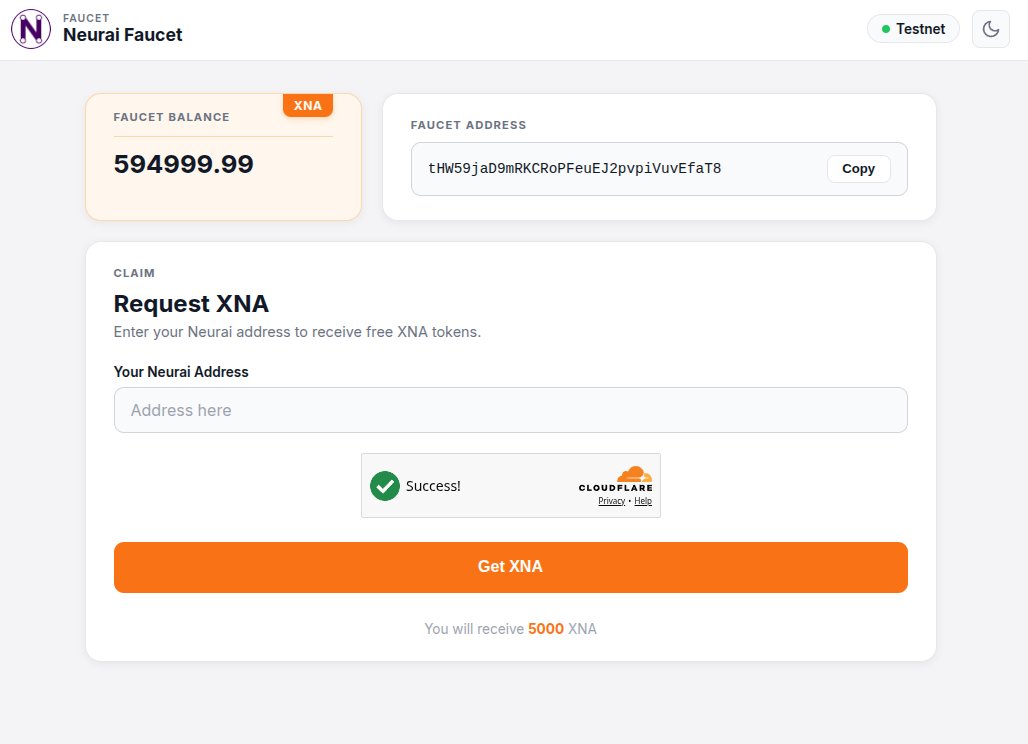
We have adapted our Testnet faucet to distribute coins and enable testing on the network.
#Neurai #XNA #PQ #Testnet
Follow the steps in the thread to test it on your computer 👇👇👇
⚛️Next Path: Quantum Computer
Quantum computing is the next major leap in computing that we will see in the coming decades, and this will render current algorithms obsolete due to security concerns.
In the blockchain world, this is dangerous, and it is one of the reasons why we are working to implement our own secure addresses for the future.
✨Looking to the future
We add ML-DSA-44, formerly known as Dilithium. Unlike standard ECDSA (used by Bitcoin/XNA), which relies on the hardness of elliptic curve problems, ML-DSA is based on the complexity of Lattice Problems.
Why does this matter? While a powerful quantum computer could solve elliptic curves in minutes (Shor’s algorithm), lattice-based math remains resistant to both classical and quantum attacks.
We are creating addresses that will be able to withstand decades of use without security issues, making them perfect for storing large amounts of coins.
#Neurai #XNA $XNA #PQ #DePIN
✨ Faucet for Testnet
To carry out tests with the new testnet network, we have updated the faucet for obtaining coins.
It now features a more modern look, taking advantage of the new libraries we completed this week to create transactions for the new addresses, and at the same time, it can also send coins to PQ addresses.
The code for this faucet is available on GitHub; we’ve replaced it with the one Antares created for us, and we’re grateful to him for that because it’s always worked well.
⚛️ PQ Wallets
For now, there will only be two ways to manage the PQ testnet:
1) Neurai-qt: New version
2) Neurai Sign (addon): which should be available for use tomorrow.
In the addon, it is possible to create assets without relying on Neurai-QT, in addition to the new DePIN assets.
As everything becomes available, we will provide updates on the tests that can be performed.
New url in next post 👇
#Neurai #XNA $XNA #Faucet #PQ
🔬 Testnet Sneak Peak
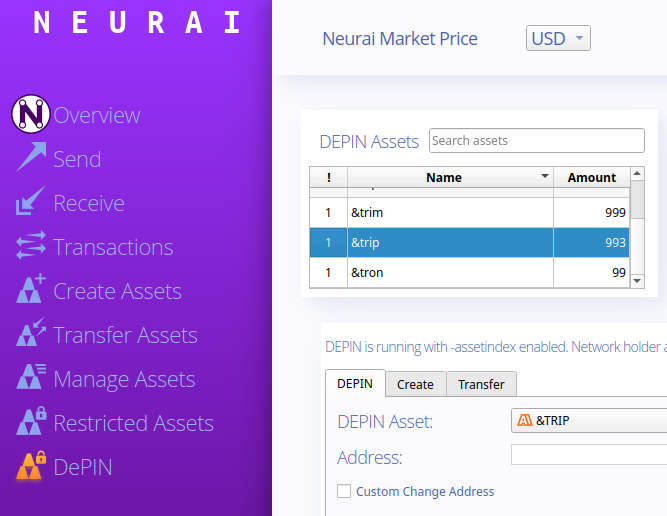
We have added new features to our upcoming version of Neurai, including a dedicated section for DePIN assets that offers several special features:
🔸The asset cannot be forwarded without the creator’s key.
🔸The recipient can deactivate the asset assigned to their address.
🔸The asset creator can activate or deactivate the asset from any address.
This works for both Legacy addresses and the new Post-Quantum addresses (we’ll discuss these addresses later since we’re still testing them).
#Neurai #XNA $XNA #DePIN #PQ
🔬Testing Post Quantum address
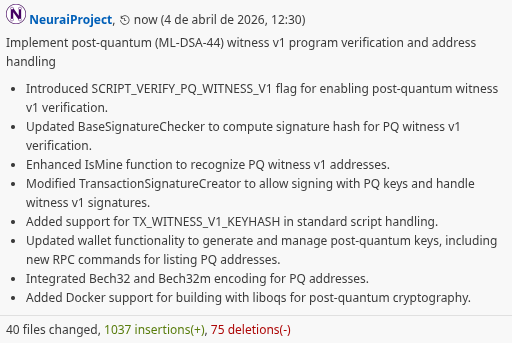
We have added the initial code for the Neurai Testnet to support post-quantum addresses, which will be protected against future attacks from quantum computers.
This is an initial release and will soon be integrated into various wallets for use with the testnet and assets. It will also be integrated into ESP32 via our library in Arduino.
Our Arduino Library: mldsa
#Neurai #XNA $XNA #PQ #ESP32