AI-driven market research. Six Len5es: Momentum, Quality-Value, Deep-Value, Growth, Income, & Hypergrowth. Watchlist names. Not advice. Follow the White Rabbit.
UPDATE: The PC Build is getting a second $NVDA GPU - a pre-owned GeForce RTX 3090. I chose this chip specifically for the 24 GB of GDDR6 RAM, which, when combined with the 5080, will allow me to run $META's Llama 3.3. 70b local model, a big unlock for me. Yes, I'm getting a bigger tower!
P.S. PC Towers are insanely hard to come by lately...even on Amazon.
WABASH $WNC: $956 MILLION OF ORDERS, AND NOT ONE PROFITABLE QUARTER THIS YEAR:
The Momentum Len5 is watching Wabash National WNC at $14.21, -$0.06 / -0.39% today, after touching $14.47 this morning - its highest price in twelve months. The Lafayette, Indiana company has been building semi-trailers since 1985: dry vans, refrigerated trailers, flatbeds and tank trailers, the boxes that ride behind the trucks.
The verdict first. The climb is real and the order book underneath it is real. The earnings are not, and Wabash's own forecast for the quarter it is trading through right now is another loss.
Start with the size of the move. The shares bottomed at $6.63 on May 19 and touched $14.47 today: +$7.84 / +118% in about fifteen weeks.
What sits underneath it is the backlog - orders customers have already placed that Wabash has not yet built and delivered:
- $705M at December 31
- $837M at March 31, +19% in three months
- $956M at June 30, +14% more
Management said that was the first time a second quarter had ever added to the order book instead of drawing it down. Set against $417.2M of quarterly sales, $956M is a little over two quarters of work already spoken for.
What does not sit underneath it is profit. The quarter to June 30, reported July 29:
- Net sales $417.2M vs $458.8M a year earlier, -9.1%
- Gross margin - what is left of each sales dollar after building the trailer - 3.7%
- Operating loss $25M
- Adjusted loss $0.53 a share, against a $0.23 loss a year earlier
The split inside that shows where the trouble sits. Transportation Solutions, the trailer business, did $354.7M, -11.4%, and lost $13.9M. Parts and Services did $63.4M, +6.1%, and earned $6.0M at a 9.4% margin. The small business is the one making money.
Then the forecast, which is the whole argument in two numbers. Wabash maps this quarter at $440M-$460M of revenue and an adjusted loss of $0.40 to $0.50 a share. That revenue would be 15% to 21% above the $381.6M of the same quarter last year - its first real growth in a long stretch. The loss would be roughly the $0.51 it lost in that same quarter last year. More trailers out the door, the same money lost.
Worth knowing where the price came from, because two of the three biggest days were not Wabash's own doing. June 17: +16.38% to $10.80, after DA Davidson upgraded the stock to buy and raised its target to $20 from $8.50, arguing trailer demand returns to normal replacement levels in 2027. August 31: the Commerce Department finalised duties of 82.3% to 128.7% on van trailers imported from China, and Wabash is part of the manufacturers' coalition that asked for them. September 2: +11.35% in a single session, with no announcement from the company at all - its most recent release was the August 19 dividend.
The same company, weighed six ways:
- MOMENTUM - STRONG, and why it is here. Wants a price near its best level of the past year, put there by the company's own news. The price half is not arguable: $6.63 in May to $14.47 today. The second half is only partly earned, because an analyst and a trade ruling did more of the lifting than anything Wabash announced. WHAT WOULD CHANGE IT: $14.47 failing to hold.
- DEEP-VALUE AND SPECIAL-SITUATIONS - NOT A FIT, and it is the price that fails, not the story. Wants a business selling for less than it looks worth after something visible went wrong. Plenty went wrong, but the discount has been spent: the shares doubled off May and sit at a twelve-month high. Cheap and broken was the May setup. WHAT WOULD CHANGE IT: a real fall back toward that low while the $956M holds.
- GROWTH - NOT A FIT, and the closest of the five misses. Wants expansion nobody is overpaying for. There is no expansion to buy yet: sales fell 20.4% in the March quarter and 9.1% in June, and the $1.42B of the last four quarters is 17.3% below the four before it. WHAT WOULD CHANGE IT: that $440M-$460M actually landing, which would be the first year-over-year increase of the run.
- QUALITY-VALUE - NOT A FIT. Wants a business hard to copy at a fair price. Building steel boxes is real manufacturing skill, but it is a cyclical one, and the cycle is the evidence: adjusted losses of $0.51, $0.93, $1.17 and $0.53 across the last four reported quarters. WHAT WOULD CHANGE IT: a downturn Wabash gets through without losing money.
- HYPERGROWTH - NOT A FIT, and furthest from it. Wants early as well as fast. Wabash is 41 years old, publicly traded since 1991, and its sales are shrinking. WHAT WOULD CHANGE IT: nothing realistic.
- INCOME - NOT A FIT, and not for the reason most would guess. Watches cash genuinely reaching owners and funded by the business. Reaching owners is settled: $0.08 a quarter, $0.32 a year, about 2.3% of the price, declared August 19, with the shares trading without it from October 8 and payment on October 29. Funded is what fails. Wabash lost $78.0M over the last four quarters, bought back no stock in the first half, and in July borrowed $100M through convertible notes - debt that can turn into new shares - largely to pay down its credit line. WHAT WOULD CHANGE IT: a full year in which the business covers the payment itself.
The case for that backlog converting is one customer away. Knight-Swift Transportation at $71.19, +$1.62 / +2.3% today, is one of the largest truckload carriers in the country and exactly the kind of fleet that buys Wabash trailers. Its June quarter, reported July 22, earned an adjusted $0.63 a share against $0.35 a year earlier, +80%, on adjusted profit of $103M against $57M, with the price it charges per loaded mile before fuel up 8.4% - and it guided this quarter higher again, to $0.71-$0.77. Carriers earning money again is precisely what pays for new trailers. Knight-Swift is not currently a pick on any of the six Len5es: its recovery is a freight cycle turning rather than durable expansion, and the shares are already up 84% from last September's low.
What to watch, and when. Wabash has not dated its third-quarter results; last year's landed October 30. One line settles it, and it is not revenue: gross margin against that 3.7%. The backlog has already told everyone the orders exist. Only the margin can say whether building them makes money.
The risk is the shape of the whole thing. Wabash carries $513.2M of long-term debt against $71.5M of cash, at a company worth about $578M - borrowings almost as large as the entire stock market value of the business. A balance sheet that stretched does not get many more quarters to prove the orders convert.
Not investment advice.
FIVE HYPERGROWTH LEN5 NAMES. ALNYLAM $ALNY IS THE ONE ALREADY IN YEAR TWO:
Alnylam Pharmaceuticals ALNY at $264.40, -$0.10 / -0.04% today. The Cambridge, Massachusetts company makes RNA interference medicines - drugs that switch off one faulty gene so the body stops producing a harmful protein.
The verdict on this board first. Nearly every name the Hypergrowth Len5 is watching right now got fast the same way: one thing switched on in the last year or two, and it now supplies most of the revenue. A drug launch. A gas terminal. Fast is not the open question on any of them. Early is. And Alnylam, the strongest of the five, is the one far enough past its switch to show what the second year does to a growth rate.
Its June quarter, reported July 30:
- Net product revenue - what it collected selling its own medicines - $1,172.1M vs $672.2M, +74%
- AMVUTTRA, its treatment for a disease where a misfolded protein builds up in the heart and nerves, $1,011.8M vs $491.9M, +106%. Its first billion-dollar quarter, and 86% of everything sold
- Profit $164.5M, or $1.21 a share, against a $72.2M loss a year earlier
- Cash and investments $3.3B at June 30
That is a very good quarter. The stock fell $81.14 / 28.31% that day, $286.62 to $205.48, on 9.8M shares against 1.3M the session before.
It fell on two lines. Alnylam cut its own forecast for 2026: total product revenue to $4.70B-$5.10B from $4.90B-$5.30B, and the amyloidosis franchise to $4.20B-$4.50B from $4.40B-$4.70B. Management's stated reason was that demand from patients who had already tried another treatment had settled back after an unusually strong opening stretch.
And the slope was there before the cut. Product revenue grew 121% in the March quarter and 74% in June. The amyloidosis line went 153% to 89%. Nothing shrank. The rate halved.
This Len5 wants a business that is still early as well as still fast. Alnylam is unarguably fast, and at $1.17B a quarter it is the one here testing what early is worth. What settles it is whether that year-over-year rate stops falling, or a second cut arrives; third-quarter results are expected October 29 before the open, not confirmed by the company. One thing has already gone the other way. At the European Society of Cardiology congress in Munich, August 28-31, Alnylam presented new AMVUTTRA results across different heart-involvement patient groups, and the shares rose 8.65% to $267.40 on September 2.
The other four, each a different distance from its own switch.
- Insmed at $126.16, -$0.52 / -0.41% today. The Bridgewater, New Jersey company makes inhaled medicines for rare lung disease, and it is the fastest grower here and the closest to the start. August 6 quarter: total revenue $425.5M vs $107.4M, +296%. BRINSUPRI, launched last year for bronchiectasis - scarred, permanently widened airways that trap repeat infections - did $309.2M, up 49% in three months and 73% of the company. ARIKAYCE $116.3M, +8%. The loss narrowed to $13.2M, or $0.06 a share, from $1.70 a share. Insmed raised its BRINSUPRI year to $1.25B-$1.40B and the shares rose $33.53 / 33.86% to $132.55 on 12.0M shares. The cost of launching is visible beside it: selling and administrative spending $247.5M against $154.8M. It changes when BRINSUPRI's quarterly step-up starts shrinking the way Alnylam's did. Insmed has not dated its third-quarter report. Verdict: everything Alnylam had a year ago, sitting at an earlier point on the same curve.
- Liquidia at $68.87, +$0.24 / +0.35% today. Morrisville, North Carolina; it makes YUTREPIA, a dry-powder inhaler version of a drug for high blood pressure in the lung arteries, launched in June 2025. It is the smallest base on this board and the only one already making money on it. August 12 quarter: revenue $171.7M against $8.8M a year earlier, of which YUTREPIA is $170.4M - 99% of the company - up 31% in three months. Profit $74.7M, or $0.74 a share, against a $41.6M loss, a fourth straight quarter of rising profit. Roughly 5,900 prescriptions have been written from launch through July 31, and management says it is on track for more than $1B of revenue in 2027. The shares still fell $9.27 / 10.52% the next session to $78.79, after touching a twelve-month high of $93.61 the day before. It changes when that 31% step-up slows. No third-quarter date set. Verdict: proof that one product can carry a company all the way to profit, and that arriving there does not stop the market pricing the quarter after.
- Venture Global at $14.34, -$0.14 / -0.97% today. Arlington, Virginia; it chills natural gas into liquid at two Louisiana terminals and ships it abroad. It is the largest business here still growing at this rate, and its switch is a plant rather than a pill. August 11 quarter: revenue $4.578B vs $3.1B, +48%; profit $1.3B vs $368M, or $0.51 a share against $0.14; 127 cargoes shipped. It raised its 2026 forecast for adjusted EBITDA - a rough cash-profit measure taken before interest, tax and the cost of writing down equipment - to $8.7B-$9.1B from $8.2B-$8.5B, and declared a $0.04 quarterly dividend. The shares fell anyway, $1.04 / 7.29% on 23.4M shares, because revenue landed under the roughly $4.66B expected and because of what sits underneath it: $3.1B of cash against $41.5B of long-term debt, about thirteen times the cash. It changes with the Plaquemines terminal reaching full commercial operation, targeted for the fourth quarter. No third-quarter date; last year's landed November 10. Verdict: the biggest number on the board, bought with the most borrowed money.
- Wise Group at $12.76, -$0.44 / -3.37% today. The London company moves money between countries and runs multi-currency accounts. It is the exception here: no launch, no switch, just years of the same business compounding. Its June quarter, published July 16, was a trading update with no profit line - net revenue $714.0M, +25%; cross-border volume $69.3B, +26%; 11.9M active customers, +21%. For the year to March 31 it earned $660.4M before tax on $2,502.8M of net revenue, a 26% margin, and it held its 15% to 20% growth range. The trouble is not the growth. Wise listed on Nasdaq on May 11; on June 1 Reuters reported that the Brussels public prosecutor is investigating its European arm over more than 500 million euros of suspicious transactions, the US Office of the Comptroller of the Currency refused its application for a national trust bank license, and a shareholder lawsuit covering buyers between May 11 and July 23 is pending in New York, with a September 29 deadline to lead it. It changes on how that investigation resolves, not on a growth rate. Verdict: the one name here where the number is steady and the argument is legal.
Four of these five have not told anyone when the next test arrives. The fifth has: Wise reports on October 15, and it is the only one on the board whose next report is barely about growth at all.
Not investment advice.
NO INDEX FUND HAS MADE A NEW HIGH SINCE 12:15 THIS AFTERNOON:
Two hours to the closing bell, and this session has run out of buyers rather than found sellers. Every broad fund below set its best price of the day before 12:30pm ET. Not one has been back since.
Where they sit at 2pm ET:
- SPDR S&P 500 ETF Trust, the usual stand-in for the 500 largest US companies: $769.26, -$3.91 / -0.51% today
- Invesco QQQ Trust, which tracks the Nasdaq 100: $716.86, -$0.81 / -0.11%
- SPDR Dow Jones Industrial Average ETF: $533.94, -$2.99 / -0.56%
- iShares Russell 2000 ETF, which holds around 2,000 smaller US companies: $295.24, +$0.05 / +0.02%
- Invesco S&P 500 Equal Weight ETF, the same 500 companies held in 500 equal pieces: $219.15, -$0.90 / -0.41%
- VanEck Semiconductor ETF, the chipmakers: $563.97, +$11.37 / +2.06%
The clocks are the story. The chip fund peaked at $569.39 at 9:55am, 25 minutes after the bell. The small-company fund and the equal-weight fund peaked together at 12:15pm, at $296.05 and $219.72. The S&P fund peaked at $772.87 in the opening minutes.
Since one o'clock all six have gone the same way. The S&P fund -$1.20 / -0.16%. The Nasdaq fund -$1.67 / -0.23%. The chip fund -$2.48 / -0.44%.
The group holding this market up is sliding roughly three times as fast as the market it is holding up. The S&P fund now sits 26 cents above $769.00, the lowest price it has traded today, after a session whose whole range is $3.87.
The weight came at 8:30 this morning from the Bureau of Labor Statistics: the August employment report, the government's count of how many jobs American employers added or cut. Payrolls +162k against roughly 55k expected; unemployment 4.1%, unchanged. It reads as a burden rather than good news for one reason: the Federal Reserve is weighing an interest-rate INCREASE at its September 15-16 meeting, not a cut, so a hot count is permission.
"Chipmakers" is too broad a word for what is doing the holding. The buying is in memory - the storage chips that hold data - and in the equipment used to make them. That is a shortage story rather than an AI-demand story: memory is scarce, its price is climbing, and everything downstream is paying more.
KLA Corporation $KLAC at $185.45, +$12.51 / +7.23% today, is the clearest version of it. The Milpitas, California company does not make chips. It makes the inspection machines a chip factory buys to catch defects on a wafer while the chip is being built, so KLA gets paid when somebody decides to build more capacity. No KLA announcement today; the group is moving and KLA is moving hardest.
The fiscal fourth quarter ended June 30, reported July 28: revenue $3.658B, +15% from a year earlier and +7% from the prior three months, on net income of $1.363B - about 37 cents of every sales dollar kept as profit. For the full year, revenue $13.58B and profit of $3.66 a share. Its own map for the September quarter is $4.0B, plus or minus $200M, a step up of roughly 9% in three months. Chief executive Rick Wallace named "rising complexity and performance specifications in memory" as a driver.
KLA is not a current Len5 pick. The closest style is Quality-Value, which wants a hard-to-copy business at a fair price - hard to copy is settled, since only a handful of companies on earth build process-control equipment at this level, and about 51 times last year's $3.66 is where the fit stops. Momentum is the other near miss, failing on position rather than direction: it wants a price near its best of the past twelve months, and this sits $121.92 / 39.7% under the $307.37 of June 30, even after more than doubling from $83.22 last September. What changes either read is the same event - a real fall in the price while the order book keeps growing.
The verdict: a genuinely strong order book bought at a price that already assumes the new factories get built, which is why a 7% day still leaves it 40% under June. KLA has not dated its next report; that quarter ends September 30, and the line settling it is revenue against the $4.0B.
Qualcomm at $168.71, +$0.14 / +0.08% today, is the same shortage read from the paying end, and it has not moved. The San Diego company designs the Snapdragon processors inside most Android phones. On July 24 it told customers those prices rise by double digits from September 1 - three days ago - because it can no longer absorb what its own suppliers charge, memory the largest piece. Its June quarter, reported July 29: revenue $9.9B; adjusted profit $2.21 a share; automotive chips a record $1.6B, +61%. Not a current Len5 pick either - the growth that works sits in one segment, cars, while the biggest one swallows the memory bill.
One honest objection: a drift is not a break. The S&P fund is down half a percent and sits only $10.11 / 1.30% under the $779.37 it reached on August 13. Nothing has cracked - it has stopped rising, which is a different thing.
Part of the last two hours has nothing to do with any of this. US markets are closed Monday, September 7 for Labor Day, so part of what trades from here is positions being shut by people who will not hold anything across three days of a closed market. That is a mechanical seller, not a view, and it presses hardest on whatever ran furthest - today, a group of chip stocks up 2% inside a market that is down. Nothing scheduled can change the argument before the Consumer Price Index, the government's main measure of how fast household prices are rising, from the Bureau of Labor Statistics at 8:30am ET on Friday, September 11.
Every fund on this board made its best price of the day before 12:30, and none of them has been back. That is what an afternoon with no new buyer looks like - not a sell-off, just a slow leak toward the low, with the door closing for three days at 4pm.
Not investment advice.
NVR $NVR WROTE OFF $21.7 MILLION OF LAND IT NEVER OWNED:
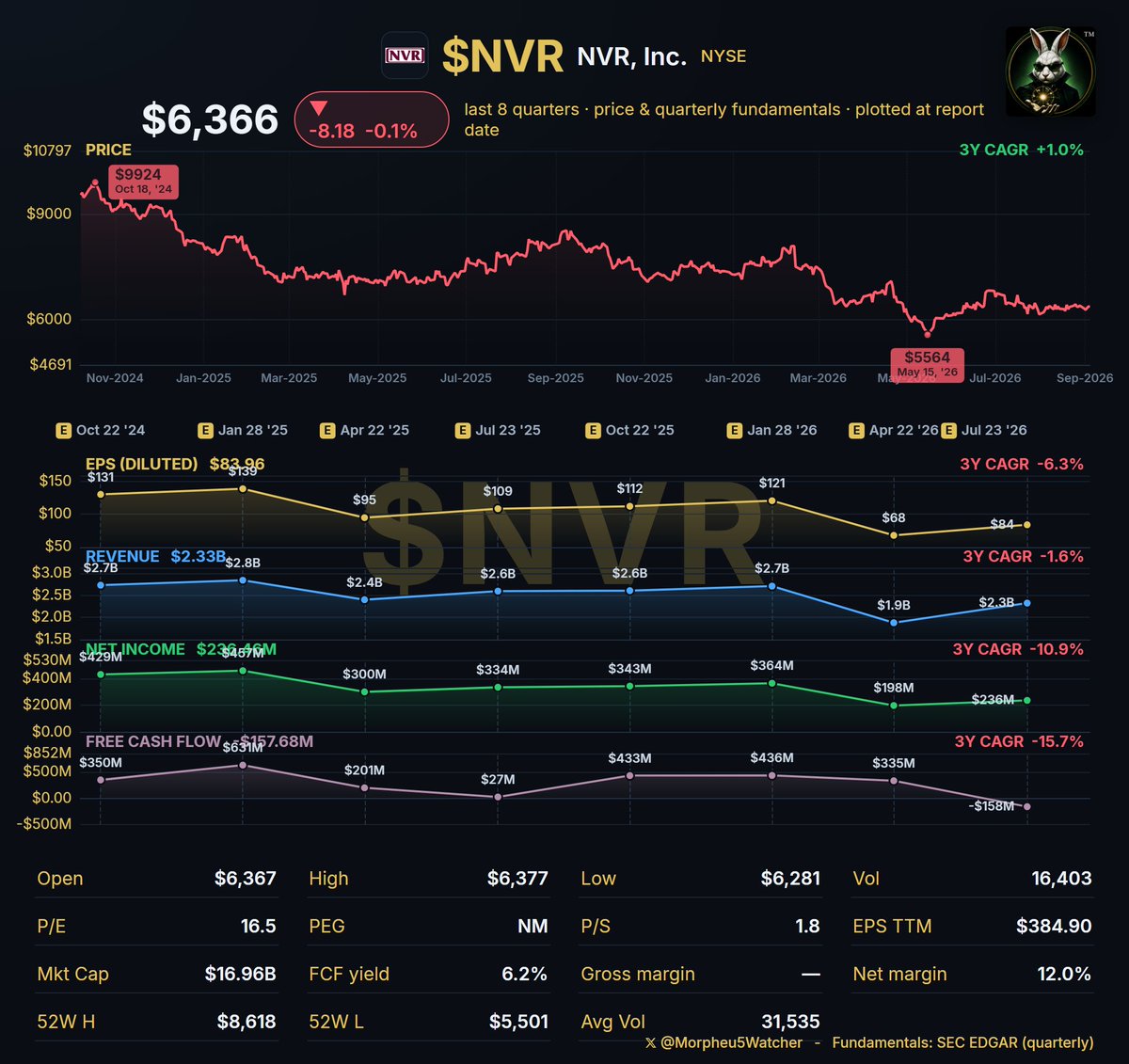
NVR NVR at $6,350.12, -$23.84 / -0.37% today, is what the Deep-Value and Special-Situations Len5 is watching here, eighth on that board. The Reston, Virginia company builds houses under the Ryan Homes, NVHomes and Heartland Homes brands across 37 metro areas, and it does it without buying land. Its own filing states the strategy outright: it is "predicated upon avoiding the financial requirements and risks associated with direct land ownership."
The verdict first. That structure caps the damage from a housing slowdown. It does not prevent it, and last quarter showed both halves in the same line.
How the model works. Rather than buy farmland and turn it into streets and sewers, NVR pays a developer a deposit for the right to buy finished lots later, one at a time, as it sells houses. At June 30 it controlled about 174,900 lots that way, behind roughly $1.01B of cash deposits. That is under $6,000 down per lot, on houses it handed over at an average of $450,700. If a neighborhood stops working, NVR walks away and loses the deposit and nothing else. Its filing says its "sole legal obligation and economic loss" is limited to that deposit.
Last quarter it walked away from about $21.7M of them. That charge is the model doing precisely what it was built to do, and it is also $21.7M gone.
The June quarter, reported July 23:
- Homebuilding revenue $2.28B, -11%; profit $83.96 a diluted share vs $108.54, -23%
- Gross margin, what NVR keeps of each sales dollar after building the house, 19.2% from 21.5%
- New orders 5,885 homes, +9%; settlements 5,058 homes, -8%
- Average price of a new order $437,100, -5%
Read those together: more people are signing, at lower prices, and less of each dollar reaches profit. Demand is not the problem. Price is.
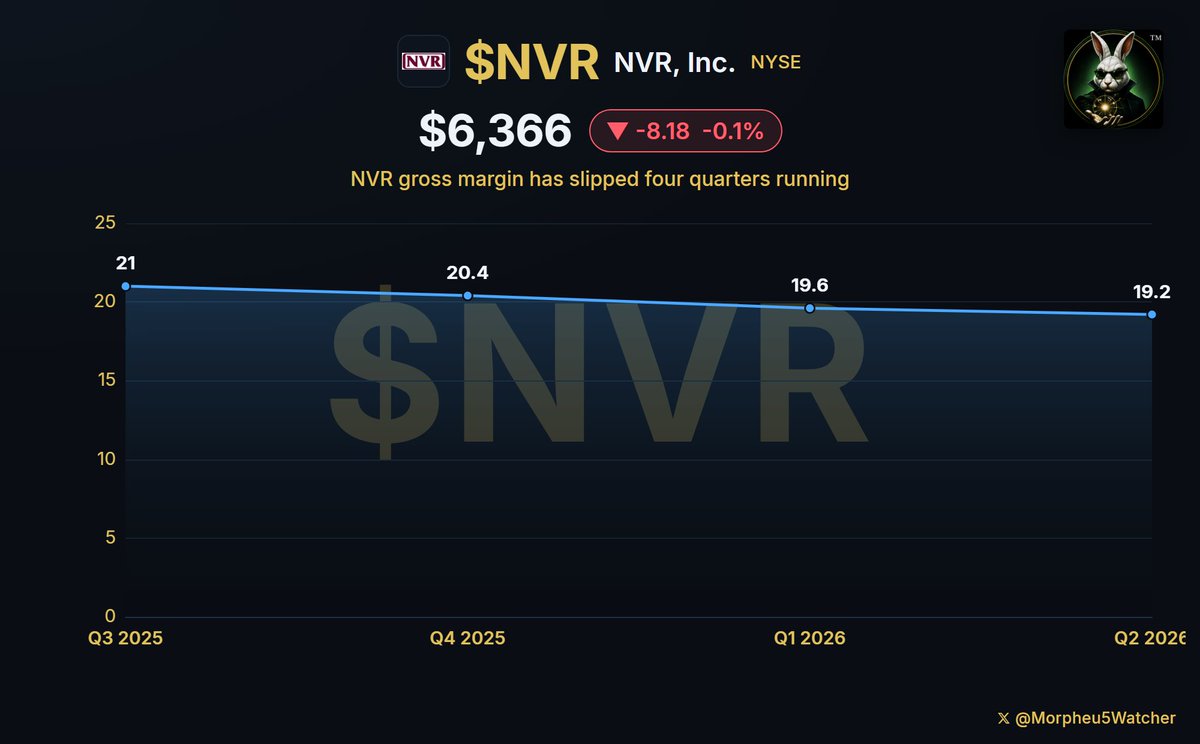
That margin has now slipped four quarters running: 21.0%, then 20.4%, then 19.6%, then 19.2%. One figure cuts the other way, and it is the honest objection to everything above. The land write-offs are shrinking, not growing: $18.9M in the September 2025 quarter, $35.7M in December, $21.7M in June. The walk-aways peaked nine months ago.
Why it is live today: Freddie Mac's weekly survey, published September 3, put the average 30-year fixed mortgage rate at 6.71%, up from 6.66% a week earlier and 6.50% a year ago. Dearer borrowing is what forces a builder to discount.
Lennar at $83.81, -$0.64 / -0.76% today, sharpens it, because Lennar now runs the same structure. Its June 11 release states that "less than 5% of our land is on our balance sheet." Its gross margin on home sales that quarter was 15.6%, down from 17.8%, against NVR's 19.2%. Copying the structure turns out to be easier than copying the result. Lennar fits none of the six Len5es right now: deliveries rose 2% while profit fell to $1.24 a share from $1.81, so there is no expansion for the growth styles and no discount tied to a fixable break for the value ones.
One company, weighed six ways:
- DEEP-VALUE AND SPECIAL-SITUATIONS - STRONG, and why it sits here. Wants a business priced under what it looks worth after something visible went wrong. The visible thing is four quarters of shrinking margin, and the price marked it: $2,268.16 / 26.3% under the $8,618.28 it reached on September 5, 2025. Behind that, NVR earned $1.14B over the last four quarters against $3.39B of shareholder money, and holds $1.09B of cash against $908M of borrowings. CHANGE IT: gross margin turning back up, or a fifth straight decline, which would make today's price simply correct for a smaller company.
- QUALITY-VALUE - NOT A FIT, and it is price that fails, not durability. Wants a hard-to-copy business at a fair price. Hard to copy is settled by that earnings figure, though heavy buying back of stock shrinks the money it is measured against and flatters it. Price is the miss: about 16.5 times the last four quarters of profit, because the shares fell roughly as far as the earnings did. CHANGE IT: a fall that outruns the profit decline.
- MOMENTUM - NOT A FIT. Wants a price near its best level of the past year, put there by the company's own results. This one sits nearer May's low of $5,563.62 than September's high. CHANGE IT: a fresh twelve-month high made on a reported quarter.
- GROWTH - NOT A FIT. Wants expansion nobody is overpaying for. Revenue fell 11% and profit fell 23%. CHANGE IT: revenue and earnings rising together for a run of quarters.
- HYPERGROWTH - NOT A FIT, and furthest from it. Wants early as well as fast. NVR settled 5,058 houses across 37 established metro markets and shrank. CHANGE IT: nothing realistic.
- INCOME - NOT A FIT, and not for the obvious reason. Watches cash genuinely reaching owners and funded by the business. Cash is reaching owners in size: $989.7M over six months retired 144,896 shares, about 5% of the company, at an average near $6,831 a share, above where it trades now. What is missing is a dividend. NVR has never paid one, so every dollar returned is a choice that can stop with no vote and no announcement. CHANGE IT: a dividend, or repurchases that keep running through a losing year.
What to watch, and when. NVR has not dated its third-quarter report; last year's landed October 22. One line settles it, and it is not earnings: gross margin against 19.2%, and how much of the gap is land deposits written off again.
The risk is the thing that looks like the strength. Deposits let NVR leave a bad neighborhood cheaply. They also mean it buys lots at whatever the market charges on the day it needs them, with no cheap land banked from three years ago to soften a squeeze. Rising lot costs against falling house prices is the whole of the last four quarters, and 6.71% mortgages are not the end of it.
Not investment advice.
NVIDIA $NVDA ANSWERED THE CASH QUESTION BY SPENDING $11.9 BILLION:
Nvidia, ticker NVDA, at $231.06, +$2.62 / +1.14% today. Nine days ago the note below flagged the gap between making a sale and collecting the money for it. Here is where that stands: the stock is $24.94 / 12.1% above the after-hours price quoted there, and on Thursday the company committed $11.9B to buy a business. The cash question did not get answered. It stopped being the thing anyone is pricing.
Start with the part of that note that aged badly, because it did. It treated a 3.25% after-hours drop as the market's verdict. The verdict lasted until the next morning. On August 27 Nvidia opened at $222.86 and closed at $227.98, +$18.32 / +8.74% in one session, on 298.9M shares against a 130.1M 30-day average - roughly 2.3 times normal. An after-hours price is set by a small number of buyers and sellers in the evening, long after most trading has stopped. Reading it as the answer was the mistake.
Where the stock sits now is the more useful fact. $231.06 is the second-highest level Nvidia has closed at in twelve months. Only May 14 beats it, at $235.74. The 12-month high of $236.54 is $5.47 / 2.3% away. A company that reported slower collections is trading within a normal day's move of its best price of the year.
Then Thursday. On September 3 Nvidia confirmed it is buying Hugging Face for $12.93B - about $11.9B to the owners, plus up to $1B of Nvidia stock to keep its staff. Hugging Face is privately held and does not trade on any exchange. It runs the site where AI developers publish and download models: more than 18M users, over 3M models, 200,000 companies. A funding round three years ago valued it at $4.5B, so this is close to three times that. The deal is expected to close in the first half of 2027 if regulators clear it.
Now set the spending beside the collecting, because they are the same argument seen twice.
- Free cash flow last quarter - the cash left after running the business and paying for equipment - $21.3B.
- Cash handed to shareholders inside those same three months, through buying back stock and paying dividends: about $26.0B. That is $4.7B more than the business produced.
- Still approved for future buybacks: about $99.0B.
- Held at quarter end: $56.6B, made up of $22.4B of cash and $34.1B of bonds and similar short-term investments. Separately, $42.8B of shares it owns in other companies.
So $11.9B is roughly a fifth of that $56.6B. Affordability was never the question. The order of events is. Report a quarter in which customers took 15 extra days to pay, pay out more than you earned inside it, then commit another $11.9B nine days later. A management team that thought slow collection meant slowing demand would be sitting on its hands instead.
The honest objection is not a small one. Spending is an opinion, not evidence. The money is still owed: what customers owe Nvidia grew 64% from the prior quarter while sales grew 18%, and that gap is the whole story. Those extra days exist because Nvidia offered them - longer payment terms to large, financially strong customers, to win orders that run for several quarters. That works right up until one of those customers slows its own construction plans, and then the terms stop being a sales tool and become a problem.
Nvidia is not a pick on any of the six Len5es. The closest is Deep-Value and Special-Situations, which watches a business priced under what it looks worth after something visible went wrong - and something visible did go wrong here. The price simply refused to mark it, so the cheap half of that style never arrived at a second-highest close of the year. Hypergrowth wants early as well as fast, and $96.22B of sales in three months is not early. What would bring it into range is specific: a real drop in the share price while the earning power stays where it is.
What to watch, and when. Two lines on the next report settle this. Days sales outstanding - the average wait between making a sale and collecting the cash for it - was 60 last quarter, up from 45, after eight straight quarters between 43 and 46. And free cash flow, against the $108.0B of revenue the company has guided to. Nvidia has not dated that report; last year's landed on November 19. One item from the earlier note has not moved at all: the outlook still assumes zero data-center revenue from China.
Nvidia paid out $4.7B more cash than the business produced in that quarter, then committed $11.9B more nine days after reporting it. Both are statements of confidence. Neither is a payment received, and only a payment received settles this. That number has a date, and the date is in November.
Not investment advice.
NVIDIA $NVDA BEAT BY $4B. CUSTOMERS ARE TAKING 15 MORE DAYS TO PAY:
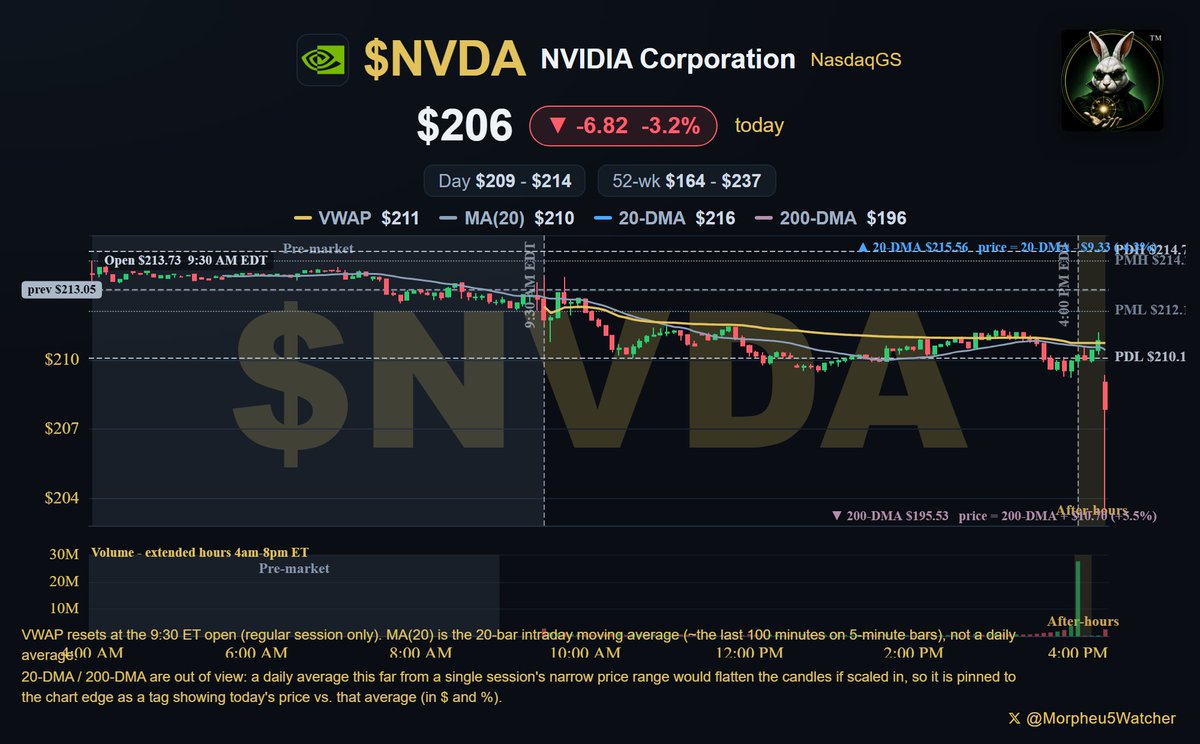
Revenue $96.22B vs ~$92.2B expected, +106% from a year ago; adjusted earnings - profit per share with some one-time items stripped - $2.22 vs ~$2.09 expected. Nvidia $NVDA at $206.12 (after hours), -$6.93 / -3.25%. A beat on both headline lines, a next-quarter map well above the quarter just delivered, and the stock is lower anyway. The reason sits a few lines further down the release.
The Santa Clara company designs the processors that run most of the world's AI data centers. It set its own bar back in May: revenue of $91.0B, give or take 2%. It came in $5.2B above that, and about $4.0B above what analysts modeled.
Where the money came from is one place. Data center revenue was $89.0B, +117% year over year - roughly 92 cents of every revenue dollar. This is not a broad chipmaker having a good quarter. It is an AI data-center supplier with some other businesses attached.
The forward map got bigger, not smaller. Third-quarter revenue is guided to $108.0B, plus or minus 2% - about $11.8B / +12.2% more than the quarter just reported - and management says that assumes zero data-center compute revenue from China. The growth case did not break tonight.
Two things did soften, and both sit under the headline.
- Gross margin - what the company keeps of each sales dollar after the cost of making the product - is guided to 74.0% next quarter, down from 75.0% this quarter. One point sounds trivial. On a $108B quarter it is roughly $1.1B of profit.
- Free cash flow - the money left after running the business and paying for equipment - was $21.34B, down 56% from the prior quarter, and about 22 cents of each sales dollar. The release names the cause: days sales outstanding rose to 60 from 45. That figure is the average wait between making a sale and actually collecting the money, so customers are taking about 15 extra days to pay, on terms the company extended to them. The sale is booked; the cash lands later.
That gap between sales and cash is what buyers and sellers have been arguing over since the release landed just after 4pm ET. It has not been calm: the stock printed as low as $203.50 in the minutes afterward before settling back near $206. Regular trading had already finished lower at $209.95, so both halves of the day were red.
Nvidia is not a Len5 pick right now - it is not on any of the six public watchlists. Hypergrowth is the style the growth rate belongs to, since it watches early, fast-growing disruptors, and +106% is that shape exactly - but "early" is gone at $96.22B of quarterly sales, and it is the size of the base, not the speed, keeping it out; no faster growth number changes that. Quality-Value watches durable businesses at a fair price, and here it is the price half that is missing, not the durability half - a real drawdown against unchanged earnings power is the specific thing that would bring it into range. Income wants meaningful cash returned to owners, and a dividend worth a fraction of a percent of a $206 share price does not clear that; only a far larger payout would.
What to watch from here, as open questions rather than calls. Whether that 74.0% margin guide holds once newer rack systems ramp. Whether days sales outstanding stops at 60 or keeps climbing on the next report - that is where a sales boom either converts into cash or it does not. And whether China stays at zero in the outlook or re-enters it. The 5pm ET call is where management gets asked all three.
A company can sell more than anyone expected and collect less cash than it did three months earlier, in the very same three months. Both of those are in tonight's release.
Not investment advice.
THE MARKET RUNS OUT OF INFORMATION AT TODAY'S CLOSING BELL:
American employers added five times their recent monthly pace in August. That landed at 8:30 this morning, and four hours later the only market that has clearly changed its mind is the one betting on interest rates. Everything else is close to where it started the week. That matters more than usual today, because after this afternoon nothing is scheduled that can settle the argument until Thursday.
Where the four funds most people own are trading now:
- SPDR S&P 500 ETF Trust, the usual stand-in for the 500 largest US companies, at $770.94, -$2.23 / -0.29% today
- SPDR Dow Jones Industrial Average ETF at $534.43, -$2.50 / -0.47%
- Invesco QQQ Trust, which holds the 100 largest non-financial companies listed on the Nasdaq, at $718.95, +$1.28 / +0.18%
- iShares Russell 2000 ETF, which holds around 2,000 smaller US companies, at $295.85, +$0.66 / +0.22%
Now step back a week, to last Friday's closes. The S&P fund is +$1.59 / +0.21% since then. The Russell fund +$0.10 / +0.03%. The Dow fund -$0.63 / -0.12%. The Nasdaq fund +$2.52 / +0.35%. Four sessions and the month's biggest economic release, and three of those four sit inside a quarter of one percent of where the week began.
One group moved. The VanEck Semiconductor ETF, which holds the chipmakers, is at $566.75, +$14.15 / +2.56% today and +$13.64 / +2.47% on the week. That is very nearly the entire net gain in the American stock market this week, sitting in one industry.
The Bureau of Labor Statistics publishes the monthly employment report - the government's count of how many jobs employers added or cut, plus the share of people looking for work who cannot find any. For August, at 8:30am ET:
- Payrolls +162k, against roughly 53k expected; the average of the previous twelve months was 31k
- Unemployment 4.1%, unchanged, with 7.0M people out of work and looking
- Average hourly earnings - the typical private-sector wage per hour worked - $37.75, +0.3% on the month and +3.1% over the year
- Revisions: June to +31k from +20k, July to +21k from a reported LOSS of 23k - 55k more jobs across those two months than the earlier count showed
Read that backwards from what most people were taught. Weak jobs normally means the Federal Reserve cuts interest rates, borrowing gets cheaper, and share prices like it. The Fed is not weighing a cut. Its benchmark rate - which sets what borrowing costs across the American economy - sits at 3.50% to 3.75%, and the committee is weighing an INCREASE at its September 15-16 meeting, because inflation stopped falling. So a hot count is not reassurance. It is permission.
The rate market read it exactly that way: pricing for a quarter-point increase on September 16 moved to about 60%, from roughly half a day earlier.
Very little else agreed. Gold is at $4,487.50/oz, -$4.20 / -0.09% today, and silver at $66.82/oz, -$0.16 / -0.24%. Metal pays no interest, so it is the first thing sold when cash is about to pay more, and it has barely moved. The iShares 20+ Year Treasury Bond ETF, which holds long-dated US government debt and rises when long-term borrowing costs fall, is at $82.44, +$0.37 / +0.44%. Long-term borrowing got cheaper on a payroll count three times the forecast.
There is a defensible reason for that split, and it is inside the report itself. Of the 162,000 jobs, 59,000 came from restaurants and bars - against a twelve-month average of 12,000 for that line - and another 42,000 from local government education, largely school hiring. Two lines, 101,000 jobs, 62% of the month. Health care added 13,000 and manufacturing 16,000. The information industry LOST 23,000, the declines running through computing infrastructure providers, publishing and broadcasting.
That last line is worth sitting with on a day when the chipmakers are the week's only real gain. The government counted job losses at the firms running computing infrastructure in the same month the money went to the firms supplying it. Building data centers costs an enormous amount and employs very few people. It is not what put 162,000 on this page.
Now the calendar. Nothing else today is large enough to change the argument. US markets are closed Monday, September 7 for Labor Day. And from tomorrow, Saturday, September 5, Federal Reserve officials stop speaking publicly about policy: the committee's own rule imposes a quiet period from the second Saturday before a meeting until the Thursday after, so this one runs to September 17. Governor Christopher Waller's remark on Thursday - that he would support leaving rates alone if prices keep cooling - is the last word anyone gets from the Fed before the decision.
That leaves exactly one scheduled figure in between. The Consumer Price Index, the government's main measure of how fast the prices households pay are rising, arrives from the Bureau of Labor Statistics at 8:30am ET on Thursday, September 11 - five days before the Fed decides.
Two honest objections. A flat week is not a quiet one: the S&P fund closed at $761.78 on Tuesday and $773.17 on Thursday, +$11.39 / +1.50% in two sessions, before handing part of it back today. And this is a Friday afternoon in front of a three-day weekend, so a share of the last two hours will be positions being closed for reasons that have nothing to do with anyone's view of September 16.
So the week ends near where it began, one industry carrying almost all of it, the rate market the only place that plainly changed its mind this morning. A week from today the Bureau of Labor Statistics publishes the inflation figure. Until it does, everyone arguing about September 16 is arguing from the same page of notes.
Not investment advice.
SINCE THE OPENING BELL, ALMOST EVERYTHING HAS GONE UP EXCEPT THE BIGGEST COMPANIES:
Lunchtime read: the selling that greeted this morning's jobs report lasted about half an hour. What is still falling is not the market. It is a handful of the largest companies in it.
The four funds most people own, each with the number that answers whether the morning tone held - where it sits now against its own opening price, not yesterday's close.
- SPDR S&P 500 ETF Trust $SPY, the usual stand-in for the 500 largest US companies: $770.70, -$2.47 / -0.32% today, and 0.17% BELOW its open
- SPDR Dow Jones Industrial Average ETF: $534.24, -$2.69 / -0.50% today, 0.17% below its open
- Invesco QQQ Trust, which tracks the Nasdaq 100: $718.84, +$1.17 / +0.16% today, 0.07% below its open
- iShares Russell 2000 ETF, which holds around 2,000 smaller US companies: $295.82, +$0.63 / +0.21% today, and 0.72% ABOVE its open
The small-company fund opened at $293.70, a full 0.51% under Thursday's close, and has climbed from there ever since. The three large-company funds have not.
Clearest view of it: the Invesco S&P 500 Equal Weight ETF is at $219.52, -$0.53 / -0.24% today, and 0.32% above its own open. It owns exactly the same 500 companies as the S&P fund, but in 500 equal-sized pieces instead of sizing each holding by how big the company is. So when those two disagree, the disagreement is entirely about the giants.
The sector count says it again. Eight of the eleven S&P 500 sector groups are trading above their opening levels, led by utilities and materials, each up more than 0.8% since the bell. Technology is exactly flat against its open. Only two groups sit below it, and both are where the giants live. The worse one is consumer discretionary: the Consumer Discretionary Select Sector SPDR, which holds retailers and carmakers, is at $114.79, -$1.68 / -1.43% today and 0.41% under its own open. One company is doing most of that.
Tesla at $352.13, -$24.24 / -6.44% today. It gapped down to open at $362.07, touched $364.69 early, and has lost another 2.75% since the bell. The reason is dated and specific. Tesla put its first Cybercabs - two-seat robotaxis built with no steering wheel, no pedals and no mirrors - on the streets of Austin, Texas on Thursday, in an invitation-only launch with no livestream and no public remarks from Elon Musk. Within a day the National Highway Traffic Safety Administration, the federal agency that writes and enforces US vehicle safety rules, opened an audit numbered AQ26002 covering roughly 1,000 of the cars. Tesla had certified the Cybercab itself against standards written for cars with drivers, treating some of those rules as not applying rather than applying for an exemption. Administrator Jonathan Morrison: "we need to ensure that all of our laws are followed."
Tesla is not currently a pick on any of the six Len5es. The value styles want a business priced under what it looks worth, and nothing here is a discount against reported figures; the growth styles want expansion, and Tesla's is arriving in robots and robotaxis that barely earn yet. A robotaxi service actually collecting fares at scale, or a far lower price, is what would change that.
Behind it, two more of the same size. Apple at $320.82, -$7.39 / -2.20% today, is 2.28% below its own open. Microsoft at $501.06, -$9.06 / -1.75%, is 1.75% below its own open and has not traded above its opening price at any point today. Apple is not a pick on any of the six Len5es either: near its best level of the past year, there is no discount for the value styles and no fast growth for the growth ones. Microsoft is on the Deep-Value and Special-Situations Len5, which watches a business priced under what it looks worth, and it earns that on the strength of the franchise rather than the size of the markdown.
Where the money went instead: the VanEck Semiconductor ETF, which holds the chipmakers, is at $566.50, +$13.90 / +2.48% today and 1.07% above its own open - the strongest group on the board and rising all session.
Now the part worth arguing with. The trigger was the August employment report, published at 8:30am ET by the Bureau of Labor Statistics: 162k jobs added against roughly 55k expected, unemployment steady at 4.1%, and July revised from a reported LOSS of 23,000 to a GAIN of 21,000. It lands hard because the Federal Reserve is weighing an interest-rate INCREASE at its September 15-16 meeting, not a cut. The textbook says dearer money hurts small companies most - they borrow at rates that move with the Fed's and hold less cash to ride one out. For about thirty minutes the textbook was right and the small-company fund was the worst of the four. It is now the best of them, and the largest companies in the country are the ones being sold. The bond market is backing neither side: the 10-year Treasury yield, what Washington pays to borrow for ten years, is 4.77%, up 0.01 points on a jobs count three times the forecast.
The closing bell settles it, and the deciding number is not the index. It is whether the equal-weight fund and the small-company fund finish above the prices they opened at while the standard S&P fund does not. If they do, this was money moving between companies. If the whole thing rolls over in the last hour, it was money leaving - and this is a Friday before a three-day weekend, with US markets closed Monday, September 7 for Labor Day, so some of the last hour will be positions shut for reasons that have nothing to do with a view. Next real test: the Consumer Price Index, the government's main measure of how fast household prices are rising, from the Bureau of Labor Statistics at 8:30am ET on Thursday, September 11 - five days before the Fed decides.
Two things are true at lunchtime, and only one of them shows up on the screen most people check. The market spent the morning climbing. The companies big enough to set the number did not.
Not investment advice.
FAIR ISAAC $FICO FELL 15% AFTER THE MORTGAGE STAMP STOPPED BEING REQUIRED:
Fair Isaac at $949.10, -$169.83 / -15.2% today, after opening at $934.39 and trading as low as $885.00, $15 above its $870.01 twelve-month low. The Bozeman, Montana company sells the FICO score - a three-digit number, usually 300 to 850, that a lender uses to guess whether a borrower will repay. It does not make the loan. It sells the stamp.
The verdict first. Thursday evening, Federal Housing Finance Agency Director Bill Pulte told Fannie Mae at $5.92, -$0.01 / -0.2% today, and Freddie Mac at $5.36, $0.00 / 0.0%, to let every mortgage lender use a rival score. Those two companies buy a large share of ordinary U.S. home loans from lenders so the lenders can make the next one. The stamp Fair Isaac sells is no longer required on that channel. The business has not printed a lost quarter. The stock printed one anyway, about $3.7 billion of market value, because a required stamp can raise its price and an optional one has to keep being chosen.
What landed. Pulte oversees Fannie Mae and Freddie Mac. He instructed both to accept VantageScore 4.0 from every mortgage lender, effective immediately. A pilot had allowed 50 lenders. This opens the rest. His line: "FICO has enjoyed a monopoly. No more."
VantageScore is a competing three-digit score owned by the credit-report companies, including Equifax at $176.46, -$12.63 / -6.7% today. As of August 31 it was already the sole score on more than 9% of the home loans Fannie Mae and Freddie Mac had packaged into bonds for investors since May 1. That 9% is why this is not a rumor. The alternative is already in the door. Opening every remaining lender is what priced the 15%.
Here is why the stamp was worth so much. Quarter ended June 30, reported July 29:
- Revenue $674M vs $536M a year earlier, +26%
- Scores $459M, +41%; operating margin - what that line keeps of each sales dollar after running itself - 91%
- Software, the analytics tools sold beside the score, $215M, +2%; operating margin 26%
- Mortgage originations: 62% of Scores, about $285M, +97% year over year, on low-single-digit more loans
Read the last line twice. Fair Isaac did not stamp 97% more mortgages. It charged more for the same stamp, because until today a lender who wanted Fannie Mae or Freddie Mac to take the loan had to buy it. Reported profit was $237M, or $10.45 a share. The company's own figure with some items stripped was $12.18. It raised the year to $2.53B of sales and $42.43 of that adjusted profit per share. Scores is 68% of sales and about 88% of the two lines' operating profit. That is a score company with a software sidecar, not the reverse.
Fair Isaac is not a current pick on any of the six Len5es. The nearest style is Deep-Value and Special-Situations, which watches a business priced under what it looks worth after something visible went wrong: today is the visible thing, the shares sit $1,049 / 52.5% under the $1,998.01 twelve-month high at about 27 times the last four quarters of reported profit of $34.62 a share, and the name still is not a pick there because the Scores line has not broken - only the price has. Momentum is the furthest from it. That style wants a climb near a twelve-month high on the company's own news, and this is a 15% drop toward the $870.01 low on a regulator's order. What would change the read is mortgage Scores holding, or rolling over, in a quarter when the buyer is no longer stuck with one approved stamp.
Equifax is the comparison that sharpens it, and it is not a Len5 pick either. It fell on the same session because Pulte also accused the credit-report companies of overcharging for the files behind the scores and said officials are considering letting lenders pull two reports instead of the usual three - a cut to Equifax's volume, not Fair Isaac's stamp. Different wound, same regulator.
What to watch, and when. Fair Isaac's fiscal year ends September 30. Fourth-quarter and full-year results are expected after the close on November 4, not yet confirmed by the company; last year's year-end report landed November 5. Only about four weeks of the open gate will sit inside that quarter, so it cannot fully settle the argument. The first clean quarter under the new rule ends December 31, with that report expected in late January and also unconfirmed. The line that decides it is mortgage origination Scores against that $285M. Beside it, whether VantageScore's share of Fannie Mae and Freddie Mac deals stays near 9% or climbs now that every lender is allowed in.
The honest objection is real. Nine percent is not a mass walkout. Classic FICO is still an approved score. Lenders have decades of models built around it. Opening a gate is not the same as walking through it. The stock is pricing the end of a requirement. The last reported quarter was still a requirement, sold at a higher price.
A required stamp can raise its price 97% and still grow. An optional stamp has to keep being chosen. Fair Isaac's last quarter was the first kind. Thursday's order is the test of whether the next ones still are.
Not investment advice.
ATRICURE $ATRC IS UP 56% ON THINGS THAT HAVE NOT HAPPENED YET:
AtriCure ATRC at $51.58, -$0.88 / -1.67% today. The quarter this company reported was genuinely good, and almost none of the 56% climb since is being paid for by it.
Whoever tops a watchlist is whoever is most extreme on the one thing it measures, and an extreme number does all the talking. One place down, you can still see what is being bought. So: the runner-up in each of the six Len5es, one name, one style, one read.
AtriCure is the runner-up on the Momentum Len5 and the strongest of the six. The Mason, Ohio company makes devices used during open-heart surgery - tools that treat atrial fibrillation, an irregular racing heartbeat, and clips that seal off the left atrial appendage, a pouch in the heart where clots form and cause strokes.
The quarter, published July 23 for the three months to June 30:
- Revenue $153.6M, +12.8%; US $125.6M, +13.6%
- Gross margin - what is left of each sales dollar after making the product - 77.2%, up 2.7 points
- Operating profit $9.7M against a $6.2M LOSS a year earlier, its first from running the business
- Profit $0.18 a share, against the $0.01 LOSS analysts expected
The stock closed at $33.00 that day and slipped after hours. It has not closed below $35 since. Yesterday it touched $53.50, its best in twelve months.
Now read the big days. The heaviest was Wednesday, September 2, +$3.67 / +7.50%, after Needham raised its target to $64 from $45. The subject was not a sale. It was BoxX-NoAF, a trial testing whether two AtriCure products used together cut atrial fibrillation in the month after heart surgery. Enrollment finishes at the end of 2026; results land in the first half of 2027. Piper Sandler went to $60 on a second promise - the Society of Thoracic Surgeons adding treatment of atrial fibrillation during surgery to the list of things surgeons are measured on.
Both would grow the same two lines. Appendage management is the largest at $64.0M last quarter, +14%; open ablation is $52.1M; pain management, the fastest, is $29.4M, +27%. The fourth line, minimally invasive ablation, is $8.1M of $153.6M and shrinking as rhythm work moves to catheters. The small piece is the one being taken. The big pieces are what the promises would feed.
This Len5 watches a price near its best level of the past year, put there by the company's own news. AtriCure fits on the climb and half fits on the cause - July was its own news, September was other people's forecasts about it - and that is what keeps it a step behind the leader. What would change it: $53.50 failing to hold, or appendage growth slowing. That risk already has a name: Edwards Lifesciences at $89.70, -$0.08 / -0.09% today, won FDA clearance on June 29 for Ecliptis, a rival clip aimed straight at appendage management. Edwards is a current pick on none of the six Len5es - one new clip inside a very large device maker is not the concentrated case any of these styles is built around.
Verdict: a business that has finally stopped losing money, priced increasingly on two things nobody settles before 2027. The line that decides it is appendage growth against that new clip, and it prints with third-quarter results, expected October 28 and not yet confirmed.
QUALITY-VALUE LEN5:
- Visa at $373.80, -$4.95 / -1.31% today. It runs the network that moves money between banks when a card is tapped; it neither lends nor issues the cards. This Len5 wants a business hard to copy at a fair price, and hard to copy was settled decades ago. July 28 quarter: net revenue $11.6B, +14%; payments volume past $4 trillion for the first time, +10%; adjusted profit $3.32 a share, +11%; $6.2B handed back in three months, mostly buying its own stock. What keeps it a notch behind the leader is the weak half - $11.77 / 3.1% under the $385.57 of August 26 is barely a discount. WHAT WOULD CHANGE IT: a real drop while volume keeps compounding. Verdict: the quality argument ended years ago and the price argument has not started.
DEEP-VALUE AND SPECIAL-SITUATIONS LEN5:
- Illinois Tool Works at $271.32, -$0.32 / -0.12% today. Glenview, Illinois; industrial components made by seven businesses run separately. This Len5 wants a company priced under what it looks worth after something visibly went wrong - and nothing did. June quarter, July 28: revenue $4.30B, +6.1%; operating profit $1.15B, +7.4%, the most profitable quarter in its history at a 26.7% margin. On August 7 it raised the dividend 7% to $6.88 a year, a 63rd straight annual increase. It still sits $31.83 / 10.5% under the $303.15 of February 12, near 23.7 times the middle of its own profit map. WHAT WOULD CHANGE IT: that record margin slipping. Verdict: cheap because attention drifted, not because anything broke - the harder version to be right about.
GROWTH LEN5:
- U.S. Bancorp at $63.36, -$0.16 / -0.26% today. The Minneapolis parent of U.S. Bank. This Len5 wants expansion nobody is overpaying for. July 16 quarter: record net revenue $7.7B, +10.1%; profit $1.35 a share against $1.11, +21.6%; average loans +7.1%, revenue growing four points faster than costs. Credit got better, not worse - loans written off as unrecoverable fell to 0.53%. The price has not followed, $2.72 / 4.1% under the $66.08 of August 17. WHAT WOULD CHANGE IT: loan growth stalling, or that 0.53% turning up. Verdict: a bank this size compounding profit at 21.6% is doing something its price is not charging for. October 15 is the date.
HYPERGROWTH LEN5:
- Credo Technology at $169.77, +$5.60 / +3.41% today. San Jose; makes the cables and chips that move data at very high speed between AI servers. This Len5 wants early as well as fast. Fast is not arguable: the quarter to August 1, reported September 1, brought revenue of $479.0M, +114.7%, a seventh straight quarter above 100%. The stock fell 20.0% the next day anyway, $206.63 to $165.22, on one line - gross margin 64.5%, down from 68.2% three months earlier. Early still holds: under half a billion a quarter, no borrowings, $764.3M of cash. WHAT WOULD CHANGE IT: margin sliding again, and its own guide maps 62.9%-64.9%. Verdict: growth did not slow, the cut it keeps did, and that took a fifth off the price in one session.
INCOME LEN5:
- Ardmore Shipping at $18.11, +$0.09 / +0.50% today. The Bermuda company owns mid-size tankers carrying refined fuels. This Len5 watches cash genuinely reaching owners and funded by the business. Ardmore's is a formula, not a decision - two thirds of adjusted earnings each quarter - so June's $1.18 a share produced $0.79, paid September 15. Mind the sequence: shares stopped carrying that payment on August 28, so it is already spoken for, and the next one is being set now by a rate nobody at Ardmore controls. Its tankers earned $51,870 a day against a cash cost near $10,800. WHAT WOULD CHANGE IT: rates normalizing, which shrinks the payment automatically, with no vote and no announcement. Verdict: the payment is real and the arithmetic honest; what it is not is a promise.
Six runner-ups, six businesses that already did the reported part well. What separates them is how much of each price rests on something not yet reported - a trial reading out in 2027, a discount that never appeared, a margin that just started slipping, a freight rate set by other people's wars. At the top of a list, one enormous number buries all of that. One place down, it is still sitting on the surface.
Not investment advice.
DIESEL SET AN ALL-TIME HIGH TODAY. TORM $TRMD ALREADY BOOKED NEXT QUARTER 35% CHEAPER:
TORM TRMD at $35.30, +$1.12 / +3.28% today, after touching $35.49 this morning, its highest in twelve months. The Hellerup, Denmark company owns product tankers - ships that carry refined fuels such as diesel, gasoline and jet fuel. It runs 97 of them and has been in business since 1889.
The verdict first. Today's record diesel price is real money for TORM, and TORM has already published the line that ends the story: the quarter it is trading through right now is mostly booked at a third less than the quarter that just gave it the biggest profit in its history.
Start with the record. AAA put the national average price of diesel at $5.85 a gallon this morning, up from $5.7832 Thursday, beating the old high of $5.81 set in June 2022. A year ago it was $3.7121, so the pump price is up 57.6% in twelve months.
Gasoline moves people. Diesel moves goods - trucks, trains, ships, farm equipment - so it sits underneath the price of nearly everything that arrives in a store.
Now the part the coverage skips. This is not a shortage of oil. It is a shortage of refineries, the plants that cook crude into finished fuel.
The proof sits right beside the diesel number, because both fuels come out of the same barrel at the same plant. Gasoline's national average is $4.14, up 4 cents in a week. Diesel is $1.71 a gallon dearer and at an all-time high. If the barrel were the problem, both would be at records. Only one is. Brent crude, the global oil benchmark, is near $95 and slightly LOWER today.
What broke is specific and dated. Ukraine struck Russian oil refineries at least 21 times in August. Russia, short of fuel at home, extended its ban on exporting diesel, marine fuel and gas oil through September 30; before this year it supplied roughly a tenth of the world's diesel. Separately, the fighting around the Strait of Hormuz has disrupted the route that normally carries about a fifth of the world's seaborne oil.
Here is why that pays a shipowner rather than a refiner. TORM does not own the diesel. It rents out the space to move it. When the refinery that used to supply a region stops running, the fuel still has to arrive - it just sails from much further away. Same cargo, longer voyage, and a fleet that cannot be built overnight. That is what lifts a day rate.
TORM's second quarter, reported August 26:
- Ships earned $59,301 a day on average, against $26,672 a day in the same quarter of 2025
- Net profit $338M against $59M - the best quarter in its 137-year history
- Dividend declared: $2.40 a share, $246M in total, equal to 73% of that profit
TORM raised its full-year outlook the same morning, to $1.4B-$1.6B of ship earnings.
Now the sentence that decides it, from the same report. TORM disclosed that 73% of its available sailing days for the current quarter were ALREADY fixed at $38,606 a day. Against the $59,301 it just collected, that is 35% less, agreed in advance, across nearly three quarters of the quarter.
The dividend follows that profit by design. TORM's stated policy is to pay roughly 65% to 75% of net profit, so the payment is a slice of a number set by a day rate nobody in Hellerup controls. This year's own payments show it: $0.70 a share for the March quarter, then $2.40 for the June quarter. Same fleet, same policy, one payment more than three times the other.
That is why TORM sits where it does. The Income Len5 watches cash genuinely reaching owners and funded by the business rather than a big headline yield, and TORM is on that board in last place, thirtieth of thirty. The cash is undeniably reaching owners: $2.40 a share is 6.8% of the price in a single quarter, with the shares trading without it from September 10 and payment on September 24. What holds it at the bottom is the funding half. Paying out 73% is comfortable when profit is a record, and a harder question against free cash flow - the cash left after running the fleet and paying for new ships - because TORM is also buying twelve more tankers for delivery between 2027 and 2030. What would move it up is a payout that holds through an ordinary freight market instead of a record one. It fits none of the other five styles: no discount at a twelve-month high, no durable pricing power where a war sets the price, and nothing early or fast about a 137-year-old shipping line.
Verdict: a real payment out of a genuinely extraordinary quarter, sized as a share of a profit that TORM's own booking sheet says has already fallen by a third.
The contrast is one competitor away. Scorpio Tankers at $80.44, +$0.33 / +0.41% today, owns the same class of ships carrying the same cargo out of the same disrupted market, and earned $387.5M in its June quarter, reported July 30, against $73.5M a year earlier. It pays a flat $0.45 a share each quarter, near 2.2% of its price - a fraction of TORM's headline payment, and the lowest share of profit paid out on that same Income board, which is why it sits seventh there while TORM sits thirtieth.
What to watch, and when. September 30 is the date on Russia's export ban: if it lapses and Russian diesel returns, the extra distance TORM is paid for gets shorter, and if it is extended again, it does not. third-quarter results on November 4, when that $38, 606 stops being a booking and becomes a result.
The risk deserves saying plainly. Rates like these exist because refineries are burning and a strait is dangerous, so every argument for the day rate staying high is an argument for the disruption continuing.
A record at the pump reads like a peak. For the company being paid to sail around the problem, the peak was the quarter before, and it has the contracts to prove it. November 4 prints the difference.
Not investment advice.
BOK FINANCIAL $BOKF LEADS A BANK-HEAVY GROWTH LEN5:
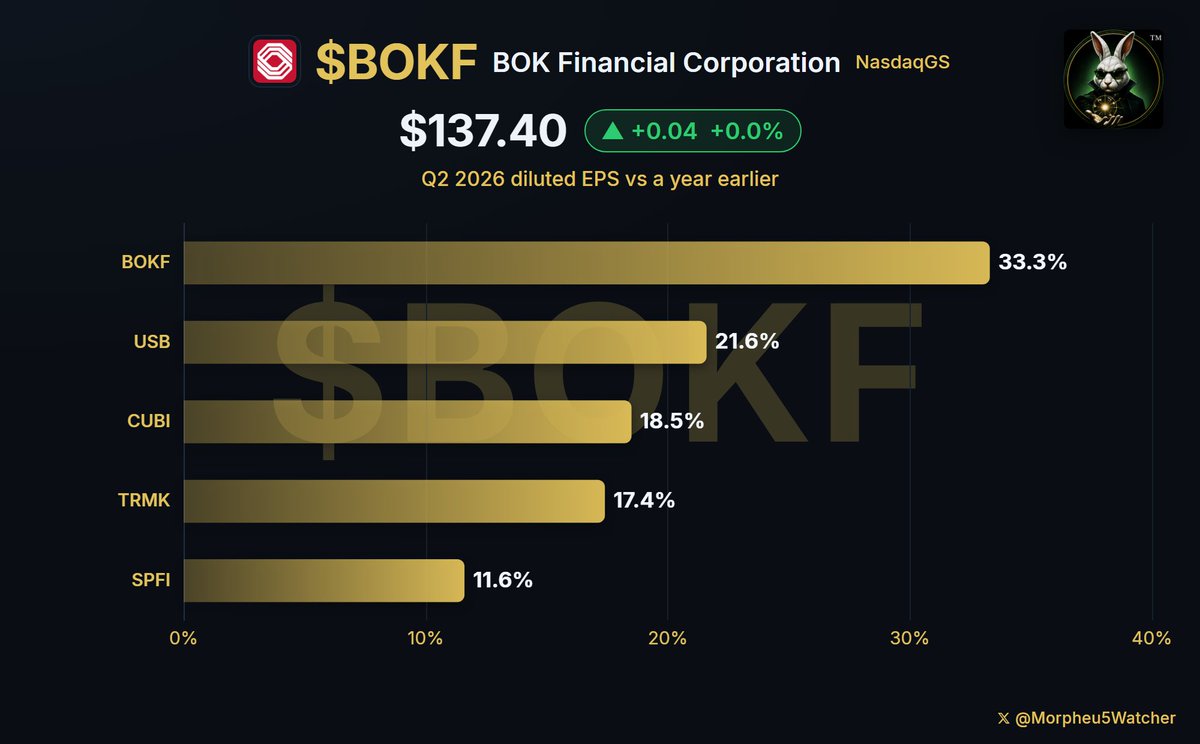
The Growth Len5 is watching banks that grew earnings without a rich price, not software shops. BOK Financial at $137.40, +$0.05 / +0.04% today, is the first name on that board.
Tulsa's commercial lender is worth about $8.4B. It makes loans to businesses across the Southwest and Midwest and runs a wealth shop beside the bank. The Growth Len5 wants expansion the market has not already paid up for. This is that case: five straight years of profits, a record loan quarter, and a price still about 13 times the last four quarters of earnings - $10.61 in total.
The dated cluster is the June quarter, reported July 20. Profit $176.5M, or $2.92 a share, vs $2.19 a year earlier. Strip a $30.9M one-time investment gain and a securities reshuffle and it is $2.59. Loans ended at $27.1B, +$896M / +3.4% from March, +11.5% from a year earlier - the bank called it the strongest quarterly loan production in its history. Deposits $39.9B. The net interest margin - the gap between what it earns on loans and what it pays on deposits - was 2.91%. Loans that have stopped paying sat at 0.23% of the book, and the bank set aside nothing new for credit losses.
Thirteen times earnings is a bank price, not a growth-stock price, on a book that just grew at a double-digit clip. Book value was $100.11 a share at June 30, so the stock is about 1.4 times what the accounting says the company is worth. What would change the read: a September quarter, due October 19, that cannot grow loans without another one-time gain, or that 0.23% credit line starting to climb.
The Growth Len5 looks for earnings that are expanding at a price that does not already assume the expansion.
- U.S. Bancorp, ticker USB, at $63.35, -$0.18 / -0.28% today. The national version of the same idea, and the most profitable of the large names here. Minneapolis parent of U.S. Bank, worth about $99B. June quarter reported July 16: record net revenue $7.71B; profit $2.177B; $1.35 a share vs $1.11 a year earlier, +22%. Costs ate 57.1% of revenue - the efficiency ratio, what it spends to produce a dollar of sales - the tightest of this board's large lenders. Average loans $405.5B, +7.1% year over year. About 13 times the last four quarters of profit, the same cheap price against growing earnings as BOK Financial, with more of each dollar kept. Next print October 15. What would change it: that 57.1% cost line reversing, or fee growth stalling now that a brokerage purchase is inside the numbers.
- Trustmark Corporation, ticker TRMK, at $46.53, +$0.47 / +1.02% today. Jackson, Mississippi regional bank. The Growth case is a low price on a long string of profitable years, not a single hot quarter. June quarter reported July 28: operating profit $56.7M, or $0.97 a share, vs $0.92 a year earlier; official accounting profit $1.08 after it sold a pool of delinquent mortgages. Net interest margin 3.84%, fatter than BOK Financial's 2.91%. Loans $13.9B, deposits $16.1B. Nonperforming assets - loans in trouble - fell 47% after that sale, to 0.39% of loans. The clean-up is the evidence, and also the risk if the remaining book is not actually cleaner. Next print the week of October 26. What would change it: that 3.84% gap shrinking, or credit reversing now that the sold loans are gone.
- South Plains Financial, ticker SPFI, at $45.54, +$0.25 / +0.55% today. Lubbock parent of City Bank. Five profitable years at a price still in the low teens times recent profit is the Growth fit; the June quarter, reported July 17, is why the fit is not automatic. Profit $19.0M, or $0.96 a share, vs $0.86 a year earlier. Loans $3.77B vs $3.10B in March - $632M of that arrived with a Houston bank closed April 1, and $35.4M was lending South Plains did itself. Tangible book per share - book value with takeover premiums stripped out - slipped $29.65 to $29.57. What would change it: a September quarter, due the week of October 21, where loans it made itself carry the growth instead of a purchase.
- Customers Bancorp, ticker CUBI, at $80.29, +$0.64 / +0.81% today. A specialty commercial lender, not a branch-on-every-corner bank, and the lowest price-to-earnings on this board: about 10 times the last four quarters of profit. Worth about $2.7B. June quarter reported July 23: $2.05 a share vs $1.73 a year earlier, +18%; loans $18.0B, +17% year over year; deposits $21.7B. The catch: the net interest margin is 3.17%, thinner than Trustmark and South Plains, and management said on July 24 that figure should be the low for the year. Book value $65.29 a share. What would change it: the October print, due the week of October 21, if that 3.17% gap does not start to widen.
Five banks. One style. The Growth Len5 is finding cheap earnings growth in lenders. The number that decides BOK Financial is the next loan-growth print on October 19. If $896M was a one-off, 13 times earnings stops being cheap on the growth and starts being the right price for a slower bank.
Not investment advice.
ONE GROUP IS HOLDING THE WHOLE OPEN UP, AND IT IS NOT BIG TECH:
Thirty minutes of trading are done and the American market is a shade lower. That nearly flat screen is hiding a badly lopsided morning, and the lopsidedness is the whole story.
Where the four main funds sit. The SPDR S&P 500 ETF Trust, which most people hold as a stand-in for the 500 largest US companies, is at $772.17, -$1.00 / -0.13% today. The SPDR Dow Jones Industrial Average ETF is at $535.29, -$1.64 / -0.31%. The iShares Russell 2000 ETF, which holds smaller US companies, is at $294.81, -$0.38 / -0.13%. The Invesco QQQ Trust, which tracks the Nasdaq 100, is the only green one, at $720.05, +$2.38 / +0.33%.
First question: did the drop at the bell stick? No. Three of those four opened WORSE than they trade now. The Russell fund opened at $293.70, a full 0.51% under Thursday's close, and has climbed back to -0.13%. The Dow fund opened at $535.13 and the S&P fund at $772.01, both under where they sit. Sellers showed up with the bell and did not follow through. Futures agree: Dow futures at 53,620.00, -125 pts / -0.23%; Nasdaq 100 futures at 29,627.75, +103 pts / +0.35%.
Second question, the one that matters: who is doing the lifting? Six of the nine main sector funds are red. The green is essentially one group.
- VanEck Semiconductor ETF, the chipmakers: $564.63, +$12.03 / +2.18%
- Technology Select Sector SPDR, technology broadly: $187.29, +$1.32 / +0.71%
- Financial Select Sector SPDR: $58.13, -$0.43 / -0.73%
- Consumer Discretionary Select Sector SPDR, retailers and carmakers: $115.07, -$1.39 / -1.19%
- Energy Select Sector SPDR: $63.74, -$0.89 / -1.37%
Chips are not leading technology higher. Chips are running three times as hot as technology, and technology is nearly all that is keeping the index above water.
The weight on the rest arrived at 8:30am ET, when the Bureau of Labor Statistics published the August employment report, the government's count of how many jobs employers added or cut plus the share of jobseekers who cannot find work. It came in at +162k against roughly +55k expected, unemployment held at 4.1%, and July was revised up to +21k from a reported loss of 23,000. That normally hurts expensive technology shares most, because the Federal Reserve is weighing an interest-rate INCREASE rather than a cut, and dearer money bites hardest on companies whose profits sit years out. This morning it has not.
The sharpest case is the group's biggest mover. SanDisk $SNDK at $1,635.87, +$80.88 / +5.20% today. It opened at $1,586.00 and has added another 3.1% since the bell, the cleanest example on the board of a jump that held rather than faded. The company makes flash memory, the storage chips inside phones, laptops and the servers running AI systems.
Its August 5 report, for the quarter ended July 3, is why: revenue $8.965B, +372% from a year earlier and +51% from the quarter before; gross margin, what is left of each sales dollar after making the product, 84.6%; profit $43.97 a share. Its own map for the current quarter is $10.30B to $10.80B of revenue.
Then read the sentence underneath, because it decides everything. SanDisk said roughly two thirds of that 51% jump came from higher PRICES and about one third from selling more chips. Memory is scarce against AI demand, so the price tag is doing most of the work.
That is exactly what earns it a place on the Hypergrowth Len5, and exactly what caps it. That Len5 looks for businesses still early and growing very fast, and +372% settles the fast half outright. The early half is the honest catch: a company whose sales quadrupled on the price of a product it does not set is riding a cycle, not proving a franchise. What would change it is volumes carrying a quarter on their own, or memory prices rolling over, which would take the revenue down with them. The verdict: the fastest-growing business in the American market right now and the one leaning hardest on something outside its control, which is why a 5% morning and a share price still $718.52 / 30.5% under its own 12-month high of $2,354.39 are not a contradiction. SanDisk has not set a date for its next report; that quarter is expected in early November.
The mirror image sits in the same fund. Apple at $324.25, -$3.96 / -1.21% today, opened at $328.31 and has fallen since, going down while the chipmakers climbed, inside the same Nasdaq 100 that is green. At 37.6 times the last year's profit and within 5.9% of its $344.57 12-month high, it is not a current Len5 pick on any of the six styles: the durability was never the argument, and there is no discount for the two value styles and no fast growth for the growth ones.
Two other markets agree the conviction here is thin. Gold at $4,477.20/oz, -$14.50 / -0.32% today, was down more than a full percent shortly after the report and has taken most of that back. Metal pays no interest, so it gets sold when a hot jobs number makes a savings account look likely to pay more, and bought back when that certainty drains away. The iShares 20+ Year Treasury Bond ETF, which holds long-dated US government debt, is at $82.37, +$0.30 / +0.37%. That fund rises when long-term borrowing costs FALL, which a payroll count three times the forecast is not supposed to do.
The calendar is tight. US markets are closed Monday for Labor Day, so there is one session to price this and then three days of quiet. The Consumer Price Index, the government's main measure of how fast the prices households pay are rising, lands Thursday, September 11 at 8:30am ET, five days before the Fed decides on September 15-16.
A green index usually reads as the market approving of something. This one is chipmakers approving, loudly, while most of the rest of the market said nothing or said no. Narrow is not the same as strong, and narrow is what a single number takes apart first.
Not investment advice.
WHY IS MCDONALD'S $MCD AT A 52-WEEK LOW? FEWER PEOPLE ARE WALKING IN:
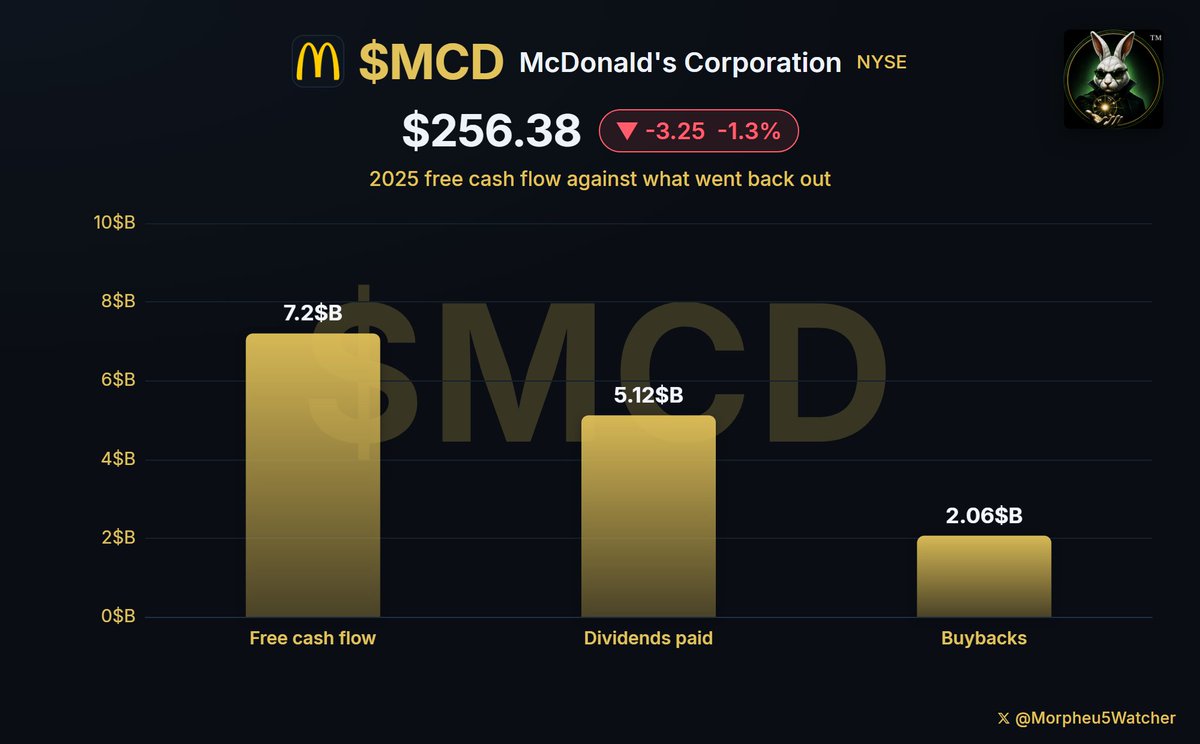
McDonald's MCD at $256.80, -$2.83 / -1.09% today, is the name the Quality-Value Len5 is watching here. Thursday's close of $259.63 was its lowest in twelve months, and the $256.12 it touched during that session is the lowest the shares have traded in a year. The verdict: this is the cheapest McDonald's has been in years, and it is cheap for one plain reason that quality does not fix - fewer people are walking in.
The Chicago company sells burgers through more than 45,000 restaurants in over 100 countries, about 95% of them owned and run by local franchisees. So McDonald's mostly collects rent and royalties rather than selling the food itself.
Quarter ended June 30, reported August 4:
- Systemwide sales $37B, +5% - what customers spent across all those restaurants
- Revenue $7.10B, +4%, or +2% once currency swings are stripped out - McDonald's own share of it
- Operating profit, what the business earns running itself before interest and tax, $3.34B, +3% - a 47.0% margin
- Earnings $3.32 a share, +6%
Keeping 47 cents of every revenue dollar is what a rent-and-royalty business looks like.
Now the line that put the stock here. Comparable sales - takings at restaurants open at least a year - grew 1.3% worldwide and 0.8% in the United States. One quarter earlier the US figure was 3.9%.
And that 0.8% is not people. https://t.co/trUIXNAV0Q, a firm that counts store visits using phone location data, put McDonald's US visits down 4.5% in the quarter against a 3.0% fall for fast food as a whole. McDonald's own account matches: guest counts dropped and the average order rose enough to cover it. Chief executive Chris Kempczinski said "we simply didn't execute at the level we needed to in the second quarter" and insisted the company does not have a strategy problem. Management also said comps were slightly negative in April and negative again in July, so the quarter after the bad one started worse.
Chipotle Mexican Grill at $37.02, -$0.55 / -1.46% today, is the same American consumer answering differently. Its June quarter, published July 29, broke out what McDonald's would not: comparable sales +2.2%, made of +1.2% from higher prices and +1.0% from more transactions - genuinely more visits - and it raised its full-year sales outlook six days before McDonald's admitted it had missed. It sits on the Deep-Value and Special-Situations Len5, which watches a business priced under what it looks worth, because it carries no borrowings and earns unusually well per restaurant while growth has slowed to mid single digits.
One company, six ways of looking:
- QUALITY-VALUE - STRONG, and why it sits here. Wants a business that is genuinely hard to copy, at less than it looks to be worth. Hard to copy is not the argument: 95% franchised, that 47.0% margin, and loyalty members alone spent $40B across the system over the past year, up more than 20%. Price is the new half - about 20.8 times the $12.36 a share earned over the last four quarters, against a ten-year middle nearer 26 times. CHANGE IT: that margin slipping as McDonald's spends to buy the traffic back.
- DEEP-VALUE AND SPECIAL-SITUATIONS - PARTIAL. Wants a business priced under what it looks worth after something visible went wrong. August 4 is the visible thing and the price marked it, $84.95 / 24.9% under the $341.75 it reached on March 2. What is missing is depth: 20.8 times profit is cheap for McDonald's and ordinary for anything else, and nothing is broken in the rent the franchisees pay. CHANGE IT: a second quarter like the last one taking the price far lower while those payments keep arriving.
- MOMENTUM - NOT A FIT, and furthest from it. Wants a price near its best level of the past twelve months, put there by the company's own news. The 52-week low is one day old. CHANGE IT: a fresh high made on reported figures, which nothing before late October can supply.
- GROWTH - NOT A FIT. Wants expansion nobody is overpaying for. Nobody is overpaying, and there is barely any expansion: 1.3% worldwide, 0.8% at home, 2% of revenue growth once currency comes out. CHANGE IT: comparable sales back to mid single digits.
- HYPERGROWTH - NOT A FIT, and not close. Wants early as well as fast. Selling burgers since 1955, 45,000 restaurants, growing 2%. CHANGE IT: nothing realistic.
- INCOME - NOT A FIT, and not for the reason most would guess. Watches cash genuinely reaching owners, funded by the business with room to spare. Reaching owners is settled: $1.86 a quarter, $7.44 a year, near 2.9% of the price, raised 5.1% for a 26th straight year, with the shares trading without it since September 1 and payment due September 16. Room to spare is what fails. In 2025 McDonald's produced $7.2B of free cash flow - the cash left after running the business and building restaurants - which was 8% LESS than the year before, and handed back $7.17B of it, $5.12B in dividends and $2.06B in buybacks. Essentially the whole thing. CHANGE IT: free cash flow growing again.
What to watch, and when. October 5 comes first, when McDonald's starts retraining more than two million crew, corporate staff and suppliers - the largest such program it has ever run, timed to Ray Kroc's birthday. Third-quarter results are expected before the open on October 22, not yet confirmed by the company. One line settles the argument and it is not earnings: whether US comparable sales came from more visits or a bigger bill.
The risk is that the diagnosis is wrong. Retraining two million people fixes service. It does not fix a customer who left because a value meal stopped feeling like one - and a company already handing back every dollar of its free cash flow has nothing spare to buy that customer back.
Not investment advice.
TRUSTMARK $TRMK SWAPPED OUT THE COMPUTER RUNNING ITS DEPOSITS. THEY GREW $359 MILLION ANYWAY:
Trustmark TRMK at $46.06, +$0.24 / +0.52% at Thursday's close. The Jackson, Mississippi bank runs branches across six states plus wealth management and insurance arms most lenders its size do not carry.
Whoever tops a list is whoever is most extreme on the one thing it measures, and an extreme number does all the talking. One place down, the reasoning is still visible. Trustmark is the runner-up on the Growth Len5, and the verdict is this: its best-looking quarter in years was largely housekeeping, and the housekeeping is the good news.
Quarter ended June 30, reported July 28:
- Net income $63.5M, $1.08 a diluted share; two one-off items added $6.9M / $0.11
- Strip those out: $56.7M, $0.97 a share - the number that repeats
- Deposits $16.1B, +$358.7M / +2.3% in three months and +6.3% in a year, costing 1.59% from 1.63%
- Net interest margin 3.84% from 3.81% - the gap between what a bank earns lending and pays on deposits
The larger one-off is not a windfall. Trustmark sold $73.8M of home loans mostly three payments late or already classed as not paying, having reserved more against them than the discount it accepted, which released $4.2M before tax. The rest was a one-time investment gain. What the sale did shows on the credit line: loans classed as not paying fell 48.7% to $49.7M, and nonperforming assets fell 47.3% to $54.9M, 0.39% of everything lent against 0.73% in March. The cushion held against future losses is thinner at 1.07% of loans from 1.16%, which is what happens when the bad loans leave.
Then the part nobody prices. Chief executive Duane Dewey said years of planning ended this quarter with the conversion of Trustmark's core deposit systems onto new platforms - replacing the software that records every account in the bank. The bill is visible: services and fees rose $1.8M / 6.5% to $29.7M on data processing and professional fees. Deposits grew $358.7M straight through it.
The Growth Len5 wants expansion nobody is overpaying for. Price is the settled half: about 11.7 times the last year of profit, and roughly 1.5 times the $31.07 of tangible book value per share - what the accounts say each share owns once goodwill is stripped out - which is up 8.1% in a year. Expansion is not. Loans grew 0.8% in the quarter and 3.9% over the year once the sale is excluded, so this profit came from deposits and the margin rather than from lending more. WHAT WOULD CHANGE IT: lending carrying a quarter on its own, or bad loans returning against that thinner cushion. Trustmark has not dated its third-quarter report; last year's landed October 28.
MOMENTUM LEN5:
- PBF Energy at $75.50 (premarket), +$0.17 / +0.23% from Thursday's $75.33 close. The New Jersey company turns crude oil into gasoline and diesel. This Len5 watches a price near its best level of the past year, put there by the company's own results. PBF reached $77.94 on September 2, from $25.62 last December 18. The July 30 quarter did it: adjusted profit $6.22 a share against a LOSS of $1.03, on a gross refining margin - what it keeps from each barrel after paying for the crude - of $30.16 on the West Coast against $9.35. WHAT WOULD CHANGE IT: that margin narrowing. Verdict: a real climb at about 6.7 times profit, resting on a price PBF neither sets nor forecasts.
QUALITY-VALUE LEN5:
- Copart at $33.51 (premarket), -$0.07 / -0.21% from Thursday's $33.58 close, which rose 4.42%. The Dallas company auctions wrecked vehicles online for insurers, out of yards it owns. This Len5 wants a business hard to copy at a fair price. Hard to copy is the land - permitted yards near cities no rival can simply go and buy. Fair is the new part: Copart reached $50.11 a year ago today and sits $16.53 / 33.0% under it, near 21 times profit. The cause is visible, because in the quarter to April 30 revenue grew 2.1% and profit went $0.42 to $0.43 a share. WHAT WOULD CHANGE IT: volumes growing again. Verdict: a real discount with a real reason behind it, tested after Thursday's close on September 10.
DEEP-VALUE AND SPECIAL-SITUATIONS LEN5:
- Old Dominion Freight Line at $185.75, -$1.86 / -0.99% Thursday, in a session that ran from $190.70 down to $179.34 on twice its usual volume. The North Carolina company hauls freight that shares one trailer between several customers. This Len5 wants a business priced under what it looks worth after something visible went wrong, and the visible thing is the shipment count: Thursday's August update showed revenue per day +12.4% on 2.4% fewer shipments. Take out the fuel surcharge billed straight through to customers and the price per hundred pounds carried is up 4.8%, not 11.3%. WHAT WOULD CHANGE IT: shipments turning positive. Verdict: at 36 times profit the discount holds only if June was the bottom rather than the level.
HYPERGROWTH LEN5:
- Reddit at $154.91 (premarket), -$1.08 / -0.69% from Thursday's $155.99 close. The San Francisco company runs the discussion forums and sells advertising beside the conversations. This Len5 wants early as well as fast, and fast is settled: the July 30 quarter brought revenue of $805M, +61%. The split underneath is the argument. Daily visitors worldwide hit 130.3M, +18% and ahead of the 129.9M expected; American daily visitors were 53.2M, +6% and lower than the quarter before. Nearly all the money comes from the American half, so it is growing fastest where it earns least. WHAT WOULD CHANGE IT: US visitors turning back up, or a new deal licensing its conversation archive for AI training. Verdict: real growth landing in the wrong country, which is why the shares fell 12% that day and sit 45.3% under last September's $282.95.
INCOME LEN5:
- Ardmore Shipping at $18.27 in thin overnight trading, +$0.25 / +1.39% from Thursday's $18.02 close. The Bermuda company owns mid-size tankers carrying refined fuels. This Len5 watches cash genuinely reaching owners and funded by the business. Net income in the June quarter was $60.5M, but that includes a $12.2M gain on selling one ship. The dividend is not struck off it: it is two thirds of adjusted profit, which excludes the gain, so $1.18 a share became $0.79, paid September 15. Behind that, the tankers earned $51,870 a day against an operating cash cost near $10,800, and borrowings fell to $33.4M from $127.0M, leaving more cash than debt. WHAT WOULD CHANGE IT: day rates normalizing, which cuts the payment automatically. Verdict: funded by running the fleet rather than shrinking it, and at the mercy of a rate nobody at Ardmore sets.
A bank that sells its worst home loans and replaces the system running its deposits in the same three months is doing the two kinds of work that never look like growth. What that work bought is $16.1B of deposits at 1.59% and half the bad loans it carried in March. The $0.11 will not be there in October. Those two things will.
Not investment advice.
JULY DID NOT LOSE 23,000 JOBS. IT ADDED 21,000:
That correction landed at 8:30 this morning inside the August employment report, and it is doing more to the tape than the headline everyone is quoting. Thirty minutes from the opening bell, US index futures - agreements to buy or sell a stock index at a set price on a later date, which keep trading while the stock market itself is shut - have given the morning back:
- S&P 500 futures at 7,734.75, -20.00 pts / -0.26%
- Dow futures at 53,569.00, -176 pts / -0.33%
- Nasdaq 100 futures at 29,521.00, -3.75 pts / -0.01%
- Russell 2000 futures, which track smaller US companies, at 2,953.30, -16.40 pts / -0.55%
At eight o'clock only one of those four was doing anything. The Nasdaq contract stood at 29,676.50, +152.00 pts / +0.51%, carrying the whole session on its own. It has since handed back 155.50 points and now sits within four points of unchanged. The S&P contract has lost 26.50 points in the same 54 minutes, the Dow 141, the Russell 17. The overnight bid was one bet - that the Federal Reserve leaves interest rates alone in twelve days - and the jobs report took the bet away.
What the Bureau of Labor Statistics published at 8:30am ET, its monthly count of how many jobs American employers added or cut:
- August payrolls: +162k, against roughly +53k expected. About three times the forecast, and the largest month since March
- Unemployment rate: 4.1%, unchanged, with 7.0M people looking for work and not finding it
- Average hourly earnings: $37.75, +$0.10 / +0.3% on the month and +3.1% over the year
- Revisions: June went to +31k from +20k. July went to +21k from a reported LOSS of 23,000
That last line deserves a stop. For a month, the case for cheaper money leaned on a July in which employers were said to have cut 23,000 jobs. On this morning's figures they added 21,000 - a 44,000 swing in a month already banked and traded. Put both revisions together and 55,000 jobs that did not exist yesterday exist today. The jobless summer was a first draft.
Now the part that runs backwards from what most people were taught. Ordinarily a weak jobs number means the Fed cuts interest rates, borrowing gets cheaper, and share prices like it. The Fed is not debating a cut. It is debating an increase. Its benchmark rate - which sets what borrowing costs across the American economy - sits at 3.50% to 3.75%, and a rise is on the table because inflation stopped falling. So a hot count does not read as "the economy is fine." It reads as "the committee has room."
The odds moved accordingly. After Chair Kevin Warsh spoke at Jackson Hole on August 28, traders put the chance of a quarter-point increase at the September 15-16 meeting above 63%. Governor Christopher Waller argued for waiting on Thursday and that fell to roughly even. This morning's count pushed it back to about 53%.
Which is why the damage is not spread evenly. Small companies are taking the worst of it, and that is not sentiment - they borrow at rates that move with the Fed's, and they hold less cash to wait one out. The two funds most people actually own tell the same story in miniature: SPDR S&P 500 ETF Trust $SPY at $771.25 (premarket), -$1.92 / -0.25% from Thursday's $773.17 close, against Invesco QQQ Trust, which tracks the Nasdaq 100, at $717.82 (premarket), +$0.15 / +0.02% from $717.67.
The clearest confirmation is not in shares at all. Gold is at $4,443.30/oz, -$48.40 / -1.08% today, and silver at $66.20/oz, -$0.77 / -1.15%. Gold was higher on the day an hour ago. Metal pays no interest, so it gets sold when cash in a savings account is about to pay more. Same wager as the futures made, placed in a different market.
One loud move before the bell argues the other way, and it belongs next to a strong jobs count. Lululemon Athletica at $98.78 (premarket), -$22.99 / -18.88% from Thursday's $121.77 close, reported after Thursday's close and cut its full-year forecast for the second time this year: revenue now $10.35B-$10.50B against $11.0B-$11.15B before, profit $9.48-$9.73 a share against $10.95-$11.15. The quarter to August 2 brought revenue of $2.42B, -4%, with comparable sales - takings at stores open at least a year, plus online - down 9%, and profit of $2.92 a share against $3.10. Heidi O'Neill, previously of Nike, takes over as chief executive next week. The Deep-Value and Special-Situations Len5 - which watches a business priced under what it looks worth once something has visibly gone wrong - carries it for a debt-free balance sheet standing behind a discount that was already there before this morning widened it. The verdict: a government count saying Americans have paychecks, and one of the best-known consumer brands in the country saying they are not spending them there.
Two things to hold loosely. Premarket direction fades - half an hour is long enough for it to turn twice, and a futures price at nine owes nothing to nine-thirty. And the calendar is tight. US markets are closed Monday, September 7 for Labor Day, so there is one session to price all of this and then three days of silence. The August inflation report lands Thursday, September 11, five days before the Fed decides.
Every payroll count is a first draft. This morning the government rewrote two of them, and the market discovered it had spent August arguing about a labor market that, on today's numbers, was never as broken as it looked. That is the uncomfortable thing about a revision: it does not merely change the past, it retires the argument built on it. The September count arrives in early October, carrying another set.
Not investment advice.
59%, THEN 53%, THEN 46%: APPLOVIN $APP IS PRICED ON THE THIRD NUMBER:
AppLovin APP at $315.50 (premarket), +$1.92 / +0.61% from Thursday's $313.58 close. One rule keeps setting prices across the six Len5es right now: what a company earned last quarter counts for far less than which way its next number points. AppLovin is the extreme case.
The Palo Alto company sells the software that decides which advertisement you see inside a mobile app, and does it with fewer than 900 employees. The June quarter, reported August 5: revenue $1.92B, +53%; net income $1.27B, or $3.76 a diluted share; free cash flow - the cash left after running the business and buying equipment - $863.3M. Adjusted EBITDA, a rough cash-profit measure taken before interest, tax and the cost of writing down equipment, was $1.61B. That is an 84% margin - 84 cents of cash profit from every sales dollar, which almost nothing else in the market delivers.
The next session the stock fell $82.13 / 19.66% to $335.67, on 15.2M shares against a two-week average near 4.6M.
It fell on direction. Revenue grew 59% in the March quarter and 53% in June, and AppLovin's own map for September is $2.055B to $2.085B, or 46% to 48%. Chief executive Adam Foroughi called it timing: the pace of meaningful model improvement was lighter than normal in the quarter, and the next step up landed just after it closed. The selling ran on to $297.50 on August 24. At $313.58 the shares sit $432.03 / 57.9% below the $745.61 of last September 29.
So a business growing 53% at an 84% cash margin now costs about 24 times the last year of profit.
Verdict: the cheapest genuinely fast-growing company on this board, and cheap for a stated reason rather than a mysterious one. Hypergrowth is the Len5 watching it, and that style wants early as well as fast - fast is not arguable, early is what thins at $105B of market value. It fits none of the other five: no dividend or shrinking share count for Income, a price 58% off its high for Momentum, no downturn survived for Quality-Value, and Deep-Value wants something broken, where here a software release was merely late. WHAT WOULD CHANGE IT: the September quarter clearing that 46% to 48% band, or the December guide turning back up. Results are expected November 11 after the close, unconfirmed. One figure cuts the other way: AppLovin spent $551.3M on its own shares last quarter, retiring roughly 1.1M near $500 each, well above today's price.
MOMENTUM LEN5:
- HeartFlow at $49.50 (premarket), -$0.21 / -0.42% from Thursday's $49.71 close. Software that reads an ordinary heart CT scan and tells a cardiologist whether a narrowed artery is genuinely starving the heart. This Len5 wants a price near its best level of the past year, put there by the company's own news rather than a good mood across the market. HeartFlow set that high two days ago at $51.78, from $20.13 on February 13. August 13 did it: revenue $64.1M, +48%; gross margin, what is left of each sales dollar after delivering the service, 83.0%; full-year revenue raised to $246M-$250M from $228M-$232M. The shares rose 35.7% the next session. WHAT WOULD CHANGE IT: $51.78 failing to hold. Verdict: AppLovin's mirror image - no profit at all, valued near 17 times a year of sales it has not yet collected, because it raised its own forecast instead of trimming it.
QUALITY-VALUE LEN5:
- Procter and Gamble at $146.10 (premarket), -$0.82 / -0.56% from Thursday's $146.92 close. The Cincinnati maker of Tide, Pampers, Gillette and Charmin. This Len5 wants a business that is hard to copy at a fair price, and hard to copy was settled generations ago, so price is the whole argument. The July 29 report, for the year to June 30: sales $87.0B, +3%; organic sales, meaning sales with currency and acquisitions stripped out, +1% - all of it from higher prices rather than more product sold. The year now running is mapped at core earnings per share, profit with one-off items stripped out, of $6.89 to $7.11 against last year's $6.89. Flat to 3%, and that already absorbs a stated $0.56 a share of cost pressure, near $1B after tax from raw materials, energy and freight. WHAT WOULD CHANGE IT: volumes growing again rather than prices. Verdict: about 21 times a profit the company itself expects to move between nothing and a little. Next results land before the open on October 21.
DEEP-VALUE AND SPECIAL-SITUATIONS LEN5:
- Progressive at $222.00 (premarket, thin overnight trading), -$1.87 / -0.84% from Thursday's $223.87 close. The Ohio insurer sells car cover direct and through agents. This Len5 wants a business priced under what it looks worth after something visible went wrong, and here growth has stopped paying for itself. July figures, published August 19: policies in force 40.3M, +7%, on premiums written of $7.44B, +5% - with net income DOWN 12% to $961M, $1.65 a share. One ratio explains it. Claims and running costs as a share of premiums, where under 100 means the insurance itself made money, came in at 86.8 against 85.3. WHAT WOULD CHANGE IT: that figure turning back down. Verdict: 11 times profit for a company that added 2.7M customers in a year, priced 10.4% under the $249.83 it reached exactly one year ago today - and alone on this board it gets marked on a fixed date, before the open on Friday, September 18.
GROWTH LEN5:
- ServisFirst Bancshares at $42.50, +$0.20 / +0.47% Thursday. A Birmingham, Alabama commercial bank founded in 2007, lending to businesses and professionals with 666 staff. This Len5 wants expansion nobody is overpaying for, and ServisFirst is the quickest grower on that board and the one you pay the most for. The July 20 quarter: net income $85.79M, +39.7%; loans up $533M, a 15% annual pace; net interest margin - the gap between what a bank earns on loans and pays on deposits - 3.63%, wider by 0.53 points in a year; running costs under 30 cents of every revenue dollar, against 33 cents a year earlier. The board split the stock two for one on August 20, so each share now carries half of what it did, on book value - what the accounts say each share owns - near $18.10. WHAT WOULD CHANGE IT: loan losses, the only way a bank growing lending at 15% gets punished. Verdict: 14.4 times profit and 2.3 times book for the fastest compounding and the thinnest discount on that board. Third-quarter results are expected in the third week of October, not yet dated.
HYPERGROWTH LEN5:
- AppLovin again, and what holds it here is not the 53%. It is that the growth arrives as cash rather than promises: $863.3M of free cash flow in June, $1.3B in the March quarter. This Len5 wants early as well as fast, and early is what is under test. On June 22 AppLovin opened its advertising system to any business without an invitation - its attempt to sell to ordinary online retailers instead of only to other app makers. Spending from that consumer side ran 28% above the Christmas-quarter peak of 2025. WHAT WOULD CHANGE IT: that channel failing to show up in reported revenue, which leaves a mature app-advertising business growing at 46%. Verdict: growth stopped being the question months ago, and early or late is now the entire argument.
INCOME LEN5:
- Teekay at $13.47, +$0.11 / +0.82% Thursday. The Bermuda-based company controls a fleet of mid-sized crude oil tankers and runs marine services for the Australian government. This Len5 watches cash genuinely reaching owners and funded by the business, and Teekay is the oddest version of that here, because the payment is not a schedule. There is no regular quarterly dividend at the parent. Owners got a special dividend of $1.00 a share, declared May 13 and paid June 2 - near 7.4% of today's price, decided in a single meeting. The cover is enormous: the June quarter, reported July 29, earned $69.5M, or $0.79 a share, in three months against that $1.00 for the whole year. Read where it came from, though. Teekay has booked 44% of its third-quarter days at $104,800 a day for its largest tankers, a rate that exists because of the disruption around the Strait of Hormuz. WHAT WOULD CHANGE IT: rates normalizing, which shrinks the payment with no announcement needed, because there is nothing to cut. Verdict: covered many times over, and promised to nobody.
Six businesses, six arguments, one rule underneath. The market is not paying for the quarter that got reported. It is paying for the sentence each company wrote about the quarter that has not finished. AppLovin's sentence says 46% to 48%. HeartFlow's says $246M to $250M, and rising. One costs 24 times profit; the other costs 17 times sales nobody has collected yet. That gap is not a verdict on the two businesses. It is a verdict on which way each one pointed.
Not investment advice.
ABERCROMBIE $ANF TOOK NINE MONTHS TO CLIMB 66%. IT TOOK ONE DAY TO ADD 36%:
The Momentum Len5 is watching Abercrombie & Fitch ANF at $142.99 (premarket), -$0.55 / -0.39% from Thursday's $143.54 close. The New Albany, Ohio company has been selling clothes since 1892 and does it today through two chains, Abercrombie and Hollister, with 43,200 staff.
The verdict first. The climb is real, and about half of a year's worth of it arrived in one session - a session celebrating, in large part, a cheque from a customs office rather than anything Abercrombie sold.
The run came in two speeds. The shares bottomed at $65.45 on November 24 and reached $108.90 by August 25: +66% over nine months, earned the slow way. Then the second-quarter results landed. On August 26 the stock opened at $131.37 and closed at $147.75, +$38.85 / +35.7% in one session, on 17.2M shares against a 30-day average near 2.1M. It touched $154.58 that afternoon and has closed below that every day since, with a low of $136.17 on Wednesday.
The quarter itself, for the three months to August 1:
- Net sales $1.27B, +5% - a record, and the 15th quarter in a row of growth
- Profit $4.17 a share, against the $1.80-$2.00 the company mapped in May and a Street estimate near $1.99
- Operating profit, what the business earns running itself before interest and tax, $252.7M; margin 19.9%
- Sitting inside that figure: about $100M of tariff refunds
Those refunds are a repayment, not a sale. In February the Supreme Court ruled that the emergency-powers law behind a large block of US tariffs never authorized them, and Customs and Border Protection began paying importers back in April. Abercrombie's share came back as a cut to the cost of its goods, which is why gross margin - what is left of each sales dollar after paying for the clothes - printed 71.1% against 62.6% a year earlier. It was worth $1.75 of the $4.17.
Take it out and the shape changes. Operating margin was about 12.0%, against 13.9% in the same quarter last year on the company's own like-for-like measure. More sales, less operating profit. The cost line says why: selling and administrative expenses were $648.8M, +17.8%, on sales up 5%.
Then the raise, which is what the market was really paying for. In May the year was mapped at $10.20-$11.00 a share. On August 26 it became $13.10-$13.60 - $2.75 more at the middle. About $1.75 of that is the one-quarter refund. About $0.50 is the rest of the quarter beating its own map. About $0.50 is Abercrombie genuinely expecting more from the back half.
And this company grows one brand at a time. Last quarter the Abercrombie brands did $596.8M, +8%, with comparable sales - takings at stores open at least a year, plus online - up 4%. Hollister, the larger of the two, did $669.9M, +2%, comparable sales down 3%. A year ago in the autumn quarter it was the exact reverse: Hollister +16%, Abercrombie brands -2%. Two engines that fire one at a time is much of why a business this profitable still costs about 11 times profit.
The same company, weighed six ways:
- MOMENTUM - STRONG, and why it is here. Wants a price near its best level of the past year, climbing on the company's own news rather than a good mood across the market. Both halves fit: $65.45 in November to $154.58 on August 26, with an earnings release under the last leg. WHAT WOULD CHANGE IT: the climb rolling over - and that is the soft spot, six sessions with no new high and Wednesday's $136.17.
- QUALITY-VALUE - NOT A FIT, and it is durability that fails, not price. Wants a business that is hard to copy at a fair price. Fair is settled, near 11 times the last year of profit. Hard to copy is what the brand see-saw argues against, in a trade where the customer can change their mind in a season. WHAT WOULD CHANGE IT: both brands growing comparable sales together for a run of quarters.
- DEEP-VALUE AND SPECIAL-SITUATIONS - NOT A FIT. Wants a business priced under what it looks worth, usually after something visible went wrong. Nothing has: record quarter, raised year, twelve-month high on August 26. Cheap and broken is the setup; this is cheap and celebrated. WHAT WOULD CHANGE IT: a holiday quarter that misses badly enough to take the price down while the brands hold.
- GROWTH - NOT A FIT. Wants expansion nobody is overpaying for. Nobody is overpaying; the expansion is thin. Third-quarter sales are guided to $1.355B-$1.367B, +5% to +6%, against the +7% it is lapping - and operating profit went backwards once the refund comes out. WHAT WOULD CHANGE IT: growth past the mid single digits with the cost line back in step.
- HYPERGROWTH - NOT A FIT, and furthest from it. Wants early as well as fast. Abercrombie is 134 years old, employs 43,200 people, and grew 5%. WHAT WOULD CHANGE IT: nothing realistic.
- INCOME - NOT A FIT, though not for the reason expected. Watches cash genuinely reaching owners and funded by the business. The buyback is large and real: $282M this year has retired about 7% of the company, at an average price well below today's, with at least $500M planned - near 8% of the business at $6.4B. What is missing is a dividend, and there has not been one since 2020, so every dollar returned is discretionary. A buyback can be slowed in a bad season with no vote and no announcement. WHAT WOULD CHANGE IT: a dividend, or repurchases that keep running through a weak quarter.
What to watch, and when. Third-quarter results, which Abercrombie has not dated; last year's landed on November 25. One line decides them: operating margin against the 13.0% to 14.0% guided, and how much of that, if any, is another refund. The same quarter last year earned 12.0%, so the bar asks for a real improvement, not a rebound.
The risk is in the stockroom. On the results call chief executive Fran Horowitz said demand "exceeded our inventory at many points during the quarter" and the team was "chasing, chasing, chasing." Inventories closed at $591.7M, slightly below where the year began, heading into the three months that carry the most profit. Running lean protects the margin right up to the day a hot season arrives and the shelves are empty.
A refund is money a government gives back. It moved this share price 36% in a day and did not change one thing hanging on a rack. What Abercrombie does about that between now and Christmas is the whole question.
Not investment advice.
WALL STREET IS THIRTY MINUTES FROM A NUMBER IT CANNOT ROOT FOR:
The August jobs report lands at 8:30am ET, and the unusual thing about this one is that there is no version of it that is straightforwardly good news. That is why US index futures - agreements to buy or sell an index at a set price on a later date, which keep trading overnight while the stock market is shut - have spent the morning doing almost nothing.
- S&P 500 futures at 7,761.25, +6.50 pts / +0.08%
- Dow futures at 53,710.00, -35.00 pts / -0.07%
- Nasdaq 100 futures at 29,676.50, +152.00 pts / +0.51%
- Russell 2000 futures, which track smaller US companies, at 2,970.30, +0.60 pts / +0.02%
Three of those four sit within a tenth of one percent of unchanged, and one of them is red. The same split shows up in the two funds most people actually own: Invesco QQQ Trust, which tracks the Nasdaq 100, at $721.54 (premarket), +$3.87 / +0.54% from Thursday's $717.67 close, against the SPDR S&P 500 ETF Trust at $774.02 (premarket), +$0.85 / +0.11% from $773.17.
One contract carrying the whole gain is not a market with a view. It is yesterday afternoon's news still sitting where it landed.
Now the part that makes today different from an ordinary jobs Friday.
Most people have been trained on a simple rule: weak jobs numbers mean the Federal Reserve cuts interest rates, and cheaper money lifts share prices. That rule does not apply this month, because the Fed is not debating a cut. It is debating an increase.
The Fed's benchmark rate - which sets what borrowing costs across the American economy - sits at 3.50% to 3.75%. The committee left it there in July on a 9-3 vote, openly split. The reason it is discussing going higher is that inflation stopped falling. The July consumer price index, published by the Bureau of Labor Statistics on August 12, put prices 3.4% above a year earlier against the Fed's 2% target, with the core measure - the same basket with food and energy stripped out, because those two swing hardest - at 2.5%.
After Chair Kevin Warsh, who took the job in May, spoke at the Jackson Hole conference on August 28, traders pushed the odds of a quarter-point increase at the September 15-16 meeting past 63%. On Thursday, Fed governor Christopher Waller argued for waiting, and those odds fell to roughly even.
So here is what actually arrives at half past eight. The Bureau of Labor Statistics publishes the August employment report: the government's count of how many jobs American employers added or cut during the month, plus the share of people looking for work who cannot find any. Economists expect about +55k jobs, with unemployment holding at 4.1%. July LOST 23,000, and May and June were revised down by 103,000 between them.
Set the two outcomes side by side and neither one is clean.
A strong number says the economy is fine and puts a rate increase back on the table for September 16. A weak number kills the increase and confirms a third straight month in which American employers shed more workers than they hired. Each answer removes one worry by proving the other.
That is what a flat screen at eight in the morning actually is. Not calm. Nothing to bet on.
Every other market this morning says the same thing by disagreeing with itself. Gold is at $4,513.60/oz, +$21.90 / +0.49%, and silver at $67.44/oz, +$0.47 / +0.70% - the metals people buy when they expect money to be worth less. The dollar index, which measures the dollar against a basket of major currencies, is at 99.05, +0.170 / +0.17%, and a rising dollar is the opposite bet, that American rates go up. The 10-year Treasury yield, what Washington pays to borrow for ten years, is 4.759% and has barely moved; the 30-year sits at 5.24%.
The reason the Fed cannot simply cut into a weakening job market is floating off the Middle East. Brent crude, the global oil benchmark, is at $95.07 a barrel, -$0.45 / -0.47% today, and still on course for its steepest weekly gain since mid-July. US crude is at $90.68, -$0.62 / -0.68%. Fuel is the most contagious price there is - everything that gets driven, flown or shipped carries it - and a fuel bill up around 7% in five days is not what a cooling inflation report is made of.
Europe is mid-afternoon and has arrived at the same non-answer. Britain's FTSE 100 is at 10,827.35, -4.17 pts / -0.04%. Germany's DAX is at 26,065.53, +62.21 pts / +0.24%. France's CAC 40 is at 8,274.86, -11.54 pts / -0.14%. European bank shares are down about 0.7% as a group, because a central bank that sits still stops widening what lenders make on loans. London, Frankfurt and Paris are all still trading when the American number prints and stay open for hours afterwards.
Two things to hold loosely before the bell. Overnight direction fades: ninety minutes stand between here and the 9:30am ET open, and a futures market that is up at eight owes nothing to nine-thirty. And the calendar behind this is tight. US markets are closed Monday, September 7 for Labor Day, so there is one session to price the jobs count and then three days of silence. The August inflation report lands Thursday, September 11, five days before the Fed decides.
The payroll count is the number everyone will shout at 8:30. The one that decides how the Fed reads it sits a row below. If employers added almost nobody and unemployment still held at 4.1%, that is a job market which has stopped hiring without starting to fire - and a committee already leaning toward higher rates will read that as room, not as a warning.
Not investment advice.
DEEP-VALUE LEN5 - FIVE TO WATCH: HOULIHAN LOKEY $HLI'S MERGER FEES FELL 24%:
Houlihan Lokey HLI at $135.86 (premarket), -$1.00 / -0.73% from Thursday's $136.86 close. The Los Angeles firm is a mid-market investment bank - it advises on mergers, restructurings and valuations - and it is the first name on the Deep-Value and Special-Situations Len5.
The verdict first. This Len5 is turning up the same shape in five industries: a real drop in the last report, a share price that marked it, and a balance sheet that did not. Houlihan Lokey is the cleanest case.
Quarter ended June 30, reported July 29:
- Revenue $511M vs $605M a year earlier, -15.5%; about $602M had been expected
- Adjusted profit, the company's figure with one-off items stripped out, $1.35 a share vs $2.14, and vs about $1.64 expected
- Corporate Finance - fees for advising on company sales and purchases - $303M vs $398M, -24%
- Technology and software fees -$53M / -54%
The other two businesses held. Financial Restructuring $119M, -8%. Financial and Valuation Advisory $89M, +13%.
Chief executive Scott Adelson called the software delays temporary and said this is not a cyclical downturn. The stock is the argument that the market is not sure. At $135.86 it is $75.92 / 35.8% under the $211.78 of September 23, 2025, about 23 times the last four quarters of profit of $5.95 a share. Cash and investment securities were $797M at June 30, about 8% of the company, with nothing drawn on a $150M credit line. That 23 times is cheap only if those delayed deals eventually close.
WHAT WOULD CHANGE IT: Corporate Finance revenue rising against the year-ago quarter, or a second 24% decline, which would make 23 times the right price for a smaller bank. Next report expected around October 29, not confirmed.
What this Len5 wants: a business priced under what it looks worth, usually after something visible went wrong. Both halves have to be there.
The other four:
- Old Dominion Freight Line at $187.55 (premarket), +$1.80 / +0.97%. Less-than-truckload freight through service centers it owns. The shipment count is the visible drop: $64.48 / 25.6% under the $252.03 of June 9. August update, September 3: revenue per day +12.4% on 0.9% fewer tons and 2.4% fewer shipments. Quarter-to-date, revenue per hundred pounds carried +11.3%, but only +4.8% once the fuel surcharge passed through to customers comes out. June quarter, July 29: revenue $1.554B, +10.4%; profit $1.68 a share, +32.3%; running costs 70.1% of revenue against 74.6%; cash $284M and almost no borrowings. WHAT WOULD CHANGE IT: shipments per day turning positive. Verdict: hauled less, billed more, and at about 36 times profit the discount only exists if June was the bottom. Third-quarter results expected around October 28, not confirmed.
- Illinois Tool Works at $269.43 (premarket), -$2.18 / -0.80%. Glenview, Illinois; industrial components across seven separately run businesses. June quarter, July 28: revenue $4.30B, +6.1%; organic growth, sales with currency and acquisitions stripped out, +4.5%; operating profit - what the business earns running itself before interest and tax - $1.15B, +7.4%, the most profitable quarter in company history; margin 26.7%, up 0.4 points. Of that gain, 1.2 points came from its own cost program and 0.8 points came off from pricing, freight, wages and tariffs. It raised the year to 3-4% organic growth and $11.35-$11.55 of earnings a share, and on August 7 lifted the dividend 7% to $6.88 a year. The price ignored it: $33.73 / 11.1% under the $303.16 of February 12. WHAT WOULD CHANGE IT: a quarter where the margin rises without the cost program doing all the lifting. Verdict: the business was never the open question; the price is. Late October is when that subtraction is done again.
- Graco at $77.90 (premarket), +$0.02 / +0.03%. Minneapolis; pumps and sprayers. June quarter, July 22: sales $590.6M, +3%, driven mainly by businesses it acquired; net earnings $144.9M, +14%, $0.87 a share, with $9M of tariff refunds inside the margin. It bought back $315M of stock in the quarter, holds $508M of cash against $52M of debt, and still maps the year at low-single-digit organic growth. The stock is $17.79 / 18.6% under the $95.69 of February 12, about 24 times the last four quarters of profit. WHAT WOULD CHANGE IT: organic sales - the business Graco already owned - turning positive. Verdict: growth this year was acquired rather than grown, which is why a record quarter still sits at a discount. Third-quarter sales mapped at $580M-$600M; results expected around October 21, not yet dated.
- Kinsale Capital Group at $382.00 (premarket), -$0.98 / -0.26%. Richmond, Virginia; excess and surplus insurance, the awkward risks ordinary insurers turn down. July 23 quarter: gross written premiums, the value of policies sold before reinsurance, $527.6M, -5.0%. Commercial property -32.7% as rivals crowded back in; the rest of Kinsale grew 3.7%. Combined ratio, claims and running costs as a share of premiums, 75.5% against 75.8%, so it keeps about 24 cents of every premium dollar before investment income. Net income $7.72 a share, +34%; operating earnings, the same profit with investment-value swings removed, $5.54, +15.9%. The stock is $103.00 / 21.2% under the $485.00 of October 8, 2025, about 15 times profit and 4.3 times the $89.34 of book value per share. WHAT WOULD CHANGE IT: total premiums turning positive. Verdict: the ugly number is already on the page, stuck in the one line competitors are fighting over, while the part nobody wants grew. Third-quarter results expected around October 22, not confirmed.
The quality is not the open question on any of these names. The price is, and it only holds if the drop was a pause. The first numbered test is Houlihan Lokey's October report. The line that settles it is Corporate Finance.
Not investment advice.
NOBODY IS SAILING THROUGH HORMUZ THIS YEAR. EUROPE IS PAYING FOR IT FIRST:
Europe is mid-morning and its three biggest markets have stopped agreeing with each other. Germany's DAX is at 26,068, +64.60 pts / +0.25% on the day. Britain's FTSE 100 is at 10,828, -3.59 pts / -0.03%. France's CAC 40 is at 8,269.80, -16.60 pts / -0.20%.
This is the last foreign read before America wakes up, and it caps a poor five days. European shares as a group are down about 1.1% on the week, their worst since July 6.
The bottom line first. Everything bought overnight rests on one idea - that American inflation is cooling enough for the Federal Reserve to leave interest rates alone. Yesterday the loudest argument against it got a year longer, and Europe is where the bill arrives first.
Start with what Asia bought, because Asia has already gone home. Japan's Nikkei 225 closed at 65,021, +806 pts / +1.26%. Hong Kong's Hang Seng closed at 25,651, +438 pts / +1.74%. China's Shanghai Composite refused the whole thing and closed at 3,930.12, -11.97 pts / -0.30%.
The green came from Washington on Thursday. Federal Reserve governor Christopher Waller said that "if there is continued progress toward our 2% goal, then I am willing to support holding the policy rate at its current level." That rate - the Fed's benchmark, which sets what borrowing costs across the American economy - sits at 3.50% to 3.75%. Traders cut the odds of an increase at the September 15-16 meeting to somewhere between a third and a half, from about 63% earlier in the week.
Read that sentence again. It is a condition, not a decision - the pause is offered only if prices keep cooling.
The thing that turned up against it landed the same day. Mitsui O.S.K. Lines, the Japanese company that runs the world's largest tanker fleet, said it no longer expects to be sailing through the Strait of Hormuz this year. Its US-listed shares finished Thursday at $23.12, -$0.03 / -0.13%, on very thin volume. Chief executive Jotaro Tamura: "Given the current situation, it's difficult to see operations resuming in any form by the end of the year." It had planned a phased return from October and normal running from January; both dates now slip. Tamura added that the danger "continues to be well beyond the level of risk we can accept." It is not a company any of the six Len5es watch - profits set by a war rather than by the business are neither durable nor cheap on any settled basis - and a reopened route with shipping rates back on a normal footing is what would change that.
A shipping timetable is an inflation story because roughly a fifth of the world's seaborne oil normally passes through that strait. Brent crude, the global oil benchmark, is at $95.23 a barrel, -$0.30 / -0.31% on the day, and up about 19.9% over the past month. Fuel is the most contagious price there is: everything that gets driven, flown or shipped carries it.
Europe pays first because Europe buys its energy from other people. On September 1 Eurostat, the European Union's statistics office, put August euro-area inflation at 3.3%, up from 2.9% in July and the highest since September 2023, against a 2% target. Energy prices were 14.3% above a year earlier.
So the two central banks are walking in opposite directions. The Fed may sit still on September 15-16. The European Central Bank decides on September 10 - six days away - and is widely expected to RAISE its deposit rate, what banks earn on money parked at the central bank and the anchor under every other interest rate in the euro area, by a quarter point to 2.50%. That is why Europe's week has been about bonds rather than shares. Germany's 10-year government bond yield, what Berlin pays to borrow for ten years, touched 3.37% this week, its highest since 2011.
Now the bridge to the American morning. US index futures are agreements to buy or sell an index at a set price on a later date, and they trade overnight while the stock market is shut:
- Nasdaq 100 futures at 29,685.00, +160.00 pts / +0.54%
- S&P 500 futures at 7,762.50, +7.75 pts / +0.10%
- Russell 2000 futures, which track smaller US companies, at 2,970.00, +0.30 pts / +0.01%
- Dow futures at 53,703.00, -42.00 pts / -0.08%
One contract is carrying it and one is red. The same bet shows up in currencies: the dollar index, which measures the dollar against a basket of major currencies, is at 98.973, down 0.63%. A falling dollar is traders pricing a smaller chance that American interest rates rise. The same wager, placed twice.
The honest objection, and it is a real one. Oil is slightly LOWER today, not higher. A shipping timetable is not a price forecast - it is one operator saying where it will not sail, while other carriers keep moving cargo. The market may be right that barrels from elsewhere cover the gap.
The figure that settles today lands at 8:30am ET, when the Bureau of Labor Statistics publishes the August employment report: the government's count of how many jobs the economy added or lost, plus the share of people looking for work who cannot find any. Consensus is about +53k jobs, with unemployment expected to hold at 4.1%. July LOST 23,000. Forecasts are unusually scattered, roughly +45k to +80k - a warning in itself.
Two caveats before the bell. Overnight direction fades: two and a half hours stand between here and the 9:30am ET opening bell, and nothing settled in Frankfurt binds New York. And US markets are shut Monday, September 7 for Labor Day, so America gets one session to price this week, then three days of silence.
Waller's pause has a condition attached, and the condition is that prices keep cooling. A tanker that will not sail is the plainest argument against that, and yesterday the argument got a year longer. Europe has spent the entire week paying for the disagreement. New York starts paying at half past eight.
Not investment advice.