With 15 days until Steelers regular season football begins, here's the 15 yard TD pass from Ben Roethlisberger (@_BigBen7) to Antonio Brown (@AB84) against the Cowboys in 2016 on a fake spike. #Steelers#HereWeGo
Morgan Stanley's Global Head of Thematic Research Stephen Byrd discussing how Galaxy Digital $GLXY is overlooked by investors with respect to the "Bitcoin Miner to AI Data Center Developer" trade..
"That stock (Galaxy $GLXY) has been overlooked because it has so many other businesses. But Galaxy has a fantastic opportunity, mostly in Texas, that is ignored by investors, who tend to go to the more pure plays, like the Hut, like Cipher, and they've overlooked Galaxy. Galaxy has a phenomenal growth outlook..
In dialogue everyday with investors, I just don't hear Galaxy come up as much as it should, I think that will change, especially given their Texas position."
$GLXY
Yes — this does sound like new / underappreciated information, and I think you’re reading it correctly: he’s hinting that $GLXY sees Helios not just as a data center asset, but as a wedge into energy trading + compute trading + financial markets around AI infrastructure.
The key point is this:
Galaxy does not want to spin off / separate Helios too early because the combo of power + compute + trading desk may create optionality that a standalone data center company would not capture as well.
Galaxy was scheduled to discuss digital assets and HPC data centers at the Piper Sandler Global Exchange & FinTech Conference, with the focus including AI’s power and compute needs.
What he’s saying in plain English
He’s making four separate points.
1. “We already raised the capital”
He’s saying: we don’t need to issue equity right now to build the first Helios section.
That matters because one of the bearish fears has been:
“Galaxy will need to raise capital / dilute shareholders to build Helios.”
His answer is basically:
For the first phase, no. We already have the capital. We want optionality, not survival capital.
That’s bullish, assuming true.
2. “We’re a huge natural buyer of power”
This is the really important part.
If Helios becomes a large HPC/data center campus, Galaxy will be buying a massive amount of electricity every year. He says “multi-hundred million dollar natural buyer of power every year.”
That means Galaxy will have direct exposure to:
electricity prices
power contracts
grid congestion
power volatility
renewables/intermittency
hedging needs
physical power markets
A normal data center company might just see that as a cost.
Galaxy sees it as a tradable market.
His logic is:
If we’re already buying enormous power, and we already have a global trading business, why wouldn’t we eventually trade power too?
This is very Galaxy-coded: they turn balance sheet exposure into a market-making/trading opportunity.
3. “Compute derivative markets”
This is the wildest part.
He’s saying that as AI infrastructure grows, there may eventually be markets around compute as a financial commodity.
Think of it like this:
Oil has futures.
Electricity has futures/swaps.
Natural gas has hedges.
Freight has derivatives.
Carbon has credits.
Bitcoin has futures/options.
Now imagine AI compute becomes scarce and valuable enough that people want to hedge or speculate on it.
So “compute derivatives” could mean things like:
contracts tied to GPU-hour pricing, cloud compute capacity, AI training/inference costs, or future availability of compute.
Example:
A startup knows it will need huge GPU capacity in 12 months. It fears GPU compute prices will rise. It might want to lock in future compute pricing.
Or a company with excess contracted GPU capacity might want to hedge the risk that compute prices collapse.
Galaxy is saying:
We already understand derivatives, trading, liquidity, warehousing risk, and volatile scarce assets. If compute becomes a tradable market, we may be structurally positioned to participate.
That’s not a normal data center thesis. That’s a market-structure thesis.
4. “This is why we don’t want to separate the businesses yet”
This is probably the answer to a question like:
Why not spin off Helios / separate the data center business so investors can value it cleanly?
His answer:
Because if we separate it too early, we might give up the synergies between Galaxy’s trading business and Helios.
This is important. The market may want a clean data center spinco because it would be easier to value. But Galaxy is saying the messy conglomerate structure may actually contain hidden upside because Helios could feed new trading markets.
The deeper read …
1/2
@Jaimefmacias@beltrandelrio …normal en el mundo moderno. Porq en México se les hacen nudo los calzones cuando hay un jugador “nacionalizado” en la Seleccion?
@ASESORSLP@memobarba Para q la bola de borregos sea de lo q hablen, comenten y critiquen en medios y redes. En vez de los problemas reales como las desaparciones, corrupcion, aumento de deuda publica y narcoregimen.
Canada is a textbook case of how bad policy turns a resource‑rich nation into a declining one: attack energy, overtax work, bury business in regulation, and then act surprised when growth stalls and separatism rises.
"If you have laser eyes.. you're already buying the stock, that's great. If you're not, this (the crypto business) is a free call option.
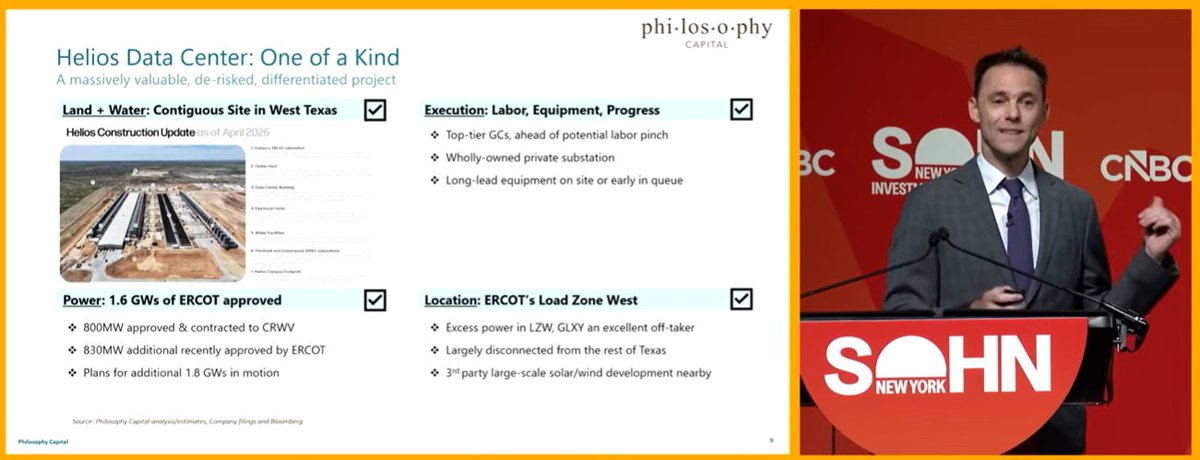
Hear me out on Helios. This is the pitch.
In fact, it's so important that a teammate and I last week flew to (Lubbock).. We (then) drove 66 miles in a northeast direction to Afton, Texas. We spent the day at the site, so what I'm about to tell you is a firsthand account from about 6 days ago. This is a special one-of-a-kind data center project, and I'm going to tell you a few reasons why.
First of all, 1,500 contiguous acres with options to expand to a few thousand. An aquifer with water underground.. It's also at a key node under a 345 kV line, the biggest they make in Texas, and 70+ GW of renewable power, and it's right underneath the line. You see it with their own privately built substation.
Then you've got execution. They just delivered the first data hall to CoreWeave on time and on budget.
And when I visited, I wanted to see is anybody there? It is a beehive. 1,300 workers. General contractors, full parking lot, security clearance, everything.
Then you've got power. They have 1.6GW of front-of-the-meter ERCOT approved power. Half of that is contracted to CoreWeave for 15 years, a billion a year to us (Galaxy). 830MW just got approved before ERCOT changed to a batch system. The company said they will announce a customer for that 830MW by the end of the year.
Finally, Load Zone West. This is key. In Load Zone West, there's something called the CREZ, go look it up. It led to a mega boom of renewable power in the region. So much so, the lines can't pull it all away. So much so that we (Galaxy) get paid for the power some of the time, it's that cheap. That is special. Go look around the country. You're not getting paid to take power."
$GLXY $CRWV