This is mostly a gimmick.
Shorter replies can save some output tokens. But Claude's responses don't cost much when you compare a 50k+ token burn on a coding task which requires model reasoning, retrieving lots of content, and writing lots of code.
Caveman mode is not worth making it harder to understand Claude's responses just to save a couple tokens. You'll end up losing the savings on time spent interpreting caveman grunts.
Better would be just ask Claude to respond consicely.
@levelsio That post is misleading. The study tested old models from 2022 like GPT-3.5 and latest one being GPT-4 Turbo.
Those models are years behind Claude Opus and GPT-5.4 which almost never make these mistakes.
Announcing a new Claude Code feature: Remote Control. It's rolling out now to Max users in research preview. Try it with /remote-control
Start local sessions from the terminal, then continue them from your phone. Take a walk, see the sun, walk your dog without losing your flow.
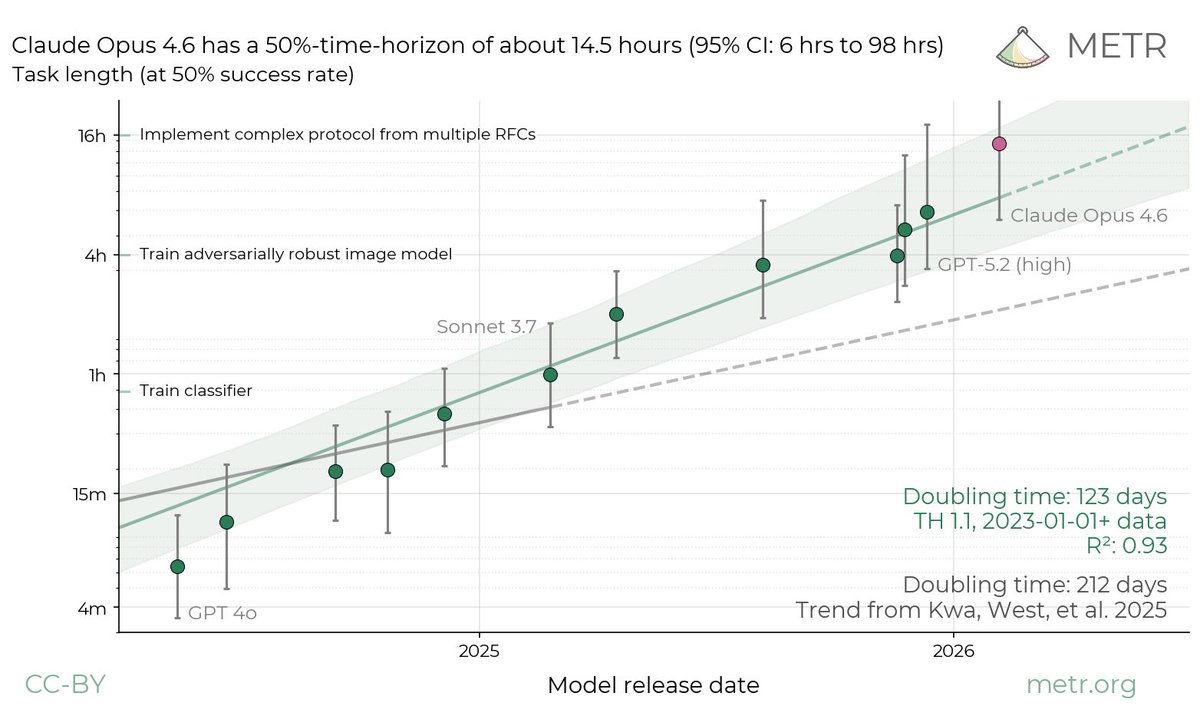
It's measuring how complex of a coding problem AI can solve fully autonomously, benchmarked in the equivalent time it would take a human.
The capability is doubling every ~4 months. In two years the best models went from solving 4-minute tasks to 14.5 hour tasks with 50% success rate. At that rate, AI will be handling week long engineering projects within a year or two.
Two years ago, AI could handle a software task that takes a human about 4 minutes. Today, it handles tasks that take an engineer about 14 hours to finish, completely on its own.
I've seen this happen in my work firsthand over the last year. AI is not a bubble about to pop. It has already fundamentally changed how software is built, and the capability is still going exponential. Software is about to get dramatically cheaper to build, especially for problems that were too niche to justify before.
We estimate that Claude Opus 4.6 has a 50%-time-horizon of around 14.5 hours (95% CI of 6 hrs to 98 hrs) on software tasks. While this is the highest point estimate we’ve reported, this measurement is extremely noisy because our current task suite is nearly saturated.
It's measuring how complex of a coding problem AI can solve fully autonomously, benchmarked in the equivalent time it would take a human.
The capability is doubling every ~4 months. In two years the best models went from solving 4-minute tasks to 14.5 hour tasks with 50% success rate. At that rate, AI will be handling week long engineering projects within a year or two.
Sober analysis as always. AI isn’t going to stop the demographic destruction of our nation. It’s not going to make low agency people suddenly have high agency. It’s not going to solve the spiritual crisis of modernity.
Most of the jobs it’s going to replace are ironically of the people building it. For the rest of us it provides a force multiplier on our talent and existing ability, which still must be learned, honed, taught, and/or gifted by God.
The hype and utopian ideals are being pushed by companies that are raising tens of billions of dollars in order to keep the money flowing. All of them are making it up as they go along. They have no real plan. They have no real understanding of how this will really impact anything. It’s all pontification and speculation with a bias to utopianism to drive more investor interest.
Many of them are now having profound existential and eschatological crisis for the first time in their lives. They are akin to spiritual infants and quickly discovering that their marvel movie star wars theology doesn’t hold up to reality.
It’s a great Gospel opportunity if anything tbh, but sadly most are too Reddit-brained to be open enough to it. We pray for God to open their eyes and ears to the Truth.
Anyway, that’s what is behind a lot of this type of talk around the subject.
AI coding tools are hitting an inflection point where they are now capable of writing most code when given a detailed specification.
What does this mean for companies? Here are my thoughts:
1. Time spent literally writing code is trending to zero and all of the hard work is actually system design and specification (this has always been the most important work anyways). A developer who can't reason about a system from first principles and gather the information needed to solve business problems is not useful. This is why we test for first-principles business thinking very heavily in @River interviews.
2. The feedback loop required to produce a detailed implementation plan and technical specification has shrunk tremendously (with the exception of product design). This means that work can now be done effectively in small squads of 2+ people (depending on the type of project) working synchronously to iterate on a very detailed implementation plan using an agent, answer any business questions that arise, and then dive into AI-first implementation of the project. I envision a near-term future where small squads of high-caliber people ship multiple substantial projects per week.
3. Your elite operators will be people with deep technical knowledge AND a deep understanding of the business they're working in. These are the people who will be able to get substantial projects done in a matter of days (or less).
4. A very strong design competency is critical for success. AI tools lack "taste". If you are working on consumer facing apps it is still paramount to invest in the best design talent you can find because for most projects, UX is the most difficult part of the project specification. In an AI-dominated world, good taste becomes the scarcest resource.
2026 is going to be a very interesting year. At @River we have a "day zero" mindset to everything we do, meaning that we always re-evaluate the best way to do things from first principles. I have a feeling the way we build is going to substantially change in the next 12 months, allowing us to deliver more value to our clients without compromising on quality, security, or service.
This has been said a thousand times before, but allow me to add my own voice: the era of humans writing code is over. Disturbing for those of us who identify as SWEs, but no less true. That's not to say SWEs don't have work to do, but writing syntax directly is not it.
Each day that goes by, I’m becoming more impressed with Charlie Kirk‘s consistency. It might be a long time before another figure is able to love those he disagrees with as much as Charlie did. I’ve heard people go out of their way to mention that he wasn’t perfect, but bro had one of the highest batting averages for such a public figure in so many hostile situations.