I’m pleased to share our new paper, “Hippocampal ripple diversity organizes neuronal reactivation dynamics in the offline brain”, out in @NeuroCellPress!
With @_vitorLdS and David Dupret at @MRCBNDU, we show that diversity in ripple current profiles shapes reactivation dynamics
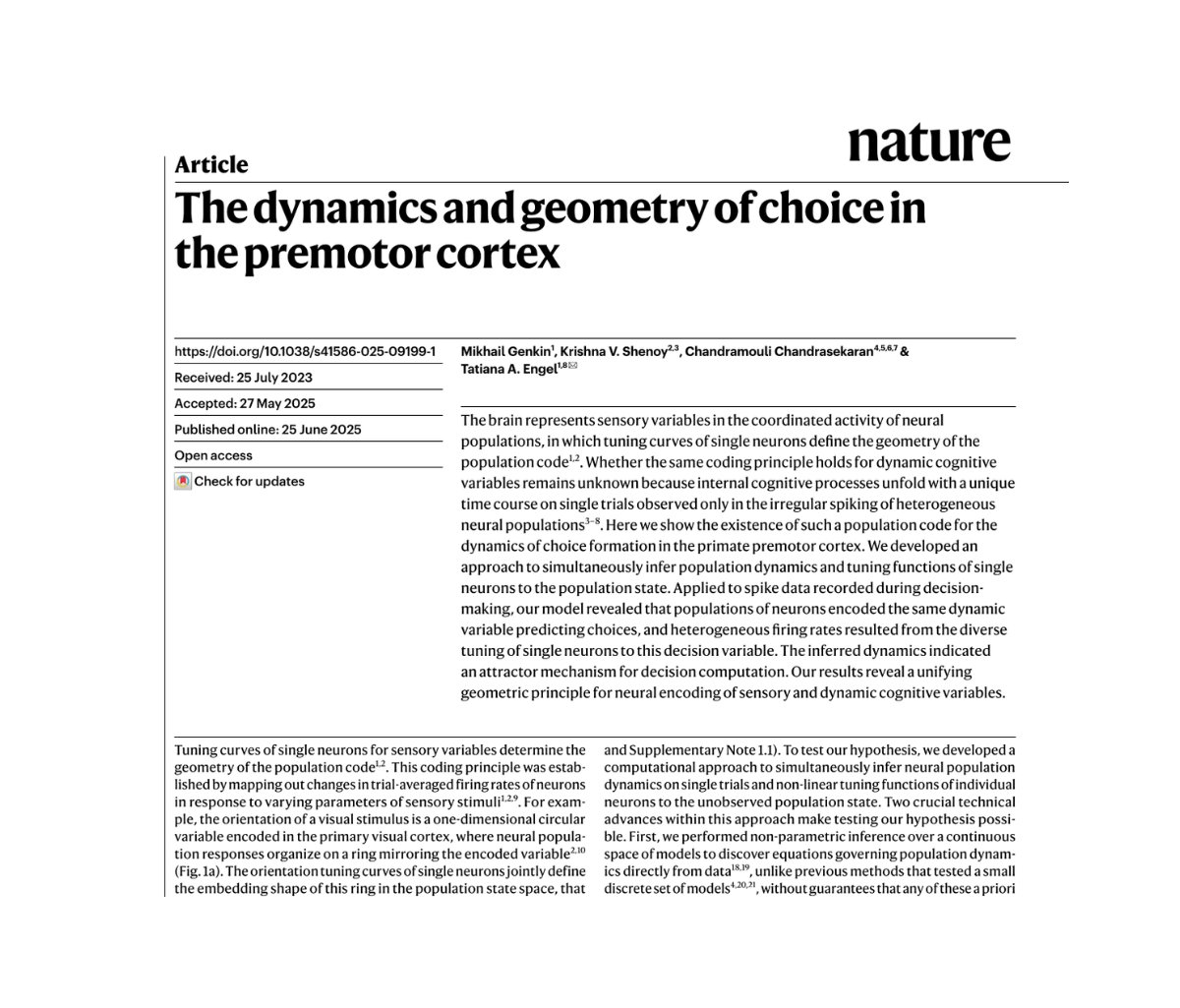
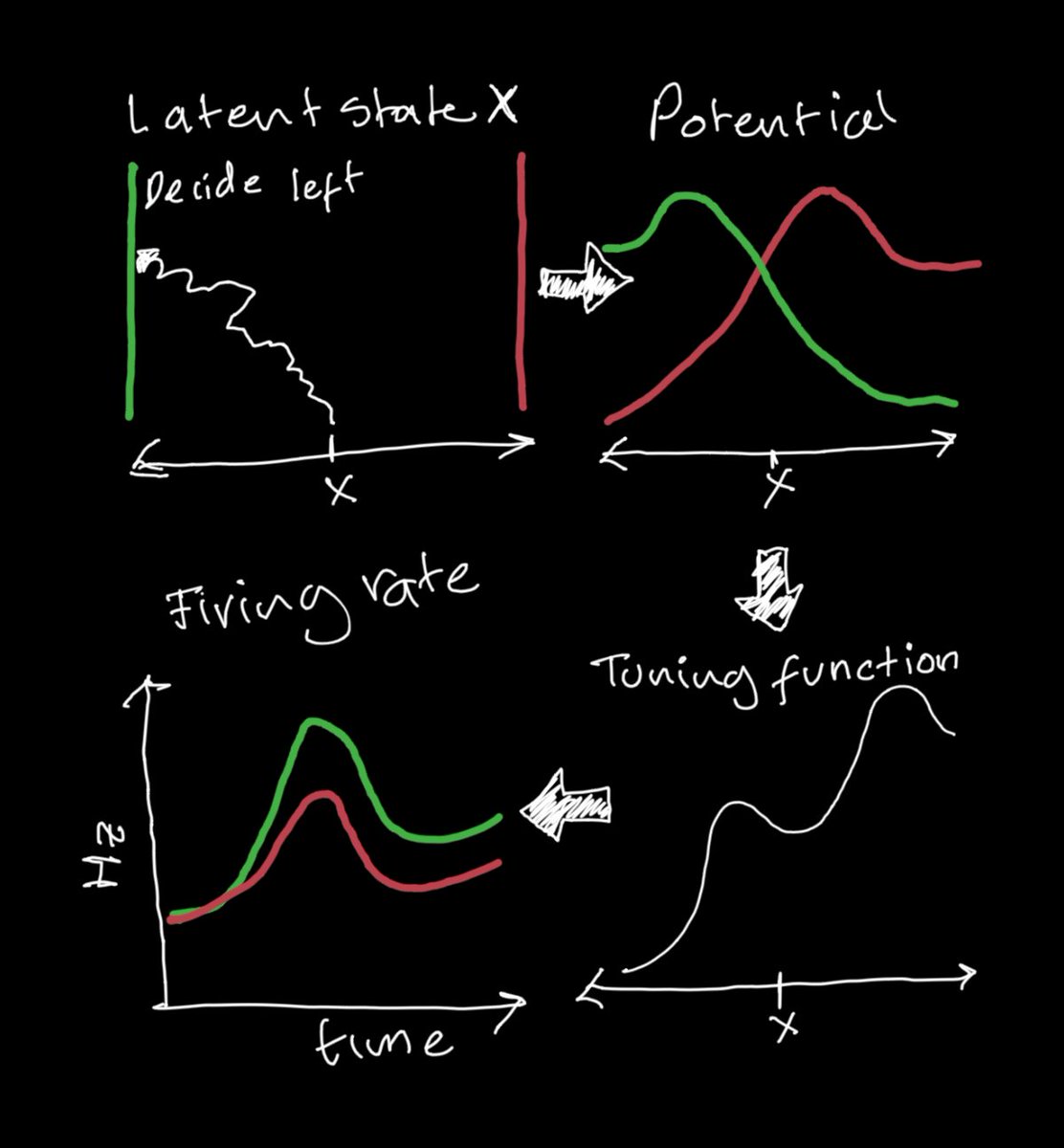
This paper may solve a core neuroscience question of the last decades: What is the cortical code?
Cognitive cortex also uses tuning, and latent variable span a non-linear manifold.
Unlocking this work requires understanding why PSTHs are bad.
Here is my toy model and notes:
Happy to announce our new paper just out:
https://t.co/KHk1e6Jnbg
We show how CRH in the thalamic reticular nucleus modulates NREM sleep helping to understand how stress impacts sleep
Congrats to Loredana Cumpana and team in work led by Simone Astori
@Brainmind_EPFL@EPFL_en
High-speed voltage imaging of action potentials in molecular layer interneurons reveals sensory-driven synchrony that augments movement: https://t.co/iDt6r9IS6J
Voltage imaging of fast-spiking interneurons in the cerebellum with 1-photon imaging at 2-4 kHz.
MIT's "Street Fighting Mathematics"
This course teaches the art of guessing results and solving problems without doing a proof or an exact calculation.
readings: https://t.co/n8o2YlsqXo…
(audio generated by NotebookLM)
In a new Science study in mice, researchers report a group of neurons in the thalamus that increases its activity during sleep deprivation and promotes sleep recovery and depth.
The findings suggest that these neurons are responsible for promoting sleep homeostasis.
📄: https://t.co/bma5HuQCPJ
#SciencePerspective: https://t.co/DsGDmjeMLp
January 1992 in Prague Jan Bureš told me about place cells, and turned me into a scientist. This Perspective reminds us that such neurons don’t respond to stimuli. Network discharge (and knowledge) is internally-organized but interdependent on the world https://t.co/ejJ7XvqbDX
OUT NOW in @EJNeuroscience
The Cortical Structural Model Extends to Thalamocortical Connections
Helen Barbas & Basilis Zikopoulos of Boston University
@BU_Tweets@b_zikopoulos@FENSorg @WileyNeuro
https://t.co/NrayHbPT3f
MIT researchers call this "cognitive debt" - like technical debt, but for your brain.
Every shortcut you take with AI creates interest payments in lost thinking ability.
And just like financial debt, the bill comes due eventually.
But there's good news...
How does the cerebellum orchestrate our movements? A cool new study by Liu and colleagues just published in Nature Biomedical Engineering, uncovers the cerebellum's pivotal role in precisely coordinating our movements. It does this by encoding motor frequencies w/ remarkable consistency across individuals.
Key Points:
- The cerebellum encodes dynamic motor frequencies w/ high numerical precision, ensuring smooth and coordinated movements.
- Despite individual brain differences, a frequency encoding mechanism is consistent across different subjects, highlighting a possible universal neural signal.
- The cerebellum shapes motor kinematics.
- They used electrophysiology and optogenetics in mice.
- The authors showed that deep cerebellar neurons encoded frequencies using "populational tuning of neuronal firing probabilities, creating cerebellar oscillations and motions with matched frequencies."
- The authors then showed the 'frequency-coding function' of the human cerebellum.
- They used EEG + alternating current stimulation during voluntary tapping tasks.
- The authors believe that their identified cerebellar algorithm for motor kinematics could be a "mathematical foundation for a brain–computer interface for motor control."
- Understanding this mechanism could open avenues for designing advanced brain–computer interfaces that could one day replicate natural movement patterns.
My take: Here are 5 resonant points I took home from this work, and from recent advances on our understanding human movement. 1- Think beyond balance; the cerebellum is crucial for timing and for coordination of our movements. 2- Uniform encoding across individuals suggests a possible shared neural blueprint for movement. Can we use this to develop a universal therapeutic approach? 3- I hope this work and the corpus or work(s) that are evolving will enhance treatments for movement disorders by targeting the cerebellum's frequency encoding capabilities. 4- Can we use this work to develop prosthetics w/ more natural and precise control? 5- How does this mechanism interact w/ other brain regions? Efficient neurorehabilitation may depend on it!
https://t.co/pNuths5GUQ
#Neuroscience #Cerebellum #MovementDisorders #BrainResearch #Neuroprosthetics @ParkinsonDotOrg@FixelInstitute@RaynorProject
Neuron
Topography of putative bi-directional interaction between hippocampal sharp-wave ripples and neocortical slow oscillations
https://t.co/dFIAXAChuS
Biologists, stop putting UMAP plots in your papers!
UMAP is a powerful tool for exploratory data analysis, but without a clear understanding of how it works, it can easily lead to confusion and misinterpretation.
Link to @simplystats blogpost below.
New trend for this year?
#Absolute_Neurophysiology
This year, I'll post classic neurophysiology stories you might not have ever heard of, but probably inform a lot about how we think about 2020s neuro...
We start with the coolest patch clamp figure, maybe ever...
🌟 Cai Lab @Nature paper alert! In new work led by @mysteriousjoe_, we find that rest periods after learning not only stabilize new memories BUT ALSO integrate new memories with older ones from days past! (1/9)
Read it here: https://t.co/Ur8dbGfuP3
Google Scholar has 76 hits for "counterfeit brain organizations", a garbled synonym for "artificial neural networks" https://t.co/MCUfalOEsf These tortured phrases are a sure sign of fake papers. One of them has 31 citations. We may have a problem....
Dorso-ventral hippocampal neural assemblies are preferentially reactivated during NREM sleep following an aversive experience https://t.co/IawGBVpTbv #biorxiv_neursci