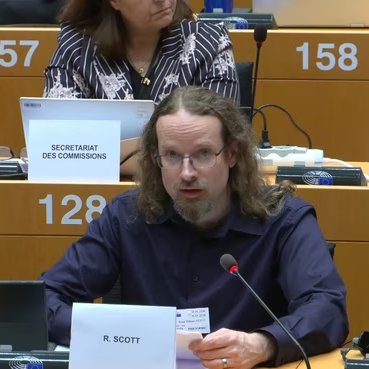
🚨 California's State Assembly approved a Stop Killing Games bill targeting games that need a server connection to play. Before shutting those servers down, developers would have to give 60 days' notice, then either release a patch that makes the game playable offline or refund players. Only applies to games released after Jan 1, 2027. The Senate still has to approve it.
Stop Killing Games is an international consumer campaign (started in 2024 by YouTuber Ross Scott) pushing to stop publishers from making purchased games unplayable. It's pursued an EU Citizens' Initiative and backs related bills like California's AB 1921.
Let me trace the timeline here because nobody's connecting it.
Step 1: Scrape the entire internet. Every book, every article, every conversation, every piece of art, every forum post. Do it without asking. Do it without paying.
Step 2: Train a model on all of it. Call it "artificial intelligence."
Step 3: Go to BlackRock's Infrastructure Summit and announce: "We see a future where intelligence is a utility, like electricity or water, and people buy it from us on a meter."
Step 3 is where you sell people's own knowledge back to them. On a meter.
They took the collective output of human thought, compressed it into a model, and now they want to charge you by the token to access a version of what you and everyone you know already created.
One Reddit user put it perfectly: "They stole all this data from us, the people, our life's work, creativity, art, by devouring the internet and blowing through all copyright laws. Now they want to sell it back to us in the form of a utility."
Imagine if someone photocopied every book in the public library, burned the library down, and then opened a subscription service for the copies.
That's the metered intelligence business model.
And they're pitching it to infrastructure investors as though they invented water.
If you see a helicopter towing one of these over your neighborhood, bad news: your town is getting a data center. They’re running airborne electromagnetic surveys to map groundwater in the area.
TRANSLATION: figuring out how much water they can divert before people notice.
‼️🇺🇸 Utah is about to become the first US state to legally target VPN use as part of online age verification. The law goes into effect Wednesday, May 6, 2026.
🔴 If you are physically located in Utah, you count as a Utah user, regardless of whether you use a VPN, proxy, or any other tool to disguise your location. Websites are now legally responsible for age-verifying you anyway.
🔴 Sites that handle "material harmful to minors" are banned from sharing instructions on how to use a VPN, or from offering any means to bypass geofencing.
The EFF calls this a "liability trap." Websites cannot reliably tell where a VPN user actually is, so the safest legal move is either to block every known VPN IP outright, or to force ID-based age verification on every visitor worldwide. Either path subjects millions of users to invasive identity checks, regardless of where they actually live.
The Cato Institute put it bluntly. When a policy can be defeated by a privacy tool millions of people legitimately use, the policy is the problem.
The collateral damage is, as always, the people who actually need VPNs:
🔴 Journalists protecting sources
🔴 Domestic abuse survivors hiding from stalkers
🔴 Activists in hostile environments
🔴 Remote workers tunneling into corporate networks
🔴 Travelers banking from abroad
🔴 Anyone who simply does not want their ISP, employer, or data brokers reading their traffic
This is not staying in Utah. The UK's Children's Commissioner has called VPNs a "loophole that needs closing." France's Minister Delegate for AI and Digital Affairs has named VPNs as "the next topic on my list."
The EU is rolling out age verification across all 27 member states by end of 2026, with EVP Henna Virkkunen openly admitting they have no plan for VPN bypass yet.
Utah is leading by example.
EFF: "Attacks on VPNs are, at their core, attacks on the tools that enable digital privacy."
A new national law has been introduced to require all Operating Systems to have mandatory Age Verification.
House Resolution 8250 : “To require operating system providers to verify the age of any user of an operating system, and for other purposes.”
The Federal bill was introduced by
Rep. Josh Gottheimer, Democrat from New Jersey. And is co-sponsored by Elise M. Stefanik,
Republican from New York.
The full text of the bill has not yet been made publicly available (but is expected shortly).
https://t.co/prqh6Y2bmc
@AriSchulman There’s a 0% chance they didn’t know where these were coming from or where the control signals were originating from. If you flip on a transmitter in the US, SIGINT stations are seeing you immediately. Esp near a military base 🙄
@Hellen__TK I was pleasantly surprised how much fun it is to play. Lmk what you think whenever you get a chance to watch some gameplay vids or play it yourself.
Legislators: “fork over your ID to protect kids or you can’t use the internet.”
Hackers: “we’ll take it from here.”
1 billion records. 203 million Americans. The age-verification mandate is the vulnerability.