For 16 years I didn’t attend church, yet God never left me. I shared my first travel plans openly. Thousands of people, here and not here, want me to fail. Some wished for my last breath. Still, I wake up every day like a newborn baby. I’ve survived a 27-hour coma. I come from a place where jealousy is part of many people’s everyday routine, but I walk with a clean heart and do good whenever I can. Year after year, I keep climbing higher. I can tell you what I will do next year or next month, and there is nothing you can do about it. I never blame anyone but myself. My God is greater than anything seen or unseen. My hustle has stamina, my spirit is unbreakable. Whether you like it or not, I will keep progressing every single day 🙌🏽
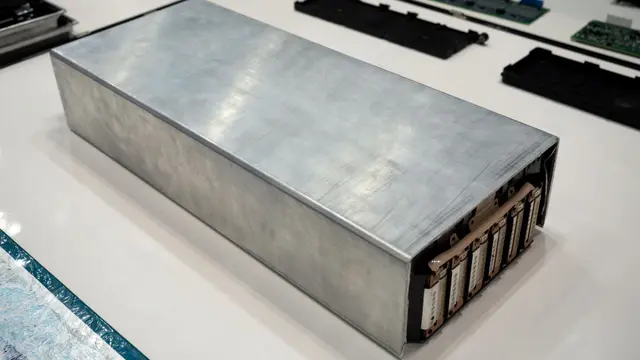
China’s record-breaking EV supercapacitor retains 81% power after 10,000 cycles | Tejasri Gururaj, Interesting Engineering
Supercapacitors are essential components of an electrical system, finding applications in regenerative braking systems in vehicles, power supplies, and electronic devices.
These devices, also called ultracapacitors or electric double-layer capacitors, work as energy storage devices. While batteries store electrical energy via chemical reactions, capacitors use ion (charged particle) separation to store the energy.
Supercapacitors are essentially advanced capacitors that use a liquid electrolyte containing ions and high-surface-area electrodes to achieve much higher energy storage capacity than traditional capacitors,
Supercapacitors that use an aqueous (water-based) electrolyte face several practical challenges, even though they are safer and more environmentally friendly.
A team of researchers from China has developed a hybrid electrolyte design to address the limitations associated with conventional aqueous supercapacitors.
The challenges
Supercapacitors function as extremely rapid rechargeable batteries, achieving full charge in seconds instead of hours. Compared to standard batteries, supercapacitors are engineered for instantaneous energy release instead of long-duration power storage.
Supercapacitors are made up of two electrodes, an electrolyte (usually ionized water), and a separator.
Electrolyte ions, under the influence of an external voltage, move toward electrodes with opposite charges, consequently forming double charge layers.
As more voltage is applied to the circuit, more charge, and hence, energy is held in the supercapacitor.
The issue arises due to water breaking down into ions at very low voltages, this restricts the energy storage capacity. Furthermore, at extreme temperatures, water either freezes or evaporates, hindering the device’s performance.
These challenges prevent the practical use of supercapacitors, leading the researchers to look for a solution.
Hybrid electrolyte
The researchers carried out extensive tests to create a hybrid electrolyte combining three components, also known as a ternary (three-component) electrolyte.
The electrolyte consisted of water, an ionic liquid called EMIMNTf₂ (which remains liquid at room temperature), and a potassium salt called potassium trifluoromethanesulfonate (KOTf).
In normal conditions, the ionic liquid doesn’t mix well with water, but the addition of the potassium salt helps the mixing process.
Through solubility tests, the researchers discovered that the electrolyte components reorganize how water molecules arrange themselves around the potassium ions.
This new arrangement prevents the water molecules from participating in the unwanted breakdown reactions that typically happen at higher voltages. Since the number of free water molecules is reduced, limiting harmful reactions, the supercapacitor is capable of handling significantly higher voltages.
Further, this composition makes the electrolyte stable at extreme temperatures, unlike water, which becomes non-functional.
Excellent performance
The researchers found that their new electrolyte could function for voltages up to 3.37 Volts, which is nearly three times better than aqueous supercapacitors. Additionally, the device operated reliably from 32°F to 212°F (0 to 100°C).
Not only was the supercapacitor reliable, but at high temperatures of around 140°F (60°C), it retained 81.8% capacity after 10,000 charge cycles, indicating stability in holding electrical energy.
Read more:
https://t.co/7ycdtaTUd0