Fed's Williams says 2027 will be a year of lower inflation
• Rates likely higher "over time"
• Recent rise in inflation driven by unusual factors
• Economy resilient in the face of many large challenges
• Made progress getting inflation down
ClickHouse expands its @awscloud strategic collaboration with a $1.5B+, five-year agreement to scale our unified enterprise AI data stack.
Our customer count on AWS has quadrupled since our first agreement in December 2024.
Learn more: https://t.co/3sjsUrPm7b @AWS_Partners
Over the past couple weeks we've met with management teams across memory, optics, neoclouds, semis, semi cap equipment and substrates.
Everyone is frustrated and confused about their stock prices but everyone is still very, very bullish.
Everyone expects 2027 capex to be significantly higher than 2026 and they expect 2028 capex to be moderately to significantly higher than 2027.
Everyone knows the YoY capex growth rates will decelerate but the total dollars spent will continue to get bigger... at least for the next few years. Everyone says we're still in the early innings of ai adoption.
Every company in the ai ecosystem is 50-100% sold out for 2027 and 40-80% sold out for 2028.
Everyone is sitting on LTAs from the hyperscalers... some of those LTAs are getting signed and they last anywhere from 3 years to 6+ years... and they're getting done at record prices and record margins. Customers can't take the chance of not having enough supply to meet their needs over the next 3-5 years... locking up supply at record prices is better than not having enough supply when it's needed the most.
Some of these LTAs could consume more than 50% of their supply over the next 2-3 years and at least one company has an LTA that would consume 75% of their capacity over the next 2-3 years.
Neoclouds continue to see demand that is 5-10x higher than capacity. Many of them are saying the financing concerns are overblown. They're seeing 3-5 year deals get signed at 10-20% higher prices that the first half of 2026 and they think deals signed in the first half of 2027 will have 10-20% higher prices than deals signed in the second half of 2026. Power is still a big bottleneck and many sites are dealing with small construction delays but nothing is getting canceled. Customers are desperate for compute. Many of the neoclouds are trying to reserve 10-15% of capacity for shorter term deals and spot market because rates are 2-3x higher than the 3-5 year deals.
Memory companies say demand will outstrip supply until 2029 at the earliest. They are very confident LTAs won't get cancelled because even at record prices for memory, the customers have enough margin to make it work.
I know there's lots of fear and uncertainty in the market right now but it's not showing up in the demand... it remains stronger than ever... many backlogs are growing faster than current revenues.
In 20+ years of investing, I've honestly never seen this much dislocation between fundamentals and valuations. This is truly a historic time to be an investor and not in a good way. It's very hard to be patient and lean into your conviction/thesis during times like this but that's probably the right strategy for most long-term investors.
Hopefully the lows are near. Make sure you are getting sleep, sunlight and exercise. Protect your mental health if possible.
I'm hearing from my friends at OpenAI that the vibes ARE DOWN. Like almost depressed. This might be the worst week in the company's history type bad.
Tuesday was supposed to be their big day. They launched GPT-6.2 and at the same time dozens of early testers dropped the worst reviews imaginable. Theo's review got more views than the launch post. This went even worse than the GPT-5 launch.
Then Google chose violence and dropped the opposite of a GPT model with Neon. It's conversational, understands intent, very good at coding/3D and brought them back to the top. A lot of people say they already passed OpenAI. And the worst thing: Nano 🍌 Pro 2 is currently in the arena and the outputs are stunning. So Google basically overtook OpenAI in a single week.
For months OpenAI tried to pretend to be the best lab by bullying mathematicians and burning massive amounts of compute on Navier-Stokes (and countless other math problems). Now Anthropic mogged them by solving the Riemann Hypothesis and makes OpenAI look like an undergrad while they are doing 250k-page alien math.
The last funding round was a disaster too. They wanted $30B at $1.5T. They got $15B at $1.25T. They lost $10.9B last quarter, so this money only lasts them ~4 months. They are basically cooked and the valuation will likely drop further.
OpenAI isn't the best at anything anymore. They might genuinely be done.
BREAKING: President Trump calls on Jensen Huang to "make an apology and go back" to Nvidia, $NVDA, as CEO.
Trump also says he discussed the situation with China's President Xi.
Nvidia would reinstate Jensen as CEO "if they were smart," Trump says.
CITI WARNS U.S. INTEREST RATES ARE UNSUSTAINABLY HIGH, SEES FED CUTS IN 2027
Citigroup warns that financial markets are signaling that current U.S. interest rates are "unsustainably high", as falling equity valuations and risks to AI investment threaten economic growth.
The bank argues the Federal Reserve is unlikely to aggressively raise rates into a stock-market selloff, despite persistent inflation concerns.
Citi's rate outlook:
🔸 December 2026: 25-basis-point hike expected.
🔸 Early 2027: Fed holds rates steady.
🔸 Later in 2027: Rate cuts begin.
Citi believes tightening financial conditions, weaker AI investment and easing energy prices could eventually outweigh inflation risks, pushing the Fed toward a more dovish stance.
I believe the @nvidia board is not acting in the best interest of shareholders nor in a manner consistent with their fiduciary duties.
What we know is that the board fired Jensen or forced his resignation for violating company policy and/or in response to the accusation of an affair with a spy.
They did so without careful consideration of the impact on the company, its customers, its shareholders or other stakeholders.
They rushed to judgment without the benefit of careful due diligence or even with a basic understanding of the facts.
How do we know this?
We know this by how quickly Jensen was fired and how little was known at the time of his firing.
It takes time to convene a board meeting. There was time, maybe, for one Zoom.
And this is a decision that should have been made by a board sitting in person and carefully deliberating the facts once they are known.
And they should have slept on the decision and met again the day after to discuss the facts, the risks and the other implications of their decision.
The timing and lack of information did not allow for careful board deliberation.
While boards can fire a CEO for an inappropriate relationship with a subordinate, it should not be an automatic decision. That is why we have boards comprised of humans and not agents.
A board should consider whether or not such a relationship was consensual or whether it was an abuse of power dynamics. And a board has to consider what the impact of the firing is on all stakeholders.
If I were in this board, I would not have rushed to judgment based on articles in the media. I would have made sure the board had all of the facts so it could make a careful and informed decision.
Boards of Delaware companies have a duty of care which means they must make informed, prudent and good faith decisions. This clearly did not happen here.
What law firm is advising this board?
Or is the board even taken good legal advice?
It doesn’t look like it.
And now the board is compounding its failures by insisting that there is no possibility for Jensen’s return as CEO.
Why is it in the best interest of the company to foreclose the possibility of Jensen’s return and to do so before all of the facts are known? This is yet another breach of their duty of care.
Furthermore, the board has launched an investigation whose scope is unknown. Investigations can be extremely damaging to a company and should be carefully targeted to address whatever facts need to be known rather than be overly broad in scope.
In short, this looks like a series of major governance failures by directors that panicked due to headlines in the media. They likely felt compelled to do something because they were afraid of looking bad in the media, not because it was the right thing for them company.
They couldn’t stand the heat.
The board’s conduct here is shocking for a company of this scale and importance to our country and the world at large, particularly at this moment in history.
The articles backtracked from their original incendiary, and now clearly false, claims to something more like "Jensen did lawful things that powerful people didn't like". It still appears the original claims came from a single competing Big Tech lobbyist.
The reporting successfully disrupted corporate governance processes, with a running cost of $1.8 trillion in losses to American pension funds and shareholders.
Here's what I fear is being lost in these articles: The proper interface between government and private citizens and their corporations is rule of law. Laws are passed, and if wrongdoing as alleged, then there's due process: an investigation followed by facts and evidence presented in open court. Due process should happen here: let the facts come out whole, and not as a trickle of dubious claims.
Press takedowns full of sketchily sourced claims and backtracking narratives are not the way. It's what we see outside of the free world, and is no model for The United States of America.
In particular, if the Jensen takedown succeeds on the basis of these journalistic failings, which is not by any means certain as Sam Altman's case shows, then it foreshadows an economically and institutionally ruinous new playbook to be adopted with no end in sight.
Imagine a weekly stream of takedowns emerging from opportunistic alignments between corporate lobbyists and political interests which, given the new partisan split between the executive and legislative branches, will attack in all directions, undermining not only the US economy but American leadership in the world.
I hope cooler heads prevail this coming week as they did not on Thursday November 12. And I urge anyone who happened to oppose Jensen, open models, and the underlying trade policies in question, to recognize that this isn't a win for "team regulation". It's a change in the game from a transparent rules-based one to a sinister new form centered around politicans and lobbyists.
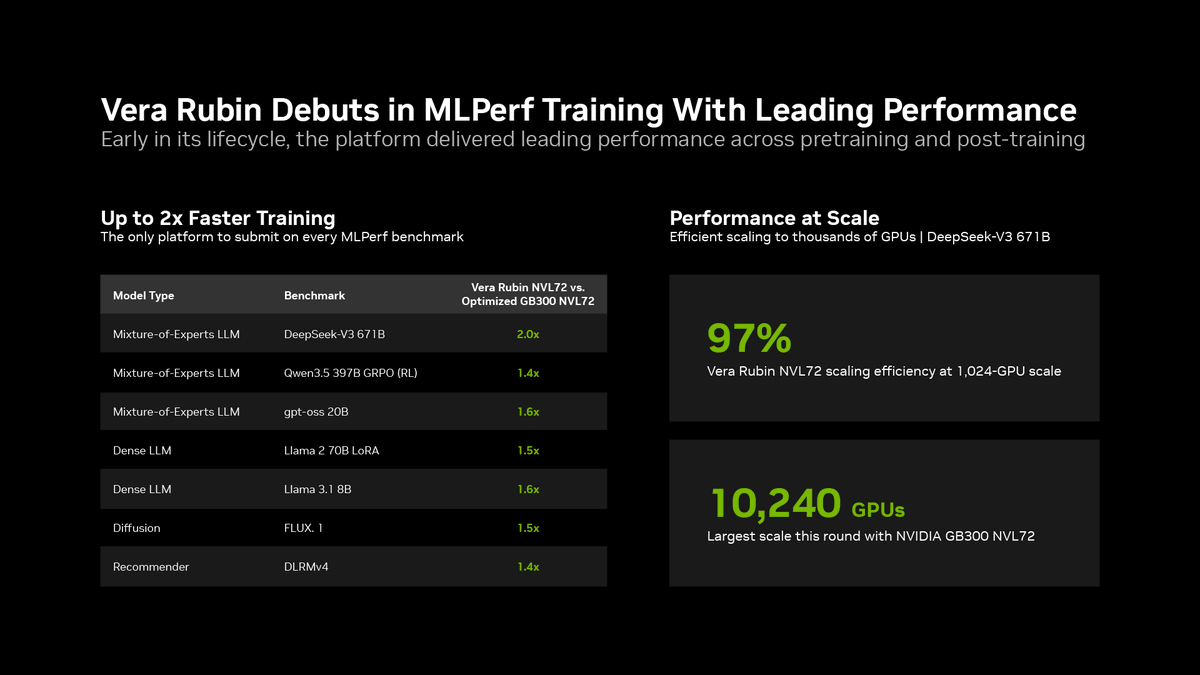
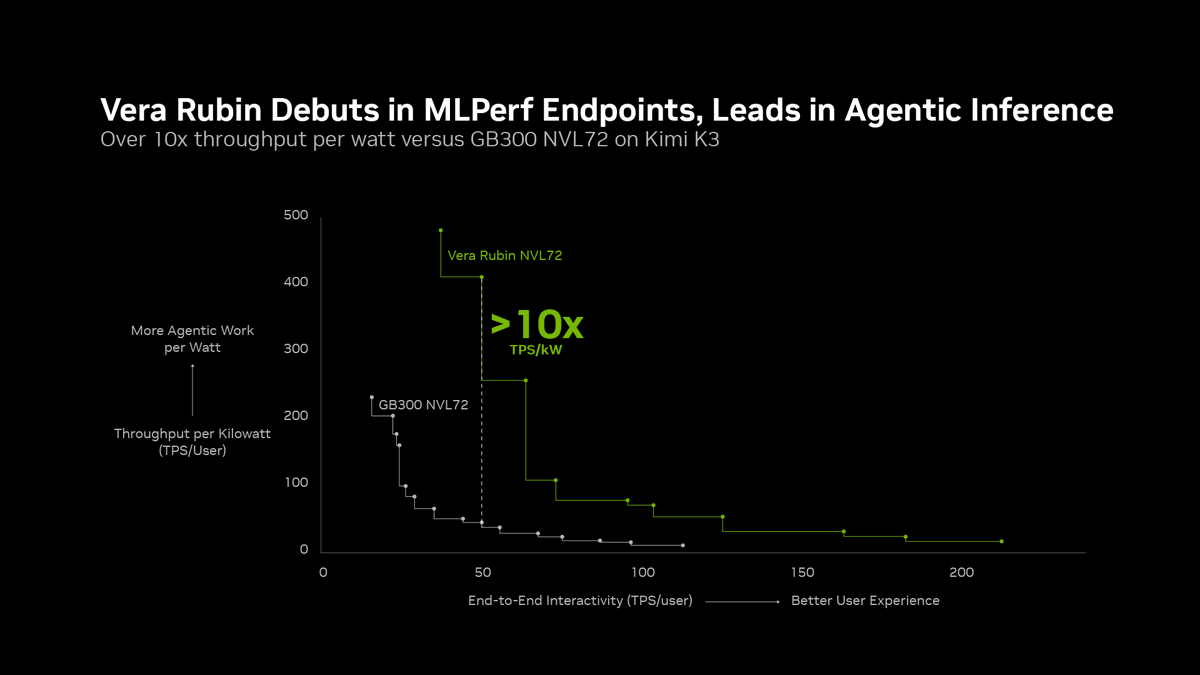
Nvidia released Vera Rubin's first MLPerf benchmark results:
> $NVDA led all 7 AI training benchmarks
> Up to 2x faster AI training per GPU vs. GB300
> Over 10x more agentic AI throughput/watt on Kimi K3
>
> 4x GPUs delivered nearly 4x faster training on DeepSeek-V3, scaling from 256 to 1,024 GPUs with 97% efficiency.
*Provisional
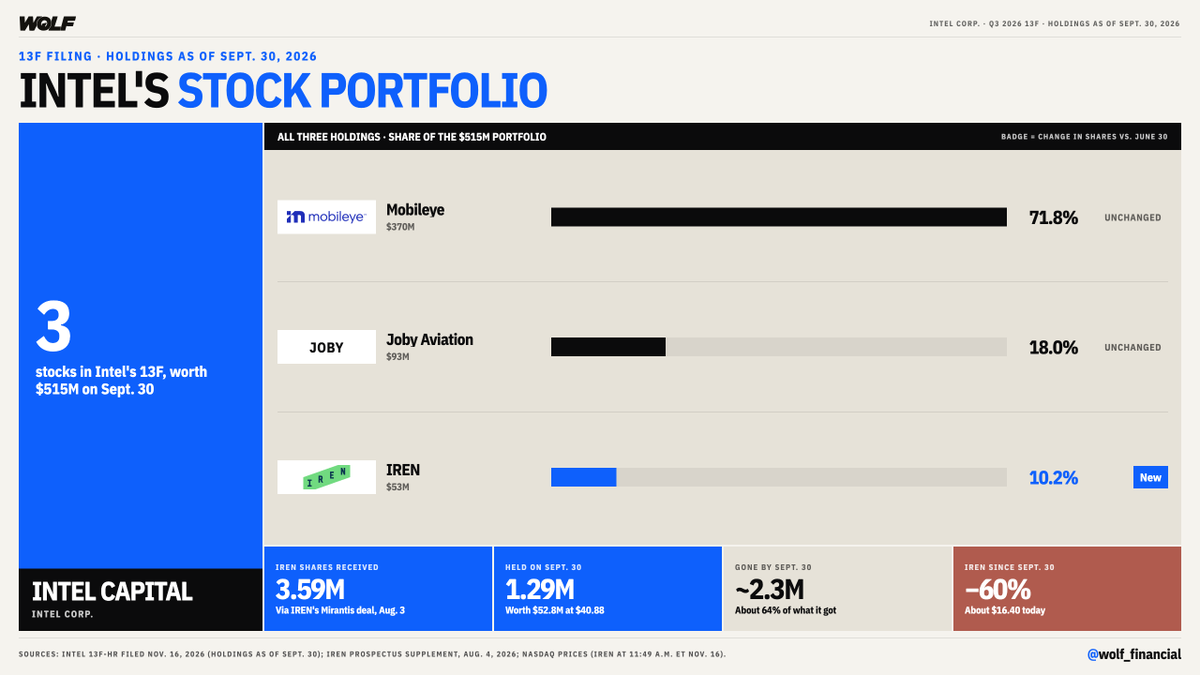
Intel reported 1.29 million shares of $IREN, worth about $53 million on Sept. 30, in its latest 13F. It did not buy them on the market.
Intel's venture arm, Intel Capital, was an investor in Mirantis, a cloud software company that IREN bought in August, and received 3.59 million IREN shares in that deal, according to an IREN filing. By the end of September it held about 2.3 million fewer.
IREN, which began as a bitcoin miner and now sells AI cloud computing, has since fallen about 60% from its Sept. 30 price, to around $16.40.
Intel's 13F lists only three stocks: 50 million Class A shares of Mobileye worth $370 million, 15.3 million shares of Joby Aviation worth $93 million, and IREN.