🚨 🇨🇳🇰🇵 DID WANG HUNING BRING A DEAD KIM JONG UN BACK TO LIFE?
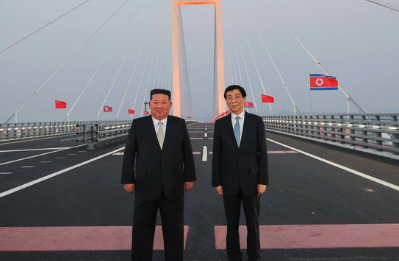
• On October 24, Chinese state media released footage showing Kim Jong Un walking alongside Wang Huning, China's fourth-highest-ranking official, on the Yalu River Bridge
• In the image on the left, the Chinese and North Korean flags are fully extended horizontally by strong winds
• This indicates that powerful winds were blowing across the bridge during filming
• However, in the image on the right, the female interpreters from China and North Korea appear to have almost perfectly undisturbed hair, despite standing on an exposed bridge without any visible wind barriers
FLAGS WHIPPING IN STRONG WINDS — YET THE HAIR BARELY MOVES
These unusual details have raised suspicions that the footage may have been AI-generated or digitally manipulated
The video was released amid growing rumors surrounding Kim Jong Un's health and possible death
Rather than putting these rumors to rest, the footage released by China has raised further questions about its authenticity
🇺🇸 TRUMP'S SUDDEN CHANGE IN RESPONSE
• October 13: President Trump said "I may" when asked about the possibility of meeting Kim Jong Un
• October 19: When asked whether he would meet Kim during the November APEC summit in China, Trump replied, "I don't know"
• Trump also said he was unsure whether anyone was requesting a meeting, while emphasizing that his relationship with Kim Jong Un remained very good
• October 24: China released footage showing Wang Huning and Kim Jong Un together on the Yalu River Bridge
TRUMP'S CHANGING RESPONSE AND CHINA'S QUESTIONABLE FOOTAGE
These events unfolded within just a few days of each other
The growing number of suspicious developments is intensifying speculation that Kim Jong Un may be facing a serious health crisis — or may already have died
If a trilateral summit between the United States, China, and Russia takes place in November, Xi Jinping will find himself in a position where he must make major concessions
🚨 🇰🇷 SOUTH KOREA'S CRYPTO TAX DELAY — A MASSIVE CATALYST FOR THE GLOBAL ALTCOIN MARKET!
A major shift is underway in South Korea, potentially comparable in significance to China reopening its cryptocurrency market
• South Korea's ruling and opposition parties are moving to postpone cryptocurrency taxation from 2027 to 2029
• The government is also reviewing whether to proceed with the scheduled implementation
• If the tax delay is approved, it could become a major bullish catalyst not only for South Korea but for the entire global altcoin market
🇰🇷 SOUTH KOREA IS THE WORLD'S SECOND-LARGEST FIAT-TO-CRYPTO TRADING MARKET AFTER THE US DOLLAR
• Korean won trading accounts for approximately 30% of global spot cryptocurrency trading volume
• The Korean won ranks second only to the US dollar among fiat currencies used in cryptocurrency trading
• A staggering 85% of South Korea's cryptocurrency trading volume comes from altcoins
• Korean investors play a major role in trading $XRP, other major altcoins, and smaller cryptocurrencies
South Korea is one of the most important sources of liquidity in the global altcoin market
🚨 A CRYPTO TAX DELAY COULD BE A MASSIVE BULLISH CATALYST FOR ALTCOINS
• Implementing crypto taxation could discourage new capital from entering South Korea's cryptocurrency market
• Weakening domestic exchange competitiveness could accelerate capital migration to overseas exchanges
• A decline in Korean investment capital could reduce buying demand and liquidity across the altcoin market
• Conversely, postponing taxation could ease the burden on investors and encourage fresh capital inflows
This could reactivate investment capital from one of the world's most influential altcoin trading markets
🇺🇸 US INSTITUTIONAL CAPITAL + SOUTH KOREAN RETAIL INVESTMENT
The United States is integrating cryptocurrencies into the regulated financial system
South Korea is the world's second-largest fiat-to-crypto trading market, with altcoins accounting for 85% of its domestic cryptocurrency trading volume
If American institutional capital and South Korean retail investment begin flowing into cryptocurrencies simultaneously, global market liquidity could change dramatically
Just as China fully reopening its cryptocurrency market would be considered an enormous bullish catalyst, South Korea's crypto tax delay and broader market liberalization could represent a development of comparable significance
Global financial powers have every reason to recognize the importance of South Korea — one of the beating hearts of the global altcoin market
One of the key developments to watch is how Trump and the United States could influence the opening of South Korea's cryptocurrency market
🚨 ARE PERSONAL WALLETS DANGEROUS? STUDY FINANCIAL HISTORY FIRST
• Those who claim that personal wallets are dangerous need to study the history of economics and finance more carefully
• 🇺🇸 In 1933, the US government restricted private gold ownership and ordered citizens to surrender their gold to designated financial institutions
• 🇯🇵 In 1946, the Japanese government froze citizens' bank deposits, restricted withdrawals, and subsequently imposed heavy taxes on personal wealth
• These historical experiences contributed to a lasting preference for cash and distrust of financial institutions among parts of Japanese society
• 🇱🇧 LEBANON — THE BANKING CRISIS
USD Withdrawal Request → Withdrawals Blocked → Forced Conversion to Local Currency → Further Withdrawal Restrictions → Currency Collapse → Savings Wiped Out
Pay close attention to the direction governments around the world are moving
Financial surveillance and the tracking of money flows are becoming increasingly sophisticated
Personal wallets are not merely tools for storing cryptocurrencies
They are an essential means of maintaining direct control over your own wealth
Does the security risk associated with personal wallets really make it safer to entrust all your assets to banks and centralized exchanges?
Study financial history
If you have a better alternative to personal wallets, feel free to choose it
But there is absolutely no reason to surrender the right to control your own wealth
🚨 🇨🇳 CHINA'S VISION FOR NORTH KOREA — A FOUR-NATION PARTITION SCENARIO
What would happen if the North Korean regime collapsed or lost control?
This map illustrates a hypothetical division of North Korea into Chinese, Russian, and American spheres of influence, along with a jointly administered zone
🔴 🇨🇳 CHINA — NORTHERN AND WESTERN NORTH KOREA
• South Hamgyong Province
• North Pyongan Province
• Chagang Province
• Ryanggang Province
🇨🇳 China would seek to secure North Korea's northern territories along its border, maintain a strategic buffer zone, and prevent US military influence from expanding toward China's northeastern frontier
🟡 🇷🇺 RUSSIA — NORTHEASTERN NORTH KOREA
• North Hamgyong Province
🇷🇺 Russia would seek to secure access to the East Sea (Sea of Japan), establish transportation and logistics corridors, and maintain its strategic influence over Northeast Asian trade and the Russian Far East
🔵 🇺🇸 UNITED STATES — EASTERN NORTH KOREA
• Kangwon Province
🇺🇸 Under this scenario, the United States would establish influence over North Korea's eastern coastline, securing a strategically important position for its military presence in Northeast Asia
🟢 🇺🇸🇨🇳🇷🇺🇰🇷 FOUR-NATION JOINT ADMINISTRATION — PYONGYANG AND WESTERN TERRITORIES
• Pyongyang
• South Pyongan Province
• South Hwanghae Province
• North Hwanghae Province
🇺🇸🇨🇳🇷🇺🇰🇷 This scenario envisions the United States, China, Russia, and South Korea jointly administering North Korea's political center, including Pyongyang
🚨 🇨🇳 WHY CAN CHINA NEVER AFFORD TO LOSE NORTH KOREA?
🇨🇳 China's greatest strategic concern is the possibility of North Korea moving entirely into the American sphere of influence
🇰🇵 North Korea serves as a strategic buffer between China and the US military presence in South Korea
🇺🇸 Losing this buffer would fundamentally reshape the military balance of power in Northeast Asia
The future of North Korea is not simply a matter concerning the Korean Peninsula
• 🇨🇳 China's national security and northeastern border
• 🇷🇺 Russia's strategic interests in the Far East
• 🇺🇸 America's military influence in Northeast Asia
• 🇰🇷 South Korea's national security and Korean reunification
• 🌍 Emerging Arctic shipping routes and the global logistics order
All of these issues are directly connected to North Korea's future
🇰🇵 WHOEVER SHAPES THE FUTURE OF NORTH KOREA WILL HELP DETERMINE THE NEXT GEOPOLITICAL ORDER IN NORTHEAST ASIA
🚨 🇸🇬🇲🇾🇹🇭 ASIA IS REWIRING ITS MONEY — 111 MILLION PEOPLE
• Three Southeast Asian central banks are moving cross-border settlement onto stablecoins
• Partners: Ripple, Visa and Mastercard, with Circle, Coinbase, JPMorgan and Stripe joining
Japan, Korea, and now Southeast Asia.
The payment rails of Asia are being connected one by one.
Whoever sits at the center of these rails wins the next financial order. $XRP
🚨 THE BIGGEST FOOLS ARE THOSE WHO WAIT FOR OFFICIAL ANNOUNCEMENTS
One of the most foolish things anyone can say is, “Where is the official announcement?”
Such people fundamentally fail to understand how Communist governments operate.
By the time an official announcement is made, everything is already over. There is nothing left to gain.
History has shown this repeatedly.
During South Korea's IMF financial crisis, senior government officials and those with advance knowledge of the country's impending collapse accumulated gold and US dollars, making enormous profits.
The general public receives the final conclusion only after everything has already happened.
By then, no opportunities remain.
The biggest fools in this world are those who sit around waiting for an “official announcement.”
Those who recognize the signals act first. Those who wait for confirmation arrive last.
🚨 THE BIGGEST PROBLEM WITH THE GENERAL PUBLIC — IGNORING THE SIGNALS
The biggest problem with the general public is that they completely ignore the signals in front of them.
When concerns about Xi Jinping’s health repeatedly surfaced, people dismissed them.
The same thing happened with Kim Jong Un.
Even when reports about his health problems emerged, and he reportedly underwent surgery before reappearing in public, people repeatedly convinced themselves that the rumors must have been false.
They assume that because someone reappears in public, everything reported previously must have been nothing more than a rumor.
Now, in Xi Jinping’s case, reports that he collapsed in India have circulated. There have also been claims that he requested a five-hour rest period during his meeting with Donald Trump.
These developments are connected to the internal power struggle surrounding Xi Jinping and the question of who will become China's next leader.
Yet the general public keeps reacting in exactly the same way.
“Isn't this just another rumor?”
“It's probably nothing.”
They continue to ignore the signals.
This is where the real difference between the truly wealthy and the general public begins.
Small signals accumulate over time.
One signal becomes two. Two become ten. Eventually, those signals reveal a much larger picture.
By the time the general public finally recognizes what is happening, it is already too late.
And the fact that some people are still saying, “Nobody has died, so nothing is happening,” only demonstrates how completely disconnected they are from the reality of the situation.
They have absolutely no understanding of the signals, the shifting balance of power, or what is unfolding behind the scenes.
The wealthy recognize the signals before the world reacts.
The general public waits until everything becomes obvious.
By then, the opportunity has already passed.
자국을 부끄러워하는 국민이 문제. 남을 헐뜯기전에 본인부터 자긍심을 갖는다면 좋을텐데요. 할로윈이 우리나라것이 아닌디 왜들 그리 좋아하게 교육이 안된건지요 ㅡㅡ.명절과 제사의 깊은 뜻의 이념을 다음 세대에게 물려 줬더라면 좀 나았을까요? 내나라가 부강해야 한다는 것을 깊이 새겼으면 합니다.
🚨 🇨🇳 CHINA'S INFILTRATION OPERATIONS — THE UNITED STATES, SOUTH KOREA, AND NORTH KOREA
China's influence operations go far beyond what most people can imagine.
• China has used money, political influence, and honey traps to target American politicians, powerful figures, university professors, and individuals possessing advanced technologies
• Prestigious institutions, including Harvard University, have faced cases involving Chinese influence, recruitment efforts, and undisclosed financial relationships
• China uses academic seminars, invitations to visit China, research funding, and personal relationships to cultivate influential individuals
• Once these individuals become financially or personally compromised, they can become instruments of Beijing's political interests
---
🇰🇷 SOUTH KOREA VS. NORTH KOREA
South Korea has become deeply vulnerable to Chinese political, economic, and institutional influence.
North Korea, however, has historically treated Chinese interference as a direct threat to its internal power structure.
Kim Jong Un viewed his uncle by marriage, Jang Song Thaek, as a powerful figure with extensive connections to China.
Jang was executed in December 2013 during a major political purge.
His removal also demonstrated Kim Jong Un's determination to prevent any rival power network from threatening his leadership.
North Korea has sought to protect its regime from excessive Chinese interference, even while remaining economically dependent on Beijing.
This is one of the fundamental differences between North and South Korea today.
China does not need to conquer a country militarily when it can influence the people who control its politics, institutions, technology, and economy.