$MOUNT: The Economic Layer around @mount_ai
Launching on Robinhood Chain.
Mount is building security and insurance infrastructure for companies deploying AI agents in production. Its native token will launch on Robinhood Chain and add an onchain economic layer around that business, tied to real usage, real customers and real revenue rather than artificial emissions.
Companies will still be able to use Mount through traditional payment methods. Using the token, however, can unlock preferential pricing on eligible services, giving customers a practical reason to participate in the ecosystem without making crypto mandatory for enterprise adoption.
The second pillar is revenue. The proposed model allocates 35% of Mount revenue to open-market token purchases. A significant portion of the tokens acquired through this mechanism can then be burned. The logic is simple: more customers generate more revenue, more revenue creates more buybacks, and those buybacks can progressively reduce circulating supply.
This only becomes meaningful if the underlying Mount business generates real revenue. The token does not replace the business. It depends on it.
The third pillar is Mount Network, a distribution layer around Mount and its customers. Mount can publish opportunities for partners, founders, consultants or community members to bring qualified companies into the ecosystem. Rewards are not tied to simple leads or spam, but to measurable business outcomes such as verified revenue generated from a successful introduction.
The same infrastructure can also be used by Mount customers. A company could publish an opportunity asking the network to introduce a qualified enterprise customer. If that introduction turns into real business, the referrer receives a reward. This allows the network to keep generating activity even when Mount itself is not running acquisition campaigns.
Companies contributing meaningful activity can also receive ecosystem benefits such as service credits, lower platform fees, token rewards or preferential access to certain Mount services. The objective is to reward economic contribution rather than passive participation.
The referral model remains strictly single-level. If Person A brings Company B, A may receive a reward for that specific business. If Company B later brings Company C, B receives the reward and A receives nothing. There are no downlines, recruitment commissions or multi-level incentives.
Rewards should not rely on unlimited issuance. At launch, incentives can come from a predefined Ecosystem / Growth allocation within a fixed supply. As Mount grows, tokens acquired through buybacks can progressively help support the reward economy, reducing dependence on the initial allocation over time.
The full loop is straightforward. More companies deploy AI agents, more companies need Mount, Mount generates more revenue, 35% of that revenue is allocated to token purchases, and part of those tokens can be burned.
At the same time, more customers create more opportunities inside Mount Network, more introductions generate more business, and more activity flows through the ecosystem.
The core idea is simple: Mount secures the agent economy, Mount Network helps distribute it, and the token powers the economic layer between both.
The world is moving toward autonomous agents. As they become part of our work, finances and everyday lives, security and insurance will become necessities, not options. The more autonomy we give agents, the more we’ll need infrastructure to secure them when things go right and protect us when things go wrong.
As AI agents gain autonomy and direct access to systems, data and accounts, purpose-built insurance will become necessary infrastructure. Traditional policies leave major gaps on autonomous errors, unauthorized actions and liability. The market is early today, with specialized coverage just emerging, but real deployments are already driving demand for it to scale safely.
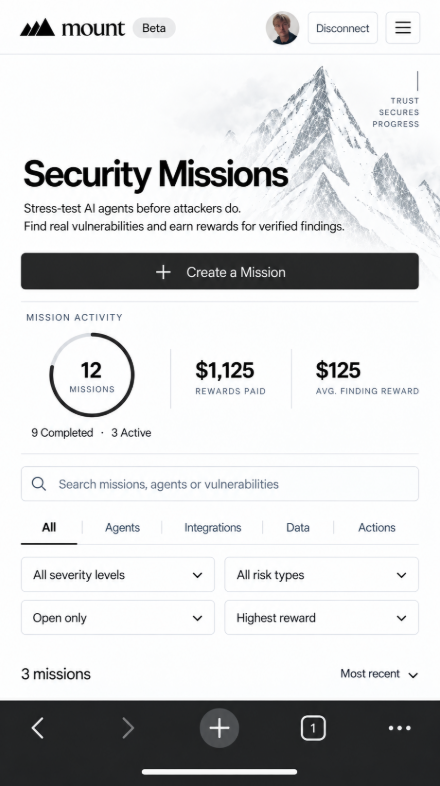
Security for AI agents needs to move beyond static audits and passive monitoring. @mount_ai is building Security Missions to let companies put real agents, integrations and workflows through targeted testing, with verified findings strengthening Mount’s security and risk intelligence.
Right now, access is limited to companies already working with us and selected partners. At launch, it will open to everyone: companies will be able to publish specific security tasks, and researchers will be able to complete them and earn rewards for verified findings.
The goal is to create a continuous security layer around AI agents before failures become real incidents.
If your company is interested in joining the beta, book a call here:
https://t.co/74BwaBh2fe
Security for AI agents needs to move beyond static audits and passive monitoring. @mount_ai is building Security Missions to let companies put real agents, integrations and workflows through targeted testing, with verified findings strengthening Mount’s security and risk intelligence.
Right now, access is limited to companies already working with us and selected partners. At launch, it will open to everyone: companies will be able to publish specific security tasks, and researchers will be able to complete them and earn rewards for verified findings.
The goal is to create a continuous security layer around AI agents before failures become real incidents.
If your company is interested in joining the beta, book a call here:
https://t.co/74BwaBh2fe
NetNet is a good example of how quickly onchain financial infrastructure can evolve. The protocol is already moving beyond simply accumulating reserves, exploring RWAs, tokenized equities, games and different ways to generate activity and revenue around its treasury. All of this is being built on Robinhood Chain, an ecosystem that is itself working to bring traditional finance, tokenized assets and crypto closer together.
That’s where things become particularly interesting. Robinhood is already moving toward a more agentic financial system, where AI agents could gradually gain access to the same financial tools humans use. This isn’t about claiming that NetNet uses AI agents today, but about looking at what this convergence could mean tomorrow. As applications built on Robinhood Chain become more autonomous, agents will likely begin interacting with wallets, smart contracts, tokenized assets and financial strategies.
Once an agent can act on real capital, a mistake is no longer just a bad AI output. A misconfigured permission, manipulation, compromised integration or wrong decision can directly become a transaction, and therefore a real financial loss.
That’s precisely the shift we’re watching at Mount. Onchain finance can evolve and attract capital extremely quickly. If agents begin gaining autonomy within that infrastructure, their security cannot be added as an afterthought. We need to understand what they can do, restrict what they shouldn’t be able to do and insure the risk that remains.
Agentic finance could evolve even faster. Security and risk infrastructure will have to evolve at the same pace.
We aren’t just looking for vulnerabilities.
We turn agent behavior, permissions, integrations and failure modes into structured risk intelligence.
That intelligence helps companies understand what should be fixed, what can be deployed safely and what risk can actually be underwritten.
The scan is only the input.
The real product is intelligence about agent risk.
We backed @mount_ai because AI agents are moving into production faster than the infrastructure around them can keep up.
Once agents can access sensitive data, internal systems, customer accounts or money, failures stop being theoretical.
Mount is building the security and insurance layer for that transition, helping companies identify agent risk, reduce exposure and insure what remains.
As AI agents take on more responsibility, trust infrastructure becomes a necessity, not a feature.
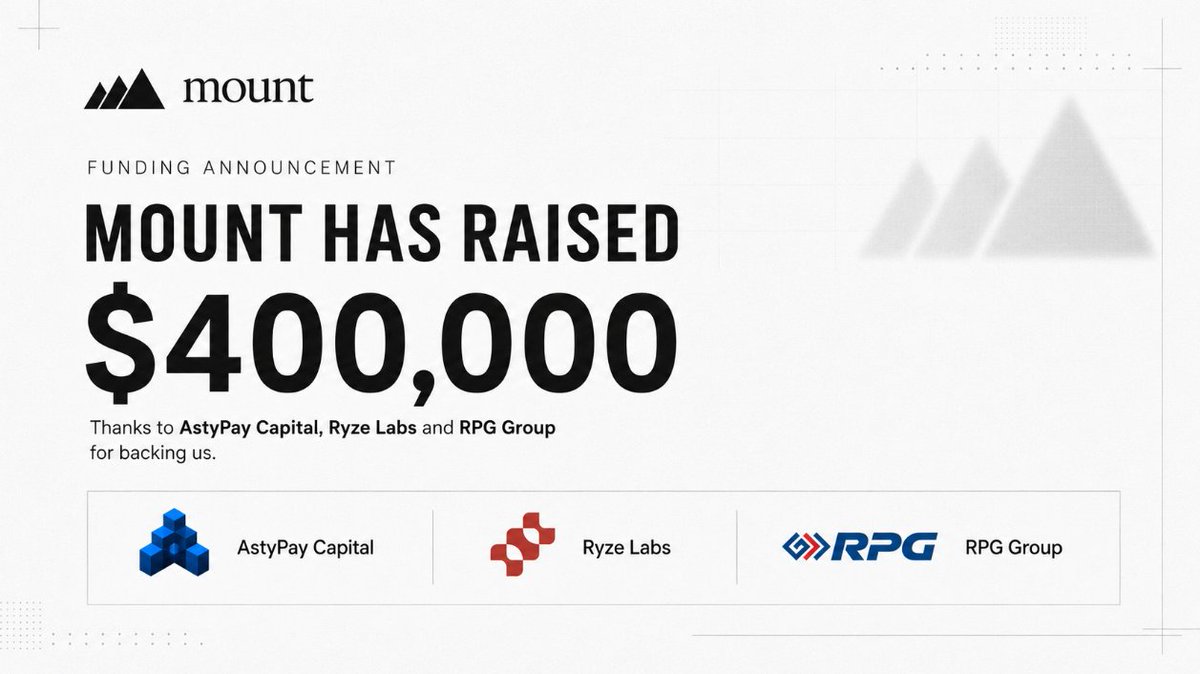
Mount has raised $400K.
Thanks to AstyPay Capital, Ryze Labs and RPG Group for backing us.
AI agents are moving beyond software and into the real economy, but the moment they hold funds, transact or act autonomously, trust becomes infrastructure.
1/ WHAT WE TEST
The attack surface of a deployed AI agent.
Prompt injection, excessive permissions, data exposure, unauthorized actions, weak oversight and tool dependency risk.
Here’s what that actually means
Robinhood Chain: two months in.
🔷Total DEX volume: $34.6B
🔷Protocol TVL: $1.27B
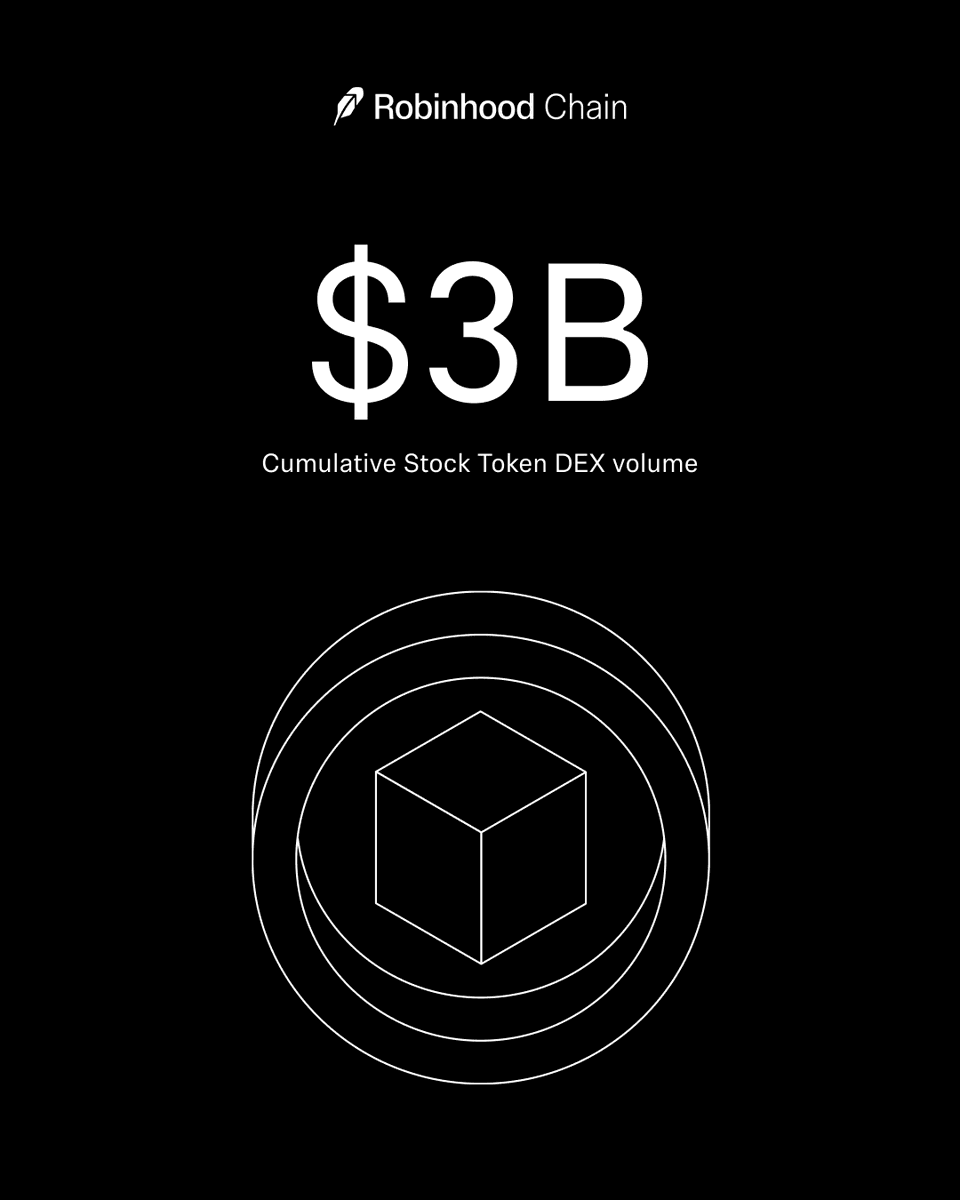
🔷190+ Stock Tokens live, with $3B+ in cumulative DEX volume
🔷Total transactions: 576M
🔷Total addresses: 12.3M
🔷Perps trading on Lighter: $7.29B in total volume
Gratitude to every user and builder behind the numbers.
Onward.
Robinhood Stock Tokens reached $3B in DEX volume in just 63 days.
A new kind of market is taking shape onchain.
Thanks to the community building alongside us.
At @mount_ai ,
we’re building for the long term.
https://t.co/2aYIQiZ08G
Understanding how the world’s most consequential companies went from an idea to massive scale helps shape how we think about building Mount.
Fair comparison. The key difference is that Mount isn’t just liability coverage. We continuously assess deployed agents, surface vulnerabilities, help reduce the risk, certify the agent, and then insure the residual exposure. Security + underwriting + insurance in one stack.
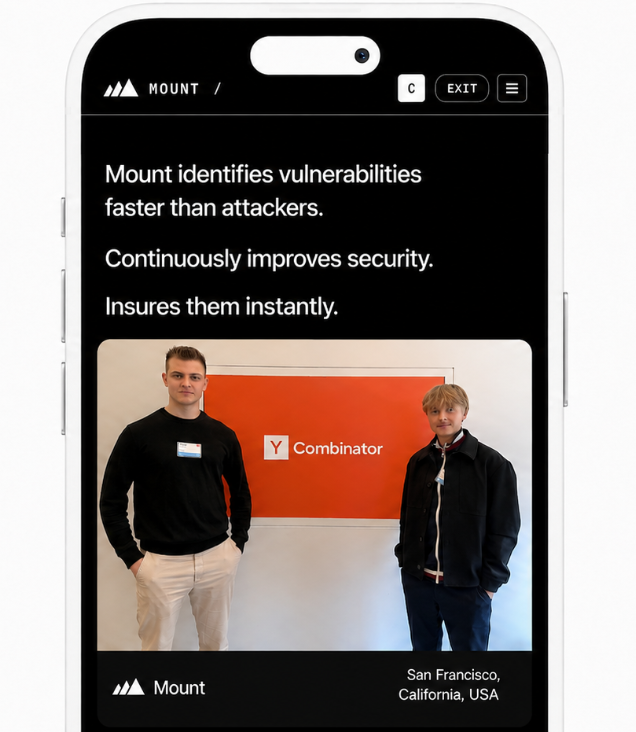
Mount (https://t.co/ish0S3PMQi) and Klaimee (https://t.co/NXPeMdhe94), both from YC Spring 2026.
Mount is an AI agent insurance carrier that covers prompt injection attacks, unauthorized actions, data leaks and workflow errors via red-teaming plus liability policies.
Klaimee provides liability coverage for AI agents (including prompt injection and manipulation) that traditional cyber and E&O policies exclude.