Something’s coming to #MozFest. And you don’t even need a plane ticket to participate.
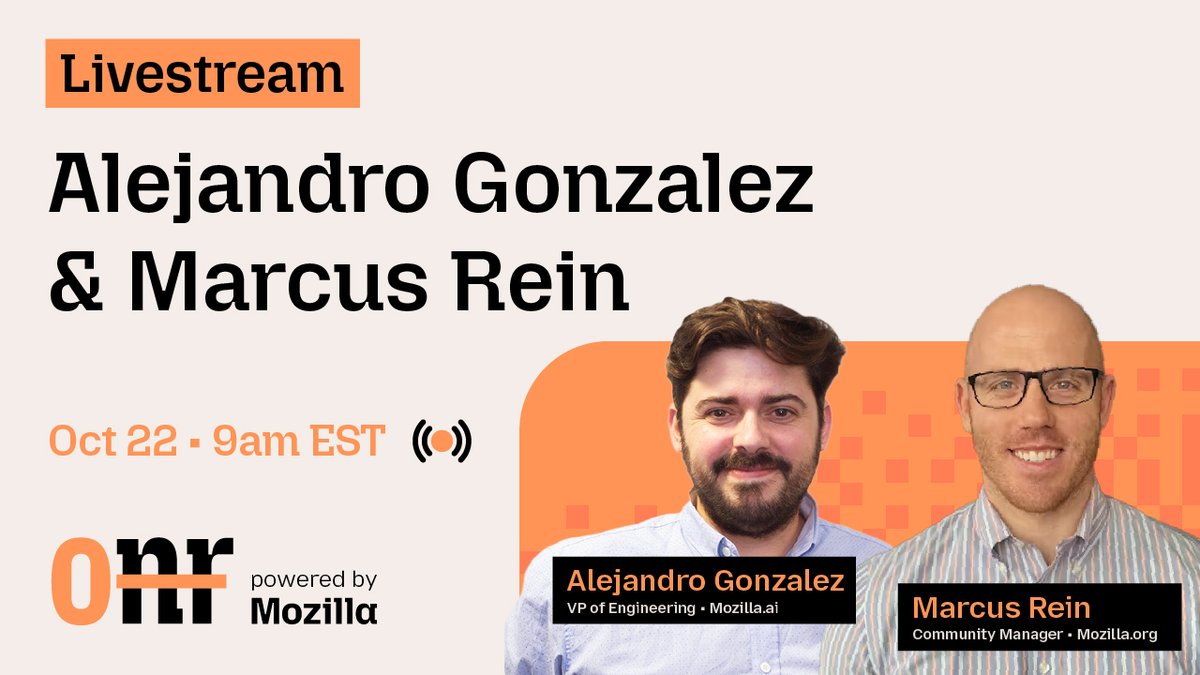
Introducing MozFest's Developers Wilding Online Hackathon! Full details will be announced during the next ONR livestream Thursday, October 22 at 9am ET with @Marcus_Rein_ and Alejandro Gonzalez from @MozillaAI.
Join us: https://t.co/f0OJcZOzXt
Open source models are rapidly narrowing the gap between closed ones and the concerns are real. At the same time, people are building ethical, human-first efforts. It all comes down to how AI is built, audited and used.
This is just one of the conversations from the latest Owners Not Renters livestream featuring Alejandro Gonzalez and Thomas Bille, and Brian Mbuba. Watch the replay and stay tuned for more information about our next live show.
open models are free to download and you can take them anywhere. so the meter moved to the things you can’t take with you when you leave: the cache, your memory, and the gateway.
when one company owns the router and the payment rail, it knows exactly how much it would cost you to leave. run a router you control. route on cost. keep a second model warm. https://t.co/GYwnW3TEsC
Funding and revenue matter for AI companies but trust might be the asset that decides the next steps for AI deployment.
Mozilla along with 70 organizations across 15 countries is supporting the launch of the Trustworthy AI Map. The goal is to build infrastructure for AI you can actually trust.
Learn more about the Trustworthy AI Map.👇 https://t.co/ES1Oj2VhAY
Verbosity is trainable. In one post-training pass, DeepSeek’s V4-Flash-0731 cut output tokens 12% and gained 10 index points. The 28M tokens it dropped weren’t buying the score.
Whether K3’s verbosity costs you depends on the comparator. On a median-verbosity workload at list rates: Fable 5 $3,150, K3 $1,950, Opus 5 $1,575. On measured cost per index task, K3 is cheapest of the three: $0.86 vs $2.03 for Opus 5 and $3.15 for Fable 5.
Full breakdown in our State of Open Source AI report. https://t.co/MtrpRf57kT
Per-token price is the wrong way to compare AI models for agentic work.
Kimi K3 lists at $15 per million output tokens. On the Artificial Analysis Index it spends 130M output tokens against a 63M median, so on the same suite at the same list rate it bills like $31/M.
The problem with ranking by per-token price is that it hides a 2x spread in what a task actually costs.
thank you to everyone who joined me and @mkrigsman on @cxotalk last week. the conversation was insighful. the questions were sharp.
watch the replay here: https://t.co/9MH1EIzrDE
Everyone’s asking how fast to adopt AI. We’re asking who gets to own it.
On Nov. 4, Mark Surman is joining @ftlive’s Future of AI Summit in London to make the case for open, accountable AI.
Join in person or online: https://t.co/ucHDFYFPVi
#FTFutureofAI
capability gains in AI no longer require a new model.
the model and the harness still matter, but real results happen when working on an open base.
in july, DeepSeek ran a post-training pass that lifted V4-Flash 21 points on Terminal Bench and 10 on the AA index.
same model. same architecture. same size.
https://t.co/C1JfJSyY83
Have you ever wondered what it takes to build your own AI stack?
On the next Owners not Renters livestream, @MozillaAI's Alejandro Gonzalez and Thomas Bille, plus Brian Mbuba who will breakdown exactly what you need.
Tues, October 13 at 11 am ET
We’ll be live here. Want to ask a question? Bring your questions to the chat: https://t.co/5CtBEE2Ofp
an agent can prove who it is. no one can say what it’s allowed to do.
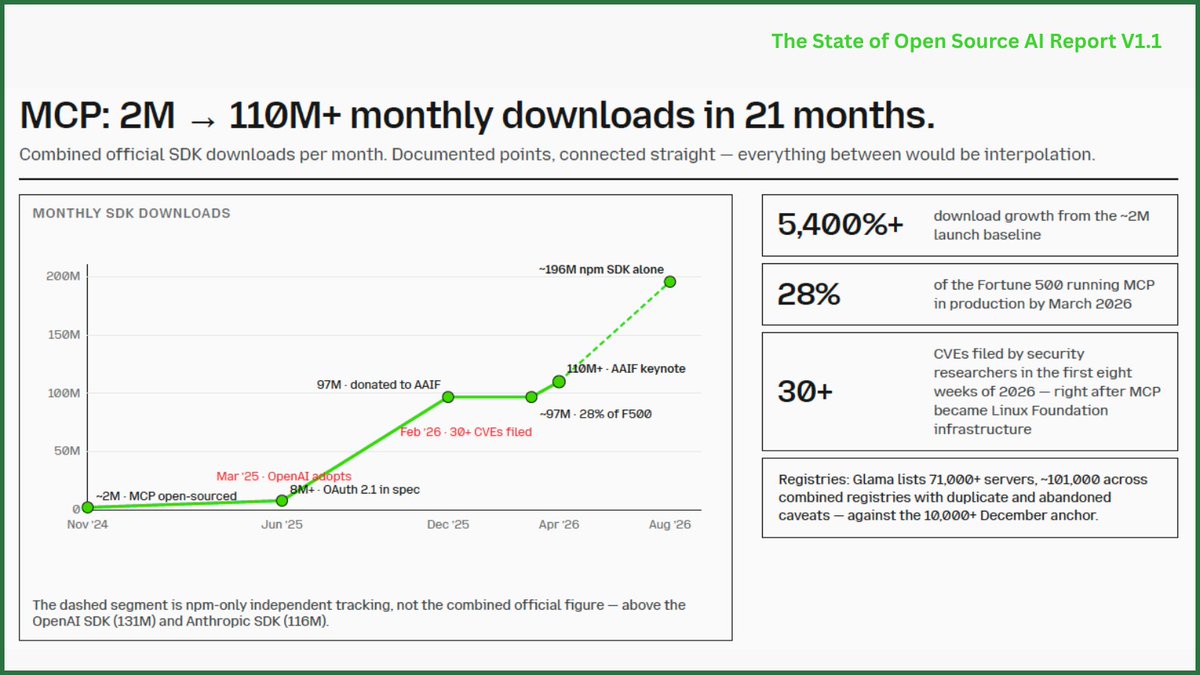
MCP went from ~2M to 110M+ monthly SDK downloads in 21 months. meanwhile ~21% of companies say their agent governance is mature. https://t.co/TLtPi9ZPOZ
Thank you to everyone who joined last week’s Owners Not Renters livestream. We had some great questions and even greater conversations. 👏
Shoutout to the #Mozfest team for coming out. Mozilla Festival returns this year, October 28- 30 in Barcelona, and for the first time it has a track built specifically for developers. Hope to see you there!
Learn more: https://t.co/XwPhYv4U2B
Who owns your AI stack– you, or the vendor that you rent it from?
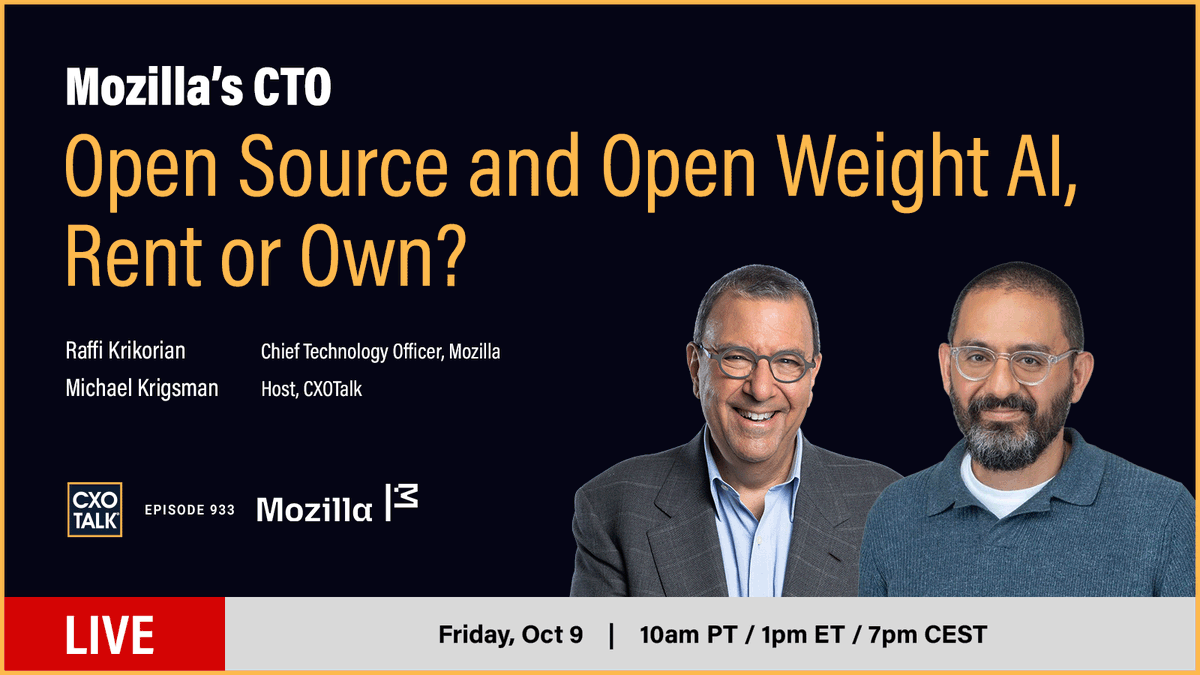
Mozilla CTO @raffi Krikorian will be a guest on @cxotalk with @mkrigsman on October 9 at 1pm EST / 10 am PST. He’ll discuss the difference between open source and open weights as well as some of the risks and limitations associated with open source AI.
Join live: https://t.co/lmggsJ8r7Y
#CXOTalk
serious AI used to live on someone else’s data center. you rented it by the token. that’s changing. Capable open models now run at every hardware tier, from a gaming PC to a small data center.
top models improved by adding hardware. smaller models improved on the same hardware. capability exists at every tier.
the complete overview is in the State of Open Source AI report: https://t.co/C1JfJSyY83
Once open models get within a few points, benchmarks may not matter as much as optionality.
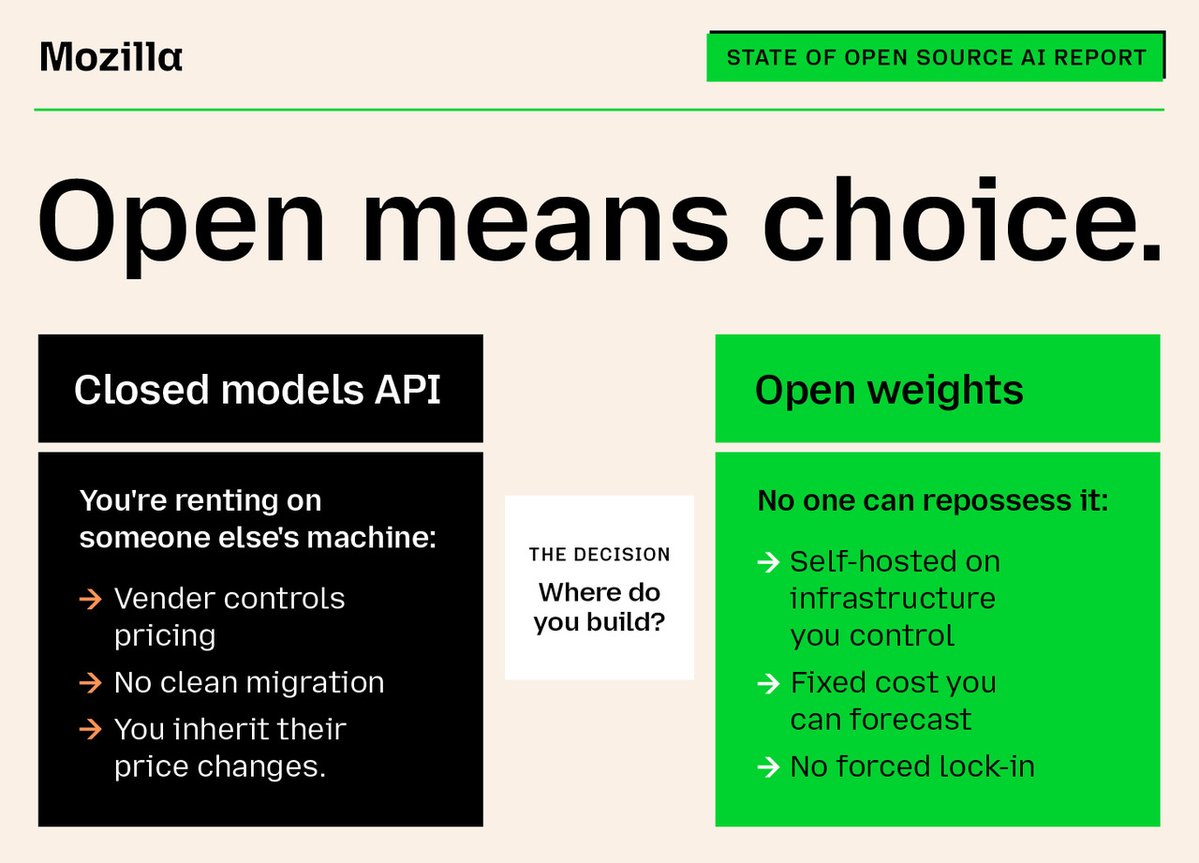
Open weights give control back to the user. Rent a closed model, you’re locked in and the price is theirs to change. Self-host on infrastructure you own, and no one can repossess it.
Where do you want to build?
Read the full State of Open Source AI report → https://t.co/HgfaxDGynk