For PhD students around the world.
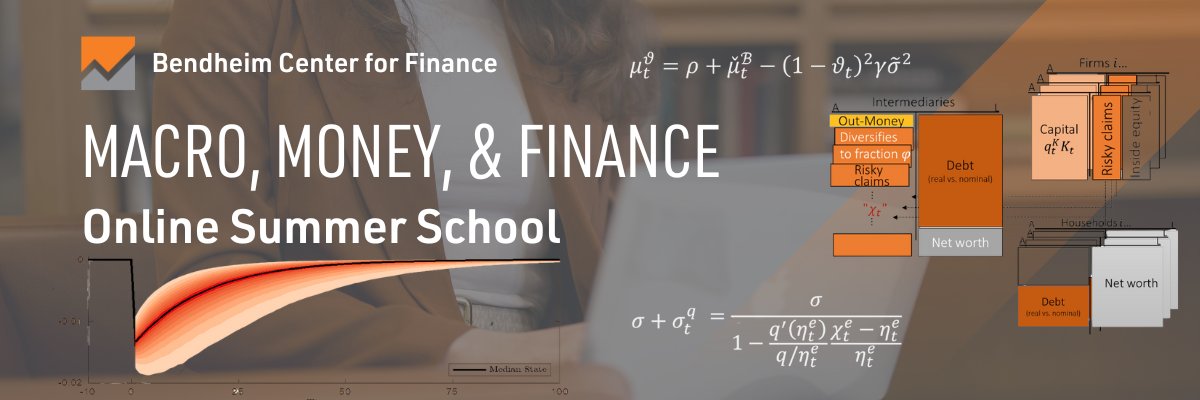
Online Summer School (6 weeks) @PrincetonBCF
Interested? Please register and join. First meeting May 19th
https://t.co/oryNoRLItO
It was a great pleasure to host the FTG @ucl@UCLSoM@EconUCL@uclnews. A big thanks to all speakers and participants, and to the team (especially to Ming Yang) for such a fantastic work.
🎉 @EconUCL was founded in 1828, just two years after @ucl. Today is UCL Foundation Day, making it 199 years since UCL was founded. #UCL200 will be celebrated next year with a great programme of activities and events.
Learn more and join the fun!➡️https://t.co/t78mlvPQSx…
🎉
When do we start including Social Security pension wealth in wealth inequality statistics?
You can’t advocate for large progressive social programs that displace private savings and then ignore their actuarial value in measuring wealth inequality.
Since the mid-1980s, real interest rates have fallen sharply, inflating the present value of stocks and private businesses—driving up inequality measures. But the present value of accrued pension benefits, essentially long-term annuities, has risen too. Why record paper gains for some assets but not others?
Social Security represents half the wealth of the bottom 90%. Excluding it from wealth inequality statistics distorts the picture, even though we know it matters.
If Bush had succeeded in partially privatizing Social Security, contributions would have accrued in individual accounts and been counted as assets—reducing measured wealth inequality.
If Social Security were privatized tomorrow and people received the fair value of their accrued benefits in individual accounts, the top 1% wealth share would hit its lowest recorded level. Yet, people wouldn’t be much better off—it would just move an existing off-balance-sheet asset in their balance sheets.
This thought experiment highlights why wealth measures that exclude the primary way most Americans save for retirement are misleading.
If you think rising wealth inequality is a huge problem and Social Security claims are worth nothing to people, you should be the main advocate of its privatization. Because, according to your own metric, wealth inequality would immediately collapse, and it would not change the intertemporal budget constraint of the government.
Princeton Initiative brings together top 3rd year PhD students in Macrofinance to study new ideas, techniques, tricks, tools, …
https://t.co/YNIBDBj4Tb
Videos will follow
Super excited to be in Princeton to participate in the 2024 Princeton Initiative: Macro, Money and Finance.
Looking forward for the lectures and discussions starting tomorrow 🤓
Also, it is my first time in the US.
📣 Job Opportunity!
We are looking for a Research Assistant with a high level of literacy and numeracy to support across our researchers.
📅 Application Deadline: 04 August 2024.
Learn more:
https://t.co/6zVKRcae05
Call for papers 🚨: SANTIAGO FINANCE WORKSHOP 2024 (deadline July 12th). We welcome submissions on Finance and Financial Economics. Workshop will be held in Santiago 🇨🇱 on Dec 9-10, 2024 ☀️. Do send us your best papers 💪!! https://t.co/2MlA1Lrplx @CBChileresearch
🆕 New Doing Economics project, by Stone PhD Scholar Joern Onken! This is the first @coreeconteam education resource produced by the Stone Centre.
Students learn how to clean a dataset and use HP filters.
Sounds good? Explore now, it's free ➡️ https://t.co/iPukhZy8rk
@EconUCL
✈️Visiting Scholars Program 2024✈️
The Research Department of the @bcentralchile welcomes applications from researchers in academia and policy institutions! Apply by March 31st.
More info at: https://t.co/NmCHqN4a72
📢 1 week to go! Interested in applying for our fully-funded PhD in #FinancialEconomics based in the heart of London’s intellectual and financial centres? Get your application in now before the deadline closes on 31st!
➡️https://t.co/RRzFFPquF4
@UCLSoM@UCLSocHistSci
Don’t miss out the chance to apply to the Financial Economics PhD at UCL.
We have a top faculty in Economics and Finance, a great program structure, lots of seminars/conferences, and more 😎
Thinking about applying for a #PhD? Take a look at our fully-funded PhD in #FinancialEconomics based in the heart of London’s intellectual and financial centres. ➡️https://t.co/RRzFFPquF4
@UCLSoM@UCLSocHistSci