@marca@rdgzcastellanos Yo soy culé y estoy encantado que gane el abuelo. Tiene edad para ir a jugar al bingo, no está para esos trotes. Que sí, que ha sido un gran presidente, pero el cerebro no funciona igual con 50 o 60 años que con 80. Era hora de cambio de ciclo. Gracias por traer a Mou 🤣🤣
🇯🇵LATEST: STABLECOIN ADOPTION ACCELERATES IN JAPAN VIA NETX
Japan is leading real-world stablecoin adoption. NETX (@netx_world) trusted computing Layer-1 infrastructure powers a groundbreaking USDC QR-code payment pilot at Haneda Airport Terminal 3.
Launched by Netstars for inbound tourists, the trial enables instant, secure Web3-to-retail settlements.
This marks a major step under Japan’s progressive regulations, with Phase 2 expansion already planned for sites like Himeji.
NetX is turning stablecoins into everyday payments, bridging crypto and commerce at scale.
@JUANMISB97 No entenc tanta comèdia...El jugador en qüestió és professional i ha de fer lo que li diguin, jugar si ho considera el míster, o no jugar si no hi considera. En els dos casos ha d'estar al 100%, que per això cobra i res l'ha de condicionar. I sinó que se dediqui a una altra cosa
@Babkov10@RadioMARCA@raulvarelar Tiene 18 años el chaval. Ni Messi, ni Mbappe, ni Cristiano habían marcado tantos goles, ni tantas asistencias a su edad
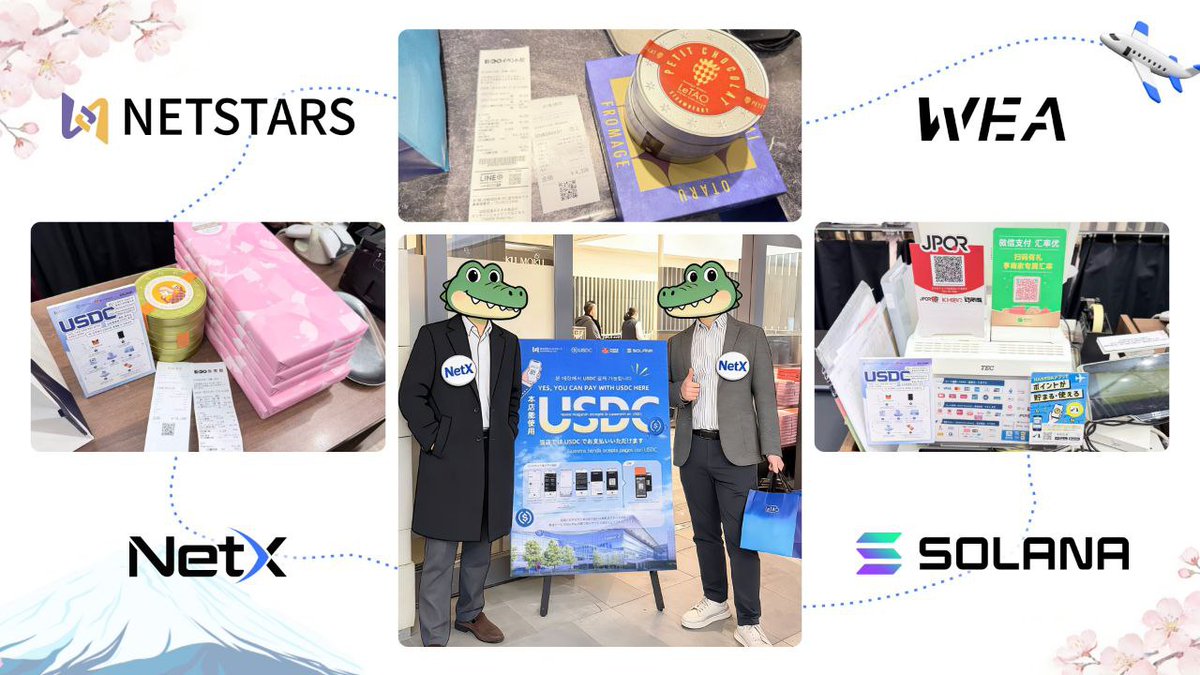
🔥 Web3 stablecoin payments are now live at Tokyo Haneda Airport! 🇯🇵✈️
The Web3 stablecoin payment pilot has officially launched at Haneda Airport Terminal 3, with USDC now accepted.
Payments are completed via QR code verification, providing a smooth and convenient experience for international travelers arriving in Japan.
🔗 Learn more:
https://t.co/bdt6pqsvtK
🎉 We’re thrilled to see real users completing stablecoin payments on-site today — Web3 is no longer just a concept, it’s happening in the real world.
Huge thanks to @Kouhou_NSS@netx_world@solana@SolanaFndn for making this milestone possible 🤝
🌐 What’s next?
WEA now supports payment deployments across multiple blockchains, with future expansion planned across major networks including BNB Chain and NetX.
As #Web3 continues to merge with the real economy, #WEA will keep working closely with #Netstars, #NetX, and #HanedaAirport partners to bring stablecoin payments into more real-world commercial scenarios — making digital assets trusted, usable, and part of everyday payments.
👇 If you participated in this stablecoin payment pilot, feel free to share your payment photos in the comments! 📸
Let’s build the future of Web3 payments together. 🚀
#Web3Payments #Stablecoin #USDC #RealWorldAssets #Solana #RWA
When people look at Netstars, they often see a payments company. What is less visible, but far more important, is how Netstars works at a technical and organizational level, and why this way of working has enabled deep coordination with Web3 infrastructure across Japan.
This perspective is not speculative. It is grounded in a recently published article on the Medusa Development Model, a layered research and development methodology proposed by Chen Bin, CTO of Netstars (@Kouhou_NSS). The article outlines how modern R&D must evolve in the AI era by separating human decision-making from automated execution, allowing teams to scale without losing control.
This framework connects naturally with the vision behind @netx_world and @WEAJapan. Where trust infrastructure and verifiable execution across technical layers are core principles.
The article was published on December 28, 2025, by a professional public account described as
“A community for PMO professionals, sharing advanced theories and best practices in project management, process management, change management, and digital transformation across industries.”
This context matters, because the Medusa Model is not a marketing concept, but a process discipline designed for real operational environments.
For more than a decade, Netstars has focused on one fundamental capability: building gateways between systems that were never designed to work together. QR payments, multi-cashless environments, cross-provider settlement, regulatory compliance layers. The Medusa Model formalizes this experience into a repeatable development paradigm.
From a technical standpoint, Netstars does not innovate by replacing existing systems. It innovates by decoupling decision layers from execution layers, and by integrating new capabilities into proven infrastructure. Human teams define architecture, constraints, and responsibilities. Execution is then modularized, standardized, and increasingly automated. This is the essence of the Medusa Model.
This layered R&D philosophy naturally aligns with collaboration across the Japanese Web3 ecosystem, including organizations such as @web3_jp_infra (日本ブロックチェーン基盤連盟), where interoperability, compliance, and long-term system stability are non-negotiable.
In joint development scenarios, Netstars does not operate through ad hoc integrations. Collaboration is layer-based. Merchant-facing gateways, settlement logic, and regulatory surfaces remain under Netstars’ control. Web3-specific components are developed where they add value, without leaking complexity into the operational core.
The Medusa Model explains how this coordination remains efficient. The “head” layer focuses on non-structured human decisions such as architecture and risk control. The “tentacles” handle structured execution such as implementation, testing, deployment, and optimization. This separation allows multiple teams and technologies to evolve in parallel without slowing each other down.
In practical terms, this is why Netstars can introduce new payment rails without forcing merchants to change how they operate. It is why collaboration with Web3 infrastructure remains stable over time. And it is why systems developed under this model can absorb AI tooling without losing accountability.
What may look like a single announcement or pilot is, in reality, the surface of a deeper development methodology refined over years. One that treats Web2 and Web3 not as competing worlds, but as layers of the same system, coordinated through disciplined R&D.
This is how Netstars works. Quietly, methodically, and with a process-first mindset rooted in real project management practice.
In the end, real adoption does not come from bold claims.
It comes from architectures and methodologies that hold.
Source: https://t.co/mNScgg7HE8
Andy Hung, Head of Alliance at @PacificMeta and an active voice in Japan’s Web3 and stablecoin ecosystem, recently shared a message that deserves attention. Not because it announces a new token or a speculative product, but because it shows what real progress in Web3 adoption looks like when execution comes before hype.
In his LinkedIn post from December 24, Andy highlighted the launch of a USDC payment pilot at Haneda Airport. At first glance, this could be seen as just another payments experiment, but the real importance lies in how it has been approached. This is not a crypto-first story. It is an infrastructure-first story, grounded in regulation, usability, and collaboration.
Andy is part of @PacificMeta, an organization that plays a unique role in the Japanese Web3 ecosystem. Pacific Meta is not positioning itself as a blockchain protocol or a payments company. Instead, it acts as a bridge between global Web3 innovation, local enterprises, and Japan’s regulatory environment. That bridging role is precisely what makes initiatives like this possible.
Japan is often described as conservative when it comes to financial innovation, but this case shows something more nuanced. Innovation is not rejected, it is structured. Stablecoins are being tested not as speculative assets, but as payment infrastructure that must function within existing systems, comply with the law, and reduce friction for merchants and users alike. Airports such as Haneda are a logical starting point because they concentrate real demand, cross-border activity, and operational complexity.
Andy’s message also points to the broader context of the Japan Stablecoin Summit, an initiative aligned with the same philosophy. Rather than focusing on narratives or shortcuts, the summit brings together regulators, enterprises, legal experts, and builders to discuss how stablecoins can be responsibly integrated into the real economy.
One important detail in Andy’s post is his personal congratulations to Yoshimoto Bansho and the team at @WEAJapan. This acknowledgment matters because it reminds us that behind every successful pilot there are people doing the hard work of coordination, compliance, and delivery. Web3 progress does not come from technology alone, but from teams willing to operate at the intersection of technology, regulation, and real business constraints.
Taken together, Andy Hung’s message is less about USDC itself and more about a mindset. It reflects a shift toward mature Web3 adoption, where systems are integrated thoughtfully instead of bypassed. For ecosystems like @netx_world and the broader vision behind $NETX, this kind of real-world alignment between infrastructure, regulation, and execution is exactly the signal worth paying attention to.
Source: https://t.co/TLgbjBzEUK
The USDC payment PoC at Haneda Airport should be understood as part of a much broader and more deliberate innovation framework. What we are seeing with Netstars, WEA Japan, and terminal.0 is not an isolated payments experiment, but a carefully structured convergence of infrastructure, regulation, and real-world execution.
terminal.0 was created by the Japan Airport Terminal Group as a dedicated innovation hub where new ideas for the future of airports can be tested in realistic, operational environments. It is not a concept showroom. It is a place designed for validation and co-creation, where technologies are evaluated under real constraints related to security, passenger flow, compliance, and operational reliability. The guiding principle is clear: innovation must work where it actually matters.
This is exactly why the stablecoin PoC involving @Kouhou_NSS and @WEAJapan makes sense at Haneda. Airports are among the most complex physical environments in the world. They combine international users, high transaction volumes, strict operational requirements, and heavy regulatory oversight. If a new form of payment infrastructure can function reliably here, it demonstrates a level of maturity that goes far beyond theoretical use cases.
@Kouhou_NSS brings deep experience in payment gateways and merchant integration, enabling stablecoin payments to fit seamlessly into existing retail and POS environments. @WEAJapan provides the Web3 payment layer, designed to bridge digital assets with real-world payment systems in a compliant and operationally sound way. Beneath this visible layer, @netx_world serves as the foundational infrastructure for WEA Japan, providing the trust, execution, and scalability required for such systems to operate in high-stakes environments. In this context, NetX is not a parallel ecosystem, but the infrastructure that makes WEA’s payment model viable in the real world.
An important part of this story is the role played by @web3_jp_infra (日本ブロックチェーン基盤連盟). As a co-constructor of WEA Japan, the association has played a key role in aligning technical standards, shaping compliance-oriented thinking, and fostering industry-wide cooperation. This contribution is critical because it ensures that innovation does not happen in isolation, but in coordination with broader industry norms and regulatory expectations in Japan.
This layered and collaborative approach mirrors the philosophy behind terminal.0 itself. Innovation is not treated as a standalone technical achievement, but as something that must integrate with existing systems, institutions, and user behaviors. The stablecoin PoC reflects this mindset by focusing not on disruption for its own sake, but on whether new financial infrastructure can coexist with and enhance established environments.
What makes this convergence especially meaningful is that it shows how financial infrastructure can become part of a larger innovation ecosystem. Payments are not isolated systems. They interact with mobility, retail, tourism, data flows, and overall user experience. By testing stablecoin payments within the innovation framework of terminal.0, this PoC becomes part of a broader experiment in how digital infrastructure integrates into physical, regulated spaces.
Haneda is positioning itself not only as a transportation hub, but as a platform for future-oriented experimentation. terminal.0 provides the cultural and operational context where initiatives like this can be evaluated seriously, refined responsibly, and scaled when ready. For ecosystems like @netx_world and the broader vision behind $NETX, this alignment between infrastructure, standards, compliance, and real-world execution is exactly where long-term value is created.
Sources:
https://t.co/wDRCpzAKcq
https://t.co/HQ9cq08bFr
🥳Congrats to our partner #WEA on the official website launch!
#NetX powers the core of their secure and trusted payment infrastructure and has supported #WEA, in collaboration with #NetStars, to launch USDC payments at Haneda Airport in Japan.✈️
💪We are proud to provide the underlying technology for this real-world payment scenario, bringing Web3 payments into everyday commerce.
Real adoption starts here. 🚀
Join us in building the future of #Web3 payments together.
#NetX #Payment #USDC #AI #Japan