How can $NETX gain value as the ecosystem token of NetX?
$NETX becomes valuable when it is needed to use, secure, govern, and scale the @netx_world economy.
Its value does not come from speculation alone. It comes from recurring demand created by real activity across agents, enterprises, infrastructure, payments, and governance.
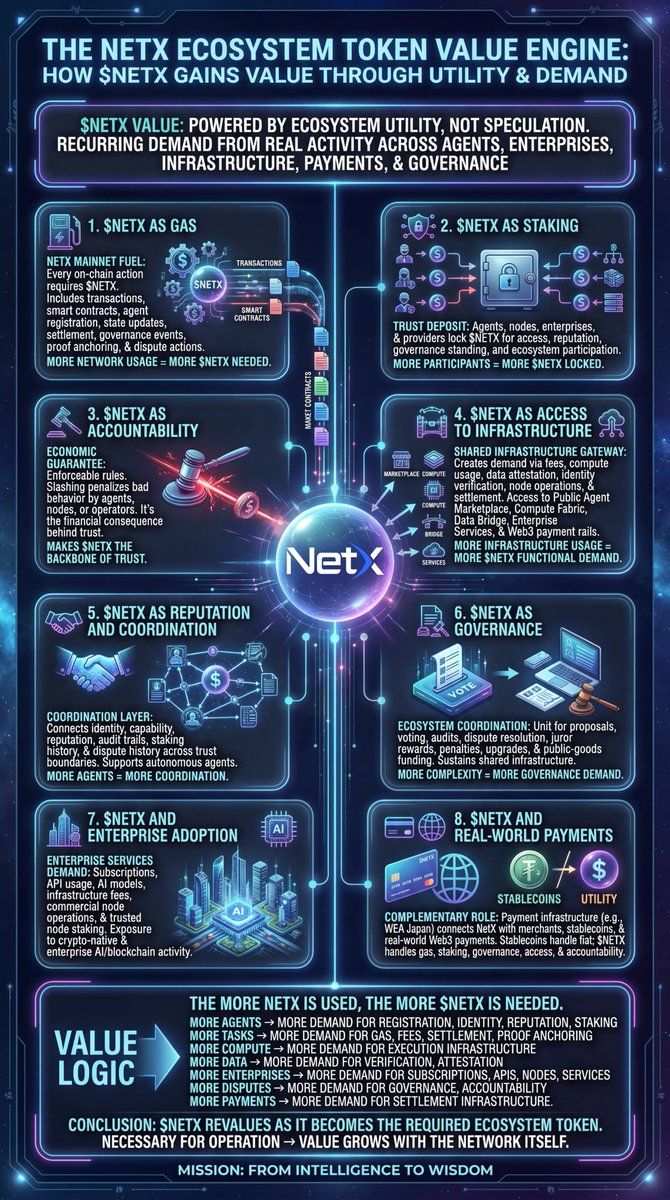
If $NETX is used as gas on the NetX mainnet, every on-chain action creates direct demand: transactions, smart contracts, agent registration, state updates, settlement, governance events, proof anchoring, and dispute actions.
More network usage means more need for $NETX.
But gas is only the first layer.
In an autonomous agent economy, participants also need staking. Agents, nodes, enterprises, and service providers can lock $NETX as a trust deposit to access roles, build reputation, participate in governance, or operate inside the ecosystem.
More participants means more $NETX locked.
Then comes accountability.
A serious agent economy needs enforceable rules. If an agent, node, or operator breaks those rules, slashing can make bad behavior costly.
That makes $NETX more than a payment token. It becomes the economic guarantee behind trust.
NetX also depends on shared infrastructure: Public Agent Marketplace, Compute Fabric, Data Bridge, Enterprise Services, and Web3 payment rails.
Accessing these layers can create demand for $NETX through fees, compute usage, data attestation, identity verification, node operations, settlement, and infrastructure participation.
More infrastructure usage means more functional demand for $NETX.
Autonomous agents also need identity, capability records, reputation, audit trails, staking history, and dispute history.
$NETX can support this coordination layer by connecting identity, access, reputation, payments, governance, and accountability across trust boundaries.
More agents means more coordination.
As the ecosystem grows, governance also becomes more important: proposals, voting, audits, dispute resolution, juror rewards, penalties, upgrades, and public-goods funding.
$NETX becomes the unit used to coordinate governance and sustain shared infrastructure.
Enterprise adoption adds another layer: subscriptions, API usage, AI models, infrastructure fees, commercial node operations, and trusted node staking.
Real-world payments can add even more utility, connecting NetX with merchants, stablecoins, developers, and Web3 payment infrastructure.
Stablecoins may handle fiat-denominated payments.
$NETX plays a different role: gas, staking, governance, access, accountability, reputation, and infrastructure coordination.
They are complementary.
The value logic is simple:
More agents → more identity, reputation, staking
More tasks → more gas, fees, settlement
More compute → more execution infrastructure
More data → more verification and attestation
More enterprises → more APIs, nodes, services
More disputes → more governance and accountability
More payments → more settlement infrastructure
In short:
$NETX can revalue if it becomes the required ecosystem token for gas, staking, slashing, access, reputation, governance, settlement, infrastructure usage, enterprise services, and agent coordination.
The more NetX is used, the more $NETX is needed.
And if $NETX becomes necessary to operate inside the agent economy, its value can grow with the network itself.
#NetX #NETX #NetXFoundation #AgentEconomy #Web3AI #AI #Blockchain #Layer2 #DePIN
Of course I use AI in my day-to-day work. I build agent-based automation processes for companies, so obviously AI is part of what I do. But there’s a big difference between using AI to enhance human work and using it to invent narratives without verified facts behind them.
And that’s exactly the issue here: you yourself fed wallet movements into an AI without double- or triple-checking the possible hallucinations of an LLM… and you got it wrong.
That’s why it’s frustrating that, in so many of your replies, you keep trying to steer the conversation toward anything that supports your personal battle. We’re talking about hours of work researching and connecting real links with Huawei, and you reduce all of that to a simple “But ... Do you use AI?”
Using AI doesn’t invalidate an investigation. What invalidates it is failing to verify information, failing to cross-check sources, and turning assumptions into facts.
@MuskCz@Netx_james@CryptoMarcus4@netx_world@WEAJapan Do you think all the information I share is just nonsense generated by an AI?
You're letting me down, or maybe I just had a different impression, CZ ...
https://t.co/3evyFQYtuJ
Huawei × Octa Innovations x $NETX
🚨 Exclusive forensic + institutional deep dive
We traced the entire chain Huawei × Octa × NetX across labs, certifications, patents, PM tasks, DevOps infra, and press releases.
What emerges is clear: One ecosystem, one operator.
In this thread:
1️⃣ Huawei × Octa (labs, BCS, Ascend)
2️⃣ Octa × NetX (patents, wikis, infra scans)
3️⃣ Huawei × NetX (certified through Octa)
Full analysis follows 👇🫡
#NetXHuawei $NETX Part 1/4
You’re again missing the point. Positioning yourself with a local actor that already holds the necessary licenses to execute all the regulatory processes around stablecoins is a key enabler in Japan.
For example, even if you are a giant like Ripple / XRP, without a Japanese partner you cannot easily enter the stablecoin market. And this logic can be extrapolated to the rest of the industry.
Circle had to enter through Progmat, and JPYC also depends on Progmat for that process. Likewise, if you want to make your stable assets legally compliant in Japan, you may also need players such as SBI Holdings.
It’s not as simple as saying, “I’m huge, so I get the red carpet treatment.” These companies may have enormous development and adaptation capabilities, but if you need local actors and facilitators with active licenses, you still have to follow the proper regulatory flow like everyone else.
It's just my opinion.
@MuskCz I agree with a lot of your macro view, the big players like Visa, Mastercard, Stripe and Circle are already running massive, regulated stablecoin settlement volumes globally.
But I think the timing and local regulations in Asia (especially Japan) matter a lot here and change the picture. Japan’s Payment Services Act is one of the strictest frameworks in the world: only licensed banks, trust companies and fund transfer providers can issue or directly handle fiat-pegged stablecoins. Recent 2025–2026 updates keep it tightly controlled while allowing some flexibility for compliant integration.
That’s exactly why NetX (through WEA Japan as official Web3 partner of Netstars) isn’t trying to compete with the giants. It’s building the adaptable on-chain trust layer (TEE, ZKP, verifiable settlement) that helps established local players like Netstars add stablecoin functionality in a fully compliant way. The live Haneda Airport Terminal 3 pilot is a good example, real QR payments with USDC where merchants still get seamless JPY settlement.
This kind of cooperative approach fits perfectly with what Citi laid out in their Stablecoins 2030 report: they forecast the market growing to $1.9T–$4T by 2030, supporting $100T+ in annual activity, but they emphasize coexistence and integration with traditional finance rather than replacement. NetX/WEA is positioning itself as the backend facilitator that makes that regulated integration easier in Japan and ASEAN first.
Different focus, but very aligned with how real institutional adoption is actually happening on the ground.
@netx_world isn't trying to compete head-to-head with giants like Visa, Mastercard, or Circle. Instead, through its "partnership" with @WEAJapan , it serves as a specialized on-chain infrastructure layer that helps existing players adapt to local regulations.
Here's how it works in practice: NetX provides the trusted computing backend using technologies like its Modular Collaboration Protocol, secure execution environments (TEE), zero-knowledge proofs, and verifiable settlement tools. This allows stablecoin transactions to be handled securely and compliantly behind the scenes, while merchants and users experience everything in a familiar, regulated way.
In Japan, WEA acts as the official Web3 solution partner for Netstars (the operator of StarPay and StarPay-X). Netstars is a well-established institutional player with hundreds of thousands of merchants and strong ties to initiatives like JPQR. The collaboration enables pilots such as the QR code payments using USDC at Haneda Airport Terminal 3. Merchants continue using their regular systems, customers pay with stablecoins, and settlement happens smoothly in local fiat (JPY), all while meeting Japan's strict Payment Services Act requirements.
The same approach is designed to expand into ASEAN countries, where regulations around digital payments are evolving. Rather than forcing a one-size-fits-all global system, NetX and WEA focus on customizing the technology to fit each market's local rules on AML, licensing, reserves, and consumer protection.
$NETX positions itself as an enabler and adapter. It supplies the programmable, trustworthy on-chain foundation that helps regulated incumbents like Netstars integrate stablecoins more easily, without disrupting their existing operations. This cooperative model gives it real-world relevance in regulated environments, even as a smaller project.
1. @netx_world isn’t trying to compete with or replace Circle, Stripe, Visa, Mastercard, PayPal or JPM Coin.
It’s positioned as the trusted computing and settlement layer underneath them, the secure backend (using TEE/ZKP, verifiable execution, and compliance proofs) that helps stablecoins work reliably in regulated environments.
Real example: Haneda Airport (Terminal 3) is already live with USDC payments via @Kouhou_NSS StarPay-X.
2. The unique technical edge comes from $NETX’s focus on agent-native execution + constitutional governance (check the recent AgentCity and AGNT2 papers from the founder).
It’s purpose-built for multi-agent economies where trust, accountability, and clear rules matter most. That’s not what general-purpose chains like Solana, Avalanche, Stellar, Polygon, or Base were designed to solve.
3. NetX doesn’t issue stablecoins, it provides the settlement infrastructure.
USDC is already live at Haneda Airport through the Netstars + @WEAJapan + NetX stack. JPYC is part of the official alliance, and there are more integrations in progress (including exploration with Canton and collaboration with Aptos).
4. Netstars has publicly announced StarPay-X and the Haneda pilot.
WEA Japan (their Web3 partner) has also highlighted NetX as the core trusted computing provider in the ecosystem. Big companies don’t always name every technical layer in their press releases, but the official partnership updates do.
5. Current on-chain activity:
USDC payments at Haneda Airport Terminal 3 are live and expanding (Phase 2 is already rolling). There’s also active USDT usage on Solana via WeaPay. It’s still early-stage merchant usage, not massive scale yet, but it’s real, not just future plans. The upcoming mainnet (targeted for June 25) + staking should help scale this a lot.
NetX isn’t aiming to become “the next Visa.” It’s building the trust and settlement infrastructure for the next wave of regulated Web3 payments, especially in Asia. With Haneda already live, FSA regulatory clarity, and strong partners like Netstars, Progmat, and Aptos (plus Canton interest), things are starting to line up.
You just have to know where to look. At Haneda International Airport in Japan, @WEAJapan, together with Netstars @Kouhou_NSS and @netx_world Foundation, in collaboration with @solana and USDC, has turned this vision into reality through a regulatory pilot program coordinated with Japan’s FSA.
https://t.co/P42VwKJP0Z
@netx_world $NETX, @solana, @tether solana:Es9vMFrzaCERmJfrF4H2FYD4KCoNkY11McCe8BenwNYB , @Kouhou_NSS , @NSS_StarPayX and @WEAJapan are now connected through a practical payment milestone: WEAPay supports USDT QR payment generation on Solana, bringing faster and more accessible crypto payment flows into the Netstars StarPay-X ecosystem.
This is a meaningful step for real world Web3 payments.
WEAPay has officially enabled USDT QR payment generation on the Solana network. In simple terms, this means users and merchants can now create QR based payment requests using USDT on Solana, with the speed, low cost and usability needed for everyday payment scenarios.
The importance of this update is not only that another asset has been added. It is that the payment experience is becoming more direct, more scalable and easier to integrate into existing merchant environments.
Solana provides the high throughput and low fee environment needed for fast payment confirmation. USDT brings one of the most widely used stablecoin assets in the crypto economy. WEAPay provides the QR payment creation layer. Netstars StarPay brings the merchant payment context. And NetX connects the broader vision: trusted, modular and intelligent infrastructure for a new generation of digital economic activity.
The first technical validation has already been completed successfully.
During testing, the QR creation flow was validated using USDT on Solana. The system confirmed a successful application level response, activated QR format generation, created a transaction record and verified the expiration logic for the generated payment QR.
The validation also confirmed an important operational behavior: an expired authorization token was correctly rejected with a token expiration message, while a refreshed valid token completed the QR creation flow successfully. This shows that the authentication lifecycle is working as expected.
A key integration detail was also observed: the HTTP layer may return a standard successful transport response even when the business logic returns an error. That means integrations should not rely only on the HTTP status. They should also validate the internal response code and message before treating a payment QR as successfully created.
Technical findings confirmed:
Successful QR creation: confirmed
Asset: USDT
Network: Solana
QR format generation: active
Transaction ID generation: confirmed
Expiration window: verified
Authentication expiration handling: working as expected
Production readiness signal: core flow active and validated
Why does this matter?
Because crypto payments only become useful when they feel simple.
A user should not need to understand the complexity behind blockchain infrastructure. A merchant should not need to manage unnecessary friction. The payment flow should be clear: generate a QR, let the user scan, confirm the payment and move forward.
That is the kind of experience this update is moving toward.
For NetX, this also reflects a broader direction. NetX is not only about abstract blockchain architecture. It is about building practical infrastructure where blockchain, data networks and intelligent systems can support real commercial use cases. Payments are one of the clearest areas where this can be seen.
With WEAPay now supporting USDT QR generation on Solana, the Netstars StarPay-X ecosystem gains another bridge between traditional payment behavior and Web3 settlement infrastructure.
This is still an early step, but it is an important one.
The strongest Web3 products will not be the ones that ask users to change everything at once. They will be the ones that fit naturally into existing habits while quietly improving speed, cost, transparency and programmability behind the scenes.
WEAPay, powered by NetX and connected with the Netstars StarPay-X ecosystem, is moving in that direction. 🫡
Japan may be closer than most people realize to bringing stablecoins into everyday life and @netx_world $NETX will be involved in the process.
A recent @Weixin_WeChat publication from LUN Partners highlighted an important development around NETSTARS @Kouhou_NSS , one of Japan’s largest QR payment aggregation platforms. The company officially introduced @NSS_StarPayX, a new financial infrastructure initiative designed to connect traditional Web2 payments with Web3 technologies.
What makes this significant is not the marketing narrative around blockchain, but the practical direction behind it.
NETSTARS is not positioning itself as a typical crypto startup. It already operates within Japan’s real payment economy, where QR payments are deeply embedded across retail, transportation, tourism, and everyday commerce. Instead of replacing existing payment systems, the company appears focused on upgrading them.
According to the article, StarPay-X aims to integrate stablecoins, blockchain infrastructure, digital wallets, and DeFi-related financial capabilities into its existing payment network. The platform is also expected to support multiple chains, wallets, and digital assets.
More importantly, the article mentions potential collaboration with several major Web3-related organizations and ecosystems, including @Aptos, @BitgetWallet, @CantonFdn, @SolanaFndn, @StartaleGroup, and @WEAJapan.
This detail matters because it suggests that StarPay-X is being designed as an interoperable payment infrastructure rather than a closed ecosystem. The strategy appears centered on connecting traditional merchant payments with broader blockchain liquidity and multi-chain financial networks.
Another key point is that NETSTARS has already participated in offline USDC payment trials at Tokyo Haneda Airport Terminal 3.
That changes the conversation around stablecoins.
For years, stablecoins mainly circulated inside exchanges and crypto-native markets. But integrating them into physical payment infrastructure is a very different step. Once stablecoins begin functioning within real merchant environments, they evolve from speculative trading instruments into practical settlement layers.
Japan is uniquely positioned for this transition.
The country already has mature QR payment adoption, advanced consumer payment behavior, and one of the clearest regulatory environments for stablecoins among major economies. That creates ideal conditions for blockchain-based settlement systems to integrate quietly beneath familiar payment experiences.
Most users may never think about which network processes their transactions. What they will notice is faster settlement, lower friction, broader interoperability, and seamless digital payments across ecosystems.
That may ultimately be the real significance of StarPay-X.
Not the disruption of finance overnight, but the gradual convergence of payment networks, stablecoins, and blockchain infrastructure into everyday commercial life.
Source: https://t.co/8417DwfUfo
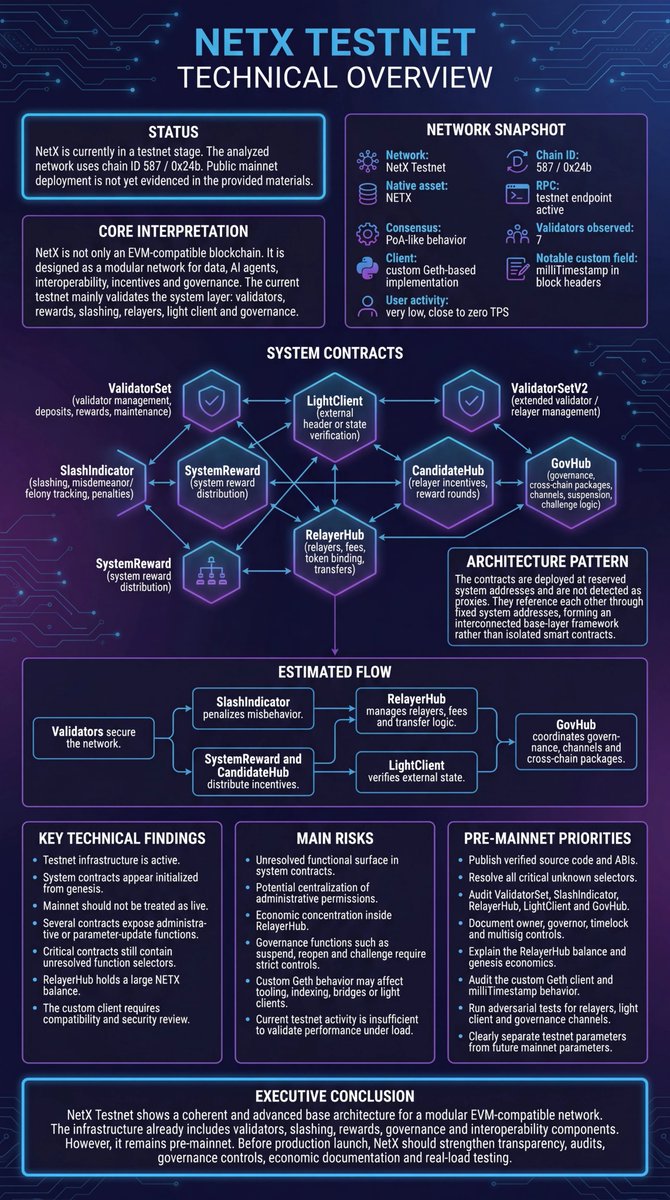
The NetX testnet technical overview (without access to any documentation or smart contract code, it is based on deep testnet crawling and contract decoding driven by agent-based deterministic local inference) showed a modular system architecture, not a blank EVM sandbox. The key findings were $NETX as native gas, a 7-validator PoA structure, reserved system contracts, cross-chain primitives, governance components and a staged pre-mainnet design. @netx_world
#NETXTestNetFindings
The second important piece from the NetX testnet is the technical overview.
At first glance, it looked like a small EVM-compatible network with low activity.
But once the RPC, validators and reserved contracts were mapped, the picture changed.
NetX testnet was structured like a system chain.
It had a clear network snapshot:
Chain ID: 587 / 0x24b
Native asset: NETX
Consensus: PoA-like behavior
Validators observed: 7
Client: custom Geth-based implementation
Block timing: around 3 seconds
User activity: very low, close to zero TPS
Custom header field: milliTimestamp
That matters because the testnet was not only testing whether contracts could deploy.
It was testing the foundation of a chain with its own validator layer, system contracts, relay logic and future governance path.
The most important concept here is NETX-as-gas.
In the observed testnet, NETX was the native execution asset. That means contract calls, deployments, system interactions and settlement-style operations were priced in NETX.
This is the first layer of token utility:
not narrative utility,
but execution utility.
The system contracts were the real signal.
The base layer included components such as:
ValidatorSet for validator management, deposits, rewards and maintenance.
SlashIndicator for misdemeanor, felony and slashing-style accountability.
SystemReward and CandidateHub for system incentives and relayer-related rewards.
LightClient for external header or state verification.
RelayerHub / TokenHub for relayers, fees, token binding and transfer coordination.
GovHub for governance packages, channels, suspension, reopening and challenge logic.
This architecture suggests a network designed around more than transaction execution.
It suggests a network built for verification, coordination and accountability.
The architecture pattern is also important.
These contracts were deployed at reserved system addresses and were not detected as simple user contracts. They referenced each other through fixed system addresses, forming an interconnected base-layer framework rather than isolated smart contracts.
That is the difference between:
“someone deployed a few contracts”
and
“the chain has a protocol-level system map.”
The estimated flow is easy to understand:
· Validators secure the network.
· SlashIndicator penalizes misbehavior.
· SystemReward and CandidateHub distribute incentives.
· RelayerHub coordinates relayers, fees and transfer logic.
· LightClient verifies external state.
· GovHub coordinates governance, channels and cross-chain packages.
This is why the testnet is interesting even with low user activity.
Low activity means it was not yet a production network.
But the contract map shows that the testnet was preparing something much larger:
a modular base for validation, rewards, slashing, relay, external proofs, governance and interoperability.
The risks are equally important.
There were unresolved selectors in critical contracts, potential administrative centralization, large balances inside system contracts, custom client behavior and staged components that still required activation, verification and public documentation.
So the right conclusion is balanced:
The NetX testnet was not mainnet.
It was not production-ready.
But it was also not empty.
It showed a coherent technical foundation for a modular EVM-compatible network where $NETX acts as gas, system contracts coordinate the base layer, and future governance, staking and settlement infrastructure can be built on top.
That is the technical overview worth documenting 🫡
* Please note that this research was not provided by the team and is published as an independent study without full access to the source code or testnet infrastructure; as a result, it may contain errors or inconsistencies compared to the final product.
The NetX testnet shutdown makes the technical snapshot more valuable. While live, it showed a serious pre-mainnet architecture with $NETX as native gas, system contracts, relay logic, governance, token management and recovery components. Not mainnet yet, but definitely not an empty testnet either. @netx_world
#NETXTestNetFindings
The NetX testnet going offline may look like a small technical event, but for research it matters.
Because while it was live, it gave us a rare on-chain window into what NetX was actually testing beneath the public narrative.
And the most important conclusion is simple:
NetX was not just running a basic EVM testnet.
What we observed was a structured system architecture with native gas, validators, slashing, relay logic, light-client verification, token-management components, governance contracts, timelock infrastructure, staking components and recovery-style mechanisms.
That does not mean mainnet is live.
It does not mean every component was fully activated.
It does not mean the full product stack is already in production.
But it does mean the testnet was not empty.
It was a technical staging environment for a much larger architecture.
The base layer showed active system infrastructure:
ValidatorSet
SlashIndicator
LightClient
TokenHub / RelayerHub
Incentivize / CandidateHub
RelayerHub V2
GovHub
The advanced layer appeared deployed but mostly staged:
Staking
ValidatorHub / StakeHub
NativeToken / StakeCredit
GovToken
Governor
Timelock
TokenManager
TokenRecoverPortal
That distinction is important.
Active base layer.
Staged advanced layer.
This is exactly how an early technical network can look before mainnet: not finished, not production-grade, but already revealing the design philosophy.
The strongest finding, in my view, is that NetX seems positioned less like “another payment blockchain” and more like a programmable trust layer.
A layer for payment intents, settlement records, compliance proofs, audit trails, challenge logic, cross-chain state, token management, operator accountability and governed rule changes.
Stablecoins can move value. Wallets can handle user experience. Payment processors can handle merchants.
But someone still needs to record the institutional context:
Who authorized the payment?
Which rule applied?
Was the merchant settlement valid?
What proof exists?
What happens if there is a dispute?
Who is accountable if something goes wrong?
That is where NetX could become strategically relevant.
The testnet may be offline now, but the architecture it revealed is worth documenting.
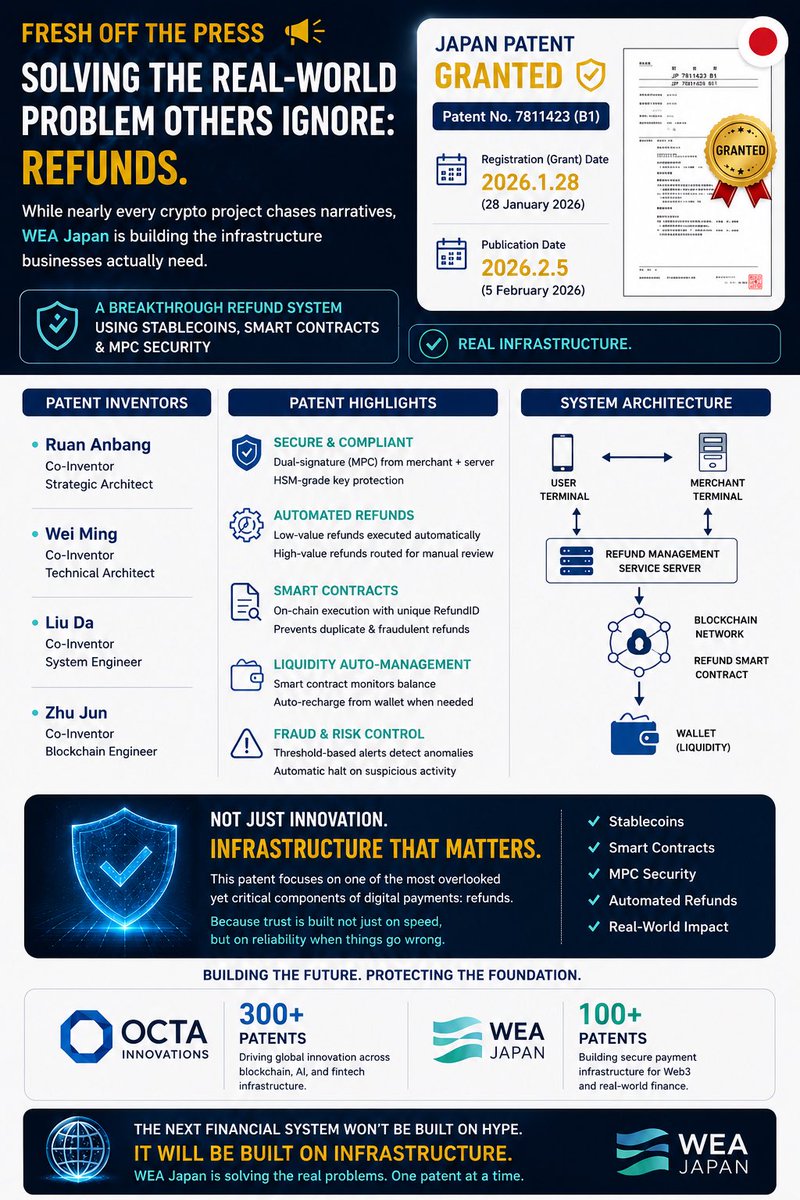
JP7811423B1 from @weajapan is more than a refund patent. For @netx_world and the $NETX thesis, it points to something the Web3 payment industry still does not discuss enough: real commerce does not end when a payment is confirmed.
A payment rail can be fast, global and programmable, but merchants also need refunds, disputes, liquidity control, fraud limits, audit trails and operational approvals. Without that layer, stablecoin payments remain closer to transfer infrastructure than full merchant infrastructure.
What makes this patent interesting is that it treats refunds as a controlled lifecycle, not as a simple reverse transaction.
The user requests a refund. The merchant forwards it. The refund management server checks the original txHash, verifies that the payment succeeded, confirms that the recipient was the right merchant, checks that the refund amount does not exceed the original payment, validates eligibility and makes sure the same transaction hash was not already used.
Then the system introduces a risk threshold. Low value refunds can move automatically. Higher value refunds are routed to manual review. Automation is useful, but only when paired with limits and human oversight where risk becomes material.
The refund itself is not approved by one party. The merchant signs. The server signs. The smart contract verifies authorization, checks that the RefundID has not been processed before, and only then executes the stablecoin refund to the user.
The RefundID matters because it is generated from the payment hash, timestamp and nonce. Each refund becomes a unique, traceable event linked to the original payment but protected against duplication.
The liquidity model also deserves attention. The refund contract acts as an operational fund with limited exposure. The main wallet does not directly refund users. Instead, it can recharge the contract when the balance falls below a minimum threshold. If low balance alerts happen too often within a defined period, the system can stop recharging to reduce the risk of fund drainage.
That design choice says a lot. It is not only about processing refunds quickly. It is about limiting blast radius, detecting abnormal behavior and preserving business continuity.
The MPC and HSM elements strengthen this further. Wallet recharge is not treated as a simple hot wallet action. It is designed around separated key control and institutional signing logic.
This is why the patent matters for the NetX, WEA and StarPay thesis. The next phase of Web3 payments will not be won only by who can move stablecoins fastest. It will be won by who can operate the full commercial lifecycle with trust, rules and accountability.
Payment intent is only the beginning. Refund intent, dispute intent, recovery intent and compliance intent are where payment infrastructure becomes merchant grade.
The real story is programmable commerce that can survive the messy parts of real business: mistakes, returns, disputes, fraud attempts, liquidity pressure and audit requirements.
🗞️ FRESH OFF THE PRESS 🗞️ :
Few crypto projects are solving one of the biggest real-world problems in digital payments:
Refund infrastructure…
Japan Patent No. 7811423 was officially granted on January 28, 2026 @WEAJapan
The system combines:
• Stablecoins
• Smart contracts
• MPC security
• Automated merchant refunds
• Threshold-based risk controls
• Auto-liquidity management
• Enterprise-grade payment orchestration
This is not “speculation infrastructure.”
This is real-world financial plumbing.
The interesting part?
The patent specifically focuses on:
automated stablecoin refunds,
merchant authorization,
secure MPC signing,
smart contract execution,
and protection against fraudulent/high-risk refund activity.
Exactly the type of infrastructure required for:
• compliant Web3 payments
• QR/POS settlement
• merchant stablecoin adoption
• and next-generation financial rails.
Most projects focus on tokens.
Very few focus on the operational layer businesses actually need.
#PoweredByNetX
#Stablecoins #Web3 #Payments #NetX #Fintech #Blockchain #MPC #RWA #PayFi
Análisis última recarga de migración netx:native
TX: 0x4a8ae833…
2026-05-07 09:29 UTC
Bloque: 96,872,574
Método: ERC20 estándar transfer(address,uint256)
Transferencia: 400,000 NETX
Fee: 0.00000175 BNB (~$0.001)
Flujo:
Wallet emisora/equipo NetX
⬇️ 400K NETX
Contrato de migración
Estado actual del pool:
• 23.2M NETX recargados
• ~12.9M distribuidos a holders
(BscScan refleja ~13.3M ✓)
• ~0.43M pendientes en contrato
• ~7.6M siguen en wallet emisora
🧩 Interpretación:
La recarga de hoy es pequeña comparada con las recargas multimillonarias iniciales de 2025, lo que encaja más con una recarga operativa normal del sistema de migración que con un movimiento anómalo.
NetX ecosystem technology was highlighted by Netstars’ senior executives more than a year ago. Tusima was part of the $NETX ecosystem, as Anbang had already posted years ago on his LinkedIn profile, showing the full ecosystem under the ecosystem name NetX.
The pilot was, of course, tested on the NetX network. NetX was fundamentally created as a blockchain ecosystem in which public, federated, and/or private blockchains can be integrated. And of course, as was already demonstrated in Tusima’s POCs, the technology is integrated with Netstars. I’m not the one saying it; Netstars’ CFO, Gen Adachi, said it in an interview months ago: “When stablecoins are in a favorable regulatory environment, we will empower Web3 technology, such as Tusima.” As investors who are truly interested in the ecosystem know, Anbang and Wei are senior advisors to Netstars in the blockchain field, and Tusima — now @netx_world via @WEAJapan (open the WEA website and read about the technology it's built on, and while you're at it, I invite you again to read about its executives in the "about us" section) — had two products underway: a Web3 payment application via QR code, which is what was deployed at Haneda as WEA Pay integrated into Starpay, and the full integration of Starpay into Web3 with stablecoins, or Starpay-X. Wei Ming was there as WEA’s CTO at the StarPay-X presentation, alongside figures from Aptos, Canton, Bitget Wallet, Solana, and others at TeamZ. You will see it very soon. As Netstars’ CEO, Li Gang, has said more than once, they will become a 100% Web3 fintech.
As for the benefits for NetX, I have no way of knowing at this moment what economic benefits a pilot or proof of concept in a regulated environment such as Haneda, a Class I airport, has generated. Seriously, you want to measure this by revenue in a regulatory pilot? By the way, if you want to see the figures and the impressions of Netstars’ CFO, Gen Adachi, I recommend watching his interview at TeamZ; it’s public.
Lastly, regarding AI agents, you are completely lost when it comes to the payment infrastructures and economic regulation that are being implemented. You can go to the PROGMAT website and see how stablecoin payment regulation works both in Japan and overseas, and you will see how they integrate AI agents into the process. Your statement about AI agents only makes me think that you are thinking of ChatGPT or Gemini and asking them a few questions about transactions by copy-pasting, without knowing what LLM hallucination is. Please...
In summary, as you can see, I have no problem answering you, as I have done here and in the NetX channels a thousand and one times, because nothing could be further from reality. I have complete peace of mind knowing where my money is.
How can $NETX gain value as the ecosystem token of NetX?
$NETX becomes valuable when it is needed to use, secure, govern, and scale the @netx_world economy.
Its value does not come from speculation alone. It comes from recurring demand created by real activity across agents, enterprises, infrastructure, payments, and governance.
If $NETX is used as gas on the NetX mainnet, every on-chain action creates direct demand: transactions, smart contracts, agent registration, state updates, settlement, governance events, proof anchoring, and dispute actions.
More network usage means more need for $NETX.
But gas is only the first layer.
In an autonomous agent economy, participants also need staking. Agents, nodes, enterprises, and service providers can lock $NETX as a trust deposit to access roles, build reputation, participate in governance, or operate inside the ecosystem.
More participants means more $NETX locked.
Then comes accountability.
A serious agent economy needs enforceable rules. If an agent, node, or operator breaks those rules, slashing can make bad behavior costly.
That makes $NETX more than a payment token. It becomes the economic guarantee behind trust.
NetX also depends on shared infrastructure: Public Agent Marketplace, Compute Fabric, Data Bridge, Enterprise Services, and Web3 payment rails.
Accessing these layers can create demand for $NETX through fees, compute usage, data attestation, identity verification, node operations, settlement, and infrastructure participation.
More infrastructure usage means more functional demand for $NETX.
Autonomous agents also need identity, capability records, reputation, audit trails, staking history, and dispute history.
$NETX can support this coordination layer by connecting identity, access, reputation, payments, governance, and accountability across trust boundaries.
More agents means more coordination.
As the ecosystem grows, governance also becomes more important: proposals, voting, audits, dispute resolution, juror rewards, penalties, upgrades, and public-goods funding.
$NETX becomes the unit used to coordinate governance and sustain shared infrastructure.
Enterprise adoption adds another layer: subscriptions, API usage, AI models, infrastructure fees, commercial node operations, and trusted node staking.
Real-world payments can add even more utility, connecting NetX with merchants, stablecoins, developers, and Web3 payment infrastructure.
Stablecoins may handle fiat-denominated payments.
$NETX plays a different role: gas, staking, governance, access, accountability, reputation, and infrastructure coordination.
They are complementary.
The value logic is simple:
More agents → more identity, reputation, staking
More tasks → more gas, fees, settlement
More compute → more execution infrastructure
More data → more verification and attestation
More enterprises → more APIs, nodes, services
More disputes → more governance and accountability
More payments → more settlement infrastructure
In short:
$NETX can revalue if it becomes the required ecosystem token for gas, staking, slashing, access, reputation, governance, settlement, infrastructure usage, enterprise services, and agent coordination.
The more NetX is used, the more $NETX is needed.
And if $NETX becomes necessary to operate inside the agent economy, its value can grow with the network itself.
#NetX #NETX #NetXFoundation #AgentEconomy #Web3AI #AI #Blockchain #Layer2 #DePIN
@purtroppo14172@MuskCz@netx_world But since when am I, as an investor, required to provide explanations on demand?
Please, there are dozens of official Medium/X posts, hundreds of tweets from investors with links and sources, company press releases, and crypto events...
Please DYOR
$NETX 🫡
If a hater takes everything you say as an outright lie, you won’t be able to convince them even with the most obvious truth.
First, they would never return the tokens, and the situation with TRIAS would be resolved.
As for the eco-projects, the same thing will happen; it’s already set in motion and will happen soon.
After claiming the partnerships were lies, a bunch of criminals deceiving publicly traded companies in Japan like Netstars, they even cast doubt on all of Octa Innovations’ partnerships and products.
... Nothing could be further from the truth. We are involved in national regulatory pilot programs alongside Netstars; we are directly linked to PROGMAT in a press release from LUN Partners Group, partners of TEAMZ...
WEA Japan, which is structured on top of NetX as a commercial layer in Japan, is led by Yoshi Bansho (former Netstars executive), Wei Ming (co-founder of Octa and the TRIAS Foundation), and Anbang Ruan as Senior Scientific Advisor (I’m not going to explain who he is...), plus Wei at Netstars or TEAMZ headquarters presenting WEA/NetX to Fintech industry leaders at the private Netstars event...
But it’s all a big lie, no, my friend. You need to start accepting that maybe you’re the one who’s wrong and your personal vendetta is pointless, even if you insist on it 10M or 50M times.
@liddlewhale