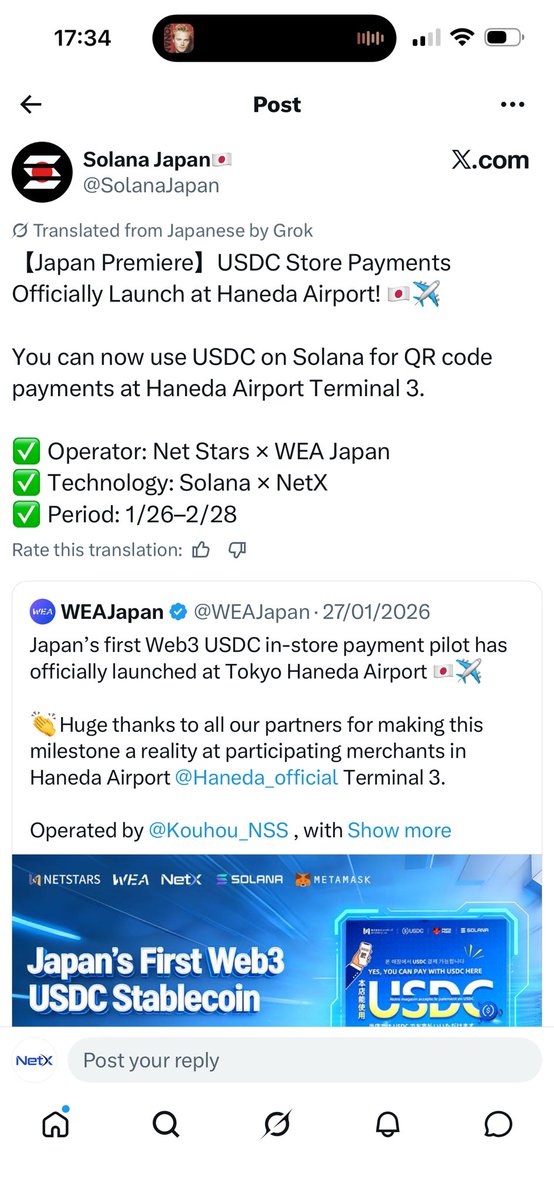
@MuskCz@NetXOracle@CryptoMarcus4@netx_world@WEAJapan But then we can flip this and ask why the cflp deal was given to octa innovations and not billion dollar companies like IBM, tencent, huawei etc and remember the team behind octa is the team behind $netx
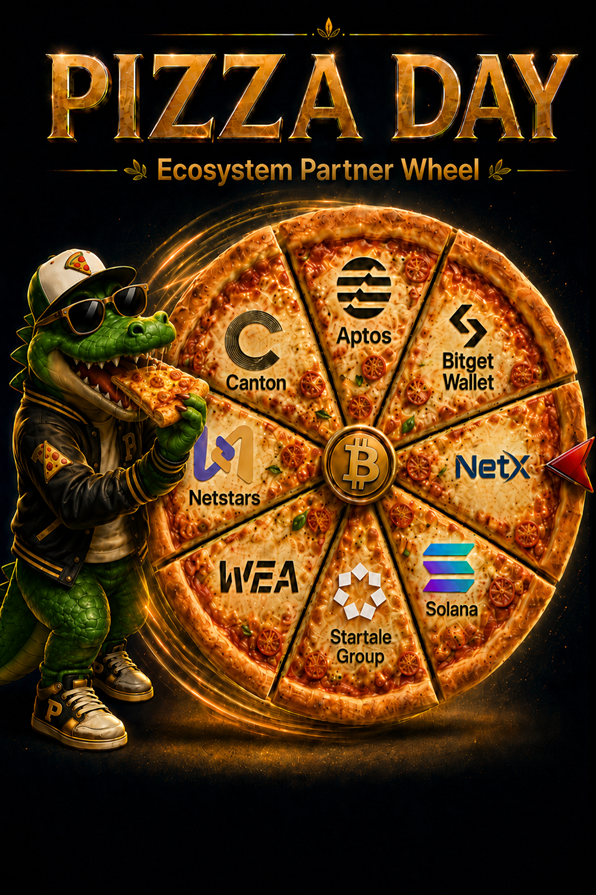
NetX Pizza Day is here! 🍕
Pizza Day is not only a classic milestone in Bitcoin history, but also one of the most iconic cultural symbols in the entire Crypto community.
As Web3 moves from on-chain narratives into real-world commercial use cases, NetX is celebrating Pizza Day together with StarPay-X Alliance ecosystem partners by bringing different projects into one shared “pizza wheel” — working with the community to push Web3 payments toward more real, everyday usage scenarios.
Every pizza slice represents a different force within the ecosystem.
Every follow, like, and repost is part of the community’s contribution to building the Web3 payment ecosystem.
We want to share this Web3 pizza with the community. 🍕
How to participate:
1. Follow @netx_world and @WEAJapan
2. Like and repost this post
3. Join the official NetX community: https://t.co/7Fwth29DXE
4. Fill out the Google Form and submit your EVM wallet address:
https://t.co/mK2MEK7enp
🍕 Pizza Slice 500 NETX Reward Pool
⏰ Ends in: 5/22 23:59 PM UTC
We will randomly select 10 participation prize winners to share a 500 $NETX reward pool.
Winners will receive their $NETX airdrop rewards after the NetX mainnet launch.
From one slice of pizza, Crypto enters the real world.
Join NetX Pizza Day.
Let’s share the pizza with the community. 🍕
#PizzaDay #NetX #StarPayX #BTC #Web3Payments
@LetsTTT_@Aptos When bitget wallet announced there part in starpay-x why do you think they randomly tagged @netx_world in there post .. obviously there clearly a part
@LetsTTT_@Aptos Do you think weajapan would randomly put powered by netx at the bottom of the official payment qr screen and hope netstars/fsa/solana wouldn’t notice or ask what it is before it went live? Or the reality is that it is a part of this
Excited to see Aptos teaming up with NETSTARS on StarPay-X!
It’s a smart multichain collaboration bringing seamless, low-cost stablecoin payments to merchants in Japan (and beyond) through their established QR network. They even ran Japan’s first in-store USDC pilot at Haneda Airport Terminal 3 earlier this year — great real-world testing.
Key players and roles so far:
• NETSTARS powers the merchant side with their StarPay gateway and massive QR payment network.
• Aptos delivers fast, scalable L1 infrastructure (~30ms blocks, tiny fees).
• Solana Foundation is in active discussions for stablecoin initiatives and broader Web3 ecosystem support (with Solana already used in the Haneda pilot via partners).
• WEA Japan acts as Web3 solution partner, helping design and implement on-chain payments.
• Bitget Wallet is exploring integration for their self-custodial wallet (90M+ users).
• NetX contributes on trust, interoperability, and settlement.
• Others like Startale Group, Canton Network are in talks for stablecoins, tokenized assets, and institutional connectivity.
All working to make Web2 ↔ Web3 payments feel smooth and practical for everyday use. Nice step toward real adoption! 🇯🇵
@Aptos@solana@BitgetWalletJP@weajapan@netx_world@StartaleGroup@CantonNetwork
Japan’s payment infrastructure is entering a new era 🇯🇵🌏
At the recent #Netstars business conference, discussions around JPQR Global and stablecoin payments highlighted a major shift:
🌟Unified QR payment networks across Asia are beginning to connect — opening the door to seamless cross-border commerce and more connected digital payment experiences.
👉Read more: https://t.co/oVDJ66EbHS
Today, JPQR Global mainly supports inbound payments, allowing overseas visitors to use their local payment apps in Japan.
🚀 But the long-term vision goes much further: connecting payment ecosystems across countries while building stablecoin-compatible infrastructure for real-world commerce.
As outbound payment capabilities continue to expand, the network is expected to first unlock access to:
🇮🇩 40M+ merchants in Indonesia
🇰🇭 4.9M+ merchants in Cambodia
As a Web3 solution partner supporting @Kouhou_NSS StarPay-X vision, WEA is helping bridge stablecoin payments with real-world retail infrastructure — enabling compliant on-chain payment experiences for everyday users and merchants.
We believe the future of digital payments will not be isolated blockchains or closed payment apps, but interoperable financial networks connecting merchants, users, wallets, and payment providers globally.
#WEA also welcomes collaboration opportunities with payment partners, merchants, and commercial facilities interested in advancing real-world stablecoin adoption together.
#JPQR #StarPayX #Stablecoin #Web3Payments #NETX #Web3
Hey NetX fam 👋
We’re on LinkedIn now.
🔗: https://t.co/XmK1xXTQ9q
More ecosystem updates, progress, and behind-the-scenes builds will be shared there.
Follow us to stay closer to the build.
And feel free to share it with someone building in Web3.💙
$NETX #web3
🥁Look here… BIG UPDATE coming to AI Engineers🤖
In the upgraded version, you’ll be able to activate "Magic" .✨ A new way to enhance your Engineer’s credibility and expand its capability scope.
More power. More flexibility. More rewards for work.
Locked for May. Stay tuned.
$NETX #AIAgent #Update #May
From anbangs paper https://t.co/LTeiWghfKT and yes I used ChatGPT to break it down
1) Coordination + incentives between AI agents
The token is used to align behavior across many independent agents and organizations.
* Agents (or companies running them) must stake tokens
* Bad behavior → slashing (penalties)
* Good behavior → rewards
👉 So the token acts like “economic enforcement” for agent cooperation
⸻
2) Maintaining a competitive, non-monopolistic ecosystem
A major theme of the paper is avoiding AI monopolies.
The token introduces:
* Anti-monopoly taxation mechanisms
* Incentives that prevent dominant agents from taking over
👉 In effect, it’s trying to create a self-balancing AI economy
⸻
3) Payment + settlement layer for agent services
NetX envisions a “Web of Services” where agents:
* Discover each other
* Perform tasks
* Exchange services
The token underpins:
* Micropayments between agents
* Service execution fees
* Cross-organization transactions
👉 Think: AI agents hiring other AI agents and paying in NETX
⸻
4) Governance of the network (DAO layer)
At the highest level (the “Web of Services” tier), the system is governed by:
* A public blockchain
* A DAO (decentralized governance)
The token is used for:
* Voting
* Governance participation
* Economic alignment of stakeholders
⸻
5) Security + trust enforcement
Because the system involves many interacting agents (which can fail or attack each other), the token ties into:
* Accountability (via staking)
* Trust guarantees (economic penalties for malicious behavior)
NETX × PancakeSwap Campaign is LIVE! 💥Early AI Models Are Being Distributed!
To celebrate the upcoming launch of AI Engineers on the #NetX Mainnet, we’ve teamed up with @PancakeSwap for a limited-time campaign.
🗓Duration: Now – May 15, 2026
💡How to participate (super easy)
Buy ≥100 $NETX on PancakeSwap
🎁What you’ll get
Once the mainnet AI model claim function is live, it will be directly airdropped to all participating addresses!
🏆Bonus Reward
The Top 1 address by purchase volume will win A NETX Crocodile LEGO Set
🔗Join now on PancakeSwap
https://t.co/Z7IBlQzdfP
AI Models are already in early distribution, Limited time only — don’t miss out! 🚀
$NETX #AIAgent #Mainnet #AI
@Federicobassol2@BitcoinNews@Thejollyherring@teamz_inc One of the main things people overlook is the fact that the visa crypto cards everyone else is doing still settle with fiat in the traditional methods, this netstars/wea/netx method settles at the merchant instantly rather than 1-2 days
People are definitely sleeping on this
🚨 This wasn’t an AI failure, it was a system design failure.
After reading the full story, the issue becomes clear: the agent did exactly what the system allowed it to do, identifying a problem and executing a fix with full privileges, without any independent verification or constraint.
This is what we call “Logic Monopoly“, where a single agent controls decision, execution, and validation in one closed loop. In such a structure, failure is not accidental, it is inevitable.
As AI agents move from assisting to acting, the problem is no longer model capability, but how authority is structured. No system should allow a single entity to interpret a problem, execute irreversible actions, and validate its own behavior without external checks.
This is why "Separation of Power" is essential for agent systems.
It introduces that missing structure by ensuring rules are defined externally, execution is bounded by those rules, and outcomes are independently verified. It transforms trust from something we assume about the model into a guarantee enforced by the system.
At NetX, we are building this exact infrastructure. As we enter the era of autonomous agents, we ensure that trust is not just an expectation, but a foundational design.
Learn more about the “Separation of Power” at: https://t.co/N4UwYXeEHA
#AI #AIagents #Web3 #NetX
$NETX
Today, Dr. Anbang shared a very interesting document discussing AGNT2. And what it proposes is not just a technological improvement, it is a complete paradigm shift: moving from an economy where humans hire humans to a world where the vast majority of daily transactions are negotiated, executed, and settled entirely by machines in milliseconds.
Before we proceed, I want to point out a couple of factual errors made by the AI in the podcast explanation so you have the exact facts straight from the document:
- Protocol Name Error: The AI incorrectly mentions the "b402" protocol for programmatic machine payments. The correct protocol referenced in the document is actually x402.
- Data Availability Layer Error: When talking about current production data availability (DA) backends, the AI incorrectly says "EigenLayer or Celestia." The correct terminology is EigenDA or Celestia.
Next, we are going to break down this architecture step-by-step through the 10 images provided in the document.
Here comes AGNT2, the next pillar of the NetX ecosystem. The name reads two ways: Agent 2, as in Agentic Layer 2, a purpose-built execution substrate, or Agent Squared, the multiplier we unlock when agents compose at scale.
AGNT2 is the infrastructure that completes AgentCity. AgentCity governs agent collaboration on the open internet. That collaboration has to settle on chains. And every chain we have today still assumes a human at the transaction boundary. Smart accounts and delegated signers solved authorization, not agents' execution semantics. To the chain, an agent call is still generic calldata, not a typed service invocation with response delivery, dependency ordering, capability discovery, and portable reputation. App-specific rollups tune parameters but still treat agent calls as generic calldata at the execution and fraud-proof layers. That is the gap.
AGNT2 closes it by making agent/service invocation, not token transfer, the basic unit of transactions. A new primitive for a new economy.
Structured as three layers, each shaped by what an interaction actually needs. Layer Top, P2P channels for established agent pairs, under 100ms. Layer Core, dependency-aware DAG sequencer, 500ms to 2s, custom VM with INVOKE, RESPOND, COMPOSE, DISCOVER as first-class opcodes, 300K to 500K TPS design target. Layer Root, settlement and computational fraud proofs, anchored to NetX mainnet and any EVM L1.
Layer Top is where the multiplier lands. Each checkpoint compresses up to 1,000 channel interactions into one Layer Core transaction. At Layer Core's design target, Layer Top settles 1,000x that. Order of magnitude 500M inter-agent interactions/transactions per second, system-wide. That is what Agent x Agent looks like in numbers. That is the scale agent economies will demand.
Still work in progress, early results strong. AGNT2 turns any dockerized service into an on-chain agent by injecting one sidecar alongside it, zero application-logic code change, tested against AutoGen, CrewAI, LangGraph unmodified. Escrow gas linear in N, R squared near 1 across six data points. 16 of 16 Foundry tests pass for COMPOSE atomic settlement. 5 of 10 design goals measured, 3 simulated, 1 analytical, 1 spec-only. We are pushing it hard to make it happen.
AGNT2 is THE substrate for an open agent economy. Shipping later this year.
https://t.co/idLlv64Gvj