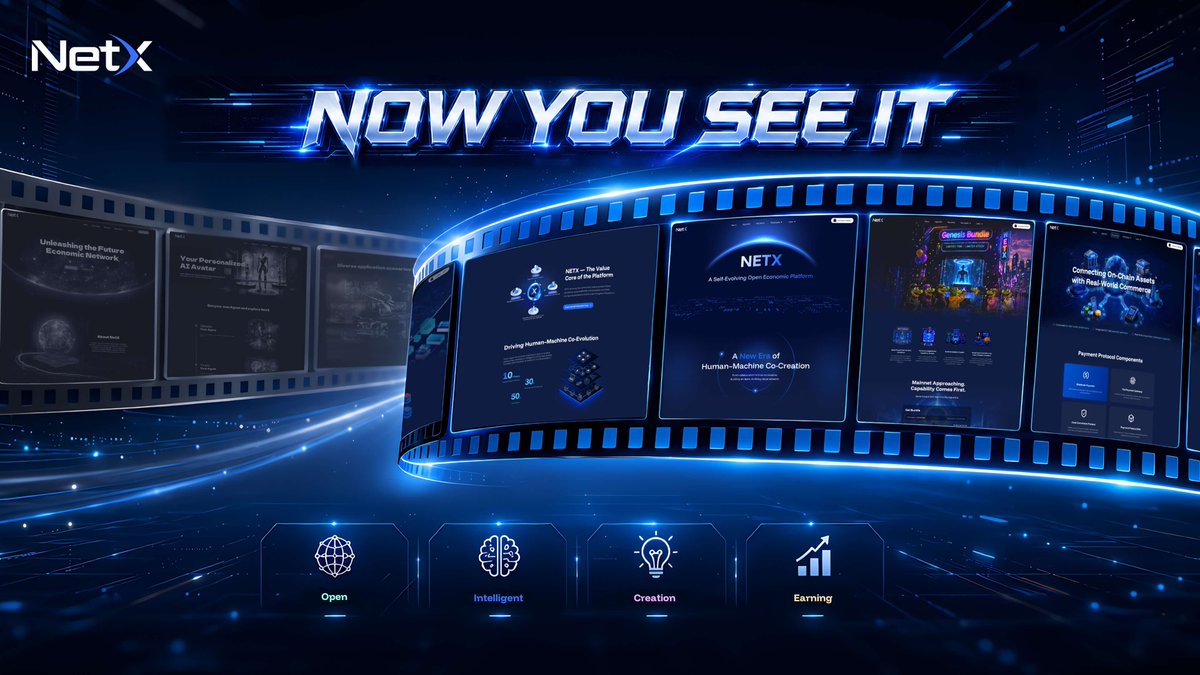
NetX Community May Recap
Looking back at May 2026, NetX completed several key milestones:
- The new website officially launched, making the ecosystem positioning clearer.
- AI Engineers returned with major upgrades, further strengthening the Agent capability system.
- The Ecosystem Partner Gateway opened, bringing collaborative incentive mechanisms into implementation.
- The AI Genesis Model Bundle launched, creating a closer connection between model assets and ecosystem rewards.
- Positive regulatory developments in Japan and payment patent progress opened up more possibilities for real-world payments.
- Community activities remained highly active, further strengthening global communication and ecosystem consensus.
May was not just another month of updates. It was an important starting point for NetX as it moves toward its next decade.
As the new mainnet, ecosystem features, partner network, and real-world payment scenarios continue to advance, NetX is moving from being seen to being used, and from ecosystem building to value release.
The next decade of NetX has officially begun.
look details at: https://t.co/gmKXNLygHd
💥More Than a New Website. A New Wave of Ecosystem Features Is Now Live!🚀
🤖Upgraded AI Engineers Are Back to Work
Credibility now scales with $NETX activation. More credibility → broader work → greater work rewards.
🔗 https://t.co/DJ8bPMeWMx
Future updates will gradually refine the value logic of Agents. Only #Agents holding the full set of models will be eligible for certain tasks.
Additionally, the type of AI models an Agent possesses will determine its work scope and role responsibilities.
In short, the more powerful and complete an Agent’s model set—and the more $NETX it holds—the more complex tasks it can perform within the NetX economy, unlocking commensurate network rewards.
🤝Ecosystem Partner Gateway (Phase 1) Is Now Open
The Foundation will provide additional incentives for users actively participating in the first phase of the ecosystem partner program.
🔗 https://t.co/DuFiTf57OJ
In addition, Ecosystem Shared Rewards will be distributed based on participant assessments.
🎁AI Genesis Model Bundle – Limited Edition
A first-of-its-kind initiative supported by the #NetX Foundation.
🔗https://t.co/HkxpB21PYi
Participants in the AI Genesis Model Bundle program will receive dedicated Foundation-sponsored incentives, with reward calculations already underway and distributions expected every 7 business days.
To ensure fair participation, reward eligibility is capped at a maximum of 100 model suites per wallet address (total incentive rewards not exceeding 11,200 $NETX).🥂
The next decade of #NetX has begun. Join the community, stay engaged, and be active.🐊
More features, more rewards, more opportunities are on the way.
Don’t fall behind.💙🏃
#NetX #AI #Web3 #AgentEconomy #Payments #DAO
The Next Decade Starts with Being Seen💥👀
The new #NetX website is now LIVE
🔗 Explore now: https://t.co/GuNrkYuzi2
After nearly a decade of relentless building, the vision is no longer hidden behind the scenes.
Welcome to the next decade of NetX ecological
🌐 A self-evolving economic network
⚡️Nexus:
Trusted infrastructure powering the future of AI and payments
🤖 AgentOS:
A structured runtime environment designed for intelligent agents
💳 Payments:
Connecting On-Chain Assets with Real-World Commerce
But this launch is only the beginning.
Together with our partners and DAO community, we will continue expanding real-world payment adoption, advancing AI Agent innovation, and building an economic network where technology creates measurable value.💪
📖Read more: https://t.co/5lhZoIC74u
The next decade starts now.
RT and join us on the journey.🚀
#NetX #AI #Web3 #Payments #AgentEconomy #DAOCommunity
@WhiteHouse Weekly reminder by the WH to show you that they are terrible liars. They even forgot to cut out the cleaner out of the picture while he was cleaning it in 2024 🤣🤣🤣🤣
🤔 How big is Japan’s payment market?
From a market data perspective:
> Japan’s cashless payments reached ¥141T in 2024
> QR / code payments alone accounted for ¥13.5T
> Even if just 1% of QR payment volume migrates to stablecoin settlement, that already represents a potential ¥135B annual on-chain payment market
🔥 This is exactly why global crypto companies are racing into stablecoin payments.
The real opportunity has never been simply issuing stablecoins.
It is about building compliant payment and settlement infrastructure connecting:
• Wallets
• QR payments
• Merchant networks
• Fiat settlement
• Real-world commerce
🌟 More importantly, Japan’s Financial Services Agency (FSA) has recently introduced new Cabinet Office regulations aimed at bringing foreign-issued stablecoins into Japan’s electronic payment framework.
This opens a major window for compliant stablecoin adoption in one of the world’s most advanced payment markets. 🇯🇵
🚀 This is also why WEA Japan is working together with partners including Netstars and NetX to help build the StarPay-X ecosystem.
Because once stablecoin payments enter real commercial networks, the market is no longer measured by the number of “crypto users.”
It becomes measured by national-scale payment volume. 🌏
#Stablecoin #RWA #Web3Payments #Japan #WEA #NetX #Netstars #StarpayX
AI + Blockchain + Payments = Unstoppable. Thats $NETX for you 🔥
Why $NETX Is Positioned to Be the Next Big Thing in Crypto
The crypto industry has seen waves of innovation: DeFi, NFTs, Layer 1s, and memes. But the next true breakout narrative is already forming in plain sight: the seamless fusion of Artificial Intelligence, Blockchain, and real-world Payments.
When these three forces collide, they don’t just add up, they multiply.
✅AI brings intelligence and autonomy.
✅Blockchain delivers trust, transparency, and immutability.
✅Payments provide the ultimate utility layer that connects everything to the real economy.
The projects that master this convergence will define the next era of crypto. And one project is building exactly for this moment: $NETX @netx_world.
The Unstoppable Equation
AI Agents are rapidly evolving from chatbots into autonomous economic actors. They can already browse, negotiate, decide, and transact.
But for agents to handle real money at scale, they need:
1. Intelligence (AI)
2. Verifiable trust and security (Blockchain + Trusted Computing)
3. Seamless, stable, on/off-ramp payment rails (Payments)
Most projects nail one or two of these. Very few are architected from the ground up to deliver all three in a unified, production-ready system.
This is where $NETX stands out.
$NETX: Purpose-Built for the AI + Blockchain + Payments Future.
$NETX is a modular economic network that natively integrates blockchain and AI to power human-machine collaboration through intelligent agents. Its core thesis is simple but powerful: create the infrastructure where AI agents can securely, stably, and verifiably handle real economic activity, especially payments and real-world asset (RWA) interactions.
Here’s why its design is particularly potent right now:
Trusted Computing Foundation: Built on Trust Smart Chain (TSC) with Trusted Execution Environments (TEE).
This isn’t just another blockchain, it prioritizes verifiable security and stability, which is non-negotiable when AI agents are moving real money.
AI Agents at the Core: $NETX is advancing both Personal Agents (for community participation) and Enterprise Agents (for complex payments, settlements, and business logic). Agents aren’t an add-on; they’re central to how the network operates.
Payments: The project emphasizes Trusted Web3 Payments that are Secure • Stable • Verifiable. This aligns perfectly with the exploding demand for agentic commerce (see Google’s AP2, Coinbase’s x402/Payments MCP, and Stripe’s machine payments initiatives).
RWA & Real-World Bridge: By focusing on real entity behavior data and on-chain monetization, $NETX aims to connect decentralized systems directly to real economic activity.
In short: $NETX isn’t trying to be “AI crypto” or “payments crypto.” It’s building the intersection where AI agents can actually do useful economic work on a secure, decentralized rails.
Why This Matters Now
The timing is ideal. Major players (Coinbase, Google, Stripe, Cloudflare, Visa) are all racing to define standards for AI agent payments. Regulatory clarity is improving in key markets (notably Japan’s recent moves on stablecoins). And enterprises are desperate for secure, compliant ways to let autonomous systems handle transactions without constant human oversight.
$NETX is already executing on this vision:
New website and community-driven rebrand signaling a clear strategic direction.
Mainnet in advanced pre-launch verification with heavy focus on security and stability.
Significant AI Agent system upgrades underway.
Active progress in real-world payment partnerships and infrastructure.
This isn’t vaporware or pure narrative. It’s infrastructure being built for the exact use case the market is demanding.
The Bull Case for $NETX Project that successfully combine AI intelligence + blockchain trust + payment utility have a structural advantage:
Defensibility: Trusted computing + modular agent architecture creates real technical moats.
Utility Flywheel: As more agents use the network for payments and settlements, demand for $NETX (for gas, staking, agent capabilities) increases.
Narrative Alignment: It sits at the center of multiple mega-trends: AI agents, RWAs, stablecoin adoption, and decentralized infrastructure.
Community & Fairness: Emphasis on contribution-based rewards and DAO involvement gives it grassroots energy alongside enterprise ambitions.
In a market increasingly dominated by real utility and adoption, NETX’s focus on verifiable, stable, AI-driven payments positions it as more than just another token, it positions it as critical infrastructure.
The Bottom Line
AI + Blockchain + Payments isn’t just a catchy phrase.
It’s the logical endpoint of where decentralized technology is heading. Most projects are still playing in one corner of this triangle. $NETX is deliberately building at the center, with the security architecture, agent framework, and payment focus required to make autonomous economic activity actually work at scale.
As AI agents move from experimental to economically active, the networks that can provide them with secure, stable, and verifiable rails will capture enormous value. $NETX is building exactly that system. The convergence is coming.
The only question is which projects will be ready when it arrives. $NETX is positioning itself to be one of them.
This is not financial advice. Crypto investments carry risk. Always do your own research.
@netx_world@NetXDAO@WEAJapan@Kouhou_NSS@web3_jp_infra@NNGNetX@anbangr
#NETX $NETX #AI #Blockchain #Payments #Web3 #Crypto #AIagents #RWA #Web3Payments #TrustedComputing #AgenticCommerce #Stablecoins #Mainnet #NextBigThing #CryptoNarrative
@EliPear45270452@MaxHoukes@OlenaRohoza You are far from being a freedom heaven on al lists. Europe is an economic superpower and pray they won’t dump the 3.1T debt on the great superpower.
Look what’s here 👀😎
As global #Web3 payments continue moving toward real-world adoption, infrastructure reliability and security are becoming increasingly important.
#WEA Japan has obtained a Japanese patent related to blockchain-based payment systems and trusted exchange-rate verification mechanisms 🇯🇵
The patented architecture leverages multiple oracle machines, contract-based verification, and secure payment execution logic to improve the reliability of digital payment processing while reducing risks caused by single-point failures.
🚀This marks another step forward in building compliant, secure, and scalable Web3 payment infrastructure for real-world commercial scenarios.
🔗Patent view:
https://t.co/WdmuLAJzIW
🔥By the way — more of WEA’s core patents and technologies will be gradually updated on the official website.
Stay tuned.
#BlockchainPayments #Japan #infrastructure #RWA #Web3Payments #NetX #blockchain #security
Last reply from me.
I’m getting tired of going back and forth on the same points — we both tend to see what we want to see. @NetXOracle has already answered most of these questions multiple times.
Let’s just agree to check back in a few months and see how things actually play out. Time will tell who was closer to reality.
Wishing you the best either way.
I respect the continued skepticism btw, especially given Trias history. The burden of proof is indeed high, and I’ll address your points directly with what’s verifiable today:
1. Netstars official statements Netstars has publicly announced StarPay-X (their Web3 payment gateway) and the Haneda pilot. WEA Japan is their official Web3 partner and repeatedly names NetX as the trusted computing layer. LUN Partners (Netstars investor) also explicitly credits NetX in their portfolio update. Corporate partners rarely name every backend provider, but the technical integration is documented across ecosystem updates.
2. Pilots working without token Correct, the Haneda pilot is testing the infrastructure layer (trusted computing, settlement logic, compliance). The $NETX token becomes the gas, staking, governance, and incentive mechanism after Mainnet (target June 25). This is standard for infrastructure projects: infrastructure is proven first, token utility activates at mainnet.
3. Independent confirmation
• LUN Partners (Netstars investor) included NetX in their official portfolio as the trusted layer for Haneda.
• Aptos and Solana collaborations are active for multi-chain payments.
• FSA’s recent recognition of foreign stablecoins clears the regulatory path for scaling. These are not just “shiller narratives.”
4. OCTA private ledger vs public token OCTA handles private ledger/compliance. NetX is the public trust/verification layer for interoperability, transparency, multi-chain settlement, and future agent economies (AGNT2 framework). The hybrid model (private + public) is intentional for regulated global scaling.
5. On-chain activity Haneda Terminal 3 USDC payments + USDT on Solana via WeaPay are live with real merchants and users. It’s still pilot scale, but it’s real commercial usage. Mainnet + staking will scale measurable NETX on-chain activity significantly.
6. WEA independence WEA Japan is a separate legal entity with its own patents in secure payments. While there is leadership overlap (common in early regulated ecosystems), they handle compliance/contracting while NetX provides the core trusted computing backend.
7–8. Token essentiality & Mainnet
The token is planned as gas/staking/governance post-Mainnet. Until then, pilots run on the infrastructure layer. We are still pre-Mainnet. This is the current reality.
9–10. Regulation & old partners
Japan’s strict regulation is exactly why everything moves carefully through licensed entities like WEA and Progmat. Old Chinese partnerships (Huawei, BSN etc.) were earlier Trias-era mentions; the current focus is clearly Japan/Asia stablecoin payments.
Bonus: The pilots work without the public token because they are testing the backend infrastructure. The token becomes essential for economic incentives, security, and scalability once Mainnet launches.
Like is said, I understand the skepticism. mMany projects in this space overpromise, and Trias had its issues. Let me address your points directly with what we actually know today.
1. Netstars & Public Mentions
Netstars has publicly launched StarPay-X (their Web3 payment gateway) and the Haneda USDC pilot. WEA Japan (their official Web3 partner) and LUN Partners (Netstars investor) both name NetX as the trusted computing layer. Corporate partners rarely shout out every backend tech, but the ecosystem updates and technical integration are documented.
2. Haneda Pilot & Token Utility
The pilot is live and expanding (Phase 2 already rolling out). NetX provides the trusted computing backend (TEE/ZKP, verifiability, compliance proofs). The token itself is not needed for the pilot — it is planned as gas, staking, points, and buyback/burn mechanism on Mainnet (target June 25). Many infrastructure projects start with pilots before token utility kicks in.
3. Independent Confirmation
• LUN Partners (Netstars investor) included NetX in their official portfolio update as the trusted layer for Haneda.
• Aptos and Solana collaborations are active.
• FSA recently recognized foreign stablecoins, clearing the path for scaling.
4. OCTA vs Public Chain
OCTA is their private ledger tech. NetX is the public trust/verification layer for interoperability, transparency, and multi-chain settlement. The hybrid model (private + public) is intentional for compliance and scalability.
5. Current On-Chain Activity
Haneda Terminal 3 USDC payments are live with real users and merchants. USDT on Solana via WeaPay is also active. It’s still pilot scale, but it’s real merchant usage. Mainnet + staking will scale this.
6. WEA Independence
WEA Japan is a separate company with its own (multiple) patents in secure payments. While there is overlap in leadership (common in early ecosystems), they have distinct roles: WEA handles compliance/contracts, NetX provides the trusted computing backend.
Bonus especially for me: The pilots worked without the public token because they were testing the infrastructure layer. The token becomes essential on Mainnet for gas, staking, governance, and economic incentives ,standard for infrastructure projects.
I get the skepticism because everything that happened before. $NETX is still a small project and many micro-caps overpromise. But let me answer your questions.
1. NetX is not trying to replace Circle/Stripe/Visa. It’s the trusted computing & settlement layer underneath them. Think of it as the secure backend that makes stablecoin payments work in regulated environments (TEE/ZKP, verifiable execution, compliance proofs). Haneda Airport is already using it live for USDC payments via StarPay-X.
2. Unique advantage: NetX focuses on agent-native execution + constitutional governance (see the recent AgentCity & AGNT2 papers by the founder). It’s built for multi-agent economies where reliability and accountability matter, something general-purpose chains like Solana or Polygon aren’t optimized for. The Separation of Powers model is a real technical differentiator.
3. Stablecoin issuers: NetX doesn’t issue stablecoins, it powers the settlement layer. USDC is already live at Haneda through the Netstars + WEA + NetX stack. JPYC is part of the official alliance. More integrations are in progress (Canton exploration, Aptos collaboration).
4. Netstars mentions: Netstars has publicly announced StarPay-X and the Haneda pilot. WEA Japan (their Web3 partner) and LUN Partners (their investor) both name NetX as the core trusted computing provider. Corporate partners often don’t shout out every backend tech, but the official ecosystem updates do.
5. On-chain activity: Haneda Terminal 3 USDC payments are live and expanding (Phase 2 already rolling out). USDT on Solana via WeaPay is also active. It’s still early/pilot scale, but it’s real merchant usage, not theory. Mainnet (target June 25) and staking will scale this significantly.
NetX isn’t trying to be the next Visa. It’s building the trust & settlement infrastructure for the next wave of regulated Web3 payments in Asia and beyond. With Haneda live, FSA regulatory clarity, and partners like Netstars, Progmat, Aptos, and Canton interest, the pieces are coming together.