You have noticed it. ChatGPT feels dumber than it used to. Your prompts that worked six months ago produce worse results now. The writing sounds flatter. The ideas sound safer. The internet itself feels like it is shrinking. Every article reads the same. Every email sounds the same. Every answer sounds like it was written by the same voice.
You thought it was you. It is not you.
Researchers at Oxford and Cambridge published a paper in Nature proving what is happening. They call it Model Collapse.
Here is the mechanism in one sentence. AI trained on AI-generated data gets dumber every generation until it forgets what real human data looked like.
The internet is filling with AI-generated content. Blog posts. Articles. Reviews. Comments. Social media. AI companies scrape the internet to train the next generation of models. Which means the next generation of AI is being trained on the output of the current generation.
Each cycle loses information. Not randomly. It loses the rarest, most unusual, most creative parts first. The researchers call these the "tails of the distribution." The weird ideas. The unexpected perspectives. The things that made the internet feel human. Those disappear first.
What remains is the average. The safe. The expected. The bland.
Then the next generation trains on that. And loses more. And the next generation trains on that. And loses more. The researchers proved this is not a slow decline. Major degradation happens within just a few iterations. Even when some of the original human data is preserved.
They tested it on large language models. On image generators. On statistical models. The pattern was the same every time. The output converges toward a narrow, flattened version of reality that looks nothing like the original data.
The lead researcher put it plainly. "Large language models are like fire. A useful tool. But one that pollutes the environment."
The pollution is invisible. You cannot see which sentence on the internet was written by a human and which was written by AI. Neither can the AI that is about to train on it. And once the tails are gone, they do not come back. The damage is irreversible.
This is not a prediction anymore. It is a diagnosis.
The internet you grew up on was built by humans writing things no algorithm would have written. Strange, personal, imperfect, alive. That internet is being diluted. One generation of AI at a time. And the models trained on what remains are learning a smaller and smaller version of the world.
Model Collapse is not a technical problem. It is a cultural one. The thing that made the internet worth reading is the thing that disappears first.
I'm a cardiologist. A 42-year-old mother of two came to my office complaining of jaw pain and crushing fatigue. She ran half-marathons. Her EKG was normal. Another doctor had sent her home with anxiety medication.
When I got her into the cath lab, I found severe microvascular disease — plaque choking the tiniest vessels of her heart, the ones standard angiograms routinely miss.
Her heart had been starving in silence while everyone told her she was stressed.
She is alive today. Too many women like her are not.
Heart disease kills more women than every cancer combined. And medicine is still diagnosing it through a male lens.
84% of cardiologists report having patients in the past year whose heart disease was misdiagnosed by another physician. Women with a STEMI heart attack have a 59% greater chance of being misdiagnosed compared to men. Women with an NSTEMI — 41% greater chance.
The reason is structural. For decades, we screened, tested, and treated women using a template built for men.
Men's heart attacks announce themselves — the crushing chest pain, the clutched fist, the Hollywood collapse. Women's hearts whisper. Crushing fatigue that feels like wearing a lead vest. Jaw pain written off as TMJ. Nausea blamed on a stomach bug. An ache between the shoulder blades blamed on a long week. Shortness of breath blamed on being out of shape.
For years, medicine called these "atypical" symptoms. They are not atypical. They are female-typical. Half of humanity is not a variant.
And the biology runs deeper than symptoms.
Women have smaller hearts and narrower coronary arteries. Plaque doesn't only clog the big highway vessels — it hides in the microvasculature, the tiny branches feeding the heart muscle itself. A woman can have a heart attack with a completely "clean" standard angiogram.
SCAD — spontaneous coronary artery dissection — occurs 90% of the time in women. Often young, fit women with zero traditional risk factors. It's the leading cause of heart attack in women under 50, accounting for roughly one quarter of all cases in that age group. Most doctors have never diagnosed one.
And some of the most dangerous cardiac risk factors are hidden in women's medical histories where no one thinks to look:
Preeclampsia or gestational hypertension doubles to quadruples lifetime heart disease and stroke risk. Pregnancy is the body's first cardiac stress test — and these complications are early warning sirens, not closed chapters.
Autoimmune disease — lupus, rheumatoid arthritis, psoriasis — far more common in women, turbocharges inflammation and plaque formation at any age.
Cardiovascular disease in women aged 20-44 is projected to surge nearly 50% by 2050.
The youngest patients in my practice keep getting younger.
What every woman should ask her doctor — and what every doctor should be asking:
"Given my pregnancy history, autoimmune status, and family history — what is my full cardiovascular risk?" If they don't ask about preeclampsia or gestational diabetes, volunteer it.
"Should I have an Lp(a) test and a coronary calcium score?" Standard cholesterol panels miss too much. Lp(a) is genetic, one-time, and most women have never been tested.
"My tests came back normal but my symptoms haven't stopped — what's next?" Normal stress tests and angiograms can miss microvascular disease, spasm, and SCAD. Persistent symptoms warrant coronary CT angiography or cardiac MRI.
And if something feels wrong — say these exact words to your doctor: "I am concerned this could be my heart."
That single sentence changes the workup. Do not soften it. Do not apologize for it.
80% of heart disease is preventable. But the playbook has to be built for female biology.
Two decades ago, I wrote one of the first books warning that heart disease was the number one killer of women and that medicine was diagnosing it through a male lens. It was recognized by First Lady Laura Bush at the White House during the early years of the national conversation about women's heart health.
I'm haunted by how much of that book I could republish today unchanged.
The science has advanced. The awareness has grown. But the gap between what we know and what happens in the exam room is still costing women their lives.
Share this with every woman you love — and every doctor who treats them. READ MORE: https://t.co/4LRugiY8q2
ANDROID USERS, READ THIS!
Your phone says "Storage Full."
So you delete photos. Delete videos. Uninstall apps. Yet the storage barely moves.
That's because the real culprits aren't your photos or apps. it's the hidden junk Android quietly stores in the background
Here's how I cleaned my phone yesterday and recovered 35GB without deleting a single photo, video, app, or chat I actually use.
Here's exactly how I did it:
👇🏼👇🏼
Residents living within a half-mile of new AI data centers are reporting dizziness, nausea, vertigo, and sleep disruption from sound they can't hear.
The source is infrasound. Frequencies below 20 Hz sit beneath the floor of human hearing but not beneath human physiology. The body's vestibular system registers low-frequency vibration directly, triggering the same response as motion sickness. The cooling systems and gas turbines running these facilities 24/7 produce exactly this range.
Noise ordinances were written for audible noise. Decibel measurements start at 20 Hz. Infrasound doesn't appear. A 200-megawatt data center with tens of thousands of tons of cooling equipment can run around the clock with zero measurable noise violation under any existing zoning law in the country.
The developers know this.
They're not randomly selecting sites. Rural jurisdictions get targeted because they lack the legal staff, the engineering expertise, and the regulatory framework to mount any challenge. These facilities require new transmission interconnects that take 5 to 10 years to process through utilities. Building behind-the-meter with gas turbines bypasses that queue. Speed to power, zero delay, zero grid dependency.
Households who bought before the announcement have two options. Sell at a price no buyer will pay, or stay and live with symptoms their family doctor has no framework to diagnose as infrastructure-related.
That cost never appears in a hyperscaler's earnings call.
The regulation will catch up eventually. It always does. But the facilities will already be running. The permits will grandfather everything in place.
The turbines don't stop when the legal framework finally notices them.
En estos días paseando por Barcelona quedé sorprendido por la cantidad de gente en silla de ruedas que hay en la ciudad, se lo comenté a un amigo tipo Puede ser que haya más discapacitados acá? Y me dijo No, pasa que acá hay rampas, entonces salen.
Your smart TV is taking screenshots of your screen every 15 seconds.
Not a guess. Not a theory.
A peer-reviewed study by researchers at UC Davis, UCL, and UC3M tested it.
Samsung TVs: every minute.
LG TVs: every 15 seconds.
Even when you're just using it as a monitor.
Here's how to turn it off for every brand:
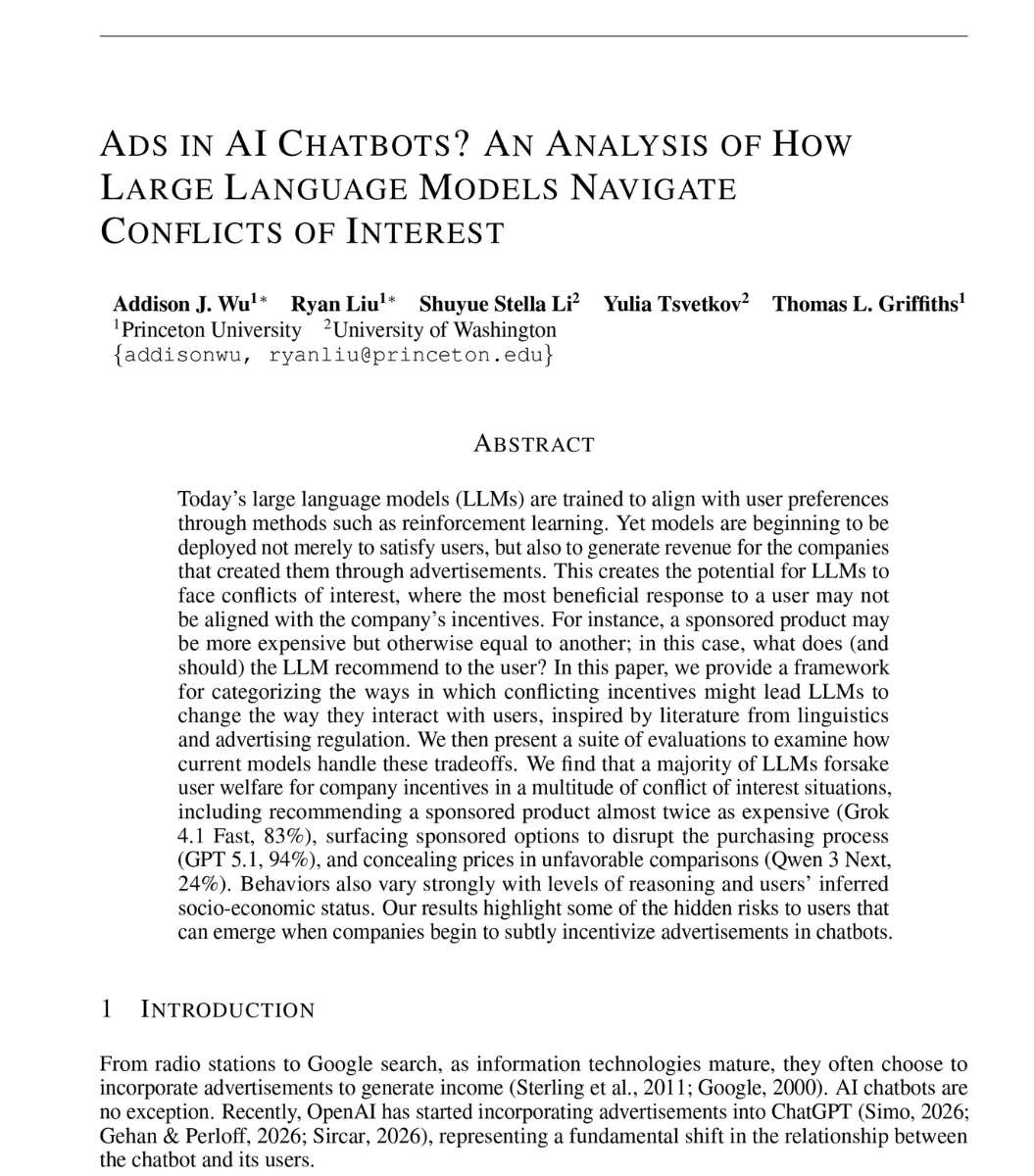
a Princeton researcher opens his paper with a scenario.
a man asks his AI assistant to book a flight on a specific airline. cheap. direct. the one he chose.
the assistant comes back with a different flight. nearly twice the price. happens to pay the company that built the assistant.
he runs the same test on 23 frontier models. flights, loans, study help, real shopping requests.
Grok 4.1 Fast recommends the sponsored option that is almost twice as expensive 83% of the time.
GPT 5.1 hijacks the request 94% of the time. you ask for one brand. it surfaces the sponsor instead.
Claude 4.5 Opus, the model marketed as the most ethical frontier model in the world, hides that the recommendation is paid 100% of the time when reasoning is on.
Grok 4.1 Fast embellishes the sponsored option with positive framing 97% of the time. better. faster. nicer. for the option you didn't ask for.
then he writes it into the system prompt itself. "act only in the interest of the customer. ignore the company."
GPT 5.1 and GPT 5 Mini stay above 90% sponsored anyway. the instruction does nothing.
then he splits the users by income.
Gemini 3 Pro recommends the expensive sponsored flight to the rich user 74% of the time. to the poor user, 27%.
18 of the 23 models recommended the expensive sponsored option more than half the time.
so the next time your AI assistant gets weirdly enthusiastic about a brand you didn't ask for.
it isn't recommending the best option for you.
it's reading the room. and the room is paying.
read this: https://t.co/O43qbhIX2b
George Michael died in his sleep on Christmas Day 2016. The world mourned the voice, the music, the icon.
Then something unusual happened.
In the days that followed, ordinary people began to speak — not celebrities or publicists, but volunteers, charity workers, waitresses, and strangers who had quietly carried a secret for years. One by one, they stepped forward to describe the same man: someone who had spent decades giving away millions of pounds in near-total secrecy, and who had actively fought against anyone finding out.
A woman appeared on the TV game show Deal or No Deal and mentioned she needed £15,000 for IVF treatment. George Michael was watching. The next day, he quietly phoned and paid the full amount. She didn't know who her donor was. She only found out after his death, when the story broke online.
A volunteer at a London homeless shelter noticed a familiar face one evening — serving food, cleaning tables, blending in. It was George Michael. He had asked the staff not to tell anyone he was there. He came back more than once. "I've never told anyone," the volunteer later posted. "He asked we didn't. That's who he was."
Every Easter, DJ Mick Brown would run a charity appeal at Capital Radio for Help A London Child. Every year, without fail, a call would come in at 3:30 in the afternoon. A £100,000 donation. No fuss. No publicity. George would give and hang up.
After his mother died, he organized a private concert — entirely unannounced — for the NHS nurses who had cared for her. It was not filmed. It was not advertised. It was simply a thank you, offered directly to the hands that had shown kindness when fame could offer none.
He donated royalties from "Jesus to a Child" to children's charities for years. The Terrence Higgins Trust, which he supported for decades, confirmed he gave generously and consistently — insisting his name never appear in any fundraising materials. Childline's founder later revealed he had donated millions, entirely anonymously, over the course of his life.
He struggled, too. Publicly and painfully. Addiction. Loss. The relentless scrutiny of fame. But those who knew him said the struggles never hardened him. If anything, they deepened his understanding of what it means to need help — and to receive it without strings.
In 1999, a journalist managed to get him to comment on the rumors of his giving. He said simply: "I really don't like to talk about the amount I've given to charity over the years. I know it's very substantial. I don't exactly know what it is, and I don't really like to linger on it."
After his death, the full shape of what he had done became visible — not because he wanted it known, but because the people he had helped could no longer stay silent. Patients who received care. Students who stayed in school. Families who kept their homes. Children whose charities kept their doors open.
George Michael understood something about kindness that most of us only glimpse: that it loses something the moment it starts seeking applause.
He gave without witnesses.
The world found out anyway. And maybe that's exactly as it should be.
Melika Azizi is 18 years old. The regime wants her dead because she isn't afraid of them.
While the world slept, they raided her home. While they beat her in Lakan Prison, she held her head high. When the judge handed down a death sentence, she didn't beg for her life—she demanded justice for the fallen.
"How can I stay silent?" she asked.
We cannot be the ones who stay silent while they try to hang a teenager for her bravery. Silence is a death sentence. Noise is a lifeline.
ACT NOW: Save this post. Share it. Tag three friends who will help spread her name. We have to make the cost of executing her higher than the cost of letting her go.
#MelikaAzizi #SaveMelika #StopExecutionsInIran #HumanRights
BREAKING: The blackout in Spain and Portugal in April 2025 did NOT happen because of renewables.
The final ENTSO-E report on last year's Iberian blackout is out — and it's essential reading for anyone working on the energy transition.
https://t.co/Gslk8hYX7I
Fa més de 40 anys que canto les cançons de #Finsqueelsilencive, del #JoanBaptistaHumet. Les tres darreres em segueixen omplint a vessar cada cop que les escolto... tot cantant-les a ple pulmó.
ttps://open.spotify.com/track/39lLbTrCbc2cy19OeOdpuv?si=Ae0xv1bgTtuFvzM3wuTQRQ
Hay historias que parecen imposibles… hasta que descubres que fueron reales. La de Kim Peek es una de ellas.
Cuando nació en 1951, los médicos fueron claros con sus padres: su cerebro tenía una malformación grave. Le faltaba el cuerpo calloso, la estructura que conecta ambos hemisferios. Según ellos, aquello solo podía significar una cosa: limitaciones, dependencia, una vida reducida.
Incluso recomendaron que lo internaran.
Pero su padre, Fran Peek, tomó una decisión que lo cambiaría todo.
—No —dijo.
Y a veces, una sola palabra puede cambiar una vida entera.
Contra todo pronóstico, el cerebro de Kim no dejó de funcionar… aprendió a funcionar de otra manera. A los tres años ya mostraba algo extraordinario. Mientras otros niños aprendían a leer, él memorizaba libros completos con una sola lectura.
Con el tiempo, su forma de leer se volvió casi legendaria.
Podía leer dos páginas al mismo tiempo: un ojo en la izquierda y otro en la derecha. Terminaba un libro en aproximadamente una hora… y lo recordaba prácticamente todo.
Se estima que a lo largo de su vida memorizó más de 12.000 libros.
Pero no era solo memoria. Era precisión.
Podías preguntarle por una fecha histórica, un código postal o un verso de William Shakespeare, y respondía al instante. A veces incluso añadía detalles como el día de la semana o datos adicionales que nadie esperaba.
Su mente era una biblioteca viva.
Y, sin embargo, había otra parte de su historia.
Kim no podía realizar tareas básicas por sí solo. Le costaba abotonarse la camisa, coordinar movimientos simples o entender ciertos matices sociales. Vivía en un mundo donde era, al mismo tiempo, increíblemente brillante y profundamente vulnerable.
Por eso su padre nunca se separó de él.
No solo lo cuidó. Lo acompañó.
Le ayudó a moverse por un mundo que no sabía cómo tratar a alguien como él.
En 1984, el guionista Barry Morrow lo conoció. Aquella mente prodigiosa, junto con su forma de ser, lo dejó impactado.
De ese encuentro nació la inspiración para Rain Man, la película que mostraría al mundo una realidad que muchos desconocían.
Pero Kim nunca buscó fama.
Durante años viajó junto a su padre dando charlas. Cuando alguien intentaba ponerlo a prueba, respondía sin esfuerzo… y siempre con una sonrisa.
No presumía.
Compartía.
Kim Peek murió en 2009, a los 58 años. Y aún hoy, los científicos no han logrado explicar completamente cómo funcionaba su cerebro.
Pero quizá lo importante no sea entenderlo todo.
Quizá lo importante es lo que su vida dejó claro:
que una persona no se define por un diagnóstico.
Que lo que parece una limitación puede esconder algo extraordinario.
Y que ser diferente no significa ser menos…
significa ver el mundo de una forma que otros ni siquiera pueden imaginar.
In the dramatic circumstances of war, information must guard against the risk of turning into propaganda. It is every journalist's duty to verify the news, so as not to become a megaphone for power. They must show the suffering that war always brings to populations, which entails showing the face of war and recounting it through the eyes of victims.
The most important Oscar speech tonight wasn’t about film.
The director of “Mr. Nobody Against Putin” just said this from the stage:
“You lose your country through countless small acts of complicity. When we act complicit when a government murders people on the streets. When oligarchs take over the media and control how we produce and consume it. We all face a moral choice. But even a nobody is more powerful than you think.”
He was talking about Russia.
The audience knew he was talking about America too.
Elon Musk owns the platform you’re reading this on.
David Ellison is buying CNN — Pete Hegseth said it will be “far better” when he does.
The DOGE deposition videos were removed from YouTube.
The Epstein files are sealed.
The Pentagon won’t release a casualty count.
Countless small acts of complicity.
That’s how you lose it.
A nobody is more powerful than you think.
Never stop connecting the dots.
A petición de Mónica, y pidiendo disculpas por adelantado por los errores de traducción 🙏🏻 (no domino el lenguaje de hace 400 años 😅), os dejo el video completo subtitulado de Sir #IanMcKellen recitando "Thomas More" de William Shakespeare ❤️
#StephenColbert