Drexel College of Med. | Neurobiology & Anatomy. Our research focuses on plasticity and functional recovery after spinal cord injury. Account is managed by lab
Multi-session transcutaneous spinal cord stimulation prevents chloride homeostasis imbalance and the development of spasticity after ... https://t.co/6KRfGZsdQJ #biorxiv_neursci
Preprint of our @mpcotelab latest work using noninvasive spinal cord stimulation to mitigate the development of spasticity after spinal cord injury!
https://t.co/t6jaJ6L8nk
Absolutely thrilled to share our latest preprint from the @mpcotelab demonstrating the effects of KCC2 enhancers on reflex and locomotor pathways after SCI! @simonmdanner@gwihelm
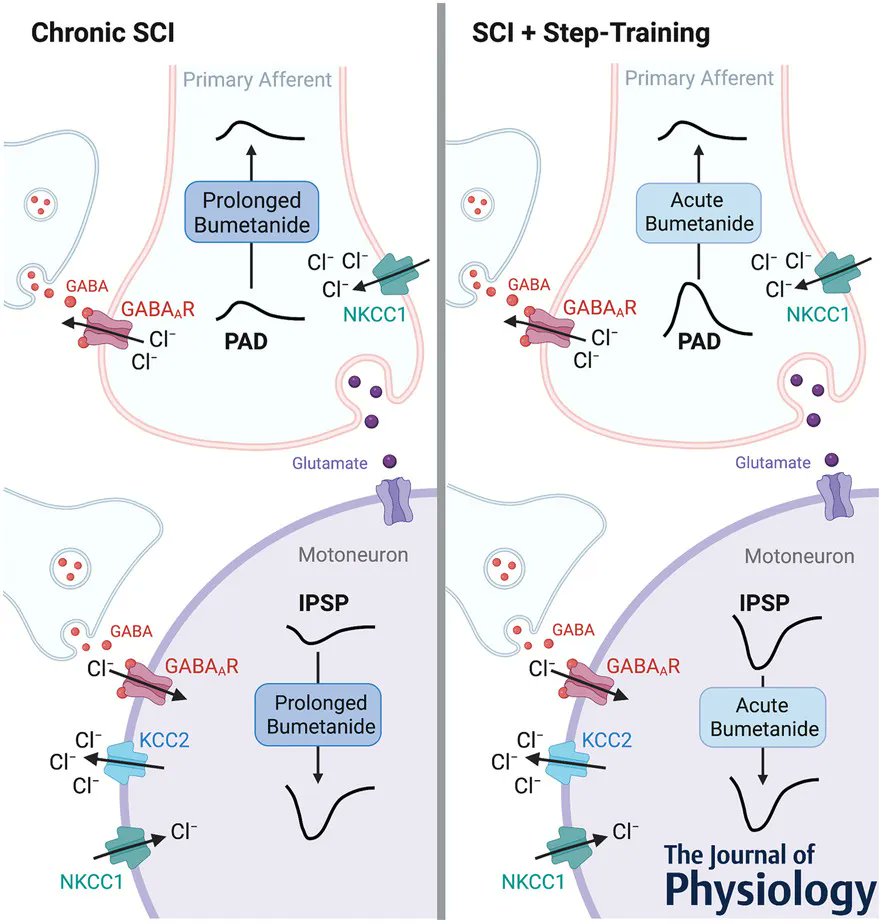
@gwihelm, @bilchak_j and @mpcotelab (@mmscrc) show how bumetanide changes postsynaptic inhibition after chronic SCI and step-training!
📜https://t.co/PpxzR1z8V4
What impact does spinal cord injury have on primary afferent depolarization interneurons and what is the ultimate impact on flexor muscle group I afferents? Excellent new study from @mpcotelab@DrexelNeurobio@Drexel_med_grad Read it now 👉 https://t.co/dJoSZKvtNT
Interested in an NIH-funded post-doc in an outstanding research laboratory at the University of Florida? If so, check out the details on the laboratory website of Dr. Ashley Smuder in the Department of Applied Physiology and Kinesiology
https://t.co/blLnrQJCrD
Proud to show you my work at @mpcotelab. In this study, I developed a decerebrated rat preparation to investigate the effects of spinal cord injury and step-training on the presynaptic inhibition that was first described by John Eccles et coll. in the 60s.
https://t.co/YjIF937a4m
And another one hot off our bench! @gwihelm uses a decerebrated prep to show how pre-synpatic inhibition is reorganized after chronic SCI and restored with step-training https://t.co/iJHQwa7Oif
Direct evidence for decreased presynaptic inhibition evoked by PBSt group I muscle afferents after chronic SCI and recovery with step-training in the decerebrated rat
https://t.co/ejkihVyjk2
Our next recent submission available in preprint! @gwihelm@bilchak_j
If you're curious about how chloride extrusion enhancers affect spastic symptoms after spinal cord injury, check out my first paper, hot off the bench! And if you're not, check it out anyway ;)
https://t.co/GOg5cuASwe
Enhancing KCC2 activity decreases hyperreflexia and spasticity after chronic SCI
https://t.co/DbwgSLdPXx
Our recent submission available in preprint! @bilchak_j@dilloncmalloy
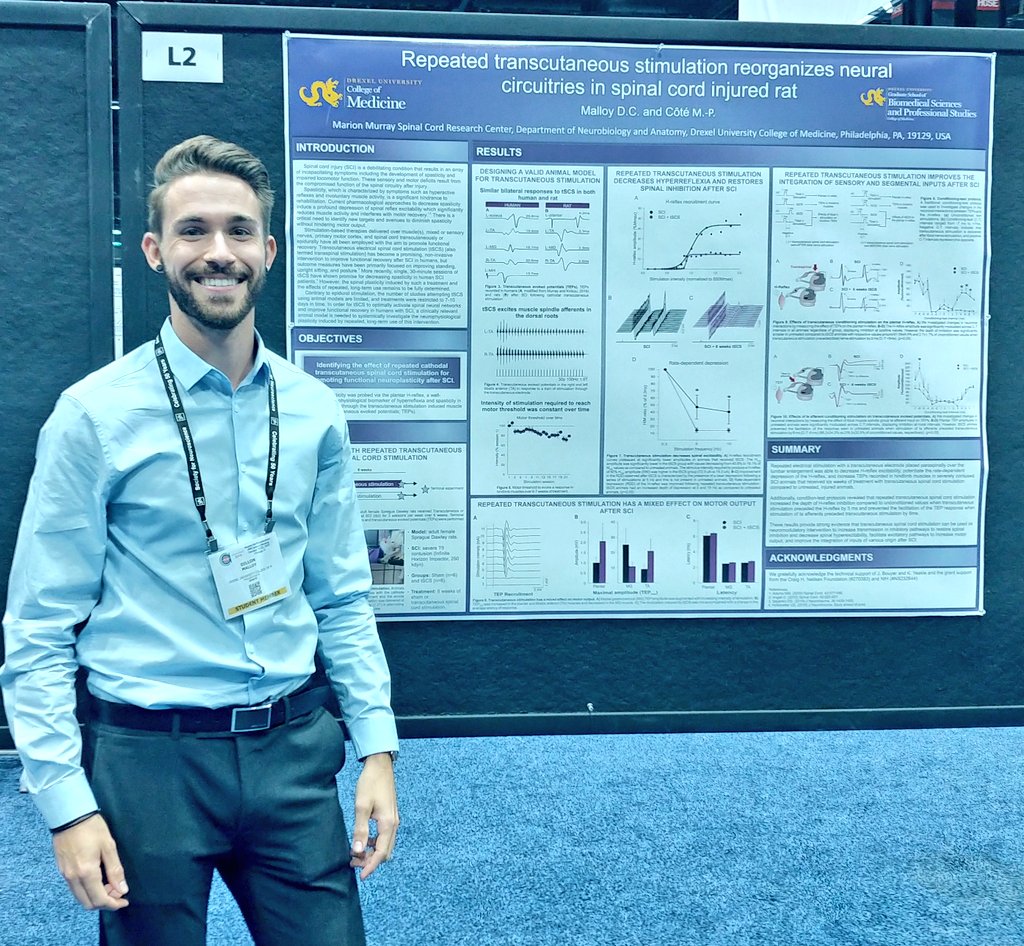
Come and see @dilloncmalloy (board L2) present his work this afternoon on repeated transcutaneous spinal cord stimulation for promoting fictional plasticity after spinal cord injury!
Come and see @bilchak_j (board J12) present her work this morning on reducing the development of spasticity by restoring chloride homeostasis after spinal cord injury!