The thing I learned this year is that when engineers say they like working on “hard problems”, they actually don't. What they like is puzzle solving, and having a repertoire of patterns that they can pattern match onto traditionally hard problems, usually involving databases or something with scale, etc. And they know that the industry used to pay you a lot for how deep and broad this repertoire was. Unfortunately, in 2026, well, you have a cheat code machine that has infinite breadth and depth for pattern matching. So the question is, do you actually like hard problems? Because there are now hard problems that are a complection of engineering, product, society, culture, politics, and they are fairly intractable, probably unsolvable! Because if you do want to work on those actually hard problems, there is so much money that people will pay you for it. But you’ll have to face that truth about yourself first.
@JeremiahDJohns Try two across a wide range of tasks. For me that includes coding, writing mundane emails, negotiating, home repair, coaching youth sports, etc.
If you think you’re okay with one of them, ditch the other one for a while. For a while I used only one model provider.
The reactions to this tweet are telling.
About a year ago, I spoke with someone who has worked in the high-end denim industry for a few decades. He's traveled the world to meet with some of the best indigo dyers, fabric weavers, and cut-and-sew factories. He lives and breathes denim.
We talked about whether the US could ever create a high-end denim industry that could rival Japan's. His answer, delivered to me without any sentimentality, was a straightforward "No."
According to him, the issue isn't just history.
To be sure, Japan has a long history of weaving textiles, which has led to a particularly robust denim industry in and around Okayama Prefecture. It was here, after all, that farmers found that the soil was too saline for rice cultivation sometime in the 17th century, so they switched to cotton. Over the next four hundred years, cotton cultivation here supported the development of yarn spinning, fabric weaving, and eventually a cut-and-sew industry that specialized in producing some of the world's best jeans. Economists call these "industrial clusters," which can be remarkably durable and particularly fruitful for innovation.
But according to my friend, history is not enough to explain why Japan excels at producing high-end denim. He believes culture also plays a role.
It can be uncomfortable to invoke culture as an explanatory variable, especially in today’s political climate. To be sure, sometimes "culture" is just used as a lazy variable to explain things when someone doesn't know enough about history, institutions, or laws. It's not the first variable I turn to when trying to understand social outcomes.
However, my friend feels strongly that differences between Japanese and American culture lead craftspeople in Japan to approach spinning, dyeing, and weaving more as an art than as an industrial processes. They are also more open to experimentation — tinkering with machines to get neppy weaves, using slubby yarns, dyeing hanks in unique ways.
In the US, he claims, people are much more focused on profit and efficiency. There's less appreciation for craft and therefore less incentive to produce the kinds of unusual, labor-intensive fabrics that distinguish high-end Japanese denim.
I still think some structural factors are involved. In a nation of 350 million people, I'm confident that there are tens of thousands of people interested in craft. However, they can't become artisans because few apprenticeship programs exist. Skyrocketing rents and car dependency make it hard to earn a living as an artist or craftsperson, as you have to forgo earning a lot of money for a long time. The US government also provides little support for apprenticeships and craft-based businesses.
Additionally, US fashion media focuses much more on trends and celebrities. In Japan, you can find hundreds of speciality publications that really get into the weeds about bourbon, woodworking, denim, tailoring, and any other hobby you can imagine. This creates an informed consumer base ready to purchase things from artisans.
This came to mind as I scrolled through the replies to this tweet — the incredulity of jeans costing $300 and confident claims that jeans are just jeans. Lots of people insisting that some brand's $100 jeans are the same as these that cost $300.
$300 for jeans is not even expensive in this corner of menswear. This Business Insider episode below gets into why a pair of Momotaro jeans can cost upwards of $2,000. It has much to do with how the material is dyed and the fabric is handwoven.
Is this ridiculous? Yes, on some level. But to my mind, no more ridiculous than a lot of stuff celebrated in the US, such as monster truck rallies, sports memorabilia culture, and the garages full of expensive recreational equipment that gets used once a decade.
Textiles are one of our earliest forms of art, so it's never a surprise to me to hear that some prosaic garment can be made in a more artisanal and thus expensive manner. Of course, whether you're willing to pay the price of these garments is another matter. But appreciating craftsmanship is always free.
Writing code isn’t the bottleneck => something else is => look at your organization to figure out what it is
It can be Product. If you can build anything, what is Product saying you should build?
It can be Sales, etc.
AI can force clarification if you let it.
Rachel Laycock (CTO Thoughtworks) has written a piece that every executive who built an app over the weekend should read.
The question she gets all the time: "If AI can do this, why aren't our engineering teams 10x faster?"
Her answer: Writing software is not software engineering.
The weekend app is real software. But the moment a business depends on it, the questions change. Is customer data protected? What happens when a dependency fails? Will someone understand this in two years? Will it survive an audit?
These questions don't show up in a demo. They show up in production.
Her formula: Citizens build. Agents execute. Experts govern.
This is not about roles. It is about where value moves. Anyone can express ideas as software now. Agents handle the execution. But someone still has to decide if this software deserves to exist in production. Architecture, security, resilience, operability, compliance, cost.
Two points that resonated strongly with me:
A team at FOSE described their workflow: design a specification during the day, let agents work overnight, review in the morning. The interesting part is not the overnight pipeline. It is what the humans do: decide what good looks like and judge the result.
When agents generate lots of code very quickly, good design matters more, not less.
This is exactly why I work requirements-first with AIUP. The scarce resource is not people who can write code. It is engineering judgement: knowing what good looks like before the agent starts.
Organisations don't run on code. They run on trust.
Full article: https://t.co/nndp5iMpIn
#SoftwareEngineering #AI #SpecDrivenDevelopment #AIUP
Directionally right at least, but things don’t have to be this way
- Have the agent write slimmer PRs
- Defend against large PRs with automated checks
- Adjust your approach to code review
- Have more autonomous agents write your PRs and you spend more time reviewing code
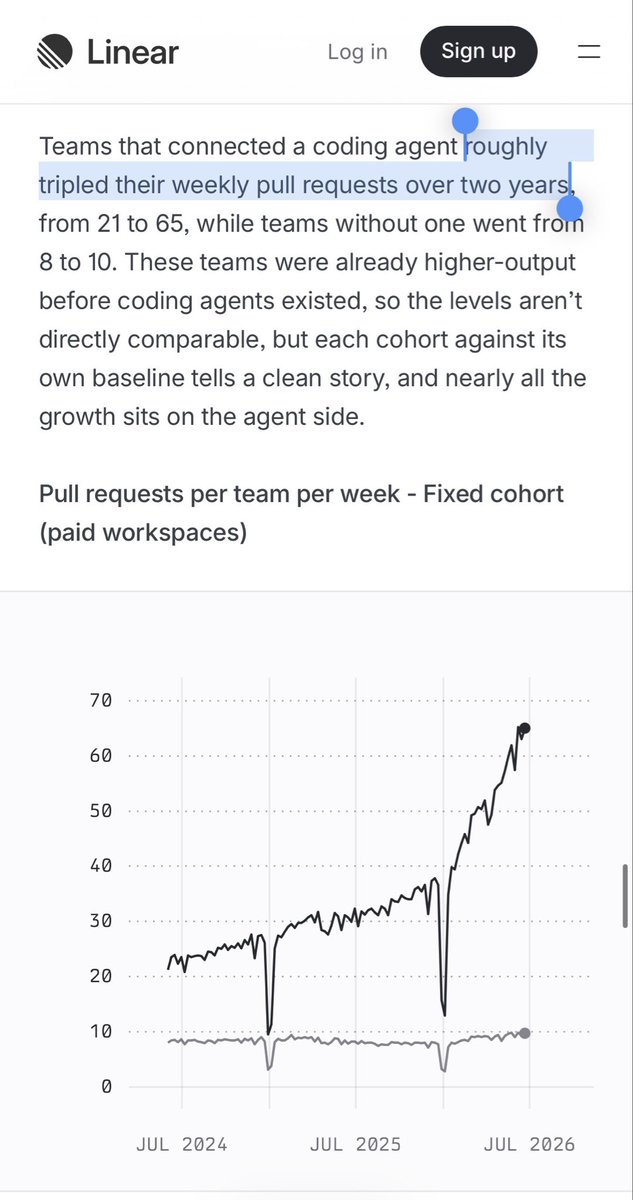
One reason code reviews will not hold up at many (most?) startups: coding agents (obviously) mean a LOT more PRs. And more verbose PRs. It’s already less motivation to review AI-generated code… and so much of it?!!
Data from a new report by Linear: https://t.co/SMIfxrOGnp
The optimal profile probably requires having learned your core skills without AI while being fluent enough with AI to augment them.
Unfortunately, for now at least, that’s mostly a matter of birth cohort.
@vasilios_s If the board only sees incidents, reliability always looks like a cost center. A useful ledger might track customer-hours at risk, error-budget burn avoided, and the deploys that stayed boring because a failure mode was removed. “Nothing happened” needs an alternate history.
We really need a database of these occurrences. Attention fades. DB records live longer.
I kid, slightly.
I know we joke about “Why we can’t have nice things.” But many pathologies (knowledge, bad debates, service quality, competent orgs) are due to not internalizing harms.
FWIW, I think people should be a lot MORE angry about the people who falsified highly influential Alzheimer's research and set the field back by decades than they were about Jason Arday making up a million lies about his personal life.
I love agents for codebase audits.
We're small, so I just have an agent running on my laptop (Go + cron).
It reads our pipelines for philosophy violations, opens PRs, responds to CI failures, and does a little QA against the data warehouse if warranted.
A good way to audit your codebase:
• a strong orchestrator inventories every subsystem
• it sends fresh read-only agents through with a DSA prompt
• it validates, dedupes, and ranks
I ran this overnight and it found 93 opportunities across 55 subsystems! Audit only.
Funniest thing in physics history is that the Royal Society couldn't afford to publish Newton's Principia because they had just blown their entire budget on a massive, highly detailed encyclopedia called De Historia Piscium (The History of Fishes).
The fish book was a catastrophic commercial flop. The Society was left so completely broke they couldn't bankroll the foundational text of classical mechanics. It gets worse: they couldn't even make payroll for their clerk, Edmond Halley (of Halley's Comet fame). Instead of a salary, they literally paid him in unsold copies of the fish book.
Halley, however, had enough scientific intuition to recognize what Newton was building. He believed in the work so much that he personally bankrolled the Principia out of his own pocket.
It is wild to think about. The rigorous, mathematically formalized thought experiments that completely re-engineered our understanding of the physical world, and permanently altered the trajectory of human civilization -- were almost entirely derailed by a bad institutional bet on fish anatomy.
> The lesson is that the NBA is trending towards "get shots you make" instead of "get higher expected efficiency shots" which is good because it creates way more variation in offenses.
Makes sense (up to shot distribution across players). Averages mask individual variation.
the nerdiest segment I think we've ever done.
the strongest correlations in offensive rating this year by playtype frequency was isolation, which has gone up every season. Teams have figured out how to attack switching defenses so well that they're pivoting to just not using screens as much.
shot type location has very little correlation to success anymore, finding the right shots is no longer a cheat code or market inefficiency.
only five of the top ten offensive rating teams were top 10 in eFG%, compared to six in midrange FG%. not volume (only three teams in top 10), but FG%.
The lesson is that the NBA is trending towards "get shots you make" instead of "get higher expected efficiency shots" which is good because it creates way more variation in offenses.
It's no longer a chuck-3's league, at least comparatively, with only three teams in top 10 in 3pt volume in top ten in ortg.