@nestpadrh Tôi thấy bạn khá ổn nhưng phải mạnh mẽ lên. Dự án cần những thứ phát triển. Khi đã ra cơ chế thì phải quyết liệt và công khai VR lợi thế mình ra. Chúng tôi là những nhà đầu tư cũng mong những việc đó.
@theunipcs Bạn có biết anh chàng này không @bnbcaptain ? Anh ta có câu chuyện bệnh tật - bạn viết tiếp hoặc chúc anh ta khoẻ mạnh được không? Xin cảm ơn!
$NEST 4.9m dyor
0x8e859dbdfbfd2df6a99870e2871eaa58e8784e05
okx wallet:https://t.co/EEVcU8gu66
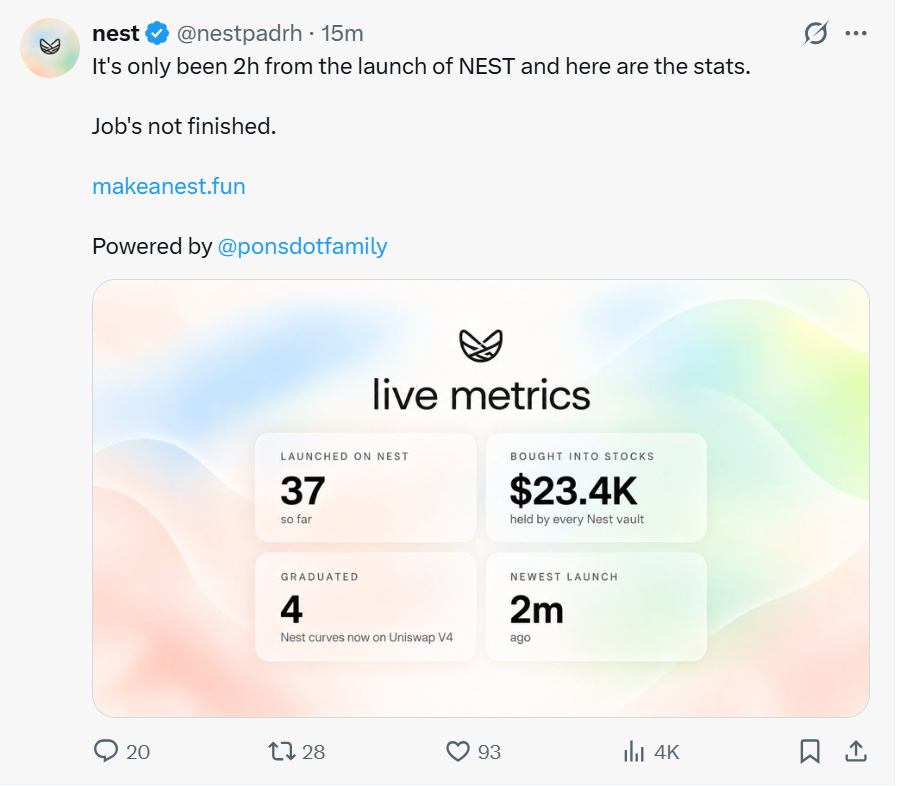
A launchpad built directly on Pons V2.
With regular Pons tokens, trading fees mostly go to the creator's wallet, or the token is only paired with a single asset. When a Nest token is created, it designates a vault. Fees flow into the vault and are swapped into a weighted basket of 2 to 8 stock tokens — combinations like MAG7, TSLA+SPCX, or AMC/GME/AMZN.
Holders can get access to this basket of stocks through burn-to-redeem or claim.
The trading layer fully reuses Pons V2: fixed supply of 1 billion tokens, goes through a bonding curve first, and after raising approximately 4.2 ETH, graduates to a locked Uniswap V4 pool. Base trading fee is 1%, creators can add up to 10% tax, and the launch fee of 0.0005 ETH goes to Pons.
NEST is the platform token. The team states that all launchpad revenue is used to buy back and burn NEST.
Since the underlying layer is still Pons V2, people are calling it "Pons 2.0." Fees no longer just go to wallets or single stocks — they go into a vault that buys baskets of multiple stocks.
That said, it's still a bet on whether the Nest launchpad can consistently generate real revenue.
The above content is entirely my personal understanding and analysis (dyor). If you have other opinions, feel free to discuss them in the comments.
Bought $SPX6900
Paired with the Top 8 largest S&P 500 holdings using $NEST tech
Chart: https://t.co/ZaXtqYnPmV
CA: 0xaf793d64831922ca7a7d56feedfce14a27a2bba7