$BTC Update
Previous weekly close was a fake rejection followed by a rally into higher supply. It wouldn't surprise me to see a fake breakout this weekly close, followed by a rejection towards lower liquidity
Strategy needs to come up with $10B - $12B of cash in the next two years.
They’ll dilute $MSTR as much as possible and eventually be forced to sell some $BTC to do it.
The US government, citing national security authorities, has issued an export control directive to suspend all access to Fable 5 and Mythos 5 by any foreign national, whether inside or outside the United States, including foreign national Anthropic employees.
The net effect of this order is that we must abruptly disable Fable 5 and Mythos 5 for all our customers to ensure compliance.
Access to all other Claude models is not affected.
We apologize for this disruption to our customers. We believe this is a misunderstanding and are working to restore access as soon as possible.
Read our full statement: https://t.co/bwn0sximKZ
A look at #Bitcoin historical bottoming pattern using Fibonacci levels
2013 - 2017 - 2021 - Present
Fibonacci instant reversal zone has never failed to be the EXACT bottom.
Will this time be different?
If you’re wondering why $HYPE is making new ATHs today, this is your best resource to understand the thesis.
@defi_monk and I spent an enormous amount of timing detailing the evolution of Hyperliquid and quantifying how big the opportunity could be, potentially reaching $300B+ in the coming years.
The job is far from finished.
SEC IS SAID TO READY PLAN FOR TRADING CRYPTO VERSIONS OF STOCKS
THE SECURITIES AND EXCHANGE COMMISSION IS EXPECTED TO RELEASE ITS SO-CALLED INNOVATION EXEMPTION FOR TOKENIZED STOCKS AS SOON AS THIS WEEK
Singapore’s Foreign Minister, Dr Balakrishnan casually explaining how he built his own AI agent (a 2nd brain for diplomacy) using Claude & WhatsApp integration etc. on a Raspberry Pi
“You cannot govern a technology you have only been briefed on.” 🇸🇬
One image that explains the next trillion dollar industry better than any analyst report.
Building a humanoid robot requires an 8-layer supply chain most people have never thought about:
Energy ($UUUU, $OKLO) → Chips ($TSM, $AMD, $NVDA, $ASML) → AI models ($GOOG, $TSLA) → Data centers ($CRWV, $IREN, $NBIS) → Servers ($DELL, $CLS, $CSCO) → Sensors ($ADI, $OUST, $CGNX) → Batteries ($QS, $ABAT) → Testing ($TER)
The companies supplying AI infrastructure saw $318 billion in spending last year alone. That doubled from the year before.
Now add the robotics demand on top. Tesla is converting its Fremont factory from cars to robots. Figure AI just helped BMW build 30,000+ vehicles with humanoid workers.
The robots are here and the supply chain to build them is investable today.
🚨JUST IN: The Senate Banking Committee has released the new 309-page draft of the Clarity Act it’s been working on since January.
Committee members now have until close of business tomorrow to file amendments ahead of Thursday’s markup.
Yesterday, four institutions settled tokenized United States Treasury debt across borders, across banks, and across time zones on a public blockchain in under five seconds. Nobody connected it to what happened the same day at Morgan Stanley. Read them together and the two-tier architecture stops being a thesis and becomes infrastructure.
On May 6, Mastercard, Ondo Finance, JPMorgan via its Kinexys blockchain platform, and Ripple completed the first near-real-time cross-border redemption of tokenized U.S. Treasuries on a public ledger integrated with interbank settlement rails. Ondo’s OUSG fund, representing short-term Treasury holdings with approximately $610 million in assets, processed the redemption on the XRP Ledger in under five seconds. Mastercard’s Multi-Token Network routed the instruction to Kinexys. Kinexys debited Ondo’s blockchain deposit account. JPMorgan’s correspondent banking delivered USD to Ripple’s Singapore bank account. The entire workflow executed outside traditional banking hours. Ian De Bode, president of Ondo Finance, called it the first time tokenized Treasuries had settled across borders and banks in near real time.
The XRP Ledger was chosen for a reason that matters more than speed. XRPL tokenizes assets via native Issued Currencies with built-in Trust Lines that give issuers the ability to freeze, authorize, and restrict transfers at the protocol level without smart contracts. Ondo controls who holds OUSG. Mastercard controls the routing. JPMorgan controls the fiat leg. Every node in the settlement chain has a compliance switch. The blockchain is public. The assets on it obey.
On the same day, Morgan Stanley began actively testing direct cryptocurrency trading on its E*Trade platform for 8.6 million self-directed clients at 0.50% per transaction. The bank already launched MSBT, the lowest-fee spot Bitcoin ETF at 0.14%, on April 8. It advises clients to allocate two to four percent to Bitcoin. It plans a proprietary digital wallet for the second half of 2026. Morgan Stanley is building every on-ramp to Bitcoin, the one public blockchain that has no Trust Lines, no issuer freeze, no compliance switch, and no admin key at any layer of its protocol.
Two public blockchains. Two architectures. One has freeze switches at every node. The other has none. Both are being integrated into Wall Street’s plumbing on the same day by some of the largest financial institutions on the planet.
The GENIUS Act mandates freeze capabilities for stablecoins. The CLARITY Act classifies Bitcoin as a digital commodity because it lacks them. Mastercard is building the controllable tier’s settlement infrastructure with a $1.8 billion BVNK acquisition and more than 100 partners in its Crypto Partner Program. Morgan Stanley is building the uncontrollable tier’s distribution infrastructure across ETF, spot, advisory, and wallet layers. Bessent froze $344 million in USDT on April 24 under Operation Economic Fury. Nobody froze a single satoshi because nobody can.
The distinction is no longer public versus private blockchain or crypto versus banks. It is controllable versus uncontrollable, and both sides are now being built by the institutions that once rejected both. Mastercard and JPMorgan are building rails for money that obeys. Morgan Stanley is building on-ramps to money that computes.
The architecture is live. Both tiers are being constructed simultaneously, by the same class of institution, for different purposes, on different ledgers. One settles tokenized Treasuries in five seconds with freeze switches at every layer. The other settles value in ten minutes with no switches at all.
https://t.co/vLQh7ydMdk
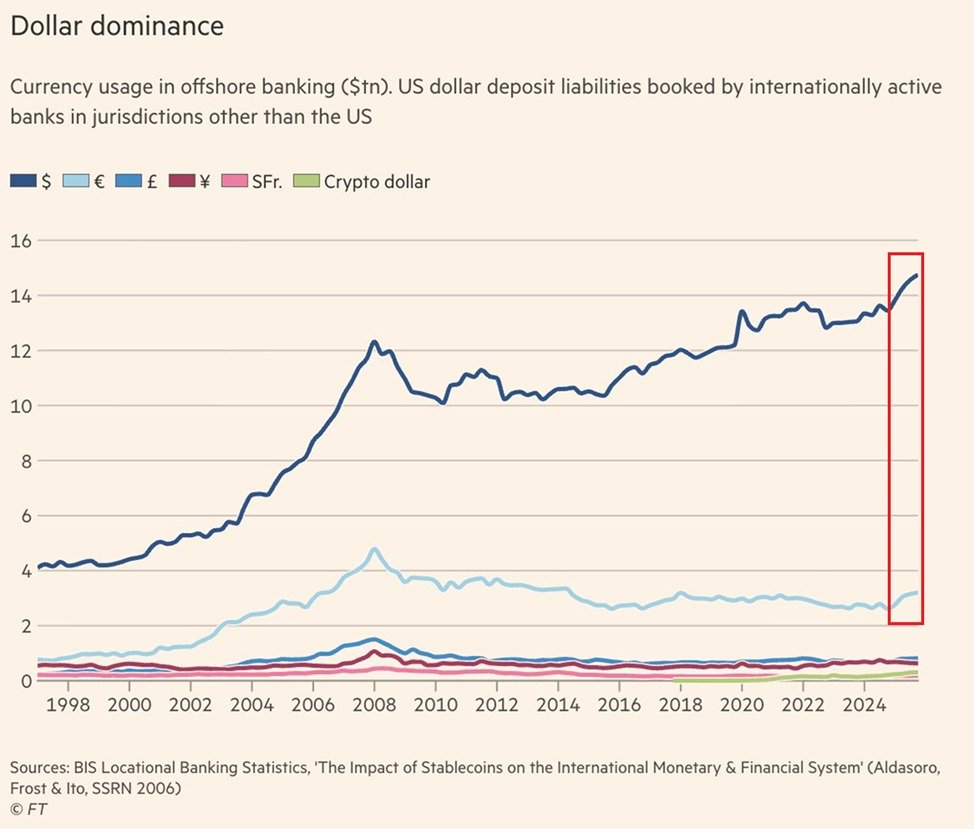
The world is using more US Dollars than ever:
Offshore US Dollar deposits held in banks outside the US are up to a record ~$14.5 trillion.
This is +220% more than the ~$4.5 trillion held at the beginning of the century.
By comparison, only ~$3.5 trillion worth of euros are held in offshore banks, outside the Eurozone.
And, the Fed and domestic commercial banks hold over $19.0 trillion.
This means offshore US Dollar deposits are now equivalent to~43% of US domestic bank deposits, with no other currency coming close to this percentage.
Global demand for USD is incredibly high.
Tokenized $STRC is now live.
Stretch (STRC) is @Strategy's perpetual preferred stock paying monthly dividends, currently yielding 11.5%.
Now available across Ethereum, BNB Chain, and Solana through Ondo Global Markets.
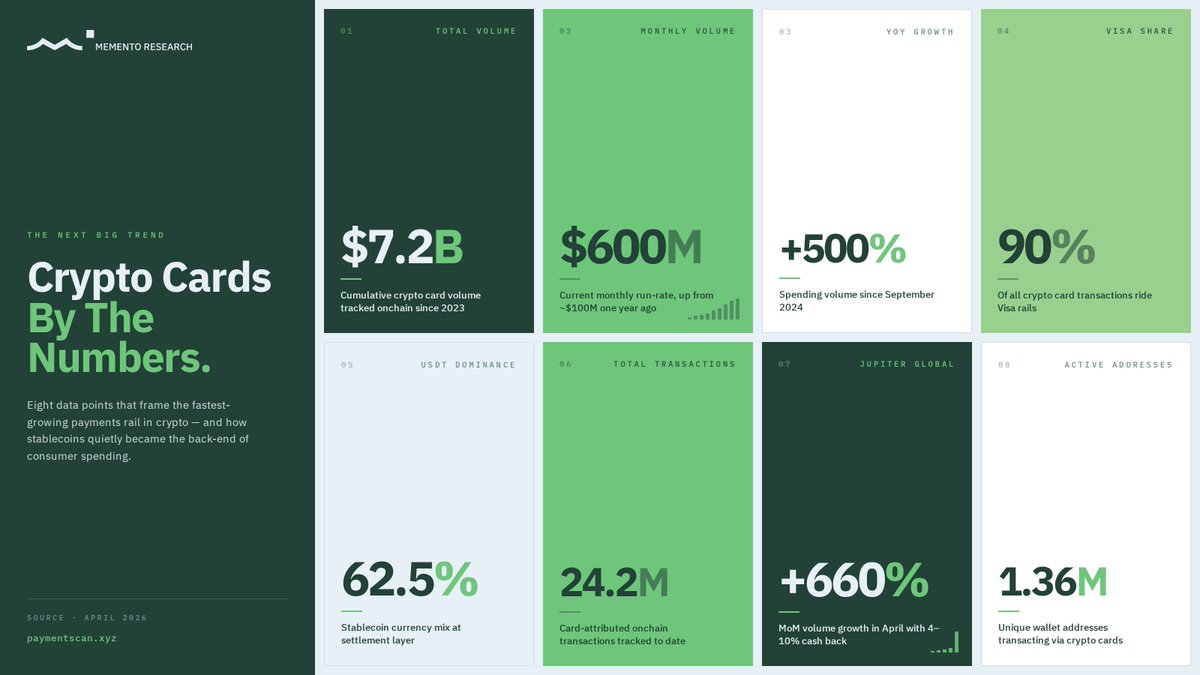
BREAKING: Crypto card spending just hit $600M a month - up 6x in a year.
In case you missed it:
$7.2B has now moved through crypto cards on-chain
• 24M transactions
• 1.36M wallets
• 62.5% in $USDT (@tether and @paoloardoino running the rails)
• $348M on @solana (@toly)
• @JupiterExchange Jupiter Global +660% MoM with 4-10% cash back (@weremeow)
• 90% on @Visa
Stablecoins quietly became the back-end of consumer spending ↓
🔥 The rumors are confirmed: The Clarity Act markup is set for the week of May 11.
This is the moment the "Wild West" era officially ends and the "Wall Street" era begins. By defining "mature blockchains" and drawing a hard line between the SEC and CFTC, this bill provides the legal air cover that every major pension fund and sovereign wealth fund has been waiting for.