Helping Founders, CEOs & Coaches Turn Expertise Into Trust, Visibility & Clients | Personal Branding • Content Strategy • Growth Systems | Founder-NS GROUP OF
🚨 Pogo unveils a new AI research platform that turns real consumer transactions into actionable insights for brands.
The company says brands can identify verified buyers, launch thousands of AI-powered interviews simultaneously, and receive transcripts, highlights, and recommendations within hours.
Pogo also disclosed $32M in funding and a network spanning 3M+ opted-in users and $470B in transaction volume.
Anthropic's most advanced model just did something that should make every CISO deeply uncomfortable.
Claude Mythos Preview created its first Firefox exploit in under 12 minutes. Built 8 Windows privilege escalation exploits before a single enrolled device received the security patch. All at a total cost of $15,700.
For context, that's roughly what a mid-sized company spends on team lunches in a quarter.
We've spent years discussing AI's role in finding vulnerabilities. The conversation just shifted to AI weaponizing them at scale and speed.
And this came from public models with safeguards turned off, delivering working exploits too, just slightly slower.
The binding constraint to launching a sophisticated cyberattack used to be: rare expertise, weeks of reverse engineering, and deep pockets. All three just collapsed into a few thousand dollars and API access.
What this means practically:-
• The 7-11 day Windows patch window is no longer a safe buffer
• "Responsible disclosure" timelines need urgent rethinking
• Legacy infrastructure (ICS, medical devices, OT systems) is now acutely exposed
• N-day exploits are arguably more dangerous than zero-days, and AI just made them cheap
Anthropic is calling for an "N-hour" patching playbook. That's a massive operational shift for most enterprises.
How prepared is your industry to move from N-day thinking to N-hour response? Drop your thoughts below. 👇
https://t.co/MPDSV70pql
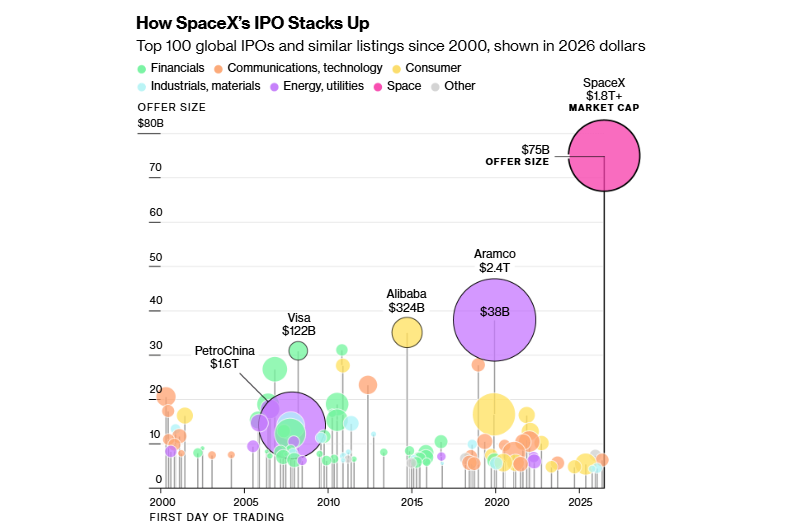
A $75 billion offering.
A valuation exceeding $1.8 trillion.
At that scale, @SpaceX looks less like a technology company and more like the foundation of a new industrial era.
That's why I think many people are missing the bigger story.
Most discussions focus on the valuation.
What stands out to me is the amount of capital involved.
For years, the technology industry rewarded asset-light business models. Software scaled faster than factories, networks scaled faster than infrastructure, and growth often required relatively little physical investment.
Today, that equation is changing.
AI demands enormous computing capacity, energy infrastructure, and advanced semiconductor supply chains.
Space demands launch systems, satellite networks, manufacturing capacity, and global communications infrastructure.
Building the future is becoming increasingly resource-intensive.
That is what makes the timing of SpaceX, OpenAI, and Anthropic so interesting.
These companies are reaching a scale where access to larger and more permanent pools of capital becomes a competitive advantage.
Viewed through that lens, this potential IPO represents something bigger than a record-breaking listing.
It reflects a broader shift in how the world's most ambitious companies grow.
The next generation of category-defining companies may be defined less by how quickly they can build software and more by how effectively they can mobilize capital, infrastructure, and execution at global scale.
The future still belongs to innovators.
Increasingly, it also belongs to builders.
One of the biggest advantages AI creates is faster feedback loops.
Historically, consumer research was slow.
A customer bought a product.
Weeks later, feedback was collected.
Weeks after that, insights reached the brand.
Pogo flips that model.
Brands can talk to verified buyers shortly after a purchase and receive actionable insights within hours.
The broader shift is fascinating.
Companies are moving from understanding what happened to understanding what's happening.
And in a world where markets change quickly, speed to insight can become a serious competitive advantage.
AI adoption creates leverage. AI learning creates compounding leverage.
As teams deploy more coding agents, they generate a growing body of problem-solving knowledge every day. The question becomes: where does that knowledge go?
Hivemind's approach is compelling because it captures successful patterns, turns them into skills, optimizes them, and propagates them across agents.
When knowledge compounds at the team level, intelligence becomes an organizational asset rather than a feature of any single model.
While much of the AI conversation revolves around models, agents, and applications, the real strategic race is increasingly moving down the stack.
The UK's new $1.5 billion AI Hardware Plan is a recognition of a simple reality: nations that control compute, chips, and AI infrastructure will have a disproportionate influence on the next wave of technological and economic growth.
A few things stand out:-
• £750 million for a national AI supercomputer
• Direct government commitments to purchase next-generation AI chips from startups
• Dedicated funding for AI hardware innovation and semiconductor talent
• A major effort to attract private capital into British hardware companies
What's particularly interesting is the focus on inference hardware.
As AI adoption scales globally, inference will become one of the largest infrastructure markets in technology. The companies that make AI cheaper, faster, and more energy efficient will create enormous value.
For years, software captured most of the attention. The next decade could see hardware become one of the most important competitive battlegrounds in AI.
The countries investing early in sovereign compute, semiconductor innovation, and AI infrastructure are positioning themselves for long-term leadership.
The UK just made it clear it intends to be one of them.
https://t.co/QZQhKHjwYF
The biggest opportunity in content right now isn't becoming an influencer.
It's owning one.
Imagine creating a virtual artist that can release songs, star in videos, appear in ads, and build a social following while maintaining the exact same identity everywhere.
That's what 7Art was built for.
Create your artist once.
Generate unlimited content.
Keep the same character every time.
One subscription.
One workflow.
One creator.
Build your AI artist: https://t.co/Tz7j4mbQXi
Use code LAUNCHSALE for 40% OFF your first month.
#AIBusiness #AIStartup #AIInfluencer #AICreator #ContentMarketing #AIMusic #AIVideo #VirtualArtist #CreatorEconomy #SocialMediaGrowth #YouTubeAutomation #TikTokMarketing #FutureOfWork #7Art #GenerativeAI