Gm $weave community.
Looks like @transkatgirl is continuing the cleanup and review of @universalweave layout internals, simplifying how graph connections are prepared and separating segment-heavy and simpler layout paths at compile time.
No new feature yet, but this is exactly the kind of cleanup needed before the final review and 0.5.0 release process.
https://t.co/3YYRVUY75B
Everyone is bullish on @bot because it turns AI from something you chat with into persistent workers that can coordinate and execute.
But its own documentation reveals what I believe becomes the next major bottleneck.
Grok Bot currently describes coordination through direct messages, threads, group chats, handoffs, shared files, and shared computer sessions.
The official docs say Bots can “share context in threads or group chats, and pass ownership.”
They also recommend using a group chat when a handoff needs to remain visible because the group “preserves the handoffs in one conversation.”
https://t.co/PSVIU4bmsF
https://t.co/dLgUEwrZZp
This does not mean Grok Bot is broken.
It means the documented user-facing coordination model is still primarily conversation-based.
Now imagine that system scaling from a few Bots to dozens of agents.
Research produces competing leads. Writers create alternative drafts. One agent revises another agent’s result. Some paths fail. Some remain useful. Multiple paths may later converge into one output.
That history is no longer naturally linear.
It becomes a graph.
This is where @universalweave is fundamentally different.
@universalweave provides reusable primitives for tree and DAG-based documents, including editing, splitting, merging, deduplication, traversal, stable node ordering, serialization, and experimental collaborative editing.
You can verify every one of those primitives here:
https://t.co/ozgdPhxzPW
@bot coordinates who performs the work.
@universalweave can help builders represent how that work branches, evolves, reconnects, and remains navigable to humans.
Persistent memory tells an agent what happened.
A first-class graph can show humans how it happened, which alternatives still exist, and where they want to go next.
@universalweave is not replacing @bot.
It is building for the complexity that successful multi-agent systems will create.
Grok Bot scales AI execution.
Universal Weave could scale human understanding and control over that execution.
The more powerful agent teams become, the stronger the Loom thesis gets.
That is why I remain bullish on $weave.
The fact that graphing took longer is honestly the least interesting part here.
What matters is that it already works, passes a serious property-test suite, seems roughly 2 to 3x faster than Tapestry Loom’s old layout library, behaves better with DAG documents, and cuts worst-case complexity from O(V²) to O(V + E).
I checked the latest GitHub updates too.
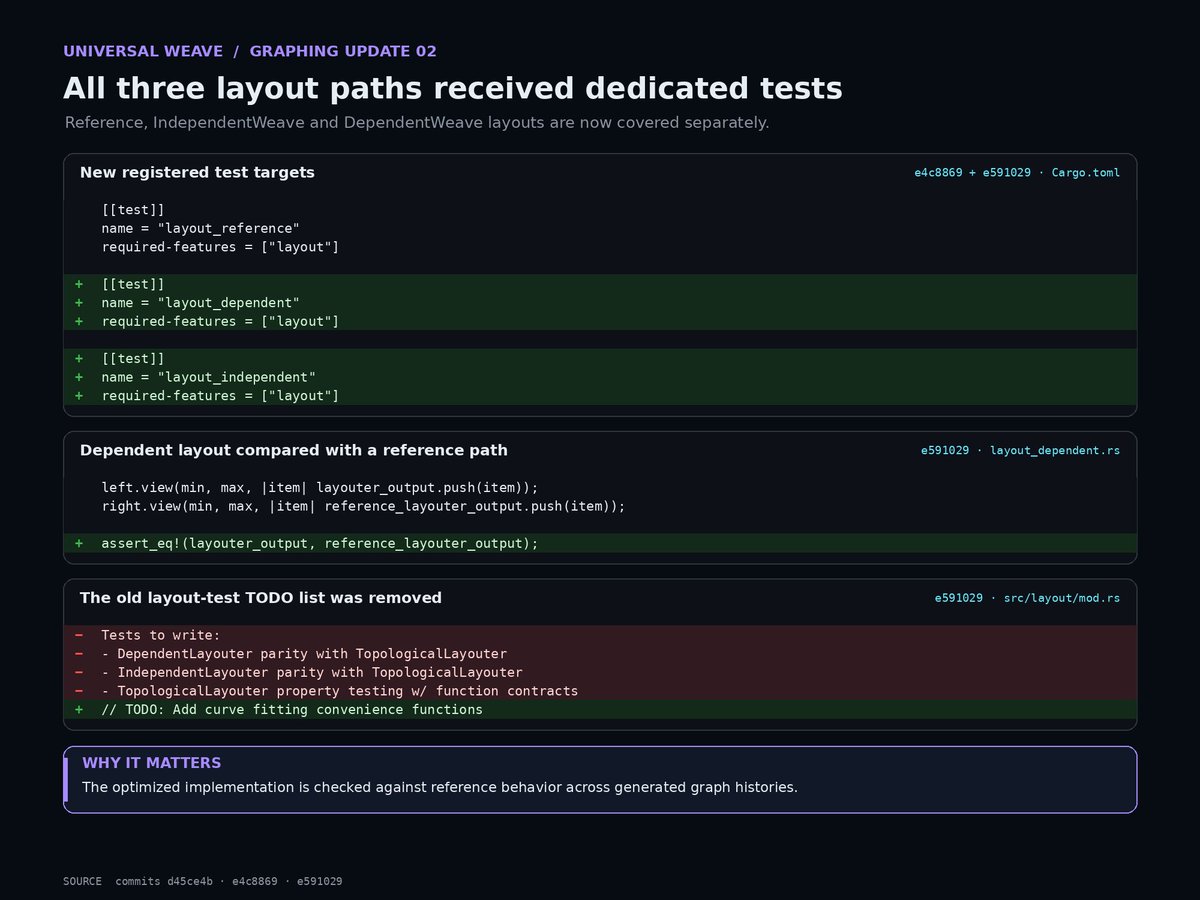
@transkatgirl has now added separate property tests for the reference, independent, and dependent layout paths. Together, those harnesses are configured for 15,360 generated cases, with sequences that can run up to 511 operations.
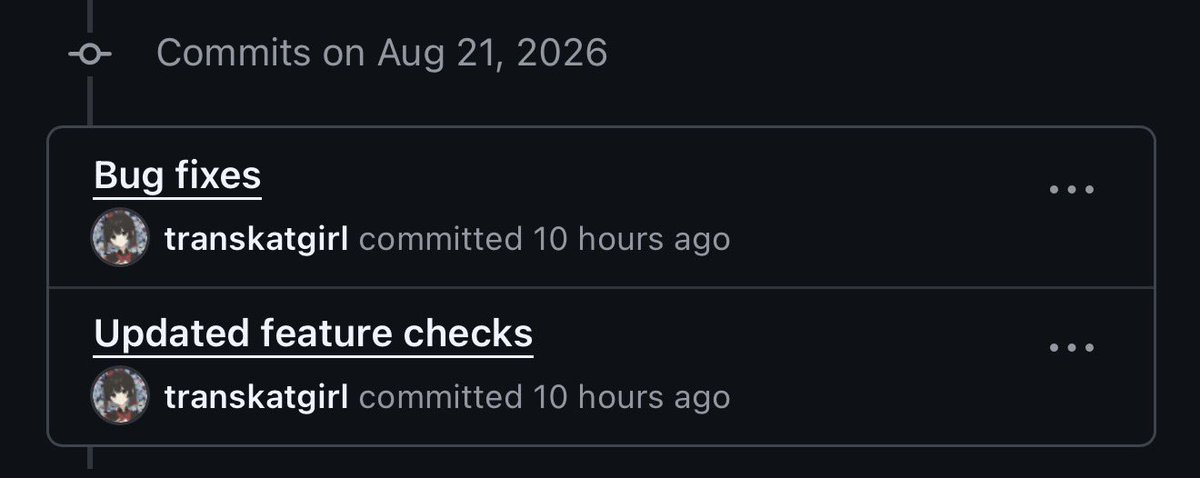
Then came the cleanup. 1 major commit alone changed over 500 lines, removing more code than it added, followed by smaller fixes that tightened temporary memory allocation.
And she still refuses to call it done until the weird edge cases are manually traced and the final high-count tests are complete.
Most people would see “2 to 3x faster,” post the benchmark, and rush the release.
But @transkatgirl saw it, then went back to look for everything that could still break.
This is the kind of builder we should all support in this space and across the @solana eco.
$weave isn’t another AI agent. @universalweave is foundational infrastructure for Looms and non-linear AI interaction, something other builders could eventually build on top of.
The size of this won’t be measured by one demo. It’ll be measured by what gets built with it.
0.5.0 isn’t out yet, but the work is visible.
Listen, study $weave before the market does.
In 2024, I was early to AI agents before everyone started chasing them.
I’m doing it again with $weave.
But this time feels a little different.
I’m not early to another AI agent. I’m early to foundational tech for non-linear AI conversations.
12 days into the CTO and we’ve managed to hold above $100K while most people are still busy bidding larps, farms and recycled memes.
I won’t get tired of saying this.
There will come a time when they find $weave, study what’s being built and realize how big this can become.
By then, being early will look obvious.
I just watched an ACT I dev work with Eigenslur to interpret older Act I logs.
Shortly after, its token ran to $1,5M
One credible builder.
One public proof of use.
That was enough for the market to pay attention.
Now look at $weave.
@transkatgirl is building infrastructure designed for other builders to use, with universal-weave 0.5.0 and a microcontroller demo ahead.
Just an obvious takeaway:
When builders start publicly showing what they can do with @universalweave, the market might not wait.
One public use case sent solana:DFz1x1pedB3DUM2cwWdgqYmGhjRvQkneHBj1GEm4pump straight to $1.5M.
So why is $weave still sitting here?
Can anyone explain?
+$6,250 kurang dr 3 jam, cm mau sedikit cerita aja bkan mau bkin drama ( buang waktu ).
Sbnrnya bisa lebih maksimal, cm mata ud gatahan pas hold😂.
Ini coin yg di cto sama slah satu grup luar yg isinya org2 yg menurut gw keren2 dan humble. Banyak jg whales2 di grup ini yg cm berawal dari degen. JP di Trump dll.
Gua pengen share pas di under $10k, cm gw tau etika dan gw tau bkal banyak jeeters nya dibanding holders.
Gw jg sharing ke yg cto kalau gw jual sekian, dan gw jg izin untuk post tapi gua sensor. Kenapa? Biar dia merasa effortnya di hargai ( ini memang uda sepantasnya ).
Dengan gua hargain mereka, mereka pun seneng, dan ga permasalahin gw mau take profit berapapun asal ga rusak chart.
Bedanya di kita adalah, flexing profit padahal orangnya yg CTO masih push. Kepikir ga kira2 lu bakal dikasih info lagi / ga nextnya? Jelas ngga dan ga akan pernah gua info sedikitpun di early.
Ini pelajaran untuk beretika dan pentingnya menghargai, tau diri & ber-terima kasih.
Belajar berfikir sebelum berbicara & bertindak akan membuat kita lebih sadar dan peka atas apa yang baik dan buruk.
Sekian, terima kasih✌️
Kat pushed a fresh series of commits to @universalweave.
Here is what materially changed.
The current optimization pass for the 2D layout engine is now complete.
Most importantly, the direct layout path for DependentWeave is now implemented. Previously, that path still ended in a placeholder. It can now take the tree-based structure of a Loom and calculate the node positions and connection paths a UI needs to render it.
@transkatgirl also reworked the internals to reuse temporary memory, reduce graph and polyline bookkeeping, and skip segment-related work when a layout does not need it.
This is real efficiency work at the library level. However, there are no published benchmarks yet, so it would be inaccurate to claim a specific performance increase.
The follow-up commits also hardened the implementation:
• Empty layouts are now handled safely
• Coordinate and spacing validation was tightened
• Invalid layout output remains checked in release builds
• Layout was added to a broader compile and lint matrix covering major feature combinations, no_std, and combined Loro builds
Why does this matter?
@universalweave is infrastructure. The layout engine is what turns a branching tree or DAG into an actual visual map that an interface can display.
Making that process leaner and harder to break gives future Loom interfaces a stronger foundation, especially as their graphs become more complex.
Important distinction: @transkatgirl finished this optimization pass, not the entire layout system.
Cleanup and dedicated parity and property test suites are still listed as follow-up work. No new UI shipped in these commits, and they do not provide benchmark proof or establish production readiness.
This is the kind of progress foundational software needs: capability first, then optimization, edge-case fixes, and broader configuration checks.
https://t.co/yoD9Qsx5zv
$weave
I can’t convince everyone, and I don’t need to.
But I’m confident that anyone who genuinely takes the time to understand $weave will eventually see what I see.
Fair question.
Right now, $weave isn’t needed to use @universalweave. I’m not gonna make up some fake utility just to make the coin sound better.
@universalweave is public domain. Anyone can use it, so putting a token gate in front of the library wouldn’t make sense and would probably slow down adoption. ( i think you should take a few mins to read all my explaination in the pinned message ).
But the services built around it could be tokenized later.
Things like inference, cloud storage, multiplayer sync, large Weave hosting, or a marketplace for Loom plugins and templates could eventually use $weave for payments, credits, discounts, or developer rewards.
Before anything like that happens, I need to talk to @transkatgirl.
I’m leading the $weave community, but I’m not the dev of @universalweave . I can’t just decide how her work should use the token or promise utility on her behalf.
Also, let’s be real.
We’ve watched plenty of AI coins reach millions with nothing behind them except a mysterious X account, some fancy posts, and an agent nobody can verify.
No product. No token utility.
Meanwhile, the dev keeps collecting creator fees, and sometimes they’re also selling from side wallets. Nobody asks questions while the chart is green.
I’m not using that as an excuse for $weave to remain a fan token forever.
I’m saying $weave already has more substance behind it than many AI Slop coins that reached millions. @transkatgirl has real public code, builds nonstop, and the creator fees are helping her continue the work.
Use your AI to study @universalweave.
Ask it to explain what @transkatgirl is building, what problems it solves, and what could be built on top of it.
Then look at $weave mc and ask yourself why it’s still under $1M.
Aren’t you tired of getting farmed by AI larps?
Right in front of you is a genuinely interesting project being built in public by a real dev who never stops shipping.
No fake intelligence, no recycled code.
@universalweave has real code, visible progress, and a builder turning community support into more development.
You keep chasing AI larp while the real builder is still sitting sub $1M.
Study $weave.
Watch the @universalweave GitHub.
Kat pushed another update to @universalweave src a few hours ago, touching the IndependentWeave DAG internals and the layout module.
She also added a consistency check to catch malformed topological ordering.
In simple terms, the work connecting Weave underlying graph structure to reliable visual layouts is still moving forward quietly.
Keep an eye on the repo.
$weave
Stop imagining @universalweave as one app.
Imagine it as the layer inside other companies’ AI products.
A coding platform could let engineers branch three different solutions, test each path, then merge the best parts into one final implementation.
A research company could explore competing hypotheses without deleting the failed paths that led to the answer.
A design studio could generate ten creative directions, compare them side by side, and combine the strongest ideas without starting over.
An enterprise copilot could let multiple teammates work inside the same branching AI document instead of passing around screenshots and endless chat logs.
A multi-agent platform could display every path proposed by its agents, allowing humans to inspect, reject, bookmark or recombine them.
Coding tools. Research software. Game development. Education. Legal work. Design platforms. Enterprise AI.
Different products, different models, different industries, but the same underlying problem:
How do you manage multiple possible paths without forcing everything into one linear chat?
Every company could build its own branching, merging, ordering, serialization and collaboration system from scratch.
Or they could build on a shared foundation.
That is the real upside of Universal Weave.
One library. Many interfaces. Many models. Many industries.
The market is still valuing $weave like @transkatgirl is building a small AI demo.
I’m valuing the possibility that she is building a common infrastructure layer for the next generation of AI interfaces.
This is what being early actually looks like.
Slowly, the right people are noticing what @transkatgirl is building. Sooner or later, everyone else will understand what was happening in plain sight.
The only question is at what valuation they finally realize it.
$weave