Hello! My name is Abdussalam.
I am an engineering student and tech enthusiast. Recently I decided to venture into web development. I'll be documenting my journey here.
Let us begin!!
#techtwitter#webdev
What happens community is the forefront of crypto?
That's the idea behind bPay connecting, onboarding and BNB on-chain participation.
Check it out yourself.
CA: 0xb13003bf44de426dd2a3aae3df9c3400de0a7777
Code: BP-AAF03B10A682
https://t.co/UWsIdnp0ZR
#bPay#BSC
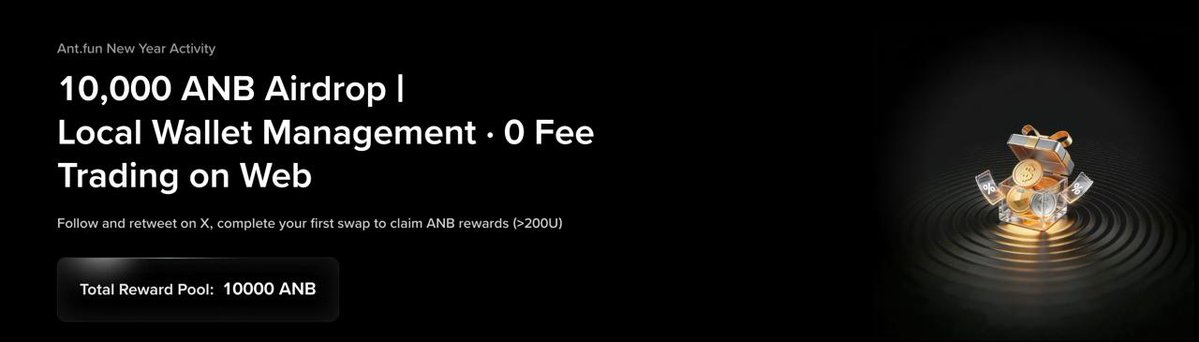
🎆2026 https://t.co/5xo7LSIrN4 New Year Airdrop🎉
Snag your slice of 10,000 $ANB rewards by finishing a few quick tasks:
🔶Connect your X account and follow @ant_fun_trade
🔶Retweet our post
🔶Make your first trade on Web (0 fees!) or in the App
🔶Invite friends and earn extra bonuses
Event ends in 15 days, check the details on the event page.
Join now: https://t.co/YgHTiUmKnk
Fully Local Wallet Control + Multi-Chain All-in-One + Zero Platform Fee = Your Future Trading!
GM X
So last week I was able to complete these amazing artworks 😇
It’s a new week now let’s see what we can do😊
LFG!💪🏽
@DejaVuPunks@perpltrade@monad_xyz@cocodourt
I’m open for commissions tho🙃
💪 I took it a step further and added:
function decrement() public {
require(count > 0, "Count must be greater than 0");
count -= 1;
emit CountChanged(count);
}
Now the counter can go down — but not below 0 ✅
🔄 function reset()
This sets count back to 0.
Also emits the CountChanged event:
function reset() public {
count = 0;
emit CountChanged(count);
}
Clean and simple. Great for testing function logic.
increment() function
➕ function increment()
When this is called, it adds 1 to count.
It then emits an event with the new value.
function increment() public {
count += 1;
emit CountChanged(count);
}
Anyone can call it, thanks to public.
Event?
📣 event CountChanged(uint newCount);
This creates a custom event. Later in the code, we call
emit CountChanged(count);
Telling the blockchain (and frontend apps): “Hey, the count just changed!”
Let’s break it down 👇
What's the state variable?
🔢 uint public count;
This is a state variable stored on the blockchain.
uint: unsigned integer (only positive numbers)
public: auto-creates a getter function. This keeps track of the count, even after the contract is deployed.
Let’s break down the actual Counter smart contract I built 👇
It's simple but packs in key Solidity concepts: state variables, functions, events, and basic logic.
I built this on Remix IDE
https://t.co/0dZQAyeQQ4
📢 Events = Blockchain shout-outs
You use emit to say “something just happened!”
emit ItemBought(msg.sender, 1);
This executes the event ItemBought.
By who? msg.sender.
How many? 1.
Frontends & explorers use these logs to show what your contract did.
🧙 Modifiers = What a function can or can't do
view: can read blockchain data
pure: can’t read or write – just math/logic
payable: lets the function accept ETH
You must use payable if people send assets to your contract.
🔒 Function Visibility
Let's us choose who’s allowed to use a function.
public: anyone.
private: only this contract.
internal: this contract + its children.
external: only outsiders.
🧱 Data Types: Building blocks.
They represent what kind of info you're storing.
uint: whole numbers.
address: crypto wallet ID.
bool: true or false.
string: text.
mapping: like a dictionary (key → value).
struct: custom object with multiple fields.
DAY TWO CHECK IN
The objective for today was a bit more technical: Understand Solidity syntax, structure, and build your first deployable smart contract.
Coming from a Javascript background, most of the syntax was easily relatable for me. So what smart contract did I build today?
I built a counter contract. Though simple, it allowed me to practice with the syntax and use new keywords.
Before writing the contract, I studied these core concepts:
Data types
Function visibility
Modifiers
Events
DAY TWO CHECK IN
The objective for today was a bit more technical: Understand Solidity syntax, structure, and build your first deployable smart contract.
Coming from a Javascript background, most of the syntax was easily relatable for me. So what smart contract did I build today?
DAY ONE CHECK
The objective for today was simple: Understand how Ethereum, the EVM, and smart contracts work at a conceptual level, and that's what I tried to do.
Follow me.🧵
💪 I took it a step further and added:
function decrement() public {
require(count > 0, "Count must be greater than 0");
count -= 1;
emit CountChanged(count);
}
Now the counter can go down — but not below 0 ✅