@onionsman Token plan is not efficient way. Instead of developing efficient token models, they are developing worst models.
I burn 20M tokens in 16 hours of single task. ( mimo 2.5 pro).
A single tool wrong call/ repeated call counted as consumed tokens. User is taking responsibility.
@Teknium@Legendaryy Thank you.
After trying all, hermes agent really helpful. All other tools are doing 70% of work only.
Request to Include scientific documentation skill inbuilt, for example officecli, typst document, set of scientific journal plots templates. Journal formats.
@Trae_ai Trae is great, using since launched. After using all IDE. Trae with solo is the best. Now, i would like to use solo. Can't wait to try it out! @Treai
First SOLO invite code giveaway 👾
- Follow @trae_ai and retweet this post
- Share your thoughts on what you want to build with SOLO
You'll receive codes in DMs once verified. For the next 24 hours only.
DeepSeek just fixed one of AI's oldest problems.
(using a 60-year-old algorithm)
Here's the story:
When deep learning took off, researchers hit a wall. You can't just stack layers endlessly. Signals either explode or vanish. Training deep networks was nearly impossible.
ResNets solved this in 2016 with residual connections:
output = input + what the layer learned
That "+" creates a direct highway for information. This is why we can now train networks with hundreds of layers.
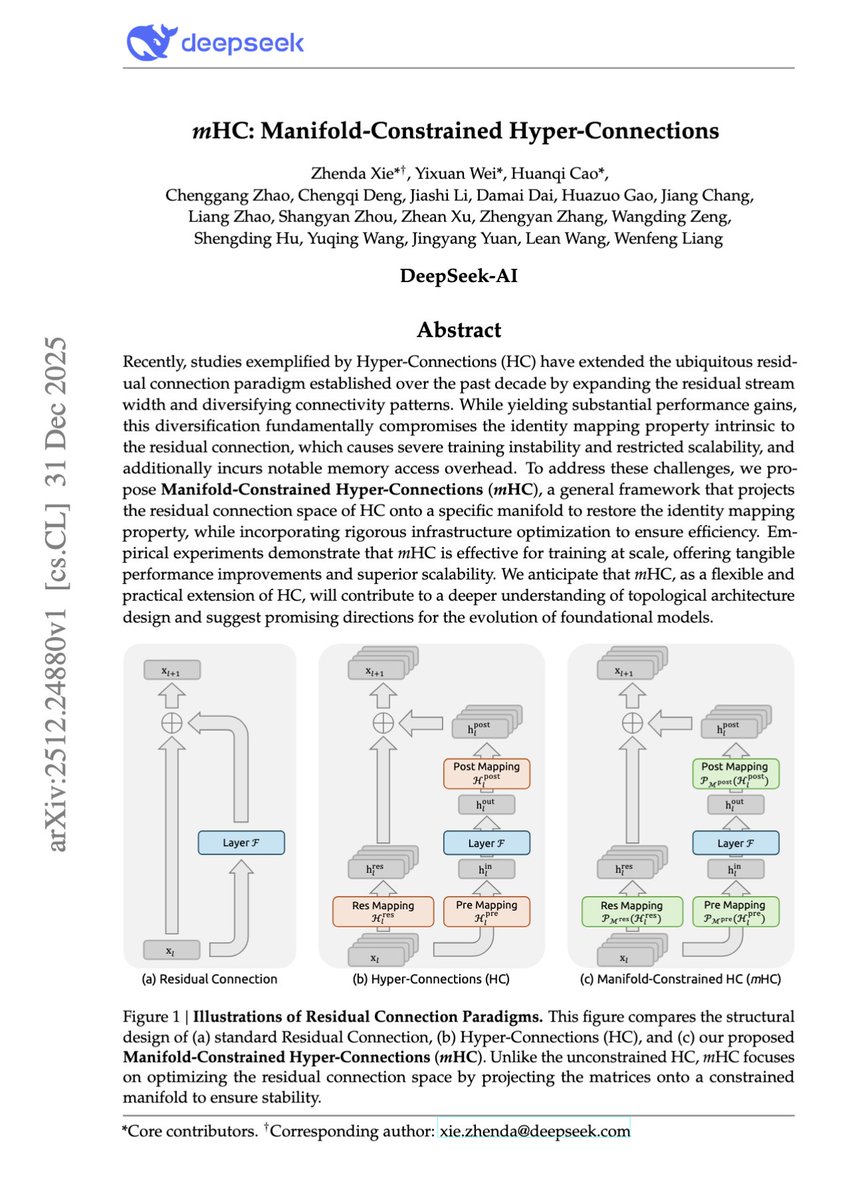
Recently, researchers asked: what if we had multiple highways instead of one?
Hyper-Connections (HC) expanded that single lane into 4 parallel lanes with learnable matrices that mix information between streams.
The performance gains were real. But there was a problem:
Those mixing matrices compound across layers. A tiny 5% amplification per layer becomes 18x after 60 layers. The paper measured amplification reaching 3000x. Training collapses.
The usual fixes? Gradient clipping. Careful initialization. Hoping things work out.
These are hacks. And hacks don't scale.
DeepSeek went back to first principles. What mathematical constraint would guarantee stability?
The answer was sitting in a 1967 paper: the Sinkhorn-Knopp algorithm.
It forces mixing matrices to be "doubly stochastic," where rows and columns each sum to 1.
The results:
- 3000x instability reduced to 1.6x
- Stability guaranteed by math, not luck
- Only 6.7% additional training overhead
No hacks. Just math.
I've shared link to the paper in the next tweet.