This chart is a brutal reflection of why public frustration toward political elites in many emerging markets continues intensifying because it shows that Indonesian lawmakers are compensated at levels that look extraordinarily disconnected from the underlying economic reality faced by the average citizen, with parliament salary reaching roughly 14.7x GDP per capita, among the highest ratios globally and second only to the Philippines in this dataset, despite Indonesia still remaining a country where purchasing power remains relatively weak, informal employment is massive, public service quality remains uneven, infrastructure bottlenecks persist, legal enforcement often feels inconsistent, and upward economic mobility for large parts of the population remains structurally difficult.
And this is precisely why charts like this become politically toxic because citizens naturally begin asking a very simple question: what exactly are taxpayers receiving in return?
In high-income countries, lawmakers may also earn very large nominal salaries, but those economies simultaneously generate far stronger productivity, higher institutional quality, better healthcare systems, stronger education outcomes, more efficient bureaucracy, higher legal predictability, and materially better public goods overall, meaning political compensation exists within a much larger and wealthier economic ecosystem.
But in Indonesia, the optics become far more uncomfortable because the political class increasingly appears capable of extracting upper-middle-class or even developed-market lifestyles from an economy that still struggles to generate broad-based prosperity for much of the population itself.
And perhaps the harshest part is that compensation alone is probably not even the real issue. The real issue is performance.
Citizens are generally willing to tolerate highly compensated leaders if the country visibly becomes richer, more efficient, more meritocratic, less corrupt, and economically stronger over time. But when corruption scandals remain persistent, policymaking appears inconsistent, infrastructure projects repeatedly face rent-seeking concerns, and wealth creation remains concentrated among political insiders, conglomerates, and connected elites, high political compensation begins looking less like professionalization and more like institutionalized extraction.
Importantly, this also helps explain why anti-elite sentiment, populism, and distrust toward institutions continue rising globally because once the gap between elite living standards and ordinary household realities becomes too visible, citizens increasingly stop believing the system operates primarily for collective national advancement and instead begin viewing politics as a mechanism for self-enrichment among those already close to power.
Ultimately, this chart reflects something much deeper than salary levels alone because it exposes the uncomfortable reality that in many emerging markets, the political class often succeeds in upgrading its own prosperity far faster than the nation it supposedly represents, and over time that divergence itself becomes corrosive to institutional trust, social cohesion, and long-term political legitimacy.
the engineer who built Claude Code just dropped a 28-minute video on how to write prompts that actually work
I've seen $300 courses that don't cover what he shows in the first 10 minutes
CLAUDE.md files, memory shortcuts, parallel sessions, prompting patterns
all in one video and completely free
works whether you're a developer, a beginner, or someone who's been using Claude for months
based on this, I put together 11 Claude things I wish someone had told me 12 months ago
full guide in the article below
Indonesia is taking steps to slow or reverse currency depreciation.
Starting next month, all natural resource exporters are required to deposit 100% of their earnings in state banks.
Private contracts will be replaced by a state agency buying from domestic producers and exporting abroad. The goal is to get a better price, prevent under-invoicing, and get FX directly into state coffers.
I expect other exporting nations to do something similar.
New CursorBench results just dropped.
Two big takeaways.
Composer 2.5 is way better than most people think.
63.2% score at $0.55 per task.
Nearly matching Opus 4.7 Max and GPT 5.5 Extra High at 20x less cost.
This is insane value.
Gemini 3.5 Flash is #10 at 49.8%.
Below GPT 5.5 Low.
Below Opus 4.7 Low.
Google's newest model can't even beat budget tier competition.
Composer 2.5 is the sleeper.
Gemini 3.5 Flash is the disappointment.
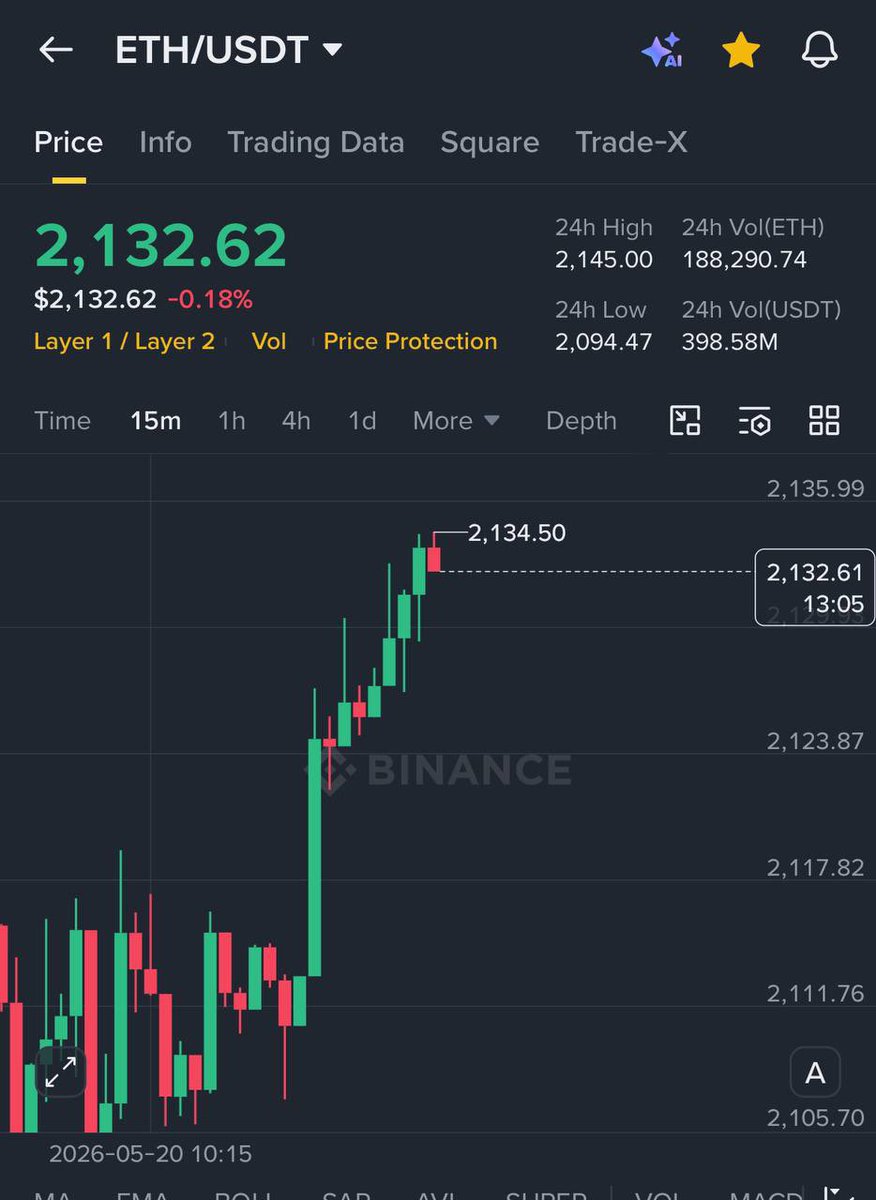
Bitcoin and ETH are pumping after Trump ordered Fed to grant crypto firms direct access to master accounts.
$25,000,000,000 has been added to Crypto market in the past 4 hours
Indonesian President Prabowo Subianto laid out plans to tighten state control of commodity exports as the government contends with mounting fiscal pressures and a plunging rupiah https://t.co/lcyxkqWOFR
OpenClaw just plugged into X, and now your own hardware gets the claws. 🦞
Bring your Grok, SuperGrok or X Premium subscription to your OpenClaw agent.
Now even your personal agent is red-pilled and based.
Get Grokked:
https://t.co/pIj2vp1IpM
Following the success of our first drop, we’re proud to continue our collaboration with Manchester City.
Together, we’ll be creating exciting experiences at the intersection of physical and digital and bringing Pengu and Pudgy Penguins to City fans worldwide.
More details soon.
🇺🇸 Reversal in the US Market
$320 Billion added in the last 30 MINUTES.
Nvidia becomes the first company in history to hit $5.5 Trillion in market cap.