TSMC just committed another $100B to Arizona, at least four more 2nm fabs, taking total US investment to $265B, announced alongside a record quarter where net income jumped 77.4% YoY.
Every single one of those fabs needs a resource most investors never think about: water pure enough to rinse a wafer without destroying it.
One company controls that resource for TSMC globally, and it’s a $4.2B stock trading like a boring industrial contractor.
$6368.T — Organo Corporation (TSE: 6368)
Not a chipmaker. Not an equipment supplier. The company holding 70-80% of TSMC’s global water treatment infrastructure, and effectively 100% of the market for Ultrapure Water (UPW) systems at sub-10nm nodes, across Taiwan, Japan’s Kumamoto JASM fab, Arizona, and Dresden.
Why this is physically unbreakable:
A 2nm chip’s manufacturing process is over 30% wafer rinsing between etching, deposition, and lithography. At sub-10nm, one particle bigger than 10 nanometers causes catastrophic yield loss. The spec, SEMI F63, demands total organic carbon under 0.1 parts per billion and dissolved oxygen under 1 ppb. That’s continuous electrodeionization, catalytic UV oxidation, and proprietary ion-exchange resins pulling trace ions down to parts per trillion. Without this exact chemistry, EUV scanners can’t run, the fab doesn’t underperform, it doesn’t function.
The moat, layer by layer:
Switching costs are close to infinite. A 3nm gigafab produces over $20M of wafers per day, halting that line to qualify a competitor’s water loop takes 24-36 months of continuous testing. Water infrastructure is under 3% of a fab’s total capex but carries 100% of the yield risk, nobody experiments there once qualified.
Organo also owns hundreds of active patents covering its UV deoxification chambers, CEDI modules, and particle filtration matrices, chemistry that isn’t replicable just by spending capital. Its closed-loop HF and PFAS recovery systems now double as a regulatory moat too, as environmental discharge rules tighten globally. The supply side backs this up: a global shortage of specialized chemical process engineers and long lead times on high-purity fluoropolymer piping and specialty resins. Organo and Kurita together already control over 70% of Japan’s high-purity industrial water market, leaving foundries few qualified alternatives to call.
Against direct competitors, it’s share, not just tech. Nomura Micro Science, the next-closest listed peer, holds only 20-30% share in sub-10nm installs versus Organo’s 70-80%. Qualification cycles lock second place out for years.
The business is quietly transforming under the hood:
Every plant built becomes a decades-long service annuity, resin regeneration, filter replacement, continuous monitoring. That Service Solutions segment is over 40% of revenue, targeted to hit 55% by 2030, carrying margins above 25%. Blended operating margin expanded from 11.5% in FY2023 to 19.1% in FY2025. ROE grew from 14.5% to 21.7% over the same stretch. Order backlog sits at ¥105.8B, with ~¥185B in new fab-related orders guided for FY2027, before yesterday’s Arizona news even hits it.
The valuation gap:
A reverse DCF on the ¥14,385 share price shows the market pricing in just a 5.1% five-year revenue CAGR and a 15.5% terminal operating margin. Global advanced fab capacity is growing north of 12% annually, and semiconductor UPW specifically is projected at a 12-15% CAGR through 2035, faster than the broader UPW market. At ~22.6x forward earnings with a 62% equity-to-asset ratio and a net cash balance sheet, this isn’t a cyclical contractor being mispriced, it’s a recurring-revenue infrastructure monopoly still trading like one.
Catalysts stacked ahead:
TSMC’s N2 equipment hookups at Baoshan and Kaohsiung ramping through this year, a 5-for-1 stock split effective October improving retail liquidity, and full revenue recognition from the Arizona and Dresden builds landing over the next 24 months.
$6368.T
NFA. Do your own DD.
Yield does not need speculation.
Nawa’s USDT Vault is now live on Ethereum, offering double digit APY through Shariah aligned, asset backed strategies with documented financing activity and transparent distribution.
Put your USDT to work: https://t.co/d4yTjk06Q6
If your portfolio is red right now, do not worry my friend.
The markets drop 5%, two or more times every year since 2000.
The scary feeling you have right now happens all the time. Just close the laptop, stay invested, and keep investing every paycheck and you'll be rich.
Markets will go back to all-time highs.
Nawa has opened its doors to Ethereum.
The USDT Vault is live, opening access to ethical, asset-backed yield for stablecoin holders.
Enter a new frontier as Nawa leads the way.
Just look a the speakers we have coming together and the topics that are being covered… Alhamdulillah
You will not find a Bitcoin event as dedicated to solving real problems as this… let alone one for Muslims, by Muslims
I urge every Muslim who sees this to consider dedicating a minimum of just 1 day of your free time to learning about something that has the potential to change the future of our Ummah 🤲🏽
Bismillah.
I take full responsibility in the afterlife if studying Bitcoin and reading "The Bitcoin Standard" from @saifedean and reading Anti Riba Money from @MBitcoiner is haram. So you no longer have any excuses not to study Bitcoin.
Oxford Metrics is valued at roughly £44 million.
It holds £31.7 million in cash and fixed-term deposits.
That leaves the market valuing the operating business behind Vicon at roughly £12 million before lease liabilities.
The arithmetic is real.
The “physical AI bottleneck” story is not proven yet.
$OMG.L
Vicon builds high-precision motion-capture systems: camera arrays and software that reconstruct 3D movement. The technology is already used across biomechanics, entertainment, engineering and robotics.
The robotics angle is straightforward. Training and validating machines in the physical world requires accurate reference data. Engineers need to know where a robot, tool or human joint actually moved—not merely where its own sensors believe it moved.
That makes optical tracking useful for teleoperation, manipulation research and sim-to-real validation.
But I would not call Vicon an irreplaceable chokepoint. Oxford Metrics does not disclose robotics revenue, and the evidence is stronger in laboratories than scaled humanoid production. OptiTrack is a credible competitor. Synthetic data and improving markerless vision could also reduce demand for expensive fixed-camera systems.
The investable thesis is subtler: the market is charging very little for a high-gross-margin motion-data franchise while giving investors optionality on physical AI.
FY2025 revenue was £44.8 million with a 64.8% gross margin and £2.2 million of adjusted EBIT. In H1 FY2026, Motion Capture revenue grew 10% to £16.3 million and group gross margin improved to 66%.
Yet the group still reported a £0.2 million adjusted EBIT loss.
That contradiction explains the valuation.
Vicon remains the quality asset, but Oxford Metrics has spent cash acquiring and integrating smaller vision-metrology businesses. These expand the opportunity, but add execution risk and dilute Vicon’s economics.
Management is consolidating those businesses and targeting £1.0–1.6 million of annualised savings from FY2027. Its medium-term ambition is to double revenue and reach mid-teens adjusted EBIT margins.
I would not underwrite those targets yet.
What surprised me is how little improvement is required for the valuation to change. A £1.5 million cost reduction matters when the operating business is valued at roughly £12 million after cash.
If Vicon keeps growing and the acquired division merely stops consuming margin, earnings can improve quickly.
Markerless capture is the speculative upside.
Oxford Metrics says it has more than 40 years of motion data and is using that archive to train proprietary AI models. Markerless capture could open environments where suits and reflective markers are impractical.
But the initial push is focused on entertainment, not robotics. I need commercial conversion before valuing it like software.
The balance sheet provides time, not immunity.
Cash fell from £37.3 million at FY2025 to £31.7 million after dividends and buybacks. The previous 3.25p dividend was not covered by that year’s profits, and management has since shifted toward paying dividends as a percentage of free cash flow.
I would not treat the headline yield as permanent.
This is also an illiquid AIM micro-cap. Project timing is uneven, US academic and entertainment markets have been soft, and acquisitions can turn cash-backed protection into cash spent badly.
My view:
Oxford Metrics is investable as a small, cash-backed position with physical-AI optionality.
The evidence is not strong enough to call it the optical bottleneck for humanoid robotics.
The thesis strengthens if Motion Capture keeps growing, markerless produces meaningful sales and integration savings restore profitability.
It weakens if cash keeps falling while adjusted EBIT remains near zero.
At roughly 39p, the market appears to price in operational disappointment and very little robotics upside.
That interests me.
It does not prove the upside has arrived.
when you have prayer in your life vs when you don't
prayer = inner peace despite outer chaos + success
no prayer = inner chaos + outer chaos + no success
Just wanted to let out a message from my heart.
I am sincerely appreciating all the new followers and investors enjoying my content.
With that comes some limitations on X.
For some reason I don’t get proper notifications of every reply on my posts.
That is a shame cause I always try to make an effort to reply to every single comment you guys put out.
I will still try to do this, but don’t be sad if I don’t manage to reply.
If you really want a reply, just comment again. And hopefully it’ll pop up in my notifications.
Thanks guys. I sincerely do enjoy and appreciate every single one of you guys.
Have a great Sunday!
- TTS
📉📈 The strangest six weeks I've tracked in a while. The prices went one direction. The filings went the other.
$EOSE → stock red YTD. Record revenue, record $807M backlog, collections above revenue, Pentagon added to the customer list.
$AAOI → cut in half from the high. Broke ground on 400K sq ft of new capacity against $324M of hyperscale orders.
$ASTS → down 59% from the peak. Placed $1B of 7-year converts overnight at a $149 effective conversion price, institutions oversubscribed.
$NBIS → down a third. ~$50B contracted.
Two ledgers, one company, opposite directions. That's not a market being wrong. That's a market pricing flows while the businesses price demand: de-grossing, margin unwinds, systematic selling, none of which reads an 8-K.
The discipline: sometimes price is early and the filings catch down. Watch conversion, not headlines, and the next two earnings weeks are the arbitration.
But price and fundamentals cannot diverge forever. One of them closes the gap, and it's usually the one that wasn't forced.
DYOR. Not FA.
Most defi vaults are built to chase the best yield available.
A Shariah-compliant vault has to do more. It must generate yield inside a certified, asset-backed structure where profit stays connected to real economic activity, without interest-based mechanics or speculative exposure.
Every strategy, native or from partners, goes through Shariah certification before a single dollar moves.
That is the standard Nawa was built around. And the structure every vault on the protocol is held to.
As Nawa expands its vault infrastructure to Ethereum, the smart contracts behind the new deployment have been independently audited by @SecurityOak.
Ethical capital should only move through infrastructure that has been properly reviewed. That standard does not stop at Shariah certification. It extends all the way down to the code.
The vault opens soon.
@NawaFinance@SecurityOak Finally after 7 years in crypto a legit Islamic crypto defi project besides Inshallah defi, let's hope it will continue be active.. inshallah
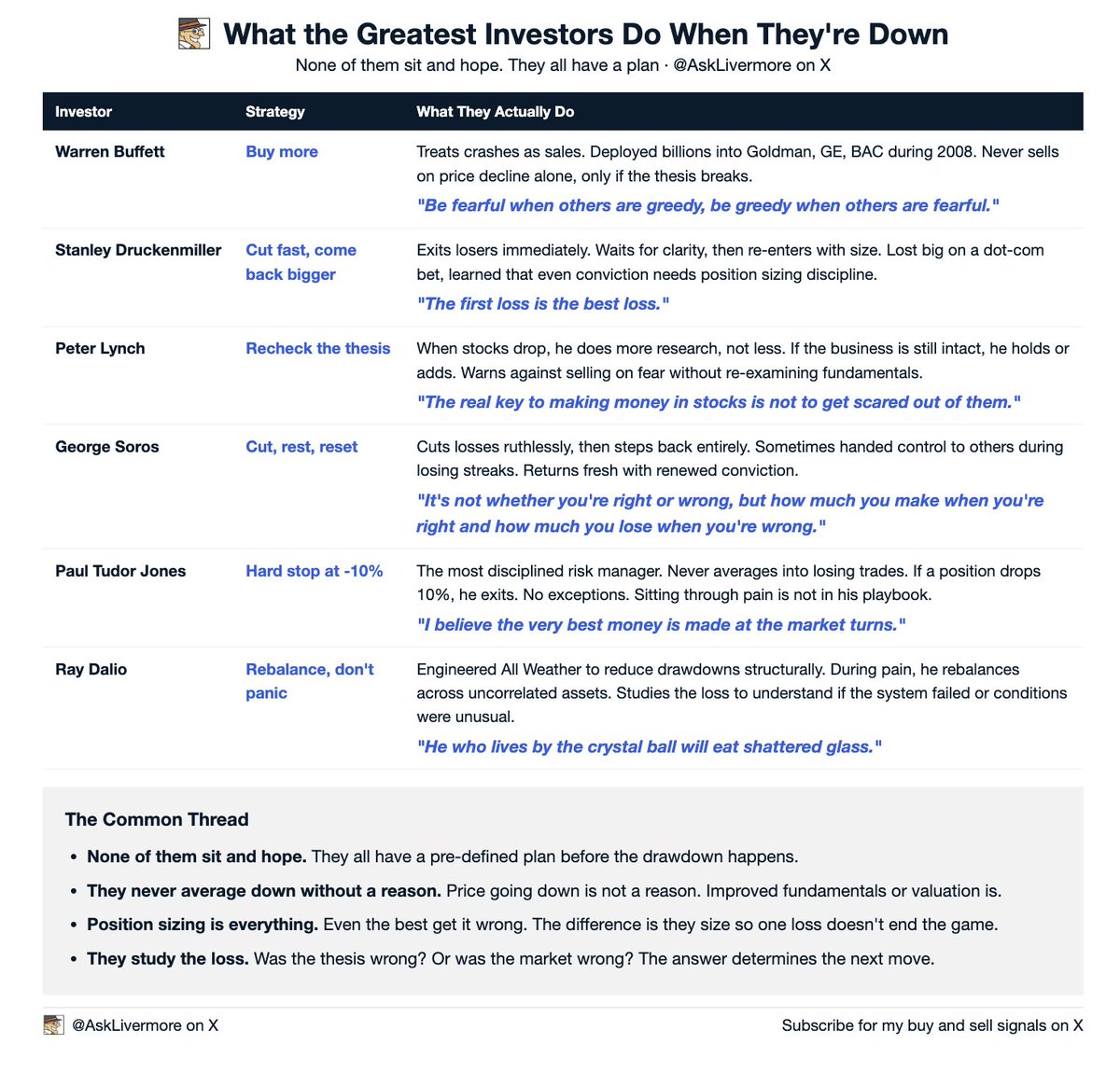
Your portfolio is down and you don't know what to do. Save this for the next time your portfolio is red. You will need it.
Here's what the 6 greatest investors of all time do when they're losing money:
1. Buffett: Buys more.
- he deployed billions into Goldman Sachs and Bank of America during 2008 while everyone else was panicking.
2. Druckenmiller: Cuts fast, comes back bigger.
- he exits losers immediately. No ego. Waits for clarity, then re-enters with conviction.
3. Peter Lynch: Rechecks the thesis.
- when stocks drop, he does more research, not less. If the business is intact, he holds.
4. Soros: Cuts, rests, resets.
- he cuts ruthlessly, steps away from the screen, then comes back fresh with a clear head.
5. Paul Tudor Jones: Hard stop at -10%.
- if a position drops 10%, he exits. No exceptions. No averaging down. No hoping.
6. Ray Dalio: Rebalances, doesn't panic.
he studies the loss. Was the thesis wrong or was the market wrong? The answer determines the next move.
The common thread across all 6:
- None of them sit and hope
- They all have a plan before the drawdown happens
@Sandeman52 I would assign a high probability of this scenario playing out. A great market technician @ProblemSniper who called the past 6 weeks of weakness said this Friday would be the end of this period between OPEX and tech earnings. 💪
Opinion: AI stocks bottom on Monday July 20 with the most likely window being Friday afternoon through Monday morning.
Why?
Today looked much more like capitulation than the start of a new bear trend.
TSMC delivered outstanding results yet semiconductors still sold off hard. If great news cannot lift prices it most often signals forced selling rather than deteriorating fundamentals.
Friday is monthly options expiration which can create additional mechanical selling pressure. Monday often becomes the final flush as fear peaks and positioning resets.
The next major catalyst is big tech earnings beginning next week. Markets often start pricing those in before they arrive.
My view is there is about a 70 percent chance the AI sector bottoms Friday or Monday.
If I had to pick one day it is Monday July 20.
The AI story is still intact. This lookss more like a sentiment reset than the end of the cycle.
Not financial advice…just my 2 cents. Let’s see what happens. I think it’s almost over.