Patient: My blood sugar's high.
Doctor: We'll start you on metformin.
Patient: Could I just stop eating sugar instead?
Doctor: You won't be eating sugar. You'll be eating wholegrains.
Patient: And what do wholegrains break down into?
Doctor: Glucose, eventually.
Patient: Which is?
Doctor: ...sugar.
Patient: So I'd be eating sugar.
Doctor: It's a slower sugar.
Patient: But still the thing my blood already has too much of.
Doctor: The medication handles that.
Patient: Or I could just not eat the slow sugar?
Doctor: That's quite hard for people to stick to.
Patient: Harder than injecting myself for the rest of my life?
Doctor: ...
Patient: I'm only asking why we're mopping the puddle instead of turning off the tap.
Doctor: ...
Patient: Doctor?
"It's compiled away. This is why I talk about zero overhead abstraction."
And there lies the problem: Why have an abstraction in the first place, if we are planning to compile it away anyways? Compiling things away takes time. Slower compile times reduce programmer productivity. Also more abstractions make it harder for programmers to reason about the code. It's a lose-lose situation.
THIS GUY INHERITED A REPO FROM A "VIBE ENGINEER" AND REWROTE THE WHOLE THING IN A WEEK
he joined a new company and got handed a 3 month old backend repo that everyone celebrated as "advanced agentic engineering"
here's what he actually found:
> 220 route handlers. only 20 were in use
> 40+ secrets configured. only 2 were needed to run the project
> 309,000 lines of code covered by 240,000 lines of documentation
> 1 million+ lines of agent logs sitting in markdown files
> files with 5,000+ lines of code and barely any architecture
> tests that covered who knows what
the previous engineer had used some kind of agent loop running skills and different agent roles to build functionality that nobody asked for
he rewrote the entire backend in one week with claude code. kept the same functionality. proper architecture. real integration tests
his takeaway is the one that every vibecoder needs to hear right now
all those fancy knowledge base management systems and agent orchestration setups people invest in
how much of that actually helps vs just producing the feeling that you're doing a lot?
his approach is simple. a few AGENTS.md files, a backlog accessible to the agents, good architecture principles, and integration tests that cover the main scenarios
he also made the point that building "for the future" is almost always a waste. when that future comes it's never how you imagined it, so you end up rewriting anyway
Wait, hold up. Why have a mode that pushes the CPU to work harder just to have a smoother UI experience? Why not optimize Windows so that it doesnt require more power from CPU and require more power from the PSU?
Furthermore, this is worse for people on the move with laptops.
Hidden trick not acceptable, we need reliability and optimization.
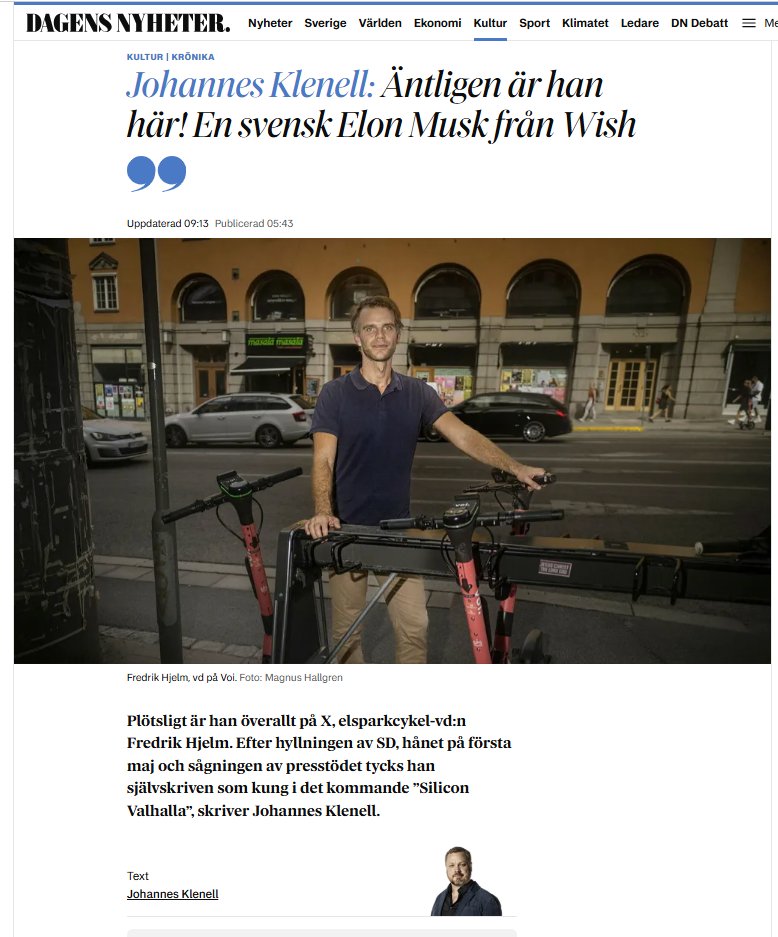
Today I got a full page in @dagensnyheter culture section. A columnist calls me "a Swedish Elon Musk from Wish."
I'll take it. One factual claim deserves a response.
Klenell calls Swedish tech "air business" affecting "a few thousand Swedish jobs." Stockholm has the second highest number of unicorn companies per capita in the world, after Silicon Valley.
Hundreds of thousands of Swedes work in tech.
Ericsson, SAAB, MySQL. Spotify, Klarna, King, iZettle, Mojang, Truecaller, Sinch, Epidemic Sound. Not air businesses. They're why Sweden can afford its welfare state.
Then: I'm doing this to avoid paying tax.
As I've written before. I grew up in northern Sweden. Nurse mom and teacher dad. My grandparents worked hard to survive and build something. My parents worked hard to give me and my siblings a great life.
I'm grateful for that every day.
I have more money than I ever imagined growing up. My fiancée and I live simply. Tax is not the issue.
I want Sweden to be the best country in the world to build in. I want the next generation to have the same shot we had. And I don't want us to repeat the mistake of ignoring problems for twenty years and then attacking the person who names them.
Klenell has no data, no analysis, just labels.
Labels are easier than arguments.
Sweden deserves the arguments.
@dcolascione@GeraldNnebe@olson_dan@JustDeezGuy One could also argue that you might want to ease the move over to newer c versions whenever compilers are updated and thus stick to a c compiler because you're not losing anything on it either.
Tangentially, it's worth noting that, to the extent it's not usable, it would be because modern software is poorly written, not because the hardware is insufficient for doing the majority of the tasks the average user needs to do on a daily basis.
If you run 2011 software on a 2011 laptop, it runs fine and provides essentially the same features as the equivalent 2026 software that will run dog-slow on the 2011 laptop. When I've gone back and tested even ~2005 software on ~2005 hardware, I find that the software, if anything, is more responsive doing the same operations than its equivalent today on modern hardware - which is insane considering how much faster modern hardware is :(
If you'd like a video, I already recorded one of those when someone was a dick on Twitter about it and it really pissed me off: https://t.co/DPGoo0eUkO I feel like people don't realize that programs like Visual Studio used to be fairly responsive two decades ago. It's only their modern incarnations that are sluggish despite orders of magnitude faster hardware.
I think there are good arguments about supporting q limited number of hardware configurations for simplicity and reliability reasons (eg., it's harder to develop and test on five separate instructions set targets, like x86, x64-SSE2, x64-AVX, x64-AVX2, x64-AVX-512, than it is to just target one modern one like x64-AVX2). But performance by itself is not a reasonable argument against supporting old machines unless you're working on software that handles extremely performance-intensive workloads, which 90+% of software is demonstrably not.
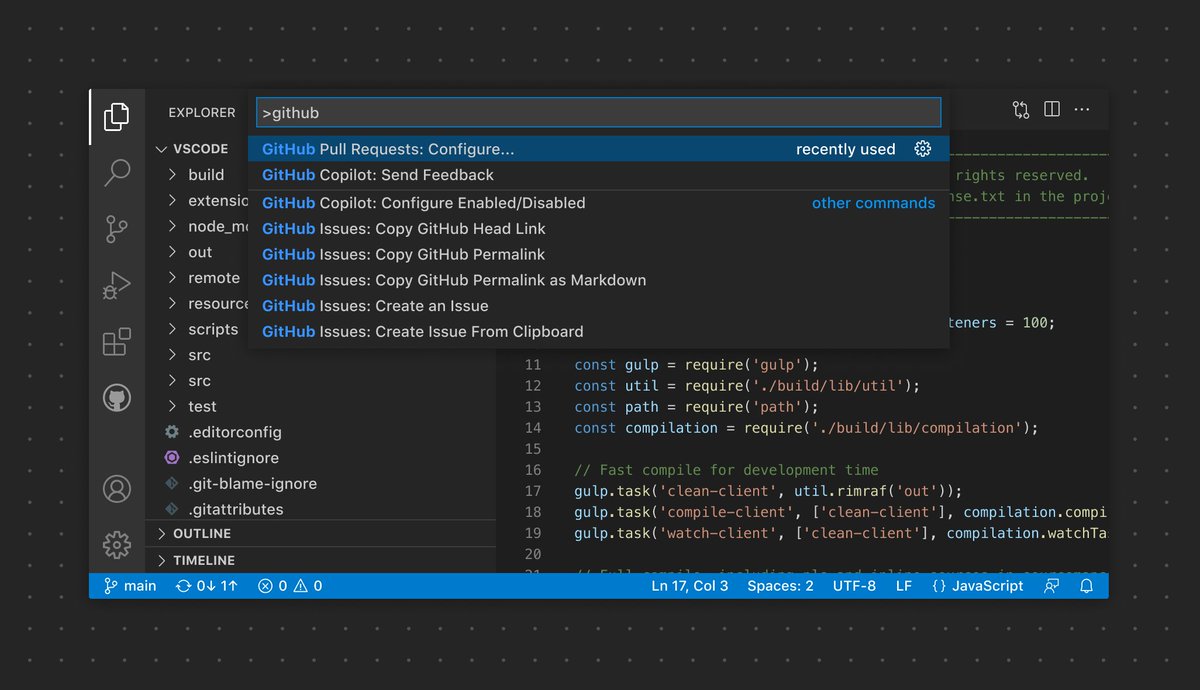
I'm completely convinced at this point that the "Command Palette" is a fundamental UI concept, and should be in all applications. It should also be a built in browser concept, there should be an API for websites to push items to the command palette ("new post", "muted words" etc)
Typed the same two lines of "The Ring Verse" (while fighting autocorrect) on Windows 11.
Notepad.exe hit 650k events (allocs/frees), ~72MB.
The text I used has roughly 145 characters.
Win10
- 103 events/char
- 4 KB/char
Win11
- 4510 events/char
- 497 KB/char