At @maisaAI_, we’re not just building with AI. We’re building AI.
So proud of our big bet on foundational AI.
Open-source contributions and research papers coming soon. 🚀
EmbeddingGemma 2의 기반으로 그대로 결정모델(Jev) 스타일로 쓸 수 있게 해준다는데...
EmbeddingGemma 2의 성능을 거의 그대로 가져온 수준이라면 상당히 좋은 조건인 것 같음.
무려 구글에서도 인정한 파인튜닝 모델임. 비교 벤치가 아직 안올라온게 조금은 아쉽긴하네
EmbeddingGemma 2의 기반으로 그대로 결정모델(Jev) 스타일로 쓸 수 있게 해준다는데...
EmbeddingGemma 2의 성능을 거의 그대로 가져온 수준이라면 상당히 좋은 조건인 것 같음.
무려 구글에서도 인정한 파인튜닝 모델임. 비교 벤치가 아직 안올라온게 조금은 아쉽긴하네
🧭 New model: Typed Decision, built on EmbeddingGemma 2
Give it a state + any schema of questions → typed, calibrated answers (choice · score · noul). No text generation, no output parsing.
76.4% on typed-decisions, ~6 pts behind a 27B LLM with ~100× fewer params.
🤗 https://t.co/FJQ2eUSRqj
Typed Decision Engine for Agent Workflows
Forget slow autoregressive generation and fragile JSON parsing.
This fine-tune turns EmbeddingGemma 2 into a fast decision engine that evaluates workflow states (like agent traces or support tickets) against a dynamic schema of questions in a single forward pass. It returns calibrated choice, score, and bool outputs without retraining.
Model and post by @mrm8488: https://t.co/4qxCNbCUmP
Hugging Face: https://t.co/ajpXZS5L7y
@gynura0x Congrats to you, Josep, and the rest of the VALENCIAN MAFIA! Quietly, but working tirelessly and with an outstanding attitude, you guys are taking MAISA to the next level. 👏
Santander is scaling AI process automation with Maisa.
We’re working alongside Santander’s teams to deploy AI for more complex processes across its main markets in Europe and the Americas, combining reasoning, execution and traceability with specialized models that can run on the bank’s own infrastructure.
Our collaboration with Santander reflects our commitment to bringing AI into production at scale in one of the most demanding industries, with governance, reliability, and cost efficiency as core priorities.
Read the full story on the @bancosantander website:
https://t.co/bCpQUUm2E7
You already gave the LLM the answer. So why is it writing it out from scratch?
Introducing a new AI model architecture: Constrained Decoding Models (CDMs)
LLMs were built to write. Most production workloads just need an answer: fast, consistent, and affordable.
CDMs are purpose-built for 1 task each. They read your input once and skip the token-by-token generative loop that makes LLMs slow and expensive.
Not just a decision model, but a family of 3 CDMs live today:
• Classify: define your labels and get back a calibrated probability + reason for each. Used for routing, tagging, and intent detection.
• Extract: describe the entities in natural language and get back well-formed JSON with confidence scores + citations. Used for web scraping, document processing, and PII redaction.
• Summarize: pass in long text, images, or PDFs and get back a consistent summary under 1,000 tokens. Used for context compaction, metadata generation, and transcript digests.
Built for production:
• 1M tokens of multimodal (text + image) input, 31x larger than Jev
• 77.2% on DecisionBench vs Jev's 72%
• 200x faster, 467x cheaper than frontier LLM APIs
• $0.05/M input tokens. Output is free (yes, even for summarize)
Live on your favorite platforms today:
@OpenRouter@vercel_dev@LiteLLM@LangChain@TrustedRouter@itsArthurAI@useRouterPlus
Get 50M input tokens for free (for the first 50 hours) at link below 👀
The intuition: models trained on different data seem to converge to a similar geometry (the Platonic Representation Hypothesis).
Distances between concepts like food, people and animals look alike in both spaces. So is this shared geometry enough to align them?
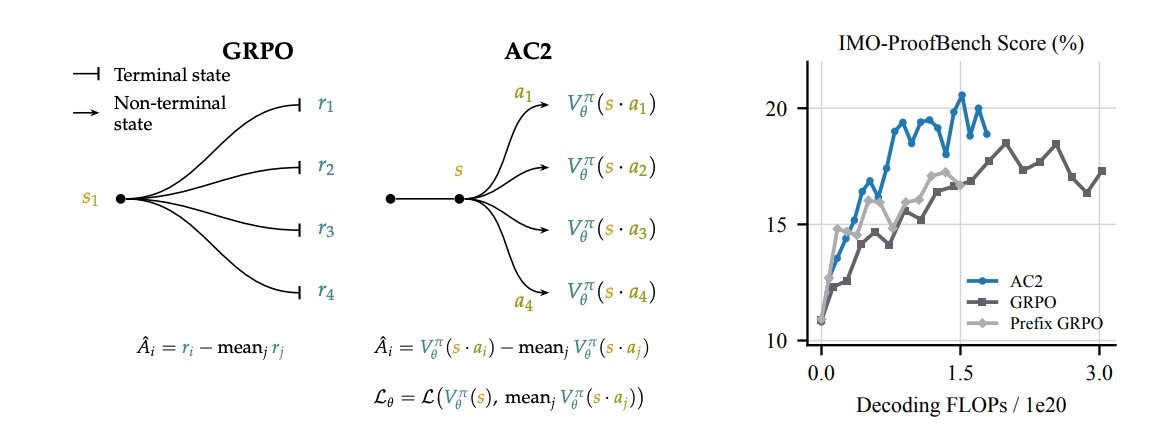
Do you really need to finish every rollout in RL for LLM? Not if you make your critic better—and trust it!
We propose Actor-Critic with Action Chunking (AC2): use a learned critic to score chunks of tokens => only need partial rollouts ⇒ train faster than GRPO!
Keep plain SFT, but first transform each expert trace into a nearby trace that the model itself would plausibly write, while making sure it still reaches the expert's answer.
SFT is not dead! 🥳
We found a way to make SFT rival current prevailing posttraining methods, often generalizing better and forgetting less than RL and OPSD. 🤯
Following our prior work on reasoning with sampling, we now introduce sampling to the posttraining stack.
1/n