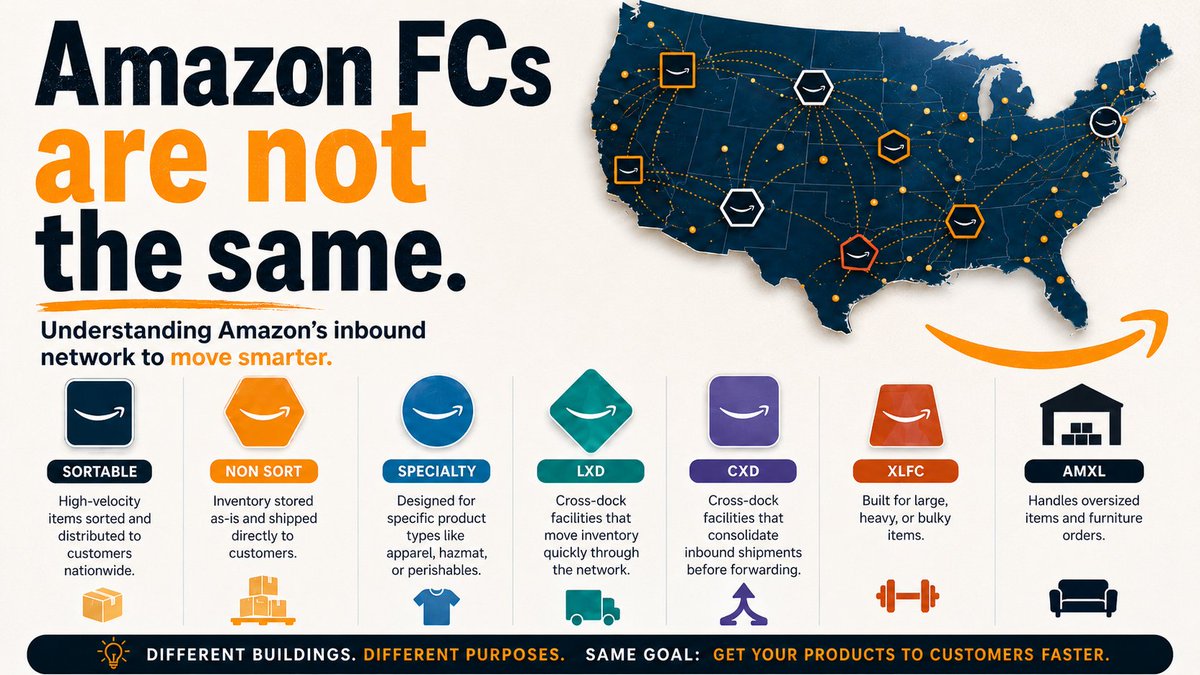
There is a hidden variable in Amazon FBA inbound shipping that more sellers should understand.
Live unload vs. drop trailer.
Your LTL shipment can arrive at the exact same Amazon facility and have a very different path to when they are available for sale.
Has it really been received by Amazon, or is it just sitting in the trailer at the FC waiting to be uploaded because these were drop load trailer transports? https://t.co/WqMotrOjx0
🚨 ASGTG alert!!! 🚨
Many sellers are seeing inventory remain stuck in FC Processing or Staging long after it has been received by Amazon.
During this time, the units are not available for sale, revenue is delayed, ranking momentum can be impacted, and storage fees still apply even though the inventory is not sellable. Not great!
The biggest challenge is the lack of visibility: sellers often do not know why the inventory is delayed, when it will be released, or how to properly escalate the issue.
Has anyone recently dealt with extended FC Processing delays?
There are quite a few posts on the forums on this issue
@amznsellerhelp
The sellers who consistently win Prime Day didn't get lucky.
They built the system before the dates dropped.
Receiving SOP. Prep SOP. Shipment templates. Carrier scheduling. Limit monitoring.
None of it is complicated, but takes time to build.
Most FBA sellers will lose 2026 Prime Day before it even starts.
Not because of bad products. Not bad pricing.
Because their inventory won't be in the FC in time to sell. Amazon announced late. The window is short. And messy inbound ops don't compress well.
A lot of sellers don't actually understand how Amazon's network routes inbound shipments.
Are you sending your goods to fulfillment-FC or a distribution FC which will then re-route your items to a final FC eating up more time you don't have?
FBA Revenue is a vanity metric. Margins are sanity.
I keep seeing large Amazon sellers hitting a profit wall because they haven’t updated their models for the new reality:
* Inbound placement fee splits
* Spiking return processing fees
* Removal/disposal costs
If you haven't optimized logistics in the last 6 months, your FBA business might be quietly bleeding out.
When you add up placement fees, returns, low inventory and storage fees and rising PPC costs, that healthy 25% net margin you had last year can easily morph into a 4% break-even nightmare.
You cannot out-advertise bad unit economics. Trying to scale your way out of a margin crisis just accelerates the bleed.
Ask your Amazon transportation partner:
“Are our Amazon deliveries typically booked as live unloads or drop trailers? Can we request a live unload?”
It is a simple question that can move your inventory through receiving and available for sale much faster.
There is a hidden variable in Amazon FBA inbound shipping that more sellers should understand.
Live unload vs. drop trailer.
Your LTL shipment can arrive at the exact same Amazon facility and have a very different path to when they are available for sale.
With a live unload, the driver stays attached to the trailer while Amazon unloads it.
With a drop trailer, the driver leaves the trailer in the yard and moves on. Amazon unloads it later, when capacity opens up.
If your priority is getting inventory checked in and available for sale as quickly as possible, the difference matters.
High-velocity SKU heading into Q4? Aim direct FC. Slow mover? Let Amazon's IXD network carry the transport cost. Know the system. Stay in control of your business.
Want all of this handled for you?
https://t.co/rh0siwAG1O Stop leaving velocity and margin on the table.
Here's what no one tells Amazon sellers:
When Amazon gives you inventory placement options, it's optimizing it's own fulfillment network. If you understand what Amazon is doing, you can optimize your business too. Here are the details:
Neither is wrong. But most sellers just pick the cheapest option without knowing what they're actually choosing between.
Amazon will always optimize its placement for its network efficiency. Your job is to know when those interests align with yours - and when they don't.
Visibility into your inbound shipments isn't a "nice to have" feature, it's business intelligence. Knowing which truckloads are stuck, and for how long is the difference between running a tight operation and quietly wondering why cash flow feels squeezed. Track it like revenue.
An FBA shipments dashboard seems boring. It's not. We're seeing multiple truck loads that haven't been delivered.This is a cash flow report. Every day a truckload sits in transit or stuck in an FC receiving queue, that's money lost.
Many sellers think delivery delays are a carrier problem. It's not. It's a working capital problem. You bought that inventory. You shipped it. Until Amazon checks that truck in, you can't sell it, you can't rank for it, and you can't cycle that cash into your business.