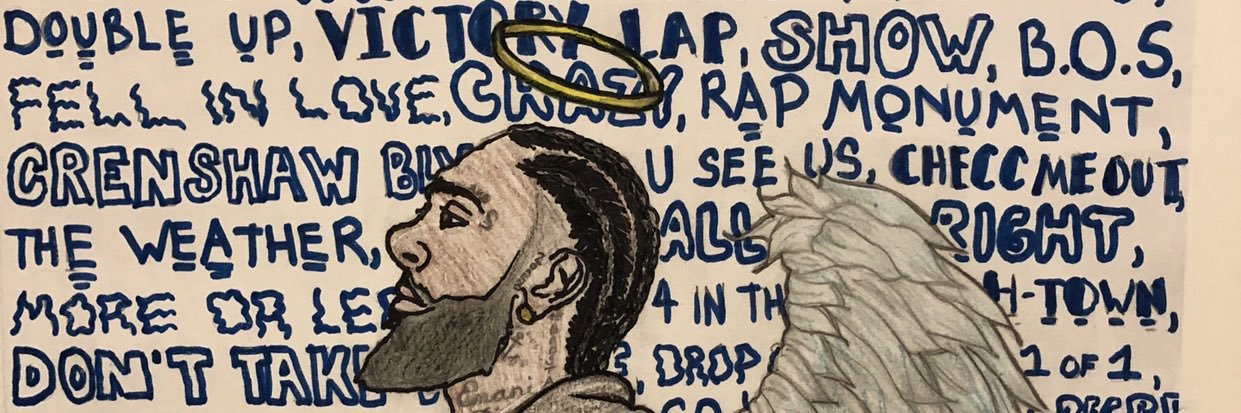
RIP to the Legendary Rico Wade 😢🕊️
He and Organized Noize played SUCH a prominent role in shaping the sound of Southern hip-hop, notably with OutKast and the Dungeon Family collective. Can’t deny the TLC factor also. 🫶🏼
I’ve moved back to handwriting at the start of the year to discover the authentic voice of my students. This helps if a student goes down the path of AI misuse for cheating. #HipHopEd
Reading the room is an art indeed. Reading it, floating words that grow into emotions resulting in connections that break barriers and develop community. But ya better be authentic or else … but isn’t this the cookie cutter publishing generic juggernaut we battle? #hiphoped
@psychbootoo@tdj6899@TheRealHipHopEd I walked into a colleague’s art class and witnessed peace as some students shaped their clay into pottery and others painted their hardened pieces with precision and focus. I love stepping into peaceful artistic rooms in my school. #HipHopEd
@bonsaidream Maaaann, I’m taking my glasses off to read some things in public and putting them on to read other things. I’m about to become that old man who puts the end of the frame in his mouth and appears deep in thought all while thinking where the hell are my glasses.
In Jaws, you don’t see the shark until 1 hour and 21 minutes into the movie.
That wasn’t the plan.
According to the script, the mechanical shark, “Bruce,” was supposed to get more screen time.
When Bruce was tested in a fresh water tank, it worked.
The problem was that…
Jaws was to be the first major motion picture shot on location in the Atlantic Ocean. The first time Bruce got into the ocean, the electrical substructure was destroyed by the salt water.
So director Steven Spielberg had to film the movie without his main character.
This, Spielberg said, “torqued up the suspension of the movie…
Rather than seeing the shark in every scene, I played a lot of the fear from the people in the water, from seeing their legs kicking, from the point of view of the camera moving along the surface of the water.
That’s what turned the movie into more of an exercise in suspense than just a horror film.”
So, Spielberg was asked, if you had the shark when you wanted it, you would have made a different movie?
“I would have made a movie that wouldn’t have been as successful,” Spielberg said. “I think the film would have made half the money had the shark worked.”
Jaws had a record $7 million opening weekend and grossed $100 million in its first 59 days, passing “The Godfather” as the highest-grossing film in history.
Takeaway 1:
The iconic Point of View shots in Jaws were a forced emergence out of Bruce breaking right before filming had to begin.
It’s an example of the “emergence through emergency” principle:
The 20th century inventor and futurist Buckminster Fuller said the engine of innovation is emergency.
“Emergency,” Fuller wrote, “evolves into emergence.”
Takeaway 2:
In Jaws, you don’t see the shark until 1 hour and 21 minutes into the movie.
"This goes to show," Cole Schafer writes, "that anticipation is scarier than confrontation."
The Stoic philosopher Seneca famously wrote, "We suffer more in imagination than in reality.”
---
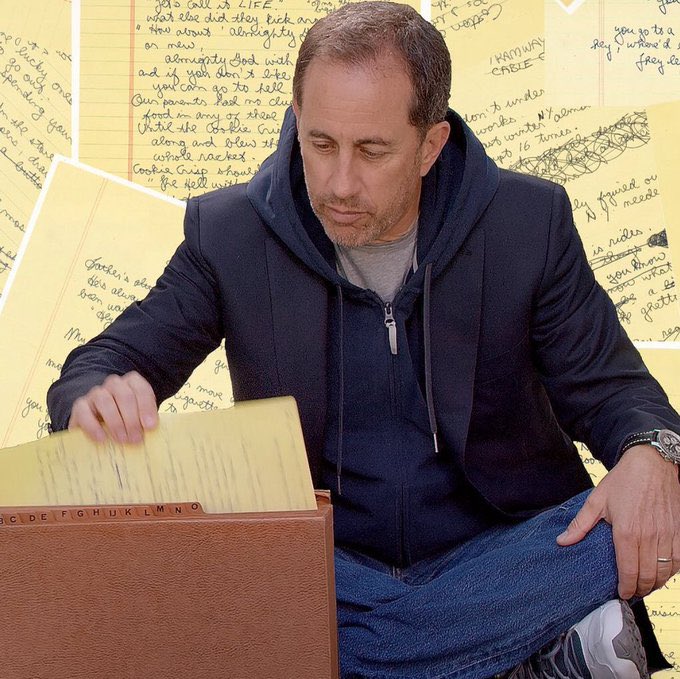
"If you break the human struggle down to one word," Jerry Seinfeld says, "it's CONFRONT. And so, I approach everything that way."
Confront the reality that the shark is broken. Confront the hardest task on your to-do list. Confront the problem you're putting off. Confront the workout. Confront the blank page.
Anticipation is scarier than confrontation.
Follow @bpoppenheimer for more content like this!
After the final episode of “Seinfeld” in 1998, Jerry Seinfeld didn’t know what to do next with his life.
With the success of the show, he had options.
“What do I do?” he asked a friend.
“Well what’s been the best experience you’ve had so far?” the friend asked.
Seinfeld said,
Two things:
First, writing—“I just see something and I write it down—I like a big, yellow legal pad—and once I get that pad open, I can’t stop…the next thing I know, the day is gone.”
Second, performing stand-up—“I just love the life of it,” Jerry said. “I love the joy of hearing laughs and making jokes.”
So, despite the cool and lucrative opportunities to further an acting or screenwriting career in Hollywood, Seinfeld moved back to New York City where he returned to writing jokes by day and performing in comedy clubs by night.
Takeaway 1:
“For anyone trying to discern what to do with their life,” the author Amy Krouse Rosenthal said, “PAY ATTENTION TO WHAT YOU PAY ATTENTION TO. That's pretty much all the info you need.”
Pay attention to what you can pay attention to so that, as Seinfeld put it, “the next thing you know, the day is gone.”
Takeaway 2:
After investing 9 years into creating the 9 seasons of the show, Seinfeld returned to being a standup comedian.
He made an estimated $38 million from just the last season of the show—when he had a boatful of money and unlimited options, he went back to the thing he loved when he had little money and few options.
It made me think of the parable of the fisherman and the businessman:
In a small coastal village, there is a fisherman who owns a small row boat. One afternoon, after fishing all morning, he returns to shore with his boat full of fish.
A vacationing businessman sees the fisherman and is impressed, “How long does it take you to catch so many fish?”
“Oh, just a couple of hours,” the fisherman says.
The businessman immediately sees a business opportunity. He offers to invest money in the fisherman—enough to buy a bigger boat and to set up his own company supplying fish to every restaurant in the village.
Fisherman: “And then what?”
Businessman: “We’ll set up a production plant and distribute fish to restaurants around the world.”
Fisherman: “And then what?”
Businessman: “Eventually the business will be so big that we’ll sell it for a huge sum of money.”
Fisherman: “And then what?”
Businessman: “You’ll have so much money that you’ll be able to do whatever you want. You can retire, move to a house by the sea, and fish as much as you want.”
The fisherman was confused, “Isn’t that what I already do?”
It’s just a reminder: the ability to do what you want for as long as you want is priceless and, often, inexpensive.
- - -
“The highest form of wealth is the ability to wake up every morning and say, ‘I can do whatever I want today.’” — Morgan Housel
Follow @bpoppenheimer for more content like this!
@BlazePizza If it’s for all my high school students I teach & delivered to my room in the fall when we start back up for the 2023-2024 school year, I’d probably dance or battle rap every student I teach.