Let me categorically Debunk this utter rot. @sainsburys.
I am a poultry Breeder. The hens that lay white eggs (Amberline/White Star) DO NOT have a lower carbon footprint.
Yes they eat a bit less and produce roughly the same amount of eggs as the Brown egg layers (Bovan/Lowman/ISA Brown) but they live shorter lives, are prone to dying suddenly when startled, a flighty and nervous and because they live shorter productive lives (12 -18mnths) vs brown 18/24mnths (both commercial farmed), you have to incubate more which is increased (Electricity/gas costs) and their eggs are not the same quality.
I breed and keep 20+ different breeds, including: ISA Brown hens and White Stars. All my hens are 100% free range, Not a single barn kept bird, I have ISA browns that are 5yrs old and still laying beautiful Brown eggs, I have not seen a White star live beyond 3yrs and certainly none have laid eggs past 18-24mnths.
White stars Lay themselves to death. They are slender birds and because they dont eat a lot, it drains their personal vitality to keep up laying the eggs you want to sell because of the nonsensical lie that they are "More Carbon Neutral"
You want to know about eggs, come talk to someone like me, Don't rely on some hairbrained imagination of a buyer who's trying to squeeze the profit margin for a few extra pennies at our expense and to the poor hens detriment.
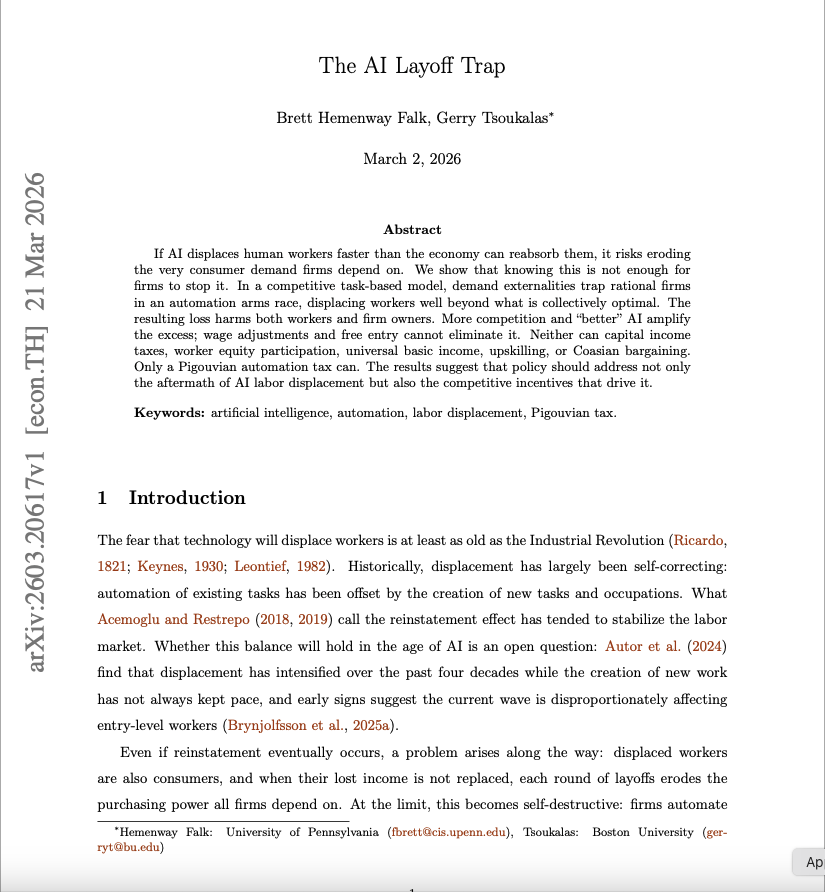
Two economists just published a mathematical proof that AI will destroy the economy.
Not might. Not could. Will — if nothing changes.
The paper is called "The AI Layoff Trap." Published March 2, 2026. Wharton School, University of Pennsylvania. Boston University. Peer reviewed. Mathematically modeled.
The conclusion is one sentence.
"At the limit, firms automate their way to boundless productivity and zero demand."
An economy that produces everything. And sells it to nobody.
Here is how you get there.
A company fires 500 workers and replaces them with AI. A competitor fires 700 to keep up. Another fires 1,000. Every company is behaving rationally. Every company is following the incentives correctly. And every company is building a trap for itself.
Because the workers who were fired were also customers.
When they lose their jobs faster than the economy can absorb them, they stop spending. Consumer demand falls. Companies respond by cutting costs — which means automating more workers — which means less spending — which means more falling demand — which means more automation.
The loop has no natural exit.
The researchers tested every proposed solution. Universal basic income. Capital income taxes. Worker equity participation. Upskilling programs. Corporate coordination agreements.
Every single one failed in the model.
The only intervention that worked: a Pigouvian automation tax — a per-task levy charged every time a company replaces a human with AI, forcing them to price in the demand they are destroying before they pull the trigger.
No government has implemented this. No major economy is seriously discussing it.
Meanwhile the numbers are already tracking the curve. 100,000 tech workers laid off in 2025. 92,000 more in the first months of 2026. Jack Dorsey fired half of Block's workforce and said publicly: "Within the next year, the majority of companies will reach the same conclusion."
Nobody is doing anything wrong. Companies are following their incentives perfectly. That is exactly the problem.
Rational behavior. At scale. Simultaneously. With no mechanism to stop it.
Two economists built the math. The math leads to one place.
Source: Falk & Tsoukalas · Wharton School + Boston University ·
https://t.co/4m8E9jQNYm
We need your help to sign the "Support the Ceramics Industry" petition created by the #SaveDenby campaign.
- Sign the petition: https://t.co/GAcP3tuh5e
- Share this post
- Tag your friends and spread the word.
Thank you for all of your support.
🇬🇧 He called her the Enchantress of Number. 🧮
In 1843 a British woman wrote the world’s first computer programme. For a computer that didn’t exist yet. 💻
Her name was Ada Lovelace. Her father was Lord Byron. Her mother feared she would inherit his madness so she was taught mathematics instead. 📐
In 1833 she met Charles Babbage. He was building a machine that could calculate. Everyone else saw a calculator.
Ada saw something a century ahead of its time. That a machine could process not just numbers but anything expressed as symbols. Music. Language. Logic. Everything. ⚙️
She translated a French article about his engine into English. Then added her own notes. Three times as long as the original. ✍️
Note G. The world’s first computer programme. Written in 1843. For a machine that would not be built for another hundred years. 📜
Published under her initials only. A.A.L. Because she was a woman in 1843 and her name was not permitted on the page. 🔏
The computer was finally built a century later. Alan Turing referenced her work in his 1950 computing paper. The US Department of Defense named a programming language after her. 🖥️
Every computer programme ever written traces back to a note written by a British woman in a Victorian study by candlelight. 🕯️🇬🇧
Did they teach you her name?
If you want to see more stories like this, find us at https://t.co/wN9S2gRUuR
If you want to help us keep them alive: https://t.co/rih7iKwVkN
Be Part Of Us.
Be Proud Of Us. 🇬🇧
🏴🇬🇧 A blind man built 180 miles of road across the Pennines.
He navigated by touch and memory.
His name was Blind Jack. 🦯
Born in Knaresborough, Yorkshire, 1717. At six he caught smallpox and went blind.
That never stopped him.
He learned to ride. To swim. To hunt. At fifteen he became a fiddler. He fought at the Battle of Culloden. He ran a stagecoach company.
He eloped with the innkeeper's daughter. The day before her wedding to another man. 💨
He bet a colonel he could walk from London to Harrogate faster than a coach. 🏴
He won. Five and a half days on foot. 207 miles.
In 1765, Parliament authorised new turnpike roads across the north. There were very few people with experience. Jack was 48 years old. He seized his moment.
He walked every route first. Alone. Then he built.
Proper foundations. Drainage. Techniques nobody had used before. 🛤️
Then he hit the bog. Other engineers said it was impossible.
Jack cut heather from the moor. Bound it into rafts. Laid the road on top.
The bog held. ✅
Across the north of England. 180 miles of road.
You have driven on his roads.
At 77 he walked to York to dictate his life story to a publisher. 📖
He died in 1810. He was 92. He left behind four daughters, twenty grandchildren, and ninety great and great-great grandchildren.
Did they teach you his name? 🏴
Jack could never see the roads he built.
He made them anyway.
For everyone who came after.
These stories are in the dark.
You keep the light on. 👉 https://t.co/rih7iKwnvf 💡
Be Part Of Us.
Be Proud Of Us. 🇬🇧
"The 6th biggest economy in the world is run by infantile fantasists with no understanding of financial markets.... There's nothing progressive about driving the economy of a cliff"📉⛰️
@LiamHalligan @ #BattleFest 2025 "From steel to railways: can the state revitalise British industry?"👨🏭🚆
👇
"No woman or maiden shall be forced to marry a man whom she dislikes."
That's not a modern law.
That was written in England 🏴 over a thousand years ago.
Anglo-Saxon women had more legal rights than your great-grandmother. On the same island. A thousand years earlier. 🔑
She could own land. In her own name. Buy it. Sell it. Leave it to whoever she chose. No permission needed. Not from her husband. Not from her father. Not from anyone.
She could run a business. She could stand in an open-air court, raise her hand in oath, and the law would hear her the same as any man. ⚖️
On the morning after her wedding, her husband owed her a gift. Land. Money. Property. It was called the Morgengifu, the morning gift. It wasn't symbolic. It was legally binding. And it was hers. Not jointly owned. Not held in trust. Hers. Through everything. 💍
A woman called Wynflaed owned seven estates across four counties, her will still survives.
Cynethryth, wife of King Offa, struck coins bearing her own name and face. The only Anglo-Saxon queen known to have done it. The coins are still in museum collections. 🪙
Æthelflæd, Lady of the Mercians, built ten fortified towns and led armies in battle. In the tenth century. ⚔️
While most of Europe treated women as property, this island wrote their rights into law. 🇬🇧
Then the Normans came. 1066.
And they took all of it away.
Every. Single. Right. 🚫
A married woman's property became her husband's. She couldn't own land. Couldn't sign a contract. Couldn't keep her own wages. Under the doctrine of coverture, her legal
identity was absorbed into his.
Bracton wrote it plainly: "husband and wife are one person, being one flesh and one blood."
In the eyes of the law, she didn't exist.
For over eight hundred years.
Let that satisfy. Eight. Hundred. Years.
In 1882, the Married Women's Property Act gave a married woman the right to own property, keep her earnings, and exist as a separate legal person. 📜
But Britain didn't invent those rights in 1882.
It restored them.
Rights that Anglo-Saxon women had exercised a thousand years before. On the same island, under the same sky, in a language that became the one you're reading now. 🏴
This island forgot once.
We won't let it forget again.
Happy Mother's Day ❤️
Be Proud Of Us. 🇬🇧
There's something in most British villages older than the church.
Older than the English language.
You've walked past it a thousand times. And nobody told you what it was.
🌳 The yew tree.
Some are 2,000 years old. Some are closer to 5,000. The Fortingall Yew in Scotland. One of the oldest living things in Europe.
They were sacred before Christianity arrived. When the new religion came, they didn't cut the trees down. They built the churches next to them.
The church came to the tree. Not the other way around.
Some are hollow. The heartwood rots away. But the tree keeps growing from the outside. A tree can be hollow for centuries and still be alive.
Yew wood made the English longbow. Agincourt. Crécy. The weapon that changed European warfare. The wood came from churchyards.
Yew is poisonous. Every part of it. Livestock can't go near it. That's why they survived in churchyards when they were cut down everywhere else. The wall saved them.
The Ankerwycke Yew. Near Runnymede. Two and a half thousand years old. Magna Carta may have been sealed beneath it.
The tree was already a thousand years old when that happened.
You can touch them. They're not behind glass. They're in your village.
Walk up to one on Sunday morning. Put your hand on the bark.
That tree was alive before Julius Caesar crossed the Channel.
And it's still growing.
Still standing in the same churchyard. Still alive. Still yours.
Sources and more available at https://t.co/wN9S2gRmFj
Be part of us.
Be Proud Of Us. 🇬🇧
Britain called her a housewife. 📰
She’d mapped the molecule that saved the war.
Dorothy Hodgkin’s hands were destroying themselves. Rheumatoid arthritis twisting every joint, locking every finger. The instruments she needed were the size of pins.
She kept working. 🔬
1945. Soldiers dying of infected wounds. Penicillin could save them — but no one knew its molecular shape. Without that, you can’t mass-produce the drug.
Hodgkin mapped it. Seventeen atoms. Four years. With hands that could barely hold the equipment.
Penicillin went into mass production. Millions survived. 🌍
Then she went bigger. Vitamin B12. A hundred and eighty-one atoms. The most complex molecule ever mapped at the time. Eight years. They said it couldn’t be done.
She did it anyway.
1964. Nobel Prize in Chemistry. 🏆 The only British woman ever to win a science Nobel.
The Daily Mail headline? “Oxford housewife wins Nobel.”
She’d solved the molecule that saved the war. Cracked the one they said was impossible. And they called her a housewife.
But she wasn’t finished. Insulin. Seven hundred and eighty-eight atoms. She started in 1935. Finished in 1969. Thirty-four years. By the end, her hands were almost useless. ❤️
She taught at Oxford for half a century. One of her students was a young chemist named Margaret Roberts. Who became Margaret Thatcher. Thatcher hung Dorothy’s portrait in Downing Street.
Every antibiotic you’ve ever taken. Every insulin injection. Every life saved by understanding the shape of a molecule. That traces back to a woman whose hands were failing her, and who never stopped.
Stories like hers get buried. We put them in front of millions.
Help us keep these stories alive → https://t.co/rih7iKwVkN
Be part of us.
Be proud of us. 🙏🇬🇧
BREAKING: The Word “Glitch” Is Doing the Heaviest Lifting in British Banking Today
This morning, customers of Lloyds, Halifax, and Bank of Scotland opened their banking apps and found themselves staring at the complete financial lives of total strangers. Transaction histories. Account numbers. Sort codes. National Insurance numbers. DWP benefit payments. English wages appearing in Scottish accounts. Pub tabs in Newcastle showing up in Wales. One Bank of Scotland customer cycled through six different people’s full account details in twenty minutes, each refresh serving a new stranger’s financial identity like a slot machine of personal data.
The banks called it a “technical glitch” and told customers not to worry. Halifax’s official response on X was to suggest logging out and back in. Lloyds asked users to “bear with them.” Bank of Scotland said they were “investigating.”
Let me translate this from institutional euphemism into plain language. A banking group serving over 26 million customers had a backend failure that served authenticated financial data, including government-issued identity numbers, to random sessions. In any jurisdiction with functioning data protection enforcement, this is not a glitch. This is a reportable data exposure event under UK GDPR. The Information Commissioner’s Office requires notification within 72 hours of any breach involving personal data that poses a risk to individuals’ rights. National Insurance numbers are the skeleton key to identity fraud in Britain. They unlock tax records, benefit claims, credit applications, and pension access. Every single NI number that appeared on a stranger’s screen this morning is now a compromised credential, regardless of whether the display bug has been “quickly resolved.”
The precedent is instructive. In April 2018, TSB suffered a similar failure during an IT migration from the same parent infrastructure. Lloyds Banking Group’s systems. Customers could see other people’s accounts, access funds that were not theirs, and were locked out for months. The FCA and PRA fined TSB £48.65 million. Over 225,000 complaints were filed. £32.7 million in redress was paid. The CEO was forced out. And that failure originated in a planned migration with known risk parameters.
This morning’s incident at Lloyds Banking Group was not a planned migration. It was a spontaneous failure in production systems that randomly distributed live financial identities to authenticated but unrelated sessions. The fact that it was brief does not reduce the severity. It increases it. A planned migration that goes wrong reveals poor execution. A production system that spontaneously begins serving random customer data to random sessions reveals something about the underlying architecture that no amount of “quickly resolved” can address.
Every customer who saw a stranger’s NI number this morning received proof that the verification promise underpinning digital banking, the promise that authentication equals isolation, failed silently and completely. The banks say your account is safe. What they mean is the display error has been corrected. These are not the same statement. The question is not whether it was fixed. The question is whether anyone took screenshots during those twenty minutes. And whether the ICO and FCA will treat this as what it is.
It is only Tuesday, and this Government has already announced an official definition of Islamophobia, an Islamophobia tsar, and plans to push ahead today with restricting our ancient right to trial by jury — all of which will stifle free speech in this country.
This is not governing in the national interest. What we are seeing is an attempt to reintroduce Britain’s blasphemy laws, 18 years after they were abolished by Parliament, and the biggest assault on English liberty — particularly free speech — in over 800 years.
This Government is becoming increasingly authoritarian and more bullish in its open disdain for free speech.
The fight for free speech has never been more important than it is today.
A study of ~1,500 US workers finds AI use can reduce burnout but also cause "AI brain fry", a mental fatigue from using AI tools beyond one's cognitive capacity (Harvard Business Review)
https://t.co/l37mDKHX4H
https://t.co/VwBmgQj2br
📥 Send tips! https://t.co/wlNZvXuhJs
🦴 A skeleton in a cave. Nine thousand years old.
They tested his DNA. 🧬
And matched it to a man living half a mile away. 🇬🇧
In 1903, workers were digging a drainage channel inside a gorge in Somerset. They hit bone. A body. Curled up. Deep inside the rock.
He'd been there since before Stonehenge. Before the pyramids.
They called him Cheddar Man. 🧀
He hunted deer through forests that covered this island. He fished rivers that still run through the same valley today. And then he died. Alone. In a cave.
For a century, he sat behind glass. A museum piece. A curiosity. A name on a plaque.
Then in 1997, a scientist from Oxford had an idea. He took DNA from one of Cheddar Man's teeth. Then he went into the village. Walked into the local school. Swabbed the
cheeks of twenty residents.
And ran the tests.
🧬 One matched.
Adrian Targett. History teacher. Living half a mile from the cave.
Three hundred generations. Same family. Same valley. Nine thousand years. And the line never left.
He didn't know.
The longest unbroken connection between a living person and an ancient ancestor. Anywhere in the world.
Same hills. Same river. Same village. Half a mile from the cave.
You are the reason we can tell these stories. https://t.co/rih7iKwnvf
Be Proud Of Us. 🇬🇧
You've probably used this word as an insult your entire life.
Luddite.
Someone afraid of technology. Against progress. Stuck in the past.
That's not what it means.
The real Luddites were the most skilled textile workers in England. Seven years trained. Every cut precise. Every cloth perfect.
Then factory owners replaced them with children operating machines that produced inferior goods.
Wages halved. Then halved again.
They petitioned Parliament. Nothing. They couldn't vote. Couldn't strike. Unions were illegal.
So they smashed the machines. Not all machines. Only the ones replacing skilled men with child labour.
They called themselves Luddites. Followers of General Ned Ludd. A leader who lived in Sherwood Forest.
Same address as Robin Hood.
Except Ned Ludd didn't exist. They invented him.
A phantom general to lead an army of starving craftsmen.
The government sent 12,000 soldiers against them. More than Wellington took to fight Napoleon in 1808.
George Mellor. Twenty-two years old. Led the Yorkshire Luddites. Six foot tall. Seven years trained as a cropper.
Seventeen men were hanged at York. Twenty-five transported to Australia. Fifty-seven children left without fathers.
For smashing a machine.
The man who betrayed them was promised £2,000.
They never paid him. He died a beggar in London.
The word "Luddite" became an insult. Written by the people who won.
Next time someone calls you a Luddite... Remember what it actually means.
This time, the machines work for us. Help us break the version they wrote.
Be part of us.
https://t.co/rih7iKwnvf
Be Proud Of Us.🇬🇧
The Government's trade deal with India will mean that it's cheaper to hire an Indian worker than a British one.
Most other countries are perfectly happy to strike trade deals without forcing us to undercut our own workforce. We should have expected India to do the same.
Instead, under the terms of our Free Trade Agreement with India, Indian companies will be able to transfer their workers to this country more easily.
Once they're here, those workers will be able to avoid National Insurance payments for up to three years. The same is true for employers. Instead, both employee and employer will pay into the Indian social security system instead.
This National Insurance exemption will make it much cheaper to hire Indian workers, in fields like IT and engineering, than to hire domestic talent.
Let's imagine a British IT firm, set to hire a computer programmer for £60,000 a year. To hire them, an employer needs to spend £60,000 a year on their salary, plus £8,250 on Employer National Insurance. That's a total of £68,250.
An Indian competitor with an office in London, meanwhile, can save money by transferring Indian workers to the UK, even if they pay the same headline salary.
They’d still spend £60,000 on the salary - but instead of paying National Insurance, they pay into the Indian Employee Provident Fund instead. Mandatory contributions to the fund are capped at 15,000 rupees a month, or about £120.
That means that, across a year, an employer only pays £1,470 into the social security system - for a total of £61,470.
So under this Government's deal, it would be at least 10 percent cheaper to hire an Indian worker over a British one for this job. This is absurd.
Over three years, it would be more than £20,000 cheaper for an Indian firm to bring over an Indian worker to London than to hire locally.
The reason for this absurd arrangement is that the India deal includes a Double Contribution Convention. DCCs make it easier for international companies to transfer their workforce. They're designed to stop highly-skilled workers from paying into two different social security systems.
We already have Double Contribution Conventions with other countries. However, these other countries tend to be either:
(1) roughly as developed as the UK - in the case of countries like Canada or Japan, or
(2) very small - in the case of countries like Jamaica.
India is by far the poorest country on the list, and by far the largest. The net result of this deal will be more Indian workers in fields like IT and engineering, undercutting British workers.
Given the relative markets in the UK and in India, we shouldn't expect this to automatically be a like-for-like swap in terms of talent.
We've seen this happen in the US already, with Indian consultancies leasing their workers to American companies, who are then able to pay an Indian worker far less than they'd need to pay an American. The result has been a massive expansion in the number of lower-cost Indian workers, at the expense of American workers.
We should not be allowing other countries to dictate the terms of our migration system, in exchange for some trade benefits at the margins. If India wants to trade, then we should trade. Migration shouldn't even come into the equation.
THANK MOO!!
And just like that – the shop is closed. We genuinely cannot believe it.
The support you’ve shown for small-scale dairy has been nothing short of incredible. This was never just about selling cheese. It was about inviting you into the whole story – from cows keeping their calves at foot, to their milk being carefully turned into proper, artisan farmhouse cheddar before being shipped to you uncut and sealed; allowing YOU to be part of the story of that cheese.
In the end, you've ordered an unbelievable 300 truckles of cheese. That blew every expectation we had.
When Mark and I first sat down and asked ourselves whether people actually wanted to support small-scale dairy – and see a new, values-led cheese exist in a world dominated by big brands – we could never have imagined this response.
This doesn’t just shape the future of Mossgiel and Torpenhow. It gives us the confidence and momentum we need to challenge how dairy has been done for the past 50 year. It's our mission to support small scale dairy, and this boost has made it all the more real.
From the bottom of our hearts – thank you for backing something worth saving.
- Farmer Bryce