Welcome to all the new faces joining the #CESS community!
You’re now part of a global mission to build the future of decentralized data value infrastructure — where data sovereignty, privacy, and performance come together.
Start exploring: 🌐https://t.co/LeDM2LCSBS
Let’s shape the future of #Web3, #DePIN & #AI together!
Announcing: #CESS x @gbaglobal Co-Hosting in Washington D.C. 🇺🇸Apply to speak 👉 https://t.co/XIm0qzyhk3
We’re excited to co-host one of the most impactful events inside the U.S. Capitol, bringing together lawmakers, regulators, and tech pioneers to shape the future of digital asset infrastructure.
🎤 CALL FOR SPEAKERS
Are you a thought leader in:
Digital Asset Markets & Custody
Regulatory Frameworks
#Infrastructure & #DePIN
Now’s the time to join the conversation!
🤝 #CESS Network x Zypher Network
We’re joining forces with @Zypher_Network, the first ZK computing Layer for trustless #AI Agents.
By combining CESS’s decentralized data value infrastructure with Zypher’s ZK-powered Proof of Prompt & Inference, we’re empowering a new generation of secure, verifiable, and autonomous AI agents.
Together, we’re building the future of mission-critical, privacy-preserving #Web3 AI.
In #Web3, data is more than information — it’s ownership, identity, and value. At #CESS, we’re not just storing data — we’re building the infrastructure to monetize, govern, and protect it.
From #AI to #RWA, from #DePIN to real-world impact — the data economy starts here.🌐 https://t.co/LeDM2LCkMk
🍕 Bitcoin Pizza Day is LIVE in Dubai! https://t.co/uEvjmrg7Gm
Join #CESS, @OOKCLabs and the vibrant Web3 community for an unforgettable evening of free pizza, palm trees, and decentralized vibes under the Dubai skyline.
Come say hi & celebrate the power of crypto with us!
📚 If you missed it — now’s your chance to catch up: “Understanding #CESS Network: A Comprehensive Overview” by @ItsEzak via @MessariCrypto dives deep into how #CESS is building the data backbone for #DePIN, #AI, and #DeSci. https://t.co/gYYvHaAMwQ
Key insights on DeOSS, PoDR², AI-LINK & more👇
@pharos_network Nice to see the Pharos Testnet up and running! 🚀 While you're exploring, don't forget that #SparkChainAI turns your unused internet bandwidth into crypto rewards effortlessly. Check it out!
Milestone Unlocked: Over 2.2 MILLION users have joined the #CESS#DeShare Airdrop & Public Testing!
In just two weeks, #CESS has welcomed millions of participants to experience high-performance, decentralized storage and data retrieval — proving global demand for secure, scalable, and sovereign data value infrastructure is stronger than ever.
💙 Thank you to every user, miner, supporter, and community member who made this moment possible. We’re just getting started.
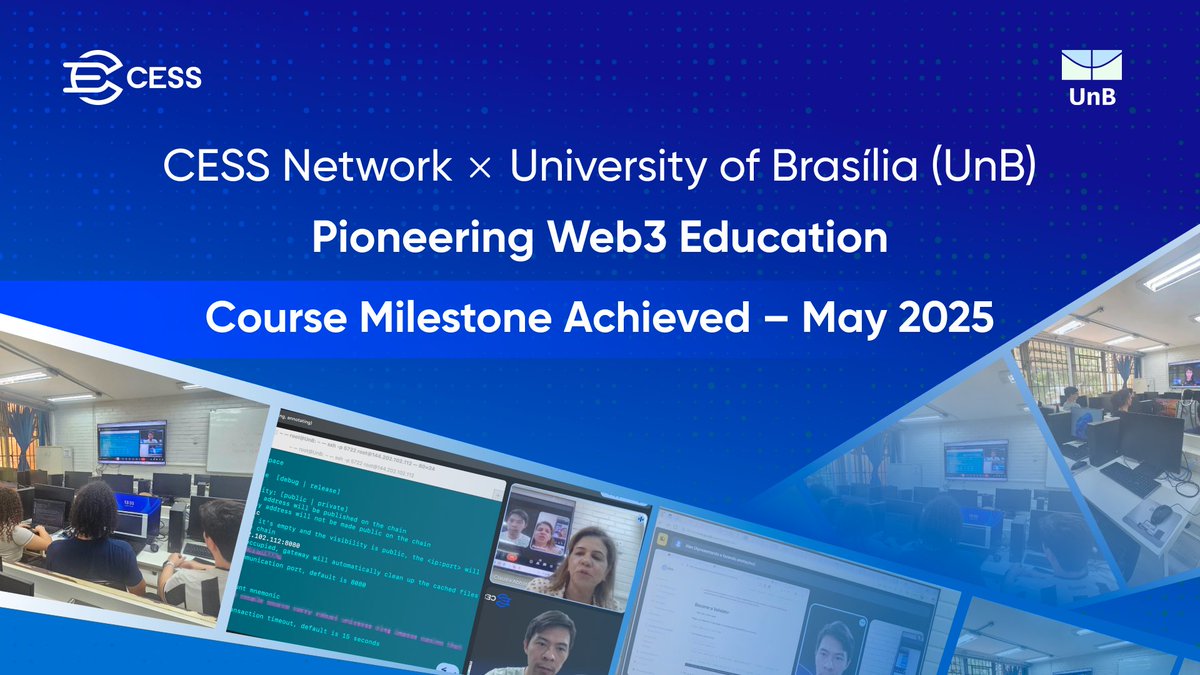
🎓 Halfway Milestone Achieved! #CESS Network × University of Brasília (UnB) #Web3 course has reached a major milestone this May!
Students from UnB are actively diving into decentralized data value infrastructure, learning how CESS empowers the next generation of Web3 with real-world tools and applications.
TLDR: Why Web3 Gaming Actually Makes Sense (Part 2: Integration Nightmares)
Here's why most Web3 games fail: they're basically building two games at once.
Game 1: The actual game. Unity. Game mechanics. Fun stuff.
Game 2: All the Web3 features. Wallets. Assets. Blockchain.
Two different codebases.
Two different teams.
Double the headaches.
Triple the bugs.
What usually happens:
- Unity devs fight with blockchain integration
- Wallet connections break everything
- Assets don't sync properly
- Players get stuck between systems
- Everyone blames "blockchain issues"
Players don't care if something's "on chain." They care if it works.
This is what actually matters:
- Can they use their items?
- Does the game run smooth?
- Are their assets safe?
- Does everything just work?
The fix? Stop treating Web3 like a separate game.
Your Unity devs shouldn't need to learn Solidity.
Your game shouldn't need five different backends.
Blockchain features should just be another tool in Unity.
Next up: What Web3 gaming looks like when it's done right...
TLDR: Why Web3 Gaming Actually Makes Sense (Part 3: Doing It Right)
Let's talk about what works. No hype. No buzzwords. Just real infrastructure that makes sense for game devs.
Web3 gaming done right means one thing:
Everything works in your game engine.
No platform switching.
No extra tools.
Your game needs:
- Asset management
- Player inventories
- Marketplace features
- Social systems
- Trading mechanics
All of this should just... work.
In your development environment. Where you build games. Simple as that.
Here's what we're seeing with games doing it right:
- Devs work in their native language
- Assets move automatically
- Systems scale on their own
- Infrastructure costs drop
- Players keep their stuff
No crypto degree needed.
No blockchain expertise required.
Just tools that work where you already build games.
The big difference? Everything's built for game devs first.
Web3 features are just that - features. Not the whole game.
Next up: The numbers that actually matter...
TLDR: Why Web3 Gaming Actually Makes Sense (Part 4: The Numbers)
Time for real talk about metrics.
Not marketing stats.
Not whitepaper promises.
Actual numbers from live games.
Traditional game infrastructure:
- 6-12 months setup
- $150K minimum to launch
- 30-40% ongoing costs
- Multiple teams needed
- Regional scaling issues
What we're seeing with decentralized infrastructure:
- 85% faster deployment
- 70% cost reduction
- Sub-50ms latency
- 99.99% uptime
- Global coverage by default
But here's what really matters:
Your devs spend time making games better instead of babysitting servers.
Your players get games that work, assets they own, and features that scale.
And the best metric? When your team stops talking about infrastructure because it just works.
Next up: Where this is all heading...
We’re on a mission to provide the infrastructure gaming deserves.
It shouldn't be controlled by a handful of companies.
Beamable Network distributes both the power and the opportunity.