Access to your own wealth shouldn’t depend on how much you have or how much you’re willing to give up.
The way we’ve always experienced it isn’t the way it has to stay.
Something better is on the horizon.
Every protocol is solving a different problem in onchain finance.
The interesting part is how they all fit together.
We’re bringing together @Brickken, @Zerion and @ShiftRWA for the conversation.
Set your reminder below 👇
For years, only the wealthy could borrow against their portfolios.
Then it opened to clients with the right private banking relationships.
For many people, it was still too expensive, required large minimums, or simply wasn’t available where they lived.
For everyone else?
Selling was the only option.
It’s time everyone got the tools the wealthy always had.
Spout Beta is getting closer.
Stablecoins have become one of the biggest products in crypto.
But what happens when they’re backed by real yield instead of incentives?
Join us with @humafinance and @OpenEden_X as we unpack one of the biggest shifts happening in onchain finance.
Date: July 27, 2026
Set a reminder below 👇
LIVE from Solana Demo Day at @DutchBlockWeek ! 🇳🇱
Dutch builders are taking the stage to pitch their projects and compete for a $5,000 prize pool.
Tune in! 👇
https://t.co/ufVifetHKZ
Access to capital has never been equal, and much of that comes down to something nobody chooses: where they happen to live.
In the US, borrowing against equities often means dealing with variable rates, broker requirements, and account structures that determine how much access you actually have. More flexible credit options exist, but they are usually designed for larger portfolios.
Outside the US, the gap is even wider. For many investors holding global assets, using their portfolio to access cash without selling has historically been expensive, limited, or simply unavailable.
For a huge part of the world, “borrow against your assets instead of selling them” was advice that quietly never applied to them.
We’re introducing a different baseline at Spout.
Your ZIP code shouldn’t determine whether your own assets can work for you.
So we’re building it to work the same for everyone: borrowing at zero interest, with no minimum balance required to qualify, and available to anyone who passes KYC, whether you’re in New York, India, Korea, Japan, Nigeria, the Netherlands, or anywhere else.
The same financial tool, available to the same people, at the same cost, regardless of where they happen to live.
That’s the version of access we believe should have existed a long time ago.
Don’t sell your equities. Borrow against them.
Solana incubator alumni @0xmryan built @spoutfi, allowing users to unlock liquidity from their assets at 0% interest.
Buy, hold, compound, and now borrow, right here on @solana .
This company started in a small office in Thousand Oaks, California in 1980.
At the time, almost nobody outside biotech knew it existed.
When it went public in 1983, $1,000 bought a stake in a company most people couldn’t even pronounce.
That same $1,000 is worth $1.25 million today.
That’s a 18.52% compound annual return over more than four decades.
Through the dot-com crash, the 2008 financial crisis, a global pandemic, and repeated drug trial failures, it kept compounding.
Today it sits in the Dow Jones 30, generates $36.75B in annual revenue, and has multiple products still growing at double-digit rates.
It is still trading below its all-time high, with analysts pricing it roughly 30% higher than current levels.
Guess the ticker.
Owning assets is almost meaningless if you can’t access it when you need liquidity.
Traditional finance slows you down with paperwork, checks, and long approval cycles.
We’re building a system where you unlock liquidity from what you already own in a few clicks.
Soon.
Real yield doesn’t have a good day and a bad day. It just pays.
Most stablecoin yields today sit around 4–5%, closely tied to the risk-free rate. They’re safe, predictable, and widely available, but there’s often little reason for them to move meaningfully higher.
At Spout, we’re building toward a different model.
We believe the next generation of yield will come from real economic activity rather than token emissions or incentives designed to attract liquidity temporarily.
Across global markets, trillions of dollars sit in stocks and ETFs. Many investors need liquidity at some point but don’t want to sell their assets, trigger taxes, or lose long-term exposure.
At the same time, stablecoin holders are searching for sustainable sources of yield.
We’re building the infrastructure designed to bring those two needs into the same system.
The goal is to make equities more productive, allowing liquidity to be unlocked while creating yield backed by activity around real assets.
Our target is a model capable of delivering 10%+ blended APY without relying on inflationary rewards.
Because sustainable yield shouldn’t depend on printing more tokens.
It should come from real assets being put to work.
Spout Finance Biweekly Space continues tomorrow.
This week features our CTO, @Mierlo1999
Topic: “Building on Solana: The Technical Bets We Made”
We’re diving deeper into the engineering choices behind Spout and why @solana is the base layer we chose.
Set your reminder 👇
Legacy DeFi has a structural problem , and the 2026 on-chain data exposes it completely.
1 - The Looping Detour (Kamino & Aave) 90.35% of all borrow transactions on Kamino are captured by just 37% of looper wallets. The remaining 63% of organic users , people who simply want efficient, straightforward credit , are left fighting over a mere 9.65% of network activity. The protocol was built for everyone but the data shows it is serving only a small, sophisticated minority. Organic borrowers are being systematically crowded out by loopers who dominate the entire network format. And this is not just a Kamino problem , on Aave, 82.42% of borrow transactions are driven by just 23.03% of looper wallets. The looping detour is a legacy DeFi-wide pattern.
2 - Fatal for Newcomers (Aave) 56.8% of Aave wallets borrow exactly once and never return. More than half of all newcomers drop off immediately because the system never made room for them. The 43.2% who stay are crypto-native whales who already understand how to navigate complex yield strategies. Legacy DeFi consistently rewards insiders and quietly filters out everyone else before they even get started.
3 - RWA Support Wasn't Enough (Kamino) Kamino recently expanded to support Real World Assets , a significant step forward. But the user data tells a different story. Small, everyday users are still not staying. The looper minority still dominates. Why? Because adding new asset types does not fix the core problem. As long as variable interest rates remain, the cost of borrowing keeps eating into margins , and mainstream users keep leaving. The barrier was never just the asset. It was always the rate.
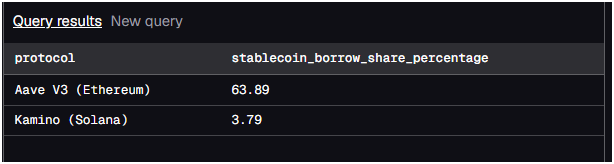
4 - Stablecoin Dominance Is Choking Aave 63.89% of all borrows on Aave are pure stablecoins. More than half of the entire protocol is being used for one thing , looping dollars to chase yield. This is not a healthy credit market. This is a system that has been quietly captured by a single repetitive strategy. Real credit markets serve people with real needs , salaries, stocks, properties. Aave's borrowing market has drifted so far from that reality that everyday users do not even recognise it as a tool built for them.
The credit market has been a closed loop for insiders. @SpoutFi is changing this , 0% interest loans against tokenized real world assets. No looping detours. No whale advantage. Just clean, efficient credit for the people legacy DeFi left behind.
@greatgabriell
kamino is solana’s biggest lending protocol with over $3.2B TVL, thousands of users and literally one of the most battle-tested money markets in all of DeFi.
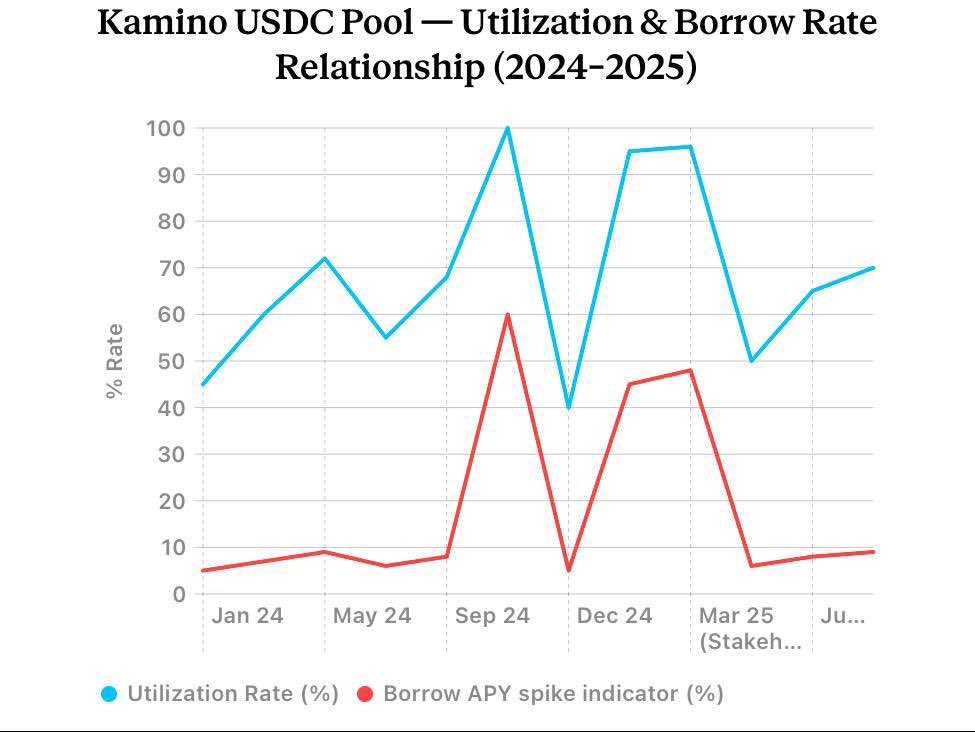
in march 2025, a bridge exploit on a completely different chain “KelpDAO on Ethereum”. this triggered a wave of panic withdrawals across DeFi, the contagion spreads cross-chain and it eventually reached Solana.
@kamino’s prime USDC pool had a total of $178M in deposits but hits 100% utilization in hours and the two other vaults cross 95%.
what does that mean in practice? borrowing costs spike with no warning, users trying to withdraw their own deposits can’t, positions that were profitable at 7% APR suddenly become unprofitable as utilization spikes and borrowing costs reprice overnight at rates they never agreed to. liquidations start cascading not because prices moved, not because anyone made a bad call. because a pool on a different chain got exploited and they got punished by everyone downstream.
kamino didn’t do anything wrong, their protocol just worked exactly as designed.
that’s the problem.
the model is designed so that your borrowing cost is a function of what strangers do with the same pool.
• one whale exits, your rate moves.
• one exploit hits three chains away, you can’t withdraw and utilization crosses a threshold and the algorithm reprices your loan while you sleep.
this literally means you borrowed from a crowd and the crowd doesn’t care about your position.
this is the biggest friction across DeFi lending today. aave. morpho. kamino. compound. all have the same model. when utilization goes up, you pay more and when utilization hits 100%, you’re stuck.
the question nobody is asking is: why does your rate have to depend on anyone else at all?
we are fixing this model
"What if your equities were more productive, could that offset the high fees you pay when margin trading?" - @EmonMotamedi
that's the problem & we are the answer.
Our CEO - @0xmryan had just Demoed this live at @incubator