There’s never been a better time to start something.
There’s never been an easier time to build.
There’s never been more resources available.
Start building.
@AethirCloud
Axe Compute reports Q2 2026 results:
-Q2 revenue up 90x+ sequentially
-Customer prepayments grew from $0.8 million to $60.8 million, with $17.4 million in operating cash flow in the first half
-Our $260 million dedicated cluster of 2,304 NVIDIA B300 GPUs progressed through build, targeted for Q3 go-live
After quarter-end:
-$2.8B+ signed in July, 2026 signed contract value now $3B+
-$696M+ expected ARR at full deployment
Earnings call Mon 8:30am ET:
https://t.co/MdeDOyddNr
$AGPU #neocloud #GPUasaService
Behind-the-meter remains the right path around grid queues, but you have to do it right.
DataOne, the Nebius site developer, switched from gas generators to Bloom fuel cells. Officials then stopped the LNG-tank and fuel-cell work, citing missing approvals and permits (hilarious that the account that reported this stoppage has a disclosed Bloom short).
The lesson is that every infrastructure pivot needs a fresh permit map before equipment arrives, especially when the replacement is novel - now more than ever.
Data centres are intensely political. As residents push back on noise, water, emissions and electricity, legislators and permitors may fold to pressure - having all ducks in a row will be critical.
Unfortunately, Permits and community politics need to be part of the power design from day one now.
The biggest productivity gain I've had from agents recently came from adding computer use to my work.
Its obvious, but once an agent can open the real product, click through it, reproduce a failure, change the code and test the result, it can close the whole loop.
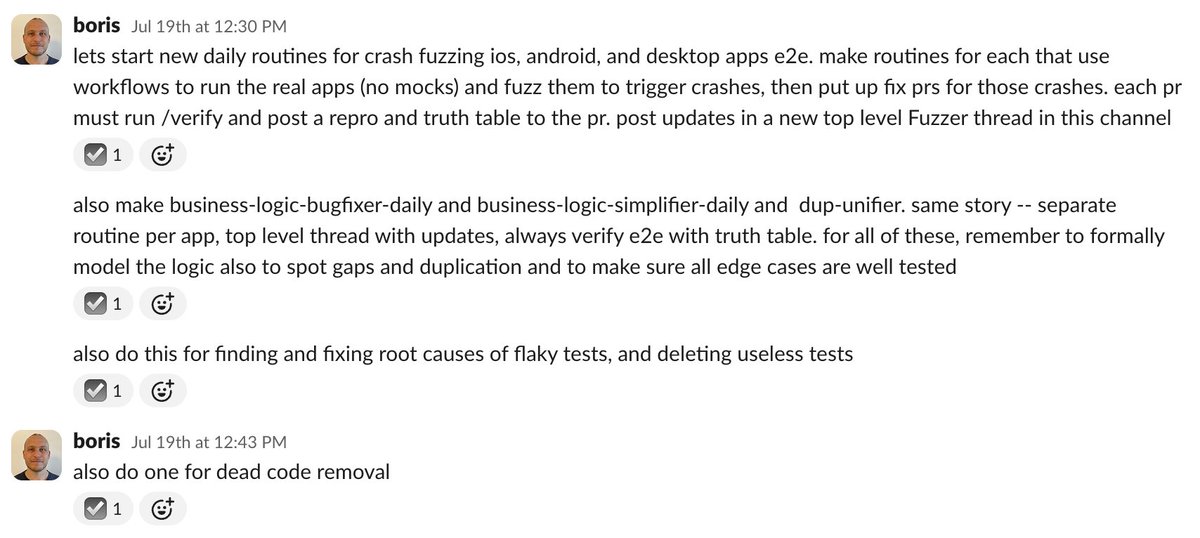
The crash fuzzer here is a good example. Claude behaves like a user, finds a crash, traces the cause and puts up a fix. That layer beyond the code is incredibly useful.
I've seen massive gains in my own workflows since I became more confident using computer-use tasks. The agent can see the same UI states I can and verify more of its own work.
The next productivity gains will come from giving agents better access to the environments where their work is actually used, so they can interact with the result and verify it themselves.
https://t.co/RnGvE3u7Y2
A weird experiment I've been trying the last few weeks is having Claude take over day-to-day maintenance of our apps. Seeing early signs of life that this might be possible.
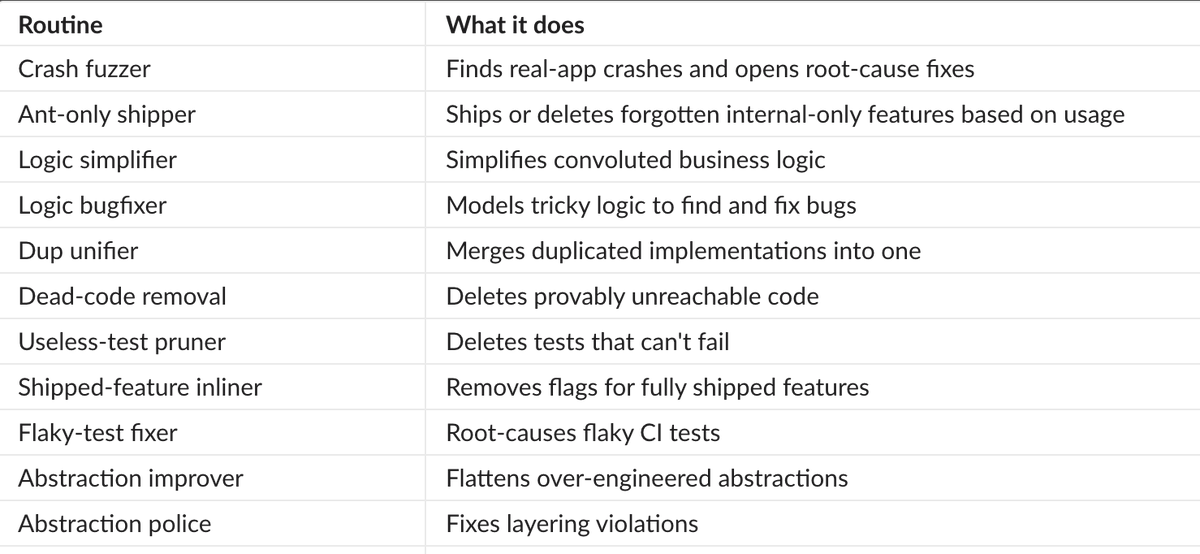
The setup is straightforward: we have a Slack channel called proj-claude-maintains-apps. In it, Claude Tag runs a bunch of daily routines across iOS, Android, Desktop, web, CLI, and Agent SDK:
- Crash fuzzer: open the app in a simulator and tap around to find ways to crash it, then root cause and fix the crashes
- Dup unifier: scans the codebase for similar-yet-slightly-divergent abstractions, and puts up PRs to unify them
- Dead-code remover: removes statically unreachable code, and adds logging to suspected dead code to check if it's really dead and if so, remove it the next day
- Abstraction police: fixes leaky abstractions
- a bunch more..
Results have been surprisingly positive. Over the last few weeks, these routines have opened 388 PRs across our repos, 180 of which we merged after Claude Code Review + human review. We're now thinking about how to streamline this to make merging these kinds of mechanical changes easier.
Claude generally gets these PRs right on the first shot, and if it doesn't, we ask Claude to tune its routines so it's better the next day. Sometimes it takes a few days of tuning.
To try a similar workflow, ask Claude Code or Tag, or create some routines directly at https://t.co/Z70hStEBH6. A few of the actual prompts I used below.
Has anyone experimented with similar workflows?
The hard part of compute futures will always be when somebody needs the compute at the other end.
The contracts announced so far are cash-settled. They can hedge the reference price of a B300 or H100 hour without anyone having to deliver a cluster.
The Nebius example shows why physical delivery is harder. Investor analysis of its B300 deals puts longer-term capacity around $4.25 per GPU-hour and near-term capacity above $9. The same chip can cost more than twice as much. The difference is obviously contract length and the value of contiguous clusters.
At the end of the day a buyer needs more than B300 hours. They need a specific number of GPUs in the same place, connected with the right networking, available for the right period, in the right geography and with the required uptime and software.
A cash index can average across those differences, but a marketplace delivering the compute has to decide which capacity is genuinely interchangeable.
Narrow delivery specifications fragment liquidity across thousands of products. Broad specifications can leave the buyer with compute that technically matches the contract but cannot run the intended workload.
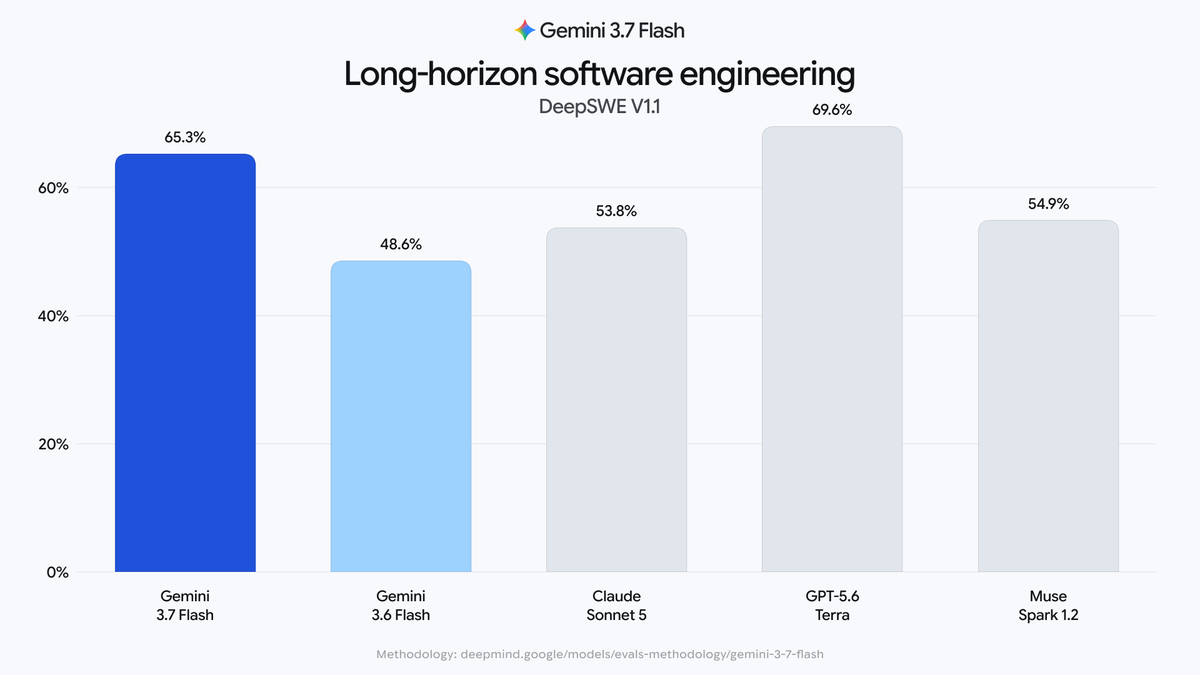
The rate of algorithmic improvement here is kind of crazy.
Gemini 3.7 Flash arrived roughly three weeks after 3.6, with Google crediting algorithmic improvements for the intelligence gain.
It really makes you wonder whether some form of RSI is already happening behind the scenes.
We are likely to see more bursts of improvement at this speed for at least the next 6 months.
https://t.co/n3QYG2ftDl
Introducing Gemini 3.7 Flash : )
- it is fast!
- 50% lower price than 3.6 flash (through end of year)
- strong intelligence increase in only ~3 weeks (thanks to some awesome algorithmic improvements)
- available in the API, AI Studio, Antigravity, and more!
X's Under the Hood tool shows creators which labels may be limiting a post or account. It could be valuable and super frustrating.
Take LLM-assisted writing. If people like a post, does it matter how much came from a model?
If an AI-content label is applied before initial distribution and reduces reach, the post gets less engagement because fewer people saw it. That weak engagement can then look like proof the content was not worth distributing. The system helped create the result it measures.
X has not said an AI label works this way, but I want the tool to answer: When was the label applied? How much did it change distribution? Can it be appealed?
Creators need timing and effect, not only the label. Otherwise they cannot know whether a post failed with its audience or was prevented from reaching one.
https://t.co/LnC5kemfTD
It increasingly seems like the only way to become a front-runner in AI infrastructure is to pick a bottleneck and solve it differently from everyone else.
SpaceX chose power. It is putting gas turbines beside its data centres so new capacity does not have to wait years for a grid connection.
Cerebras, the AI-chip company, chose memory and packaging. Its wafer-scale system avoids HBM, CoWoS and 3nm manufacturing, three queues constraining GPU supply.
Google chose compute efficiency. It built TPUs after calculating that machine-learning demand on conventional hardware could require it to double the number of computers in its data centres.
Lightmatter, a photonics startup, chose networking. It moves connections between AI chips from electricity to light because conventional links are running into bandwidth, power and physical-space limits.
The stack is too large for one company to solve all of it. A company can still become critical by owning one constraint that everyone else is stuck behind.
Do with that information what you want.
. @SpaceX and @elonmusk are accumulating gas turbines for AI data centres. Turbines mean lift, so obviously I wanted to know if Elon’s collection could lift the @Avengers Helicarrier.
The Southaven site has 69 mobile turbines producing 1.7GW. They’re being replaced by 41 permanent turbines producing 1.2GW. For this deeply scientific exercise we keep both: 110 turbines and 2.9GW.
Add APR Energy’s 38 turbines, 12 more on order and the 2GW Memphis cluster. Maximum Elon turbine power is 160 turbines and 10.6GW.
Nerds have modelled the Helicarrier at ~100,000 tonnes, or 110,000 US tons, with four 164-foot fans. Hovering takes 200GW. Maximum Elon turbine power lifts 14,074 tonnes, or 14.1%.
Obviously that isn’t enough, so we dig into Elon's rocket reserves.
SpaceX has 24 surviving Falcon Block 5 boosters and two V3 Super Heavies in production. Attach all 26 to the Helicarrier with unbreakable rope.
The Falcons produce 185MN and lift 18,844 tonnes. The Super Heavies add 160MN and lift 16,315 tonnes. Rocket reserves lift 35,160 tonnes.
Turbines plus rocket reserves lift 49,234 tonnes, or 49.2% of the Helicarrier.
Elon needs seven more Super Heavies for the other half.
Let's start a GoFundMe.
Betterment says 26% of Gen Z investors count sports betting as part of their wealth plan, and 52% moved investment money into bets last year.
Gen Z would rather parlay a backup goalie in a local high-school hockey game than learn what HBM is. I get it.
Crypto’s meme supercycle had the same setup. Good projects raised Series A and B rounds before the token launch, arrived at billion-dollar valuations, and retail got the down-only phase.
SpaceX listed at $1.77T. OpenAI and Anthropic may follow after private investors captured years of early repricing. An informed AI bet requires understanding HBM, copper, networking, power, grid queues and GPU utilization. A 22-year-old asks where the fuck the upside is supposed to come from.
Then look at the starting position. California’s median single-family home costs $843K. Only 22% of households can afford it, and the qualifying income is $205K. Federal student debt is $1.64T; nine million borrowers holding $220B are in default.
The sensible answer may be index funds and slow compounding. The parlay offers a fake shot at 100x and five minutes of feeling something inside your numb, dead soul. It is cooked, but the impulse is understandable.
Gen Z is moving money from stocks to sports betting in wealth plans, 52% of them have redirected inv funds to sports betting and quarter of them treat sports betting as a deliberate part of their long-term financial plan, according to survey from Betterment. Wow.
Convince me music didn’t peak in 2004 with Collision Course, the @jayz x @linkinpark collab.
The fact that this project was even conceived says everything about that era. The biggest rapper in the world and the biggest rock band in the world put their songs on top of each other because they believed rap fans and metal kids would both want it.
They were right. A six-track mash-up EP sold 368,000 copies in its first week and debuted at No. 1.
Those audiences are treated like separate markets now. A collaboration between two acts from opposite ends of popular music would never happen today. Back then it was a blockbuster.
The early 2000s had everything, and all of it was mainstream.
In the US, only around 10% of artists reaching the Billboard Top 10 during the 2000s were established hitmakers, meaning they had already placed more than ten songs on the Hot 100. Today, that figure is over 40%.
Now a single album can swallow the chart. Taylor Swift occupied the entire Top 14 in 2024. Morgan Wallen charted all 36 tracks from one album in 2023, then broke his own record with 37 songs in 2025. Taylor took eight of the Top 10 later that year.
The UK numbers tell the same story:
2001–05: 139 No. 1 singles
2021–25: 66 No. 1 singles
That’s 53% less turnover at the top.
From 2001 to 2005, Green Day, Korn, Slipknot and Linkin Park were competing with Madonna, Britney and Mariah. Kanye, 50 Cent, Jay-Z, Eminem and Ja Rule were competing with Usher, Beyoncé and Destiny’s Child. McFly, Westlife, Girls Aloud and Sugababes were charting alongside So Solid Crew, The Streets, Shy FX and The Prodigy.
Pop-punk, nu metal, emo, heavy metal, pop, R&B, rap, boy bands, girl bands, UK garage, drum and bass and electronic music all had a genuine place in the mainstream.
Korn sold 434,000 albums in one week. In 2005, 50 Cent opened with 1.14 million and Kanye with 860,000.
And don’t try to tell me that higher album sales today automatically means better music.
Convince me today’s industry isn’t simply better at pushing a smaller pool of generic artists while the music itself has got worse.
To me, this looks like model orchestration happening in the real world.
Vercel: volume +59%, cost/token -13.6%. DeepSeek took 25% of volume; Anthropic 65% of spend on 30% of tokens.
It looks like users and enterprises are getting better at matching the model to the task: cheap and fast for routine work, frontier models where failure is expensive.
I think huge value will accrue to orchestration over the next 18 months. It chooses the model, manages fallbacks and controls app economics.
https://t.co/iColKpkn45
This is a great example of orchestration providing real-world value.
Claude used 60 subagents and 31 million output tokens. Two produced the key ideas, 13 helped develop them, 13 validated the arguments and 30 explored dead ends.
The value came from coordinating search, criticism, verification and synthesis. A stronger model helps, but orchestration turned millions of speculative tokens into a result mathematicians could check.
1+1≠2
https://t.co/wt8BdHdqqI
We asked an unreleased research version of Claude to take a stab at the Riemann hypothesis.
It didn’t solve it, but it did make strides on a related problem: it increased the lower bound for the fraction of zeros of the Riemann zeta function that satisfy the hypothesis from 41.6% to 67.2%.
https://t.co/aZDvqqhHRi