London Legal Walk is today-830 teams, 4500 walkers from various law firms, chambers & legal advice agencies, raising funds to support free legal advice charities in London & the SE. If you would like to donate:
https://t.co/7paiUYLY0J
Thank you & good luck to all the walkers!
When a professor - a man, of course - defended regulated prostitution as necessary for men's health, Woman of the Day Aletta Jacobs swiftly retorted, “If that is really your opinion, you are morally obliged to make your daughters available for this purpose.”
Who knew that we would still be having this argument in 2026? Certainly not Aletta, born OTD in 1854 in The Netherlands, the first woman officially to attend a Dutch university and the first woman in her country to receive a doctorate in medicine.
She was born into a liberal Jewish family and wanted to become a doctor, like her father, but women were denied secondary education in many areas, and entirely excluded from universities. After primary school, she rejected the limited "finishing school" option for girls - it was “idiotic”, she said - and she had to lobby the authorities persistently just to become one of the first Dutch women to attend high school.
Persistent lobbying became the underlying theme of her life. None of the opportunities so readily available to men ever opened to Aletta unless she fought for them. She even had to petition the Dutch Prime Minister directly to be admitted to the University of Goningen in 1871 for provisional admission for one year, and thereafter to allow her to sit exams and graduate. In 1878, she earned her medical degree, and the following year, her doctorate, the first woman in the Netherlands to do so.
Aletta spent some time observing women doctors in London and met Dr Elizabeth Garrett Anderson, the first female doctor in England, and her sister, Millicent Garrett Fawcett. They shared similar views on women’s suffrage and the education of women.
Fully-qualified Dr Jacobs could not treat male patients - it was improper, indecent or unchaste for a woman to be in close proximity to male patients - and when she tried to take part in hospital clinical rounds, they would often refuse treatment or examination if she was present.
At this point, I would have expected NHS Fife’s collective head to be exploding, but then I remembered. They too are only concerned about the comfort and feelings of men.
Inevitably, Aletta established a practice in Amsterdam providing free care to poor women and children, and came up against a host of social problems that affected them most: widespread poverty, unhealthy working conditions such as long shifts without breaks for shop girls, repeated pregnancies harming the health of women, high infant mortality, sexually transmitted diseases among patients and especially among prostituted women.
"During this time I saw with my own eyes the catastrophic results that frequent pregnancies can have for a woman."
In 1882, she opened the world’s first birth control clinic and introduced the pessary (diaphragm) to the condemnation of her male medical colleagues, religious leaders, and others who called it disgusting and immoral because they thought it would lead to rampant adultery and invite divine punishment.
"If contraceptives were available – could a childless world be the result? Would they promote adultery?…I found comfort only by realising that a baby is most women’s greatest wish, which they would give up only for very serious reasons."
By 1883, Aletta was actively challenging the denial of the vote to women. She tried to register to vote. After all, existing electoral law did not explicitly exclude women: it granted voting rights to "citizens" who paid a certain amount of taxes, and she was an independent, taxpaying woman who ticked all the boxes.
After a bit of head-scratching, the mayor and city council of Amsterdam admitted that even though, strictly speaking, the law didn’t actually *exclude* women, mumble mumble, something something…she should ask the Amsterdam District Court. The District Court decreed that she was not a citizen, even though she met the criteria, so she appealed to the Supreme Court.
Shades of Canada’s Famous Five “persons” case here.
Of course you are not a citizen, said the Supreme Court, and anyway, taxes for married women are paid by their husbands, blithely overlooking the fact that Aletta was a single woman. The government obligingly amended the constitution in 1887 to explicitly limit voting rights to "male" citizens, thus closing the loophole.
Aletta responded by starting her lifelong campaign for women's suffrage, heading the Dutch Association for Women's Suffrage from 1894, and co-founding the International Woman Suffrage Alliance. She had ties with the USA’s Carrie Chapman Catt and devoted herself to women’s rights and pacifism on a full-time basis from her retirement from practice in 1903 until her death in 1929.
Dutch women were granted the vote in 1919.
"I feel happy that I have seen the three great objects of my life come to fulfillment during my life…They were: the opening for women of all opportunities to study and to bring it into practice; to make Motherhood a question of desire, no more a duty; and the political equality for women."
"Fighting for what is right makes life worth living."
Woman of the Day computer engineer Wanda Rutkiewicz born OTD in 1943 in Lithuania to Polish parents, leader of several all-women mountain-climbing expeditions who conquered Everest. She became the first woman to reach the summit of K2.
Wanda considered herself to be Polish. Her family returned to Poland immediately after the end of WW2 but it was still a hazardous place to be. Her seven year old brother was killed after he and his friends found an unexploded bomb.
A naturally gifted athlete who excelled at shotputting, the 18 year old Wanda was out riding her Junak motorcycle, the heaviest Polish motorcycle, when she ran out of fuel. A passing motorcyclist and his passenger, a keen mountaineer, stopped to help and that’s how she developed an interest in mountain climbing. It was apparent from the start that she had natural skills. She climbed efficiently and effortlessly. “I adored the physical movement, the fresh air, the camaraderie, and the excitement.”
Soon after Wanda began mountain climbing, she was approached by the Polish secret service who recognised her natural talent and believed she could be of great use to the communist state. At that time, Poland was still under the control of Russia. However, mountain climbing is very much an individual endeavour at odds with communist collectivism. Moreover, once climbers were in the mountains, they could no longer be kept under constant surveillance. Many Polish climbers found the freedom from authoritarianism liberating and Wanda was no exception. Her strong personality and fiercely individualist worldview meant that surrendering herself to the will of a communist regime was out of the question.
Her first expedition was to the Pamir Mountains in Tajikistan but she found it “unpleasant due to her difficult relationships with the male climbers”. She was belittled by the male climbers who didn’t regard a woman as an equal. Wanda, “a difficult woman”, responded by being confrontational. It was a pattern that resulted in her becoming isolated from the climbing community.
She decided to do things her way and began to lead her own all-women expeditions. In 1978, she became the first European woman to reach the summit of Everest despite suffering from anaemia. She had to take injections of iron with her to keep her haemoglobin levels high enough to remain conscious during the final climb to the top. It was the same day that her fellow Pole, Karol Wojtyła, became Pope John Paul II. He said, "The good Lord wanted this - that we rise so high on the same day."
Six years later, Wanda became the first woman to reach the summit of K2.
In fact, she scaled eight of the world’s 14 eight-thousanders, mountains more than 8,000 metres above sea level, but still experienced incredible hostility and scepticism from male climbers. One publicly doubted whether she had really reached the top of Annapurna until video footage proved otherwise. Well, why not? Male climbers are expected to provide evidence all the time, aren’t they?
In 1992, after successfully climbing Cho Oyu and Annapurna, two peaks on her list of fourteen, tragedy struck on Kanchenjunga in the Himalayas, the third-highest mountain in the world. A fellow climber saw her huddled in a snow cave and tried to persuade her to return to base camp. Wanda refused. She had one last leg to climb and was determined to conquer Kanchenjunga.
Wanda never returned to base camp and after a few days, she was declared dead at just 49. Did she make it to the summit? Her body was never found so we’ll never know but such was her determination and grit, I wouldn’t bet against it.
“I never seek death, but I don’t mind the idea of dying on the mountains. It would be an easy death for me. After all that I’ve experienced, I’m familiar with it. And most of my friends are there in the mountains, waiting for me.”
Woman of the Day teacher and suffragist Margaret Nevinson, born OTD in 1858 in Leicester: Poor Law Guardian, first woman magistrate in London, playwright. The last bit caught my attention. She used her writing to highlight one of the many injustices of coverture.
Coverture was a Norman import. Anglo-Saxon women had the right to own property but from the eleventh century, a married woman was the chattel of her husband, and property cannot own property. Everything a woman had - children, belongings, earnings - belonged to him. She had “no veto over or means of opposing” his decisions and if you’ve ever wondered why temperance was the earliest fight for women’s rights, this is why: when he drank away his wages every Friday, she couldn’t feed their children.
Margaret was trapped in an unhappy marriage for 48 years. Her husband was often away and even he wasn’t, they ate separately except on Sundays. She refused to let it define her, devoting her time to the cause of women’s suffrage. Ironically, it was the only thing they agreed on.
She was elected as a Poor Law Guardian in Hampstead in 1904, overseeing workhouses and allocating limited funds and assistance to the poor and elderly. It was the only elected position open to women in the days before women’s suffrage and she took a keen interest in the impact on women from working-class backgrounds.
On 8 May 1911, Edith Craig, daughter of Ellen Terry, staged Margaret’s play ‘In The Workhouse’ as one of a triple bill of plays at the Kingsway Theatre, Holborn. A one-act play based on a true story and set in the ward of a workhouse with religious texts on the “yellow washed walls”, its seven actresses wore “pauper dress: dark blue cotton gowns, ill-fitting, with white caps and aprons.” One character laments, “Doing time is better than this. Even in Holloway, ye runs round the yard and sees a bit of sky for an hour.”
Another character, Mrs Cleaver, was married to a taxi driver who lost his licence for being inebriated on duty and now the whole family was confined to the workhouse. A skilled dressmaker, she managed to find enough work to support herself and her children as well as somewhere for them to stay and applied to leave. The Board of Guardians refused. She was legally under the control of her alcoholic husband. Because he chose to stay in the workhouse, so must she.
Penelope, a young single mother was “put off marriage at an early age” after her drunken father beat her mother to death. Her five children were all provided for by their fathers but as an unmarried mother, she had full custody. “I’m going back tomorrow to my neat little home, which my lady-help is minding for me, to my dear children and my regular income, and I can’t say as I envies you married ladies either your rings or your slavery.
Lily, a young woman expecting to marry her child’s father, changed her mind, saying to her baby, “I think we won’t get married, my pet! Better keep single, I say, after what we’ve heard tonight.”
The play wasn’t sensationalist or caricature or allegory. It was real life, drawn from Margaret’s experience of working with women trapped by poverty, hunger and domestic violence, and its message was clear: no matter what class you were, as a married woman, you had no rights.
Audience reaction was divided between those who applauded it for telling the unpalatable truth and those who found it offensive. The Morning Post (now the Telegraph) praised it but The Times and the Daily Mail did not. One review headlined LONDON SHOCKED BY LEWD PLAY GIVEN BY SUFFRAGETTES claimed: "Votes for women's cause injured by a drama so coarse in theme and so perverted in moral that many prominent ladies withdraw their support."
Margaret pointed out, “The criticisms are strange and bewildering; only about five per cent have at all understood the point of the play…there is an air of injured innocence in the tone of some of the critics revolting and hypocritical to those of us who are prepared to face horrors if only we can reform these evils.”
“These facts told to a street corner audience invariably arouse great indignation, for the poor know by bitter experience that they are true; to bring them to the knowledge of our legislators is harder.”
The play sparked a debate in the House of Lords and so shocked the House of Commons that it legislated in 1913. Margaret noted with satisfaction that “the order by which a pauper husband had the right to detain his wife in the workhouse by ‘his marital authority’ is now repealed.”
Workhouses were not formally abolished until 1930. Coverture was not finally knocked on the head until 1990 when women were finally taxed independently on their own incomes and given their own personal allowances. 1990. It only took 924 years.
Responding to criticism of her play, Margaret said “The only apology I make is for its realism.”
Woman of the Day Charity Ann Bick, born OTD in 1924 in West Bromwich, the youngest ever recipient of the George Medal. She was just 15. She had lied about her age when she volunteered the year before as an Air Raid Precautions dispatch rider because her Dad was an ARP warden and she wanted to help.
At 7pm on Tuesday, 19 November 1940, the Luftwaffe launched a nine hour attack on West Bromwich. It wasn’t the first time that residents were subjected to the Blitz. This was their 167th air raid siren. Just nine days before, five bombs had been dropped on Tantany, just north of the town centre, severely damaging houses and the Great War memorial, and leaving huge craters. That included oil bombs, nasty devices about the size of a dustbin packed with oil and inflammable material that spat out flames and splinters over a wide radius.
Charity had already proved her mettle, cycling in the open amid falling bombs and shrapnel from anti-aircraft batteries in order to deliver vital communications between ARP posts.
Tuesday’s air raid was by far the worst. This time, the Luftwaffe started with thermite incendiary bombs, setting West Brom alight to guide in the next wave of bombers which were carrying high explosives. Their targets were thought to have been the railway sidings, surrounding factories and a gasworks at Swan Village, but they missed. Instead, they dropped the incendiaries on the cinema, which had a full audience, and on shops and homes. Even the hospital was hit.
One family lost eight members, another six, and a woman was pulled alive from the rubble only to find her firefighter husband had died trying in vain to shield their young daughter.
The bombs also took out nineteen water mains.
Charity found her Dad on the roof of a shop in the town centre, trying desperately to extinguish an incendiary bomb with a stirrup pump - a small handheld device - and a bucket of water. When the water pump failed, she splashed water on it with her bare hands to put the fire out.
The roof gave way. Charity fell through and was injured, but she got up and carried on. Shortly after, the wave of high-explosive bombs started, destroying houses both opposite and near to the ARP post in a massive explosion that nearly knocked her off her feet.
All the other wardens occupied on rescue or firefighting duties so Charity borrowed a bicycle and cycled about 1.25 miles through the height of the air raid - dodging falling bombs, shrapnel, and gunfire - to deliver critical messages to the ARP Control Room.
She successfully completed at least three such journeys during the most intense phase of the bombing, with additional trips afterwards. By serving as a vital communication link, she freed other wardens for frontline duties and ensured the coordination of civil defence efforts under "nerve-racking conditions."
In September 1941, George VI personally presented Charity with the George Medal, the highest civilian honour for bravery (the highest is the George Cross), for "outstanding courage and coolness in very trying circumstances”. She remains the youngest ever recipient.
I can’t give you a stirring quote from Charity. This modest woman led a private life after the war, serving quietly in the Women's Royal Air Force until 1962 when she retired as a warrant officer and went to live in Inverness.
Woman of the Day teacher Louise Thuliez born OTD 1881 in Northern France, one of the few women in history to have been officially sentenced to death by a foreign power for resistance activities during wartime and to have survived.
When WW1 broke out in 1914, she knew exactly what she had to do. Nurse by day, Resistance guide by night, she joined nurses Edith Cavell and Princess Marie of Cröy in forming an underground network to help Allied soldiers escape to Holland from behind enemy lines in Flanders.
“I am only a woman, but I have a heart, and that heart bled to see my country crushed under the boot of the invader.”
The Red Cross Hospital in the Belgian town of Saint-Wast de Vallee turned Louise down as a volunteer but on 24 August 1914, when it began evacuating wounded British soldiers ambulance, six were left behind. There was no room for them and the village was quickly occupied by the Germans.
Louise took over. She took them home and into her care, hung a homemade Red Cross flag from her window, and broke into a locked and deserted bakery to make bread for them. The Germans made halfhearted checks - it was still busy fighting rearguard actions - but she knew it was only a temporary reprieve.
Around this time, nurse Princess Marie of Cröy and her husband were reaching out to would-be resisters and Louise was able to make contact. She brought the six British soldiers, dressed in civilian clothing, to a safe house to join a much larger group of about forty. Once they were there, she travelled to Brussels to make ongoing arrangements and then came back to personally guide two British officers to safety. She gave them long batons of bread to carry to make them look like locals. The two men reached England and resumed active service.
“I did not hesitate a second. To save these men was a duty; to refuse would have been cowardice.”
By 1915, Louise was in touch with Edith Cavell. She and Princess Marie began guiding soldiers to Edith’s hospital in Brussels so they could be sent on to safety. She travelled by night, walking close to hedgerows so she and the men could throw themselves into a ditch to hide.
In all, those three women managed to take around 200 soldiers to safety before their underground network was betrayed.
Louise and Edith were arrested by the Germans and held in St Gilles prison. As a non-combatant, she was not protected by the Geneva Convention or international law. If the Germans wanted to shoot her, they could, and she knew it.
On 7 October 1915, Louise’s trial - if you can call it that - began. Asked to account for her actions, she was defiant: “Because I am a Frenchwoman.” Sentenced to death, she replied: “For every cross is given the corresponding strength to bear it.”
Edith Cavell’s execution by firing squad on 12 October 1915 was a dark day and Louise was scheduled to die the following day but she drew courage from the bravery of her friend. “She was calm, dignified, sublime. Never once did she tremble. She taught us all how to die.”
“The bullets that struck down Edith Cavell and my comrades did not silence us; they awakened the conscience of the world.”
An unexpected intercession by Alonso XIII of Spain spared her life and she was incarcerated for three years instead. Medical care was poor, typhus was rife, and many women prisoners died, including one in her arms as she tried to comfort her. Undaunted, she engaged in small acts of resistance. Compelled to sew buttons on German uniforms, she deliberately made them loose so they soon fell off. It was a small thing but it kept her going.
In November 1918, Louise was freed by the Allies. She was later awarded the Military Medal, the Legion d’Honneur and the Croix de Guerre and when WW2 broke out, she did it all over again. She joined the French Resistance and helped Allied soldiers escape from the Auvergne region of Occupied France, bringing them to her old friend Princess Marie who hid them in a château in Bellignies.
Louise died in 1966, aged 84, a quiet heroine of both World Wars.
“If I had to do it again, I would do exactly the same thing. I regret nothing.”
Woman of the Day MI9 agent Mary Lindell, born OTD in 1895 in London, served in both World Wars, was shot in the face and the head, run over by a car, and nearly died in Ravensbrück, but she set up an escape line and managed to help over a hundred Allied airman to escape from Nazi Germany. Codename: Marie-Claire.
Her uncompromising demeanour and her aristocratic hauteur nearly got her killed but there is no doubt about her courage or resilience. It was thanks to Mary’s negotiating skills that 47 British and American women held in Ravensbrück in 1945 survived.
When WW1 broke out, Mary became a Voluntary Aid Detachment nurse but she never could take orders and she disliked menial work so she went to France and joined a division of the French Red Cross, ministering to wounded French soldiers for four years. She’d collect them just a stone’s throw away from the German trenches - once suffering a gas attack - and get them to a forward station. That earned her the first Croix de Guerre. Both medal and her nurse’s uniform came in handy in WW2.
After WW1, Mary stayed in Paris and adopted the title Comtesse de Milleville. When Germany marched in on 10 May 1940, she found some British evaders trying to slip under the radar of the occupiers by posing as locals - they weren’t very good at it - so she took them in and fed them until she could get them to Vichy France where they would be guided across the Pyrenees to neutral Spain.
It was all achieved through sheer force of personality. Mary would present herself to the Wehrmacht dressed in her French Red Cross uniform, complete with WW1 medals, and bully or charm officers into handing over permits, extra fuel coupons and whatever else she needed, on the pretext that she was reuniting stranded children with their desperate parents in Vichy France. Impressed by this assertive and authoritative aristocratic lady, they would hand over the necessaries.
Some of her back story was pure invention of course. She was from an affluent family but not aristocratic. She was not the Comtesse de Milleville, although she’d lived with the Comte (a dodgy bloke with Nazi connections) and they had three children. She was prickly and arrogant unless you understood what motivated her: her fierce love for Britain, her refusal to bow to authority, and her belief that your word should be your bond.
The Gestapo was not as easy to impress as the Wehrmacht. They arrested her in 1941, held her in solitary confinement in Fresnes Prison and repeatedly interrogated her. All they had was suspicion but she stuck to her story and after nine months, they had to release her. It was a wake-up call. She disguised herself as a governess and escaped to Spain via her own network, making contact with the British consul in Barcelona who put her in touch with MI9 in London.
MI9 was the branch set up to get Allied airman home. It taught Mary clandestine techniques and in October 1942, a Lysander dropped her by parachute in France so she could continue helping Allied evaders. Even when a car crashed into her bicycle in December and nearly killed her, she shrugged it off and carried on.
On 22 November 1943, Mary stood on the platform at Pau railway station waiting for four airmen when she was arrested. In December, as she was being taken by her captors by train to Paris to face execution, she tried to escape by jumping off and was shot.
“As I didn't want to go to Paris, I thought the best thing to do was to get off the train and I chose my spot, and when I got there I told my guard that I usually felt sick on the train…I hit him on the knee [but] walked a bit too quickly because I wanted to get a move on, you see. He followed me, and he immediately began shooting. I thought, oh, the bastard, he's shooting. As I turned to go through, he got me in the cheek. I didn't even feel it…And as I jumped, he fired. He got me twice in the head which, of course, helped me get on a bit. It really was a hell of a jump.”
A German surgeon at a Luftwaffe hospital saved her life. When she was sufficiently recovered, she was held in solitary confinement in chains until she was transported to Ravensbrück on 3 September 1944. She was assigned to nursing duties at the camp, working long days, but she built up a rapport with the SS doctor.
The post D-Day period was a perilous time for POWs. The Germans were as methodical about destroying evidence as they were about record-keeping. That meant executing prisoners.
When Count Folke Bernadotte sent his famous White Buses (Swedish volunteers driving 36 hospital buses, 19 trucks, and other vehicles rescued over 25,000 prisoners from various concentration camps by June 1945), the ever-methodical Mary was ready with her list of 47 female British and American prisoners even though she was stricken with pneumonia. She rose from her sick bed with her list of women, demanded they be permitted to board and ushered them onto the buses. When she tried to board, the camp commander stopped her.
Be in no doubt. Mary would have died if she’d been left behind. The SS doctor intervened on her behalf and she was finally put on the last bus out of Ravensbrück. In return, she promised to help him after the war, so she caused an outrage when she spoke in his defence at the Nuremberg trials. She died in 1987, aged 91, with a second Croix de Guerre.
'When they say l'm a heroine, I am most embarrassed and I think it's ridiculous. I mean, after all said and done, one does a job - it's a job. A lot of people say, oh, how courageous, how brave, and I say, no: luck. I was lucky. And I was wounded three times and they all said, you'll never recover. Luck. My number wasn't up.
But a heroine? All twiddle rot. What is a heroine? Joan of Arc? I'm certainly nothing like that. Edith Cavell? When people say that it makes me mad. I'll tell you, in my little tupenny-ha'penny mind I represented Great Britain, who was standing up against the world and fighting for it, and I wasn't going to let Great Britain down. It just didn't enter my head. And I wasn't frightened. I mean to say, if you're shot, well, you're shot, and that's the end of the story, isn't it?'
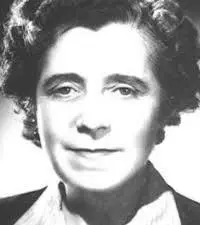
Woman of the Day epidemiologist Dr Molly Newhouse (1912-2000) of Oxfordshire who served in the Royal Army Medical Corps and treated casualties under fire in Normandy right after D-Day. Her post-war research into mesothelioma in the wives of asbestos workers prompted a change in the Asbestos Regulations.
She qualified at the Royal Free Hospital Medical School in 1936 and after a series of hospital posts, was called up by the RAMC in 1942, serving at military hospitals in Britain. To her dismay, paperwork was a major part of the job.
“My own duties after the first week or two's bewilderment were fairly simple. At 8 o'clock I had a sick parade only for ATS girls…Their chief troubles were blisters from the smart new boots they were issued with…I was also impressed by the ideal opportunity for medical research. Here were thousands of men and women living under standard conditions and diet; how easy to investigate their vitamin requirements and so on. Poor innocent that I was, I did not realise then that to perform any useful research in the Army, you needed the rank of a brigadier and the backing probably of the Cabinet itself.”
Soldiers didn’t know how to address her as an officer. “In the units, one was known as Doc, and the Doc's word, whether man or women, was law…Some of the older regulars found it a little difficult to reconcile the idea of a woman with the idea of an officer, and I was frequently told, "You are wanted on the phone, Miss Newhouse Sir".
Molly once forgot “the formality” of having to apply for one night’s leave and found herself in double trouble: not just for being AWOL but “also guilty of grinning in an insolent fashion when found not wearing my gas mask in the sacred period 9.30 to 10 Tuesday morning.”
Bored by admin, she applied for a frontline post. “I saw the Medical Brigadier, who remarked wearily that the women MOs were a good deal more bloodthirsty than the men but he would see what he could do.”
Molly was assigned to “a hospital which was situated right in the middle of Bayeux. It had stopped receiving casualties but was the hospital for the entire Aromanches and Bayeux area” and a place was found for her on an LCT (landing craft tank - think of a floating skip) bound for the Normandy beaches just after D-Day. “As we struggled up the pier we could see a curious looking craft tied up at the end and hear the startled exclamation from the deck, "Blimey, it’s women".
She was a specialist doctor but her first task at the beachhead was the sort at which every woman is expected to be expert. Delivering a baby. She did it under constant bombardment while being regaled with tales of how easily it could all go wrong. “Grandmere had a collection of obstetric horrors which, related in half understood French, beat anything I had heard in the Greys Inn Road into a cocked hat. However, the dressings and equipment and the baby's clothes were quite first class and by seven o'clock we had liberated another fine little Frenchman.”
At Bayeux, Molly worked on casualties with her customary efficiency. “I thought I had used my best bedside manner, but the overheard comment was, "Very hard, these women doctors".
In 1945, she was posted to India and then to Singapore, caring for prisoners of war liberated from the dreadful conditions in Japanese prisons in Burma and Malaya, and in 1946, she flew home in an RAF flying boat to be demobbed as a lieutenant colonel.
Post-war, Molly’s busy and varied career included an investigation into a rare form of skin disease among trawlermen, known as ‘Dogger Bank itch’ (she found it was an allergic skin reaction to a seaweed) but the research that led to her being regarded as an international expert concerned the terrible effects of asbestos.
It had been known for years that exposure to asbestos dust caused asbestosis and bronchial carcinoma, especially in smokers. The 1931 Asbestos Regulations set out strict conditions for employers but Molly was puzzled by the rate of mesothelioma in East London near a large asbestos factory. Mesothelioma is a rare cancer that can take years to develop and she found that a significant number of sufferers had been exposed to much lower concentrations of asbestos dust either at work or at home. Women who washed their husbands’ overalls were among those affected.
Her research led to significant changes in the 1969 Asbestos Regulations which for the first time, required work clothes to be washed by the employers in special laundries, a requirement that still applies today.
Mollie officially retired in 1977 but continued to carry out research and died in 2000, aged 88.
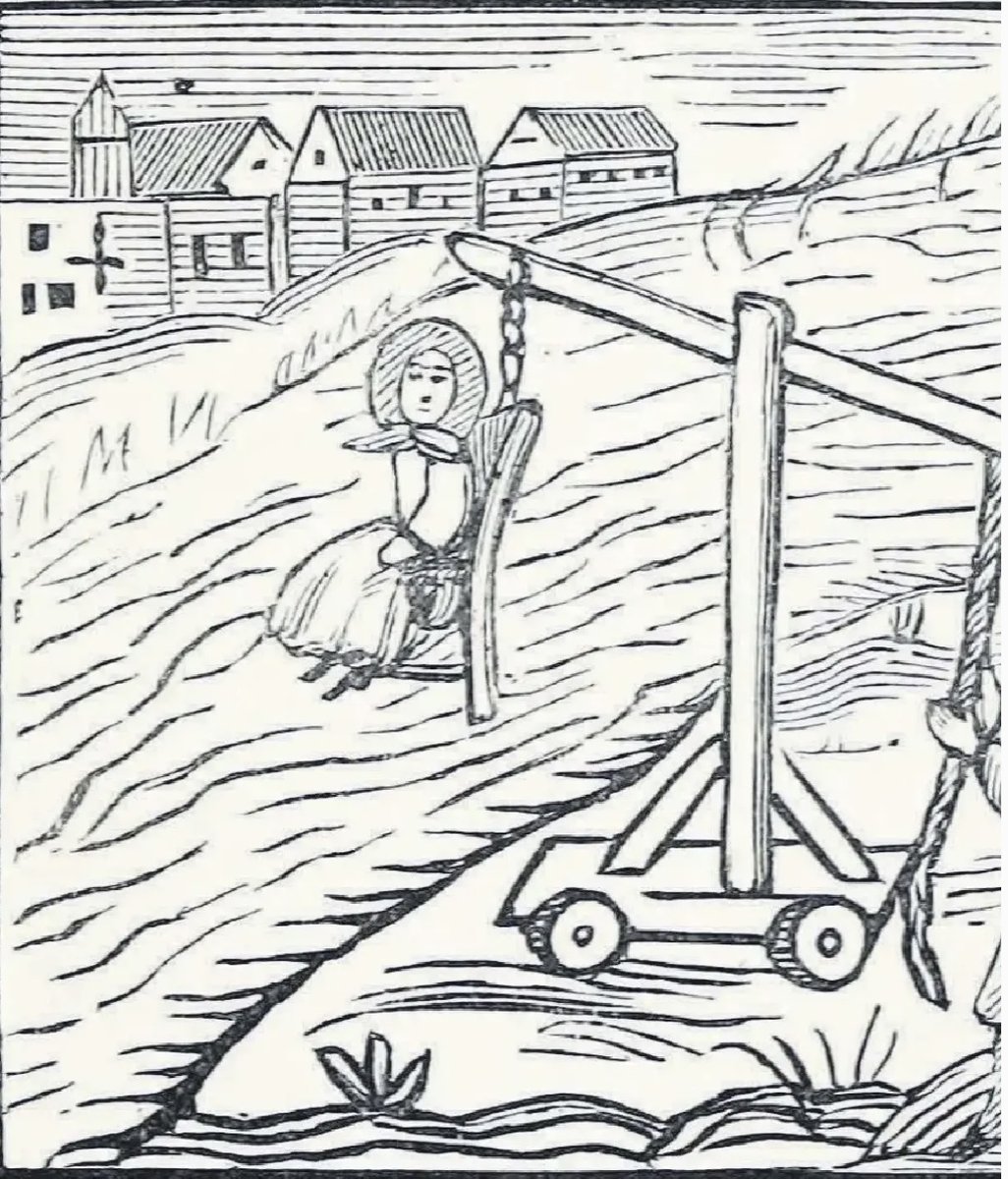
Woman of the Day is Mistress Blake of Bristol. I don’t know when she was born or much about her but it’s her day because OTD in 1621, Bristol's city fathers paid for a new ducking stool, a device exclusively used for punishing women. 97 years later, Mistress Blake made sure the Mayor of Bristol regretted ordering her to be ducked.
As you know, the term “ducking stool” has been around since at least 1597 (the much older version was the cucking stool: from ‘cukken’, an old word meaning ‘to defecate’ and therefore, a commode). It was originally intended to punish dishonest vendors but from around 1377, it was reserved for women. William Langland’s poem, Piers Plowman referred to it as wymen pine, women's punishment.
Bristol had boasted a ducking stool since Tudor times but exactly 404 years ago today, magistrates ordered that a new one be installed on the north bank of the River Frome close to the ‘The Weare’ (Broad Weir), upstream where the water would be clearer.
Weeks later, city beadles (constables) ducked a woman from Redcliffe three times for being a common scold. The same woman was punished a second time and a few years later, two women on the same day.
The purpose of the ducking stool was to silence women by humiliating them. This counted as public entertainment, by the way.
These days, Bristol Council takes a much more progressive approach. It simply erases women by including crossdressing men in its definition of womanhood, and refuses to listen to any who dare to speak in support of other women, as my sisters in the Women of Wessex can confirm. But I digress.
The city beadles might have been a bit too enthusiastic about their task, or perhaps they just enjoyed humiliating women because city accounts show that in 1625, Bristol "Paid for cords and aqua vitae for the women that were cuckte, 7d.” Translation: Bristol Council paid seven old pence, about £71 in today’s money, for cordials and brandy to revive women who nearly drowned as the result of being ducked.
There was a lull during the Protectorate - Old Noll didn’t approve of public entertainment: he banned plays, horse racing, gambling, bear baiting, inns and gambling and Christmas - but in 1660 at the start of the Restoration, Bristol splashed out on a new ducking stool at a cost of £2 12s 6d, about £455 in today’s money.
Goodwife Orchard was ducked in 1661 for being a "disorderly scold" and thereafter, it was used regularly until it was repaired and painted in 1692. Then along came Mistress Blake.
One fine evening in 1718, Edmund Mountjoy, soapmaker and Mayor of Bristol, was out walking when he spotted Mistress Blake rebuking her husband in public. Having declared that “In this Mayoralty, the ducking-stool on the Weir was used as a cure for scolding”, he ordered her to be ducked.
When Mistress Blake emerged from the river, she mocked him in front of the crowd for doing to her what he didn’t dare to do to his own wife Sarah. Then she instructed a London lawyer, sued the Mayor for assault…and won.
The ducking stool was never again used to silence women in Bristol. Bristol Council just uses No Debate instead.
Exactly 249 years tomorrow to the day, the Criminal Law Act 1967 received Royal Assent, thus removing the offence of “common scold” from the statute books and making both the ducking stool and the scold’s bridle unlawful.
Woman of the Day agricultural inventor Eva Ekeblad, born OTD 1724 in Sweden, discovered how to make flour from potatoes during a European-wide famine crisis in the 1740s caused by severe winters and crop failures. She was the first woman to become a member of the Royal Swedish Academy of Sciences.
Wasn’t the humble spud always a food source once the first one was brought over to us in 1586? Well, yes and no. South Americans used different variants to produce healthy crops but Europeans had only one sort so it was vulnerable to pests and parasites. In any case, it was viewed with suspicion - the potato is a member of the deadly nightshade family - so it was only regarded as fit for livestock to eat, and perhaps poor people at a pinch. In France, the potato was even banned for human consumption because of a widespread belief that it caused leprosy.
Eva, born to an aristocratic family, was married at 16. Her dowry consisted of two castles and her husband owned a manor estate as well as property in Stockholm. He was often absent on privy councillor duties so she got on with extensive hostess duties, bearing eight children and managing three large estates. By all accounts, she ran a tight ship and wasn’t afraid to argue with the estate bailiffs, quoting the law at them.
By the time she was 22, Eva had discovered a way to cook, crush and dry potatoes to make a starchy type of flour. Her work couldn’t have been more timely. Large areas of Europe were badly affected by famines.
She summarised her experiments in an essay entitled ‘Försök att tillverka bröd, brännvin, stärkelse och puder af potater’ (Attempts at producing bread, spirit, starch and powder from potatoes) and submitted it to the Royal Swedish Academy of Sciences. She described in some detail how to extract potato starch and turn it into a usable flour similar in texture to wheat flour by grinding and sifting it, and how to make alcohol from potatoes. She included a recipe she developed for making bread with oat flour mixed with mashed potatoes.
On 3 December 1748, Eva became the first woman elected as a member. The Academy sent her a letter of thanks on 17 December of that year, speculating in committee that by admitting her as a member, it might inspire more women to develop products which could be useful in households across the country.
Her paper was published in Kungl. Vetenskapsakademiens Handlingar (Transactions of the Royal Swedish Academy of Sciences), and the Board of Commerce printed 4,000 copies and distributed it throughout the country.
Turning potatoes into a staple food in Sweden not only reduced the impact of famine and improved the Swedish diet but it increased the availability of wheat, rye and barley for making bread, since potatoes could also be used an alternative for making alcohol. The downside was that it also led to a spike in alcohol (brännvin) consumption, especially vodka.
On 19 January 1751, the Academy downgraded her status to honorary member. Ironic, really, when it had been using her as a poster girl. Its charter still restricted membership to men.
She accepted the decision because she didn’t attend regular meetings (well, she was a bit busy, what with having seven children to raise almost single-handedly as well as running vast estates) but she continued her scientific experiments and later the same year, found another use for potatoes. Potato flour could be used in place of lead, a dangerous element, in cosmetic products such as soap. She developed a method of bleaching cotton textile and yarn with soap and promoted the potato plant by using its flowers as hair ornaments.
After the death of her husband in 1771, Eva continued to manage her estates until she died in 1786, aged 61.
And after her death?
The Royal Swedish Academy of Sciences elected its second female member…in 1951. Only 203 years later.
France dropped its ban on potatoes for human consumption, not because Eva had shown it to be a safe and versatile source of food but because Antoine-Augustin Parmentier published “Manière de faire le pain de pommes de terre, sans mélange de farine” (How to make potato bread, without flour) in 1779 - 31 years after Eva published her paper.
He is credited with making the potato popular in Europe. That’s why you’ve heard of parmentier potatoes, not Ekeblad potatoes.
Woman of the Day award-winning war photojournalist Catherine Leroy of France, died OTD in 2006, the only woman to make a combat parachute jump with US forces in Vietnam. She spent more time at the front — three weeks per month — than any other woman journalist in Vietnam and she did that for over two years.
Born in Paris in 1944, 22 year old Cathy flew to Laos as a freelancer on a one-way ticket with a Leica camera and $200 in her pocket. No work lined up, no contracts, very little by way of a portfolio, she reasoned that if she could convince US forces to accept her, she could eat rations and sleep in the countryside alongside them but first, she needed accreditation.
Cathy approached the Associated Press editor responsible for scores of photojournalists filing out of Saigon: as many as 600, but only 20 or 30 freelance and none of those were women. He told her to go and find some work that would convince him she was up to the job. So she did. “I was making $15 a photograph. There was a great appetite for this work.”
What she did have was a licence as a qualified parachutist with a record of 84 successful jumps. Military Assistance Command Vietnam granted her credentials and the commanding officer agreed to let her jump with the 173rd Airborne Brigade during Operation Junction City - an 82-day combined US/South Vietnam military operation against the Viet Cong - on 22 February 1967. He gave her just two days’ notice. “My size 6 foot was swimming in my size 7 jungle boots, the smallest they had.”
Despite persistent rumours that she’d only got permission because she’d slept with a colonel (men never have to put up with such insulting sexist nonsense but women in combat zones face it all the time), she was the seventh to jump from the seventh plane and shot photos from the air which AP sent out. Just 5’ tall and weighing six stone (85 lbs), she had to be weighed down so as not to be blown away. “I’m very proud of myself because I didn’t jump into a tree.”
Embedded with the US Marines, Cathy accompanied them on countless operations, sharing their everyday life in the heat and mud to produce extraordinary photographs depicting their gruelling lives in battle conditions. “In Vietnam, most of the time it was extremely boring. Exhausting and boring. You walked for miles through rice paddies or jungle — walking, crawling, in the most unbearable circumstances. And nothing was happening. And then suddenly all hell would break loose.”
Her photos captured the human face of war. One of her most famous photographs, “Corpsman in Anguish, 1967”, is a triptych of split-second shots showing an American soldier with both hands on the chest of his comrade trying to staunch the blood, trying to find a heartbeat, realising it was too late.
“When you look at war photographs, it’s a silent moment of eternity. But for me, it is haunted by sound, a deafening sound.”
On 19 May 1967, she went on patrol with a marine unit in an open rice paddy in the demilitarised zone near Con Thien and was hit in an ambush by mortar fire. Thirty-five pieces of shrapnel pierced her body, broke her jaw and destroyed her cameras, which took the brunt and saved her life. She had to be evacuated by tank instead of helicopter but six weeks later, she was back in the field.
When the all-out Têt Offensive began on 30 January 1968 (Têt is the Vietnamese New Year), Cathy was on holiday at My Khe Beach near Da Nang but travelled to Hue with another French journalist because they’d “heard there was action.” They sheltered with some refugees in the cathedral but were asked to leave because the presence of foreigners made the refugees nervous. Capture by the Viet Cong was inevitable. “Five or six men, all carrying guns, jumped on us, took my camera, tied our hands behind our backs.”
Realising that their captives were French, not American, the North Vietnamese colonel gave their cameras back and allowed them to interview and photograph him and his soldiers after Cathy persuaded him that the world was only hearing one side of the story. Her essay became the byline cover story in Life magazine on 16 February 1968. “It was an extraordinary experience for me. I had seen many North Vietnamese prisoners, but they were always in great fear and great pain. This was the first time, suddenly, that their humanity was in front of me.”
Cathy finally went home to Paris in December 1968. After covering the war for just over two years, she described herself as “extremely shell-shocked” when she left.
“It took years to get my head back together because I was filled with the sound of death, and the smell of death...I was extremely cool under fire. I didn’t show anything. But when I went back to Saigon…the horror of it would hit me.”
Her pictures were published on the pages of the world’s most prominent magazines and she was a trailblazer for women photographers working today in conflict zones around the world.
“I always felt that it was a great privilege to be with the soldiers, to be accepted, to spend a couple of days or maybe a week with them. But I could leave any time, and they couldn’t. Within 48 hours I would be in Saigon, have a long shower and rest. I would be in a French restaurant where the food was nice, where the wine was decent, and I always felt guilty inside. To me, it was as if I was a deserter. Which is a bit ridiculous, but it’s true.”
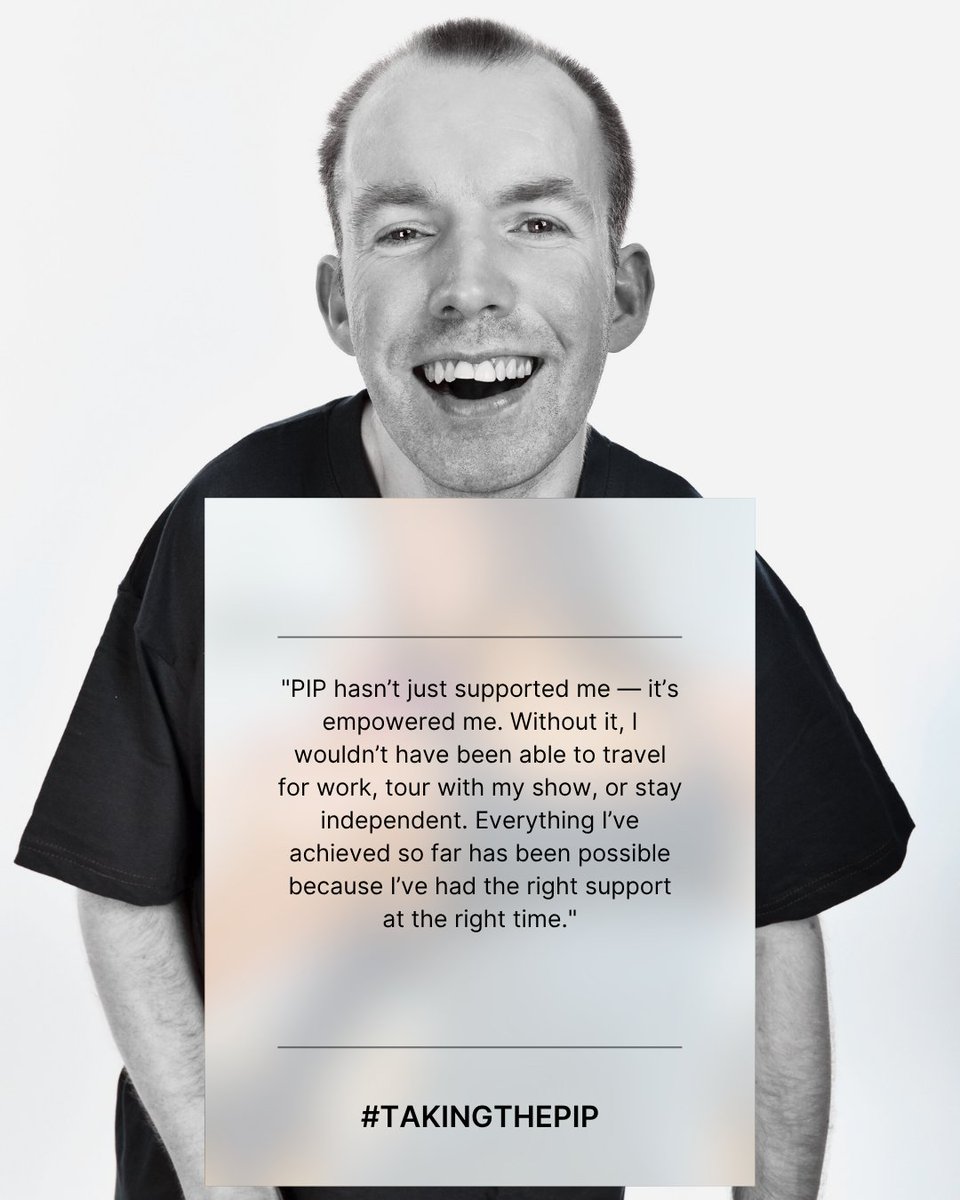
I’m speaking out because cutting PIP would be devastating. It’s been my lifeline — helping me live independently and build a comedy career. Without it, I wouldn’t have managed. This is about dignity, not just money.
These cuts are dangerous. Stop #TakingThePIP.
@TakingThePIP1
Woman of the Day Jacqueline Cochran (born in 1906 in Florida), the first woman to break the sound barrier on 18 May 1953, reaching an average speed of 652.337 miles per hour in an F-86 Sabre jet in California; the first woman to fly a jet aircraft across the Atlantic, the first to land and take off from an aircraft carrier.
Those weren’t the only records she set. In 1962 alone, she set 78 records for speed, distance and altitude in the US and internationally, including flying at 56,073 feet. Between April 1963 and May 1964, she set a series of speed records all over 1200mph in a Lockheed F-104G Starfighter and in 1964, she flew faster than Mach 2, twice the speed of sound.
How did it all start? Well, thereby hangs a tale - the facts v Jackie’s autobiography The Stars at Noon which described her life as “sawdust to stardust”.
She was born in 1906 or perhaps 1910 as Bessie Lee Pittman; the Pittmans were either her real family or she was adopted by them; either they made her work in a cotton mill at the age of eight for twelve hours a day at six cents an hour and save up to buy her first pair of shoes, or she never went without.
What is clear is that she had little formal education, married at 14, had a child, left him with her parents, then left her husband to work in a beauty salon in Montgomery, Alabama, before re-inventing herself in 1929 as a beautician in New York with her own successful business and a new name.
In 1932, Jackie’s soon-to-be second husband dared her to take flying lessons. She was a natural, achieving her pilot's licence after just three weeks’ training, and proceeded to break so many records that by the time she died, she held more speed, altitude, and distance records than any other pilot in aviation history.
By 1941, WW2 was waging throughout Europe. Jackie approached the US Army Air Corps offering to recruit qualified women pilots and personally train them for the vital role of ferry pilots in wartime, just as the UK was doing with women of the Air Transport Auxiliary. Women flying? In wartime conditions? Get real. It turned her down.
Just as Dr Elsie Inglis of the Scottish Women’s Hospital Service ignored the War Office’s dismissive advice to “go home and sit still”, Jackie flew a B-17 Flying Fortress - a four-engined heavy bomber - across the Atlantic from Florida to Scotland to prove it could be done (the first woman to do so) and promptly put 76 of the best women pilots through their paces. Her standards were high - all had 1,000 hours flying time, well in excess of the 300 hours the ATA required - but only 25 made the grade. She took herself and the 25 off to England in March 1942 where they were welcomed by the Air Transport Auxiliary. It made her the equivalent of a Squadron Leader.
Back home, the attack on Pearl Harbour on 8 December 1941 focused minds. Suddenly, women were needed after all. The US military resurrected Jackie’s plans to recruit women for specialised pilot training in what became the 319th Women’s Flying Training Detachment, intending to transfer them to the Women’s Auxiliary Ferrying Squadron on graduation.
Just as you’d expect, money and resources were lavished on the newly formed WFTD. Yes, I’m being sarky. Women were expected to do exactly what pioneering women are always expected to do: make do and mend. No uniform other than men’s khaki overalls that were too large, minimal medical care, no life insurance, no crash truck, no fire tender, an old ambulance on loan. No trainer plane bar some old aircraft that were worn-out and barely functioning.
Eventually in August 1943, the WFTD and WAFS merged to form the Women Airforce Service Pilots with Jackie as director. She supervised the training of women pilots at over a hundred bases. A total of 1074 women went on to fly American military aircraft, ferrying about 80% of all aircraft.
When male pilots balked at flying the Boeing B-29 Super Fortress because it was regarded as too difficult and cumbersome, two WASPs were asked to show the men how it was done. Dorothea Johnson and Dora Dougherty Strother flew B-29s from Birmingham, Alabama, to New Mexico and landed them perfectly in front of an audience. “From that day on, there was no more grumbling from male pilots assigned to train on and fly the B-29 Super Fortress."
Jackie flew more combat missions than any other woman in WW2, from ferrying planes to supporting frontline troops. She was the first non-Japanese woman to enter Japan after the war, and she attended the Nuremberg Trials. Her record is a mixed one - some of her views were controversial - but there is no doubt she was a groundbreaker. She died in 1980, aged 74.
“I can cure your men of walking off the [flight] program. Let's put on the girls.”
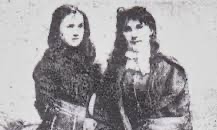
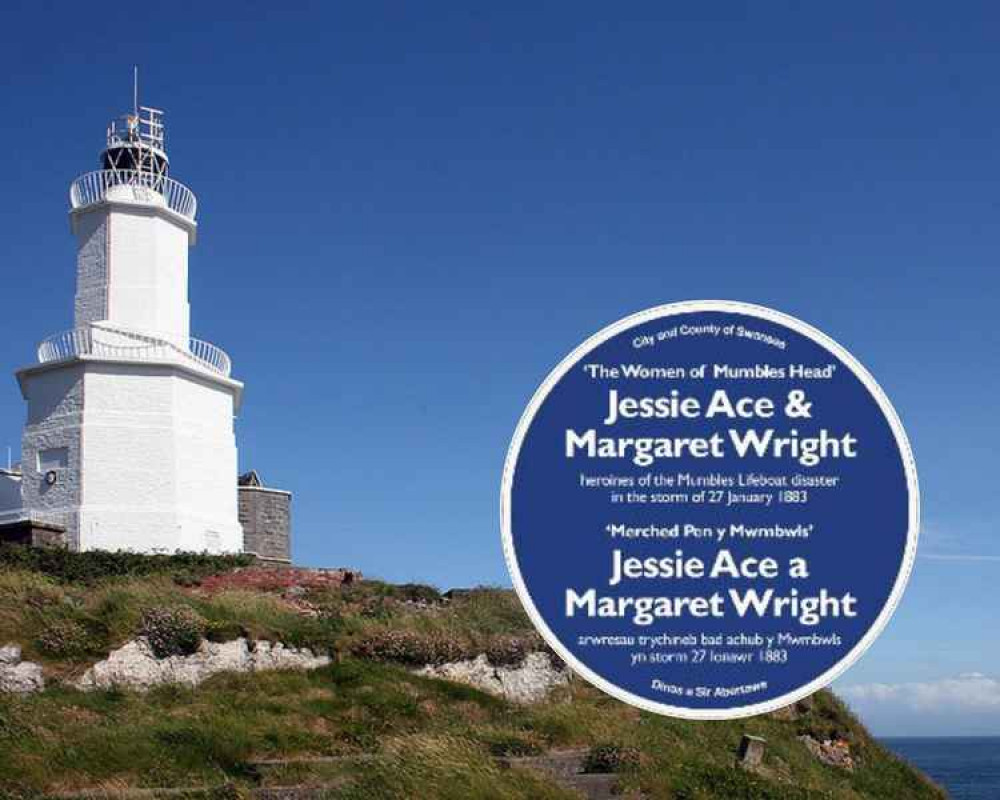
Women of the Day are Jessie Ace (1860-1936) and Margaret Wright (1854-1933) of Mumbles, Wales. It’s their day because OTD in 1883, they pulled two drowning lifeboatmen out of the sea at Mumbles Head during a raging storm, but you wouldn’t know that if you’d read the RNLI report.
Jessie and Margaret were sisters, the daughters of lighthouse keeper Abraham Ace, and they lived on the lighthouse island.
According to newspaper reports of 31 January 1883 in the South Wales Daily News, dreadful storms battered the coast of Wales on Saturday, 27th January 1883, and had already caused the shipwreck of the SS Agnes Jack at Port Eynon earlier that morning with the loss of eight lives. The RNLI were on immediate standby all down the coast.
The same newspaper reported that at Mumbles Head, Abraham Ace spotted the German barque Admiral Prinz Adalbert at about 9am “coming up the Channel unmanageable” and a steam tug was “playing about her”.
It transpired that the barque was being so badly buffeted by the gale force winds, it couldn’t steer properly. The tug captain demanded £500 (about £52k in today’s money) to “turn your bow around”. The barque captain agreed but the tug was only carrying two short ropes and both snapped. At that point, the captain ordered that the two topsails be raised to try and steady the vessel but it struck Mumbles Rock and was listing.
All of this took about twenty minutes which gave the crew of the lifeboat ‘Wolverhampton’ time to launch. They fully expected the crew of the barque to be washed overboard and needed to be in place to effect a rescue.
However, the Wolverhampton's anchor cable parted and the lifeboat capsized. The crew managed to right her but she then capsized again, throwing all the lifeboat crew overboard. Four crewmen drowned. The coxswain, Jenkin Jenkins, was thrown onto the rocks. The remaining two, John Thomas Bredger and William Rosser, clung desperately to the lifeboat's lifelines but there was no boat to come to their rescue.
Margaret and Jessie waded into the raging sea and dragged out William Rosser, assisted by Gunner Edward Hutchings from the lighthouse battery. The Ace Sisters then tied their shawls together to create a rope and rescued John Bredger too.
At the inquest, the coxswain Jenkin Jenkins gave a detailed eyewitness account of the events saying, “Two daughters of Mr Ace went to where I saw the men in the water. I was told that Mr Ace seemed afraid lest his daughters should get drowned. Maggie cried out, "I will lose my life rather than let these men drown" and she and her sister tied two shawls together and both of them threw them into the water. By this means they saved two men, William Rosser and John Thomas Bredger.”
The crew of the Admiral Prinz Adalbert managed to clamber to safety on the lighthouse island where the Ace sisters tended to them, even though they would probably have benefited from a little care and support themselves by this time.
The sisters’ courageous actions were faithfully recorded in the newspaper article, along with the fact that the RNLI awarded the coxswain Jenkin Jenkins a silver medal and £50, and for Gunner Hutchings, a commendation on vellum.
For Jessie and Maggie, not a sausage. They weren’t even mentioned in the RNLI report.
Their bravery wasn’t totally unrecognised. Augusta of Saxe-Weimar-Eisenach, Empress of Germany, awarded them gold brooches for their heroism and for looking after the crew of the German barque. They were featured on the front page of The Graphic, a weekly newspaper in London, and they inspired the Daily Telegraph theatre critic, Clement Scott, to write the poem 'The Women of Mumbles Head.'
I’m pleased to tell you that Swansea also commemorated Jessie and Maggie with a blue plaque on Mumbles Pier in 2016.
Woman of the Day Captain Flora Sandes born OTD 1876 in Yorkshire, a St John Ambulance volunteer and the only British woman to serve officially as a soldier in WW1. She fought with the Serbian army. To the soldiers of Serbia, she was nashi Engleskinja - our Englishwoman - and she was awarded the country’s highest military honour.
Flora had always wanted to serve. When WW1 broke out, she volunteered as a nurse but the War Office in London had no time for women volunteers. They’d already told Dr Elsie Inglis, who founded the Scottish Women’s Hospitals, to “go home and sit still”.
Undeterred, she left England and went to Serbia in August 1914 with a women’s volunteer ambulance unit. She worked in a hospital in Valjevo, ‘the death camp of Serbia’, contracted typhus, saw colleagues die from the disease. She did long hours, performed amputations, endured the same hardships as the soldiers.
When the Serbian Army was forced into the Great Retreat over the treacherous mountains through Albania in late 1915, Flora went with them, the only woman to do so. “Scorching days followed by freezing nights, when we lay on the bare mountainside in clothes soaked in perspiration with no covering but our overcoats; incessant fighting, weariness indescribable, but hand-in-hand with romance, adventure and comradeship, which more than made up for everything.”
Realising that her lack of nursing experience meant there was no point carrying on as she was, she applied to be a soldier in the Serbian Army. The Serb commander told her “If you remain with the army, you will have to go with them through Albania. The trip will be terrible, like nothing you have ever experienced.” Flora asked: “Will I be a burden?” He said, “Quite the reverse. It will be better for us as your presence will encourage the soldiers. You represent the whole of England to them”.
Flora removed her Red Cross badge and replaced it with brass regimental figures from the Colonel’s epaulettes. “I seem to have just naturally drifted, by successive stages, from being a nurse into a soldier.”
She could ride and shoot, had great physical endurance, spoke fluent French and German. “It was heartbreaking the way they used to ask me every evening, “Did I think the English were coming to help them?” and “Would they send cannon?”…I used to cheer them up as best I could, and said I was sure that some guns would come, and that even if they didn’t, they must not think that the English had deserted them, as I supposed they had big plans in their head that we knew nothing about, and that though we might have to retreat now, everything would come right in the end. It was touching, the faith they had in the English.”
In November 1916, Flora, by then a Sergeant with the Serbian infantry, was severely wounded by a Bulgarian grenade during hand-to-hand combat. She took the full blast. “I could see nothing. It was exactly as though I had gone suddenly blind; but I felt the tail of an overcoat sweep across my face. Instinctively I clutched it with my left hand, and must have held on for two or three yards before I fainted. The Serbs have a theory that you must not give water to a wounded man because they say it chills him, so they poured fully half a bottle of brandy down my throat and put a cigarette in my mouth. I caught the little sergeant who had helped carry me watching me with his eyes full of tears. I assured him that it took a lot to kill me, and that I should be back again in about ten days”.
It took not ten days but six months to recover sufficiently to return to the frontline. Recuperating in hospital, she was promoted to sergeant major and awarded the Kara George Star, Serbia’s highest decoration for NCOs. By the end of the war, she was awarded Serbia’s highest military honour, the Order of the Karadjordje Star.
Promoted to Captain after the war, Flora found civvie street “dull and irksome”. She felt awkward in civilian dress, and her former colleagues were uncomfortable in her company when she was not in uniform. She lived for a while in Paris, then South Africa. She married a Russian emigré a dozen years her junior, returned to Belgrade and tried to re-enlist at the age of 65 when Belgrade was bombed by the Germans in 1941.
When Hitler invaded Yugoslavia the same year, Flora and her husband were arrested and imprisoned. They were released after a few weeks on condition that Flora complied with a reporting condition to the Gestapo. Eventually she returned to England as a widow, and died in Suffolk in November 1956.
Women of the Day engineer and racing driver Dorothée Pullinger born OTD in 1894 in Normandy, the first woman member of the Institution of Automobile Engineers, co-designer of the first car expressly built for women drivers, and the first woman car manufacturer in the UK.
Born in France, six year old Dorothée spoke only French when her family relocated to the UK. She had to learn English very quickly but it was just the first of many challenges for her. On leaving school, she could have gone to university - she had the qualifications, her family had the money - but she was hellbent on being an engineer. Her traditionally-minded father wanted her to stay at home and help her mother but she pestered him until he agreed that she could become an engineering apprentice at the company he managed. She was constantly told that she was doing a man out of a job.
In 1914, Dorothée was refused membership of the Institution of Automobile Engineers because she was not classed as a real person: "The word person means a man and not a woman." It took her seven years - they tried to fob her off by offering associate membership but she was having none of that - and she was finally admitted as the first woman member in 1921, thus preceding Canada’s Famous Five “Persons” case by six years.
In 1916, Dorothée was headhunted for the post of Lady Superintendent at the Vickers factory in Barrow-in-Furness which had been given over to the production of munitions for WW1. Vickers made the right choice. She successfully recruited and supervised about 7,000 women. A tough boss with high standards, she also believed in looking after her women workers, introducing a canteen system that provided them with cooked meals.
When WW1 ended in 1918, Dorothée went to work for her father at Galloway Engineering Ltd in Kirkcudbright, a factory that had manufactured aeroplane parts for the war effort while offering engineering training for women but now no longer needed.
War changes everything. For many women, it opened doors previously slammed in their faces. They’d learned to drive ambulances and army vehicles, they had their own earnings, and they had no intention of giving up their independence or sense of freedom and going back to the kitchen.
Dorothée saw a business opportunity and persuaded her father to repurpose Galloway’s as a car factory employing the now-skilled and highly motivated local women who would build a cheap, simple motor car aimed squarely at women drivers. Together, she and her father designed the Galloway, a four-cylinder vehicle with an engine capacity of 1528cc, based on the Fiat 501 after a model was bought and secretly dismantled in the factory
The focus was on comfort, safety and reliability. Women had always been expected to just cope with cars built for men (we still are; I’ve yet to find one with a female-friendly seat belt or car seat). Automobiles around at that time had no consideration for the average height or body shape of a woman or the practicalities of getting in or out wearing a dress without it being caught in brake and gear levers that inconveniently crossed over in the doorway. The Galloway was “a tenacious hill-climber” and had wing mirrors and rear-view mirrors - all standard now but until then, the advice had been to carry a hand mirror. No great innovation required, just common sense.
Dorothée showed off the Galloway’s versatility by racing it. She loved driving at speed, wearing a jacket and a little hat, racing in a car with narrow tyres and started with a hand crank. In 1924, she became the first woman to enter the Scottish Six Days Reliability Trials, winning the silver cup.
The factory itself was designed around women. Its women’s engineering college had a tennis court on the roof, a swimming pool, a hockey team and a piano room for relaxation. About 4,000 Galloways were built but post-war competition in the motoring industry was fierce and although they remained in production until 1929, the Wall Street Crash had its impact and the business was no longer viable.
Undaunted, Dorothée built the White Service Steam Laundry, an industrial steam laundry with its own water and power supplies, in Croydon in the 1920s and ended up with seventeen of them. During WW2, one was on standby as a decontamination station in case of a gas attack and she was the only woman on the Industrial Panel of the Ministry of Production set up to plan post-war industrial strategy. She was a contributor to the 1944 report Looking Ahead: Work and the Future of British Industry.
In 1946, Dorothée sold the laundry and built a similar business from scratch in St Peter Port, Guernsey, choosing the machines and employing the women.
She never lost her love of speed and was known for tearing around corners in Guernsey. Dorothée died in 1986, aged 92.
Woman of the Day Susan Auld born OTD in 1915 in Tynemouth, the first Englishwoman to graduate as a naval architect and co-designer of the light landing craft that were key to getting Allied soldiers onto the beaches on D-Day.
It wasn’t all Susan designed to support the war effort but the landing craft were revolutionary.
Tyneside has a proud tradition of shipbuilding. Very few women were employed in the industry but Susan was born into a family of naval engineers. Her grandfather founded what became Swan Hunter and after becoming the first woman to be awarded a degree in naval architecture from Durham University in 1936, Susan joined the design office of what was then Swan Hunter & Wigham Richardson at the Neptune yard in Wallsend.
Susan was a key member of the design team for the battleship HMS Anson launched on 24 February 1940. It was equipped with anti-aircraft guns, fire-control radar, a double-ended catapult and two Supermarine Walrus seaplanes. It escorted nine Atlantic Convoys by 1943 and in August 1945 made its own little bit of history when the surrender of Japanese forces occupying Hong Kong was accepted by the Rear Admiral onboard the Anson.
In 1942, the Woman Engineer, the house journal of the Women’s Engineering Society, noted that "Lloyd's List of 25th February contained news of the only woman ship designer in the country. She is Miss S. M. Denham Christie…and that she had recently been admitted as an Associate Member of the North East Coast Institution of Engineers and Shipbuilders.”
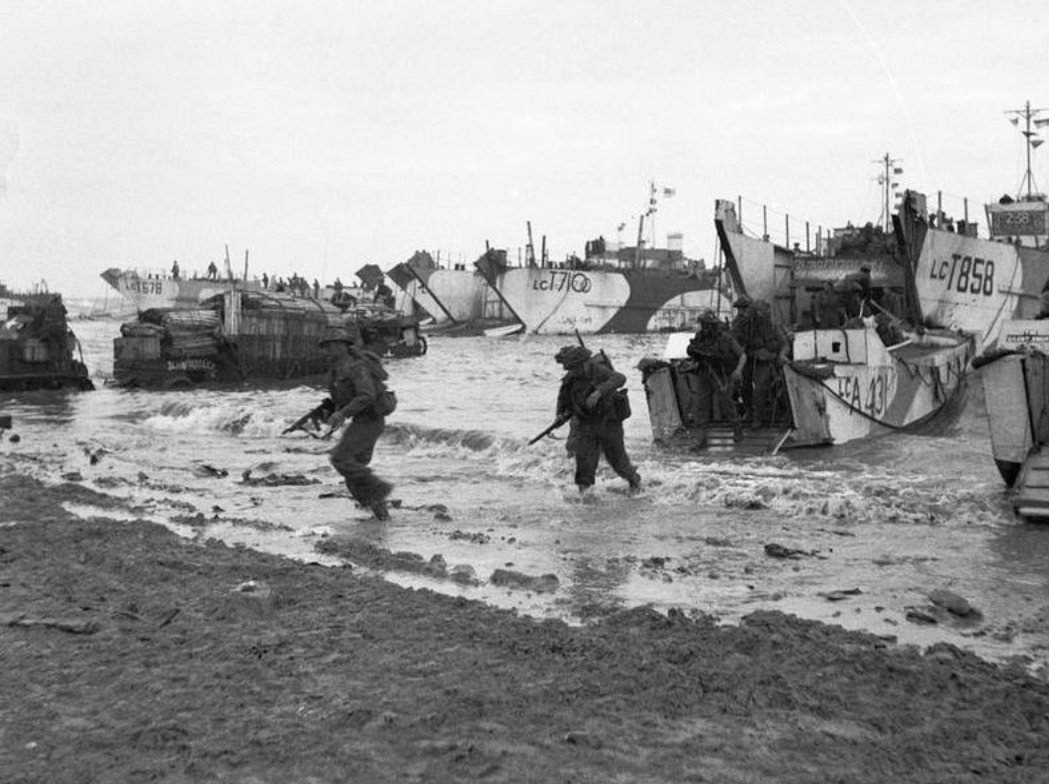
But back to those landing craft. I always thought they looked like floating skips but they were much more sophisticated than that.
Landing troops, vehicles, guns, rockets and supplies on the Normandy beaches in huge numbers was a logistical challenge. It required a landing craft capable of getting closer to the shore than deep-draft warships could. They had to be able to carry vehicles too and those vehicles needed to roll off onto the beach so they wouldn’t plunge into the water. That meant they had to open up from the front. You can't unload vehicles with an aft or side ramp or they’d just sink.
Operation Overlord comprised 4,126 landing ships and craft – 3,261 of which were British - 736 auxiliary ships and craft, and 864 merchant ships. And of course, those floating skips. Susan helped to design them and hundreds of them were built at Hebburn just outside Jarrow.
I’ve included a photo of them below so you can see what they looked like. Without them, the Allies could not have landed nearly 160,000 soldiers - including nearly 60,000 of our own - on Utah, Omaha, Gold, Juno and Sword.
Post-war, Susan carried on with her work as a naval architect. She helped to design the aircraft carrier HMS Albion launched in 1947 which saw service during the Suez Crisis in 1956, but she mainly focused on commercial and cargo shipbuilding. She was instrumental in the design of the TS Leda, the twice-weekly North Sea ferry between Newcastle upon Tyne and Norway.
Susan died in 2002, aged 87.







![TheAttagirls's tweet photo. Woman of the Day MI9 agent Mary Lindell, born OTD in 1895 in London, served in both World Wars, was shot in the face and the head, run over by a car, and nearly died in Ravensbrück, but she set up an escape line and managed to help over a hundred Allied airman to escape from Nazi Germany. Codename: Marie-Claire.
Her uncompromising demeanour and her aristocratic hauteur nearly got her killed but there is no doubt about her courage or resilience. It was thanks to Mary’s negotiating skills that 47 British and American women held in Ravensbrück in 1945 survived.
When WW1 broke out, Mary became a Voluntary Aid Detachment nurse but she never could take orders and she disliked menial work so she went to France and joined a division of the French Red Cross, ministering to wounded French soldiers for four years. She’d collect them just a stone’s throw away from the German trenches - once suffering a gas attack - and get them to a forward station. That earned her the first Croix de Guerre. Both medal and her nurse’s uniform came in handy in WW2.
After WW1, Mary stayed in Paris and adopted the title Comtesse de Milleville. When Germany marched in on 10 May 1940, she found some British evaders trying to slip under the radar of the occupiers by posing as locals - they weren’t very good at it - so she took them in and fed them until she could get them to Vichy France where they would be guided across the Pyrenees to neutral Spain.
It was all achieved through sheer force of personality. Mary would present herself to the Wehrmacht dressed in her French Red Cross uniform, complete with WW1 medals, and bully or charm officers into handing over permits, extra fuel coupons and whatever else she needed, on the pretext that she was reuniting stranded children with their desperate parents in Vichy France. Impressed by this assertive and authoritative aristocratic lady, they would hand over the necessaries.
Some of her back story was pure invention of course. She was from an affluent family but not aristocratic. She was not the Comtesse de Milleville, although she’d lived with the Comte (a dodgy bloke with Nazi connections) and they had three children. She was prickly and arrogant unless you understood what motivated her: her fierce love for Britain, her refusal to bow to authority, and her belief that your word should be your bond.
The Gestapo was not as easy to impress as the Wehrmacht. They arrested her in 1941, held her in solitary confinement in Fresnes Prison and repeatedly interrogated her. All they had was suspicion but she stuck to her story and after nine months, they had to release her. It was a wake-up call. She disguised herself as a governess and escaped to Spain via her own network, making contact with the British consul in Barcelona who put her in touch with MI9 in London.
MI9 was the branch set up to get Allied airman home. It taught Mary clandestine techniques and in October 1942, a Lysander dropped her by parachute in France so she could continue helping Allied evaders. Even when a car crashed into her bicycle in December and nearly killed her, she shrugged it off and carried on.
On 22 November 1943, Mary stood on the platform at Pau railway station waiting for four airmen when she was arrested. In December, as she was being taken by her captors by train to Paris to face execution, she tried to escape by jumping off and was shot.
“As I didn't want to go to Paris, I thought the best thing to do was to get off the train and I chose my spot, and when I got there I told my guard that I usually felt sick on the train…I hit him on the knee [but] walked a bit too quickly because I wanted to get a move on, you see. He followed me, and he immediately began shooting. I thought, oh, the bastard, he's shooting. As I turned to go through, he got me in the cheek. I didn't even feel it…And as I jumped, he fired. He got me twice in the head which, of course, helped me get on a bit. It really was a hell of a jump.”
A German surgeon at a Luftwaffe hospital saved her life. When she was sufficiently recovered, she was held in solitary confinement in chains until she was transported to Ravensbrück on 3 September 1944. She was assigned to nursing duties at the camp, working long days, but she built up a rapport with the SS doctor.
The post D-Day period was a perilous time for POWs. The Germans were as methodical about destroying evidence as they were about record-keeping. That meant executing prisoners.
When Count Folke Bernadotte sent his famous White Buses (Swedish volunteers driving 36 hospital buses, 19 trucks, and other vehicles rescued over 25,000 prisoners from various concentration camps by June 1945), the ever-methodical Mary was ready with her list of 47 female British and American prisoners even though she was stricken with pneumonia. She rose from her sick bed with her list of women, demanded they be permitted to board and ushered them onto the buses. When she tried to board, the camp commander stopped her.
Be in no doubt. Mary would have died if she’d been left behind. The SS doctor intervened on her behalf and she was finally put on the last bus out of Ravensbrück. In return, she promised to help him after the war, so she caused an outrage when she spoke in his defence at the Nuremberg trials. She died in 1987, aged 91, with a second Croix de Guerre.
'When they say l'm a heroine, I am most embarrassed and I think it's ridiculous. I mean, after all said and done, one does a job - it's a job. A lot of people say, oh, how courageous, how brave, and I say, no: luck. I was lucky. And I was wounded three times and they all said, you'll never recover. Luck. My number wasn't up.
But a heroine? All twiddle rot. What is a heroine? Joan of Arc? I'm certainly nothing like that. Edith Cavell? When people say that it makes me mad. I'll tell you, in my little tupenny-ha'penny mind I represented Great Britain, who was standing up against the world and fighting for it, and I wasn't going to let Great Britain down. It just didn't enter my head. And I wasn't frightened. I mean to say, if you're shot, well, you're shot, and that's the end of the story, isn't it?'](https://pbs.twimg.com/media/G0i5bZ_XAAA0WAB.jpg)



![TheAttagirls's tweet photo. Woman of the Day Jacqueline Cochran (born in 1906 in Florida), the first woman to break the sound barrier on 18 May 1953, reaching an average speed of 652.337 miles per hour in an F-86 Sabre jet in California; the first woman to fly a jet aircraft across the Atlantic, the first to land and take off from an aircraft carrier.
Those weren’t the only records she set. In 1962 alone, she set 78 records for speed, distance and altitude in the US and internationally, including flying at 56,073 feet. Between April 1963 and May 1964, she set a series of speed records all over 1200mph in a Lockheed F-104G Starfighter and in 1964, she flew faster than Mach 2, twice the speed of sound.
How did it all start? Well, thereby hangs a tale - the facts v Jackie’s autobiography The Stars at Noon which described her life as “sawdust to stardust”.
She was born in 1906 or perhaps 1910 as Bessie Lee Pittman; the Pittmans were either her real family or she was adopted by them; either they made her work in a cotton mill at the age of eight for twelve hours a day at six cents an hour and save up to buy her first pair of shoes, or she never went without.
What is clear is that she had little formal education, married at 14, had a child, left him with her parents, then left her husband to work in a beauty salon in Montgomery, Alabama, before re-inventing herself in 1929 as a beautician in New York with her own successful business and a new name.
In 1932, Jackie’s soon-to-be second husband dared her to take flying lessons. She was a natural, achieving her pilot's licence after just three weeks’ training, and proceeded to break so many records that by the time she died, she held more speed, altitude, and distance records than any other pilot in aviation history.
By 1941, WW2 was waging throughout Europe. Jackie approached the US Army Air Corps offering to recruit qualified women pilots and personally train them for the vital role of ferry pilots in wartime, just as the UK was doing with women of the Air Transport Auxiliary. Women flying? In wartime conditions? Get real. It turned her down.
Just as Dr Elsie Inglis of the Scottish Women’s Hospital Service ignored the War Office’s dismissive advice to “go home and sit still”, Jackie flew a B-17 Flying Fortress - a four-engined heavy bomber - across the Atlantic from Florida to Scotland to prove it could be done (the first woman to do so) and promptly put 76 of the best women pilots through their paces. Her standards were high - all had 1,000 hours flying time, well in excess of the 300 hours the ATA required - but only 25 made the grade. She took herself and the 25 off to England in March 1942 where they were welcomed by the Air Transport Auxiliary. It made her the equivalent of a Squadron Leader.
Back home, the attack on Pearl Harbour on 8 December 1941 focused minds. Suddenly, women were needed after all. The US military resurrected Jackie’s plans to recruit women for specialised pilot training in what became the 319th Women’s Flying Training Detachment, intending to transfer them to the Women’s Auxiliary Ferrying Squadron on graduation.
Just as you’d expect, money and resources were lavished on the newly formed WFTD. Yes, I’m being sarky. Women were expected to do exactly what pioneering women are always expected to do: make do and mend. No uniform other than men’s khaki overalls that were too large, minimal medical care, no life insurance, no crash truck, no fire tender, an old ambulance on loan. No trainer plane bar some old aircraft that were worn-out and barely functioning.
Eventually in August 1943, the WFTD and WAFS merged to form the Women Airforce Service Pilots with Jackie as director. She supervised the training of women pilots at over a hundred bases. A total of 1074 women went on to fly American military aircraft, ferrying about 80% of all aircraft.
When male pilots balked at flying the Boeing B-29 Super Fortress because it was regarded as too difficult and cumbersome, two WASPs were asked to show the men how it was done. Dorothea Johnson and Dora Dougherty Strother flew B-29s from Birmingham, Alabama, to New Mexico and landed them perfectly in front of an audience. “From that day on, there was no more grumbling from male pilots assigned to train on and fly the B-29 Super Fortress."
Jackie flew more combat missions than any other woman in WW2, from ferrying planes to supporting frontline troops. She was the first non-Japanese woman to enter Japan after the war, and she attended the Nuremberg Trials. Her record is a mixed one - some of her views were controversial - but there is no doubt she was a groundbreaker. She died in 1980, aged 74.
“I can cure your men of walking off the [flight] program. Let's put on the girls.”](https://pbs.twimg.com/media/GrDOukYWsAA4DRL.jpg)