Investigative journalist exposing (systemic) corruption | financial & economic reform for a more sustainable world | @ftm_nl | tweets op persoonlijke titel
@markkoster Die app van NPO start is zo gebruiksonvriendelijk. Alleen al dat telkens opnieuw inloggen. Dat los je niet op met ‘een knop op de afstandsbediening’. Je zou denken voorbeelden genoeg…
Natasja van den Berg (moderator) stelde Menno Broos (programmamanager Digitale Euro bij de Nederlandsche Bank) de vraag waarom we er niet gewoon voor kiezen om de holding limit voor de digitale euro stapsgewijs te verhogen zodra deze is ingevoerd.
Hij gaf een verrassend eerlijk antwoord. Namelijk dat centrale banken hier op de korte termijn niet openlijk voor kunnen pleiten, omdat ze bij de invoering van de digitale euro de medewerking van de commerciële banken nodig hebben.
En dit is ook precies de reden waarom ik mij als voorstander van de digitale euro niet druk maak om de (lage) holding limit. Op de lange termijn zal deze namelijk gaan verdwijnen. Net als het depositogarantiestelsel.
One of Orwell's nightmares materialised would be this: potential war criminals and arm manufacturers implicated in a genocide allowed to roam and operate freely, while citizens get arrested for opposing a genocide.
Waarom zeggen alle politici dat ze de wooncrisis willen oplossen, maar durft niemand de keuzes te maken die nodig zijn om dat ook echt te doen?
Reis mee door onze kaart op en ontdek waardoor De machinerie van de volkshuisvesting vastloopt. Hele video op: https://t.co/jgv4Z5YtsV
Wat economisch liberalisme echt betekent: hard werken belonen, maar onverdiende winsten terug laten vloeien naar de gemeenschap.
Om de wooncrisis op te lossen is de invoering van grondwaardebelasting keihard nodig. Lees waarom in mn opiniestuk in de NRC
https://t.co/oJB70h6NoB
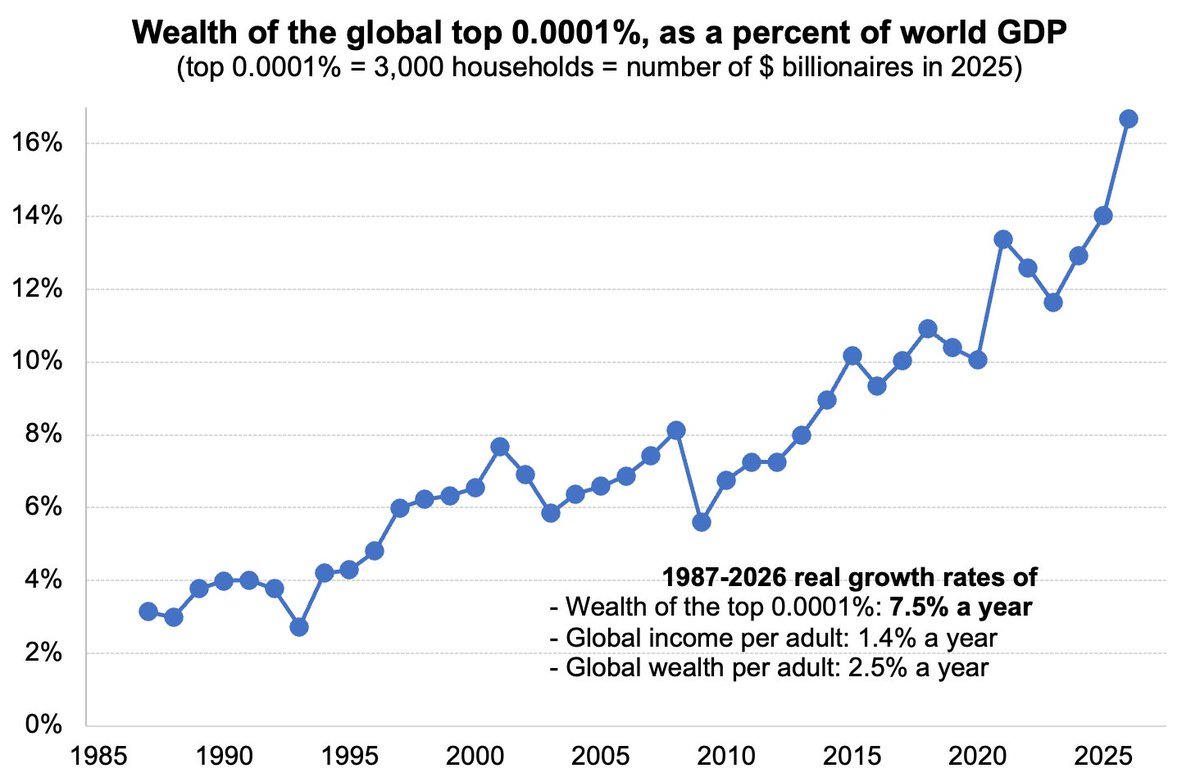
Forbes just released its latest annual ranking of global billionaires.
The pace at which extreme wealth is rising is simply staggering:
The wealth of global billionaires now reaches the equivalent of 17% of world GDP. 🧵
All my support to the Government of Spain in its condemnation of the US, Israel for violating International law, and for not authorizing the use of the joint Spanish-US military bases. It is an affirmation of the principles upon which the EU is built and of national sovereignty.
The world, Europe, and Spain have faced this critical moment before. In 2003, a few irresponsible leaders dragged us into an illegal war in the Middle East that brought nothing but insecurity and pain.
Our response then must be our response now:
NO to violations of international law.
NO to the illusion that we can solve the world’s problems with bombs.
NO to repeating the mistakes of the past.
NO TO WAR.
https://t.co/KpRjBfwY4B
Trots op Carlijn Kingma en op Sarah vd Giesen die de tentoonstelling ‘Fear of Falling’ bij Brutus heeft vormgegeven. Tof dat @NRC is gaan kijken en het ook heel mooi vond 🔴🔴🔴🔴🔴
https://t.co/Bg5FO44TyJ
De situatie in Iran is verschrikkelijk. De afgelopen dagen meerdere video’s via dit account gekeken van de slachtpartij. Het regime schiet met scherp op demonstranten. Duizenden doden.
Wat zo leuk is aan met veel mensen over hetzelfde onderwerp praten. Hun analyses lopen flink uiteen. Paul Tang geeft bijvoorbeeld stevige kritiek op Nout Wellink, mijn vorige gast. Vanuit verschillende invalshoeken krijg je uiteindelijk een beter beeld. https://t.co/nVhtSFoa9X
De wooncrisis in kaart gebracht. Interview met het ND, nu in het echt te zien in Brutus Rotterdam, en de animatie op Follow the Money komt eind februari.
https://t.co/27PrlxIp8o
🇨🇦 Canadian Prime Minister Mark Carney told the World Economic Forum at Davos that the U.S.-led “rules-based international order” is finished and “will not return.”
“For decades, countries like Canada benefited from what was called the rules-based international order,” Carney said. “We joined its institutions. We praised its principles. We benefited from its predictability.” But, he added, “we knew the story… was partially false.”
“The strongest would exempt themselves when convenient,” Carney said, arguing that “trade rules were enforced asymmetrically,” and “international law applied with varying rigor depending on the identity of the accused or its victim.”
“We participated in the rituals. And we largely avoided calling out the gaps between rhetoric and reality.”
That “pleasant fiction,” he states, no longer works. The new world is one where economic integration and financial infrastructure are openly used by hegemons—hinting at the United States—as “weapons” for “economic coercion.”
Carney rejected reliance on bilateral deals with dominant powers. “When we only negotiate bilaterally with a hegemon, we negotiate from weakness,” he said. “This is not sovereignty. It is the performance of sovereignty while accepting subordination.”
Instead, he called for “values-based realism,” urging middle powers to act together and build a third path that is not a “world of fortresses,” but partnerships with partners with shared standards.
If you are not at the table,” Carney said, “you are on the menu.” His remarks were met with a rare standing ovation in the room.
Full speech below.
🇨🇦 Canadian Prime Minister Mark Carney told the World Economic Forum at Davos that the U.S.-led “rules-based international order” is finished and “will not return.”
“For decades, countries like Canada benefited from what was called the rules-based international order,” Carney said. “We joined its institutions. We praised its principles. We benefited from its predictability.” But, he added, “we knew the story… was partially false.”
“The strongest would exempt themselves when convenient,” Carney said, arguing that “trade rules were enforced asymmetrically,” and “international law applied with varying rigor depending on the identity of the accused or its victim.”
“We participated in the rituals. And we largely avoided calling out the gaps between rhetoric and reality.”
That “pleasant fiction,” he states, no longer works. The new world is one where economic integration and financial infrastructure are openly used by hegemons—hinting at the United States—as “weapons” for “economic coercion.”
Carney rejected reliance on bilateral deals with dominant powers. “When we only negotiate bilaterally with a hegemon, we negotiate from weakness,” he said. “This is not sovereignty. It is the performance of sovereignty while accepting subordination.”
Instead, he called for “values-based realism,” urging middle powers to act together and build a third path that is not a “world of fortresses,” but partnerships with partners with shared standards.
If you are not at the table,” Carney said, “you are on the menu.” His remarks were met with a rare standing ovation in the room.
Full speech below.