We met @0xdrej years ago at ETH Denver and over the course of the meeting he covered why @grass would become a fundamental project in the AI stack. Soon after we made a sizable investment into solana:Grass7B4RdKfBCjTKgSqnXkqjwiGvQyFbuSCUJr3XXjs.
Fast forward to today and Grass has 8.5M contributors around the world. This is an insane number for a crypto project.
They have also graduated from token issuance for incentives to profitability (as of last year!) and are distributing earnings to those running nodes
I shared more on rewards here: https://t.co/Wscgzl0lnD
Grass is important because AI labs need historical and all go forward data and information created on the internet not only for training but for real time context and more
Check out my partner @YanLiberman’s full thesis below. It’s the best one shot read on getting completely up to speed on Grass
I think @grass and @0xdrej announcing they are paying out rewards in USDC is a positive for several reasons. Namely because it demonstrates that their business model (Millions of nodes harvesting historical and real time information for AI Labs) works and is profitable.
Grass has graduated from idea to a profitable business whereas most DEPIN projects are never able to cross this juncture. Using USDC for rewards means less GRASS sent to contributors and sold. Transcending to a revenue generating entity is really important and unique.
The world has also changed where projects can not use 100% of their income to buy/burn token supply. Grass has real fixed/variable costs to run its business (servers, GPUs, talent, etc). I want them to massively grow the business as I don't invest in founders for small wins
Eventually in my opinion (given no equity entity) grass will return value to token holders after it grows into an even larger and mature business. The math is simple startups use money for growth and once the return on an additional dollar is below the target rate it makes more sense to return that capital.
For those annoyed on lower payouts, I think the market needs to find an equilibrium on the number of nodes required and giving more rewards to more useful nodes in the network. There are nodes on the network which are getting much larger payouts since they are very useful for the business. I'd also note some annoyed folks are running out of date applications that are not routing traffic.
Disc. Delphi Ventures is an investor in $GRASS Tokens and we are excited for the July 7th investor call
so let me get this straight.
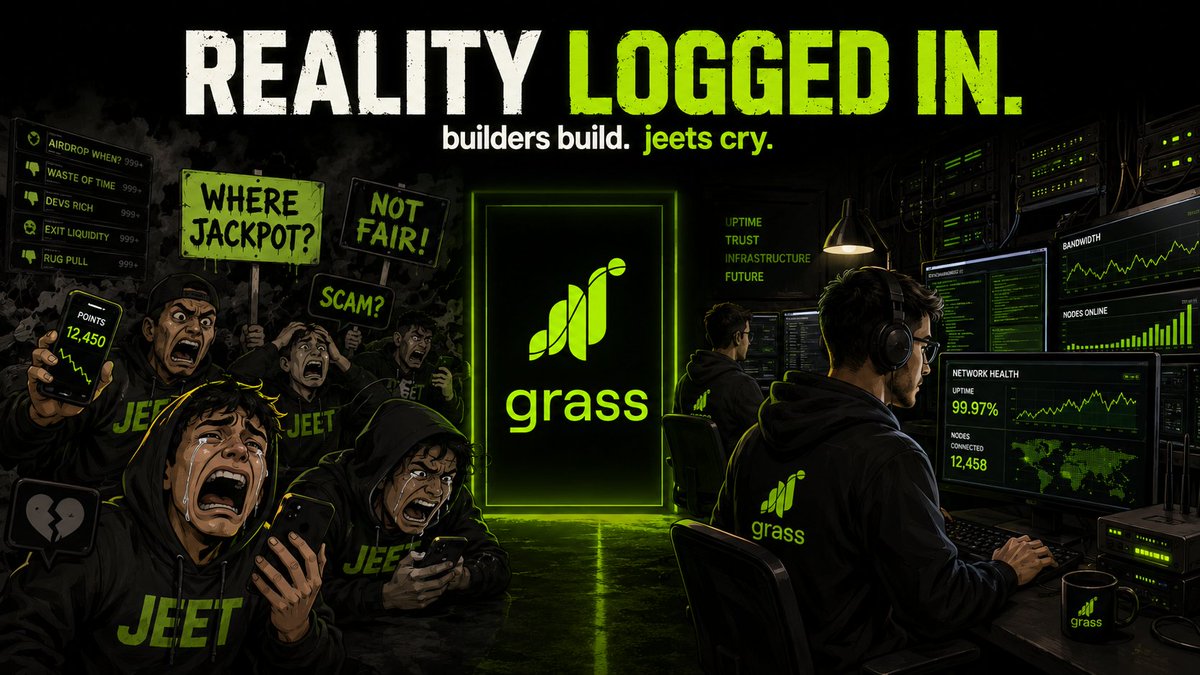
people ran a free node in the background, collected points, told themselves a fairy tale about life-changing money, ignored basic math, ignored real demand, ignored revenue, ignored the fact that millions of others did the exact same thing…
and now it’s a scam because reality finally logged in?
interesting.
yes, transparency matters.
yes, communication could be better.
yes, fair criticism is valid.
but calling yourself a “builder” because you farmed points and waited for free money is hilarious.
builders build.
jeets calculate imaginary airdrops, cry when the numbers don’t match, and then suddenly become experts in tokenomics, business strategy and community loyalty.
if you believed in $Grass, stay.
if you only believed in a jackpot, thanks for proving the tweet right.
@grass@grassfdn
Today @grass became the first (to my knowledge) DEPIN network to end native token payouts and start rewarding network participants in USDC
Really huge milestone in building sustainable onchain networks - so proud of this team
Today, Grass announced that it is rewarding network participants in USDC instead of its native token. Grass reached profitability near the end of last year, and is now in the unusual position of being able to compensate contributors directly from the revenue the network generates.
To me, this represents an important milestone. A network should eventually graduate from subsidized growth to a self-sustaining economy. Token incentives are a powerful tool for bootstrapping supply, but they should not become a permanent substitute for real demand.
The end state was never "pay people with tokens forever." The end state is a business with customers, cash flow, and a network whose participants are compensated because the underlying service creates real economic value.
We're still early in that journey, and there's an enormous amount of work ahead of us. But today feels like an important step, and it makes me incredibly excited for what's next.
We believe solana:Grass7B4RdKfBCjTKgSqnXkqjwiGvQyFbuSCUJr3XXjs is one the most exciting - and misunderstood - businesses in crypto
Read more about why we are so massively long solana:Grass7B4RdKfBCjTKgSqnXkqjwiGvQyFbuSCUJr3XXjs
My New Article on Nodes That Power Intelligence
Exploring decentralized networks behind the next generation of AI.
In Part 1, I explored the data layer of decentralized AI infrastructure, using @grass Network as a practical case study.
Nice Read.
Easiest 2x incoming with their revenue being published in less than 2 weeks
Probably the most profitable crypto x AI project on paper rn which will be revealed soon. Also strong PA considering how Bitcoin nuked.
1 dollar solana:Grass7B4RdKfBCjTKgSqnXkqjwiGvQyFbuSCUJr3XXjs
Avi Patel says AI labs are throwing billions at data companies.
“There’s almost no need for a business model with how much cash is being spent on data alone.”
“You quite literally have billions of dollars thrown at you if you’re a data company.”
“Labs come to you with specific data requests, usually like three times a week.”
“Once you build a long enough relationship, they give you a multi-year contract for a ton of money for a specific dataset.”
“Sometimes they buy non-exclusively, so you can sell that same dataset to another lab for the same price, if not higher.”
“Do it over and over again. Rinse and repeat.”