Cusp of Boomr/GenX, more GenX than Boomer, love technology, travel, reading, Golf, Hockey and Poker. Old Enough 2 have a story and young enough 2 have a Future!
Businesses that emerge from private equity funds have higher than average failure rates because they tend to be levered up.
As an alternative, we actually want to own the businesses we buy, keep their vibes intact, and back them up with a solid balance sheet.
People are astoundingly stupid. My comments about the departure tax is not that I should be treated differently from anyone else. I am making a point about the extent to which taxes are confiscatory. As I have previously explained, there was a time when ZERO cents of income tax were levied in Canada and the US. Then bit by bit, that "temporary" measure, to be applied to only a few, and at a very low percentage rate of your income, becomes a mammoth monster that takes more than 50% of your earnings. It can occur because there are no repercussions if governments do not balance their budgets (other than voting them out). Hence, what starts off as a small temporary tax on a few becomes an existential theft that is orders of magnitude larger than the so-called illegal extortion tax of the Mafia. It can exist only because the great majority of people BENEFIT from this form of parasitic taxation. But someone has to pay for everyone else, and when you are that someone, you are not necessarily pleased to be funding the ultimate Ponzi scheme. I'm making a moral, philosophical, and ethical argument. It's not just about me.
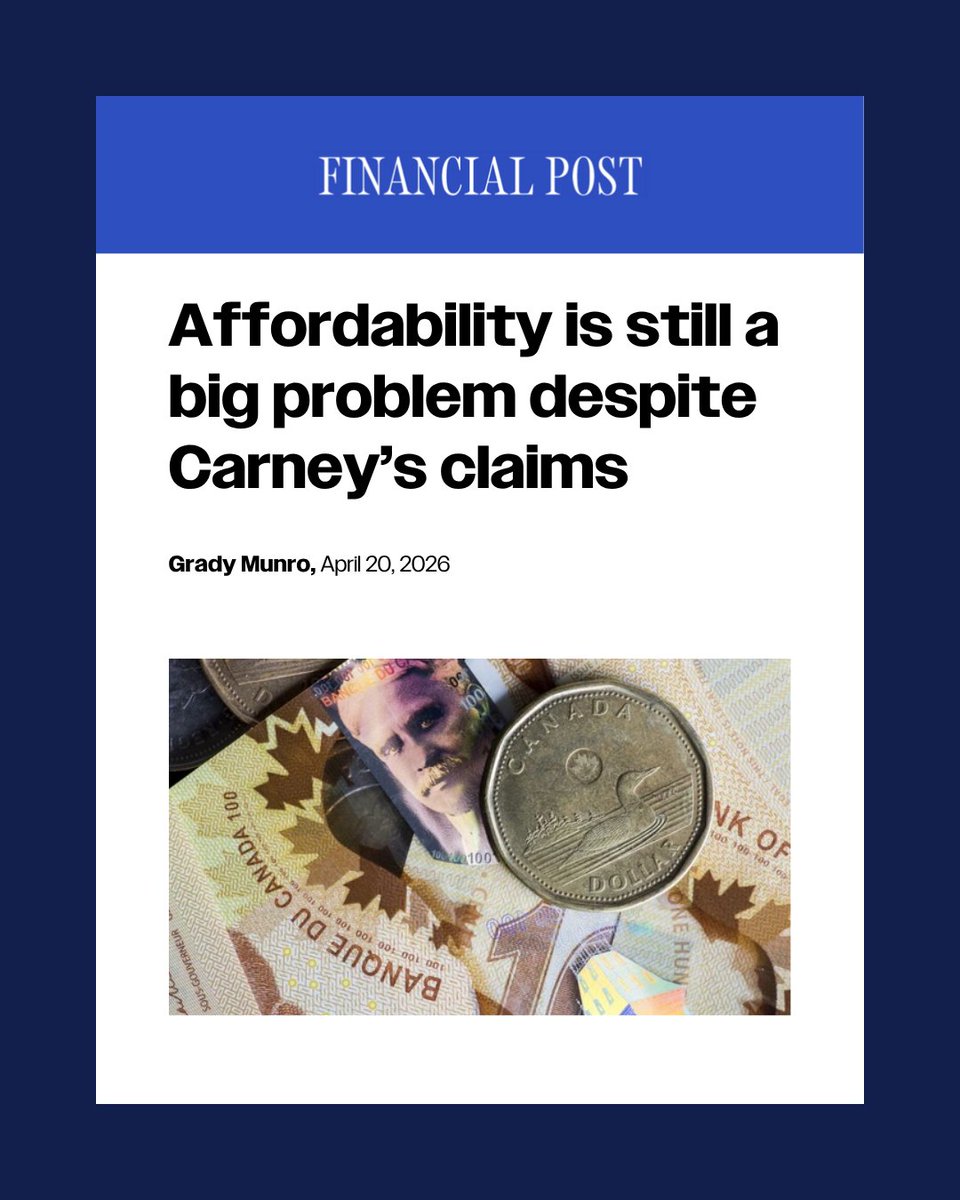
Liberal Mark Carney says "affordability's the best it's been in a over decade."
Among G7 countries Canada has:
❌The only declining economy
❌The most household debt
❌The highest food inflation
❌The highest housing costs
❌The second highest unemployment
All while more businesses are closing than opening, and $1 trillion of net investment has fled under a decade of Liberals.
Carney's illusions won't cut it. Canadians need real results.
Canadians carry more debt than what our entire country produces in a year.
Nearly half are $200 from insolvency.
Working people can't keep up with the cost of Carney's illusions.
We must build strength at home by lowering taxes, removing red tape, and green-lighting projects so our people can live affordable lives: https://t.co/vYfxX0NZEA
The Carney Liberals did not win a majority government through a general election or today's by-elections. Instead, it was won through backroom deals with politicians who betrayed the people who voted for them.
While the Prime Minister spent the year on this cynical power grab, he has doubled the deficit, and given Canada the worst grocery prices and housing costs in the G7.
Liberals expect Canadians to give up, get complacent and go away, so Carney can have total power without any accountability. That will not happen. Our country and its people are worth fighting for.
We will continue to fight for people to afford homes, food and fuel.
We will continue to fight for safety in our streets.
We will continue to fight for our resource workers and soldiers.
I will continue to lead that fight every day and in every way in Parliament, across the country and in the next election, when Canadians will reclaim the country we know and love.
I think there's a misconception amongst Canada's chattering classes that Mark Carney is an experienced and successful businessman and executive.
He wasn't. He wasn't CEO of Brookfield. He was its chairman, overseeing quarterly board meetings and spending the rest of his time flying around to different globalist conferences at the UN or WEF.
He was more of a mascot, a symbol, an ambassador of Brookfield. He didn't negotiate deals or turn around companies. He did photo-ops.
Before that, he worked at the Bank of England, and before that, the Bank of Canada.
No Googling: can you name a single actual duty of that job? Can you tell me what Carney actually achieved?
He wafted up from fake job to fake job -- like Justin Trudeau did, but instead of being a surf instructor and a substitute teacher, he had meaningless executive jobs.
And now when it's time to shine... he doesn't know what to do.
It's been a year, and he has no deal with Trump, despite saying that was his chief focus.
What exactly did he achieve in Beijing? The tariffs against Saskatchewan were lifted -- so that merely brings us back to the status quo ten months ago. Nothing else. No investments in Canada, which was the pretext of the trip. Just a capitulations, to allow the dumping of 49,000 Chinese EV cars, with their spyware and malware.
But he looks good in a suit and says ponderous words like "catalyze" and "transformative". And that's enough to impress the Parliamentary Press Gallery. Not that they needed much impressing -- they're all on his payroll already, through his massive journalism subsidies. They're too busy holding the opposition to account to take notice of this latest disaster.
But the regime media shouldn't feel too bad about being conned. Carney tricked Doug Ford pretty good, didn't he?
Dear Prime Minister @MarkJCarney,
Congratulations on your triumphant photo-op tour of Beijing. The handshakes were lovely. The smiles were radiant. The press releases were breathless. And the substance, as usual, was thinner than the paper your so-called deals were printed on.
You have just returned from China waving around a bundle of Memorandums of Understanding as if they were signed cheques. They are not. They are IOUs written in disappearing ink. They are polite promises, wrapped in diplomatic ribbon, that Beijing can ignore the moment it becomes inconvenient.
Canadians deserve to know the difference between a real agreement and a glossy brochure. You are hoping they won’t.
Let’s start with your favourite talking point: “China is Canada’s second-largest trading partner.” Technically true. Politically misleading. Morally dishonest.
You repeat that line as if China and the United States are sitting shoulder to shoulder in importance. They are not. We do roughly 77 percent of our trade with America and less than four percent with China. The United Kingdom is practically tied with China for Canadian exports. The European Union as a bloc surpasses China entirely.
But saying “China is our second-largest partner” sounds so much more dramatic at a podium, doesn’t it? It helps justify the narrative that you had no choice but to go cap in hand to Beijing.
The truth is far less flattering: you made a political pilgrimage to an authoritarian regime to trade away Canadian leverage for crumbs.
Let’s talk about those crumbs.
Your big “win” was agreeing to let up to 49,000 Chinese electric vehicles back into Canada at bargain-basement tariffs. This after Canada imposed a 100 percent tariff to protect our own auto sector from subsidized Chinese dumping.
You dressed it up as a clever compromise. You told Canadians this was only “three percent of the market.” You promised this would magically lead to Chinese investment and Canadian jobs.
That is not strategy. That is wishful thinking with a maple leaf sticker on it.
You opened the door first and hoped Beijing would be grateful enough to play nice later. That is not how China operates. It is, however, exactly how naïve Western politicians operate when they are more interested in press releases than long-term national interests.
And what did you get in exchange for weakening Canada’s industrial defenses?
A promise that China might, perhaps, consider lowering tariffs on canola and seafood. Eventually. Maybe by March. Unless they change their minds.
In other words, you traded hard Canadian policy for soft Chinese assurances.
You gave up something real for something hypothetical.
Then there are the parade of MOUs you proudly announced: cooperation on energy, culture, agriculture, “people-to-people ties.” All wonderfully vague. All deliciously unenforceable.
MOUs are not contracts. They are not treaties. They are not commitments. They are diplomatic participation trophies.
You went to Beijing, sat at the grown-ups table, and came home with a stack of autographed napkins.
Meanwhile, Canadians are supposed to forget something inconvenient.
Not long ago you yourself warned that China was our “greatest threat.” You spoke sternly about interference, coercion, and strategic risk. You nodded gravely while security officials raised alarms about espionage, intellectual property theft, and political meddling.
And now? Suddenly China is a “strategic partner.” Suddenly Beijing shares our “net-zero goals.” Suddenly we are to believe that the same regime running coal plants at record levels is Canada’s moral ally in saving the planet.
Your own Natural Resources Minister cheerfully declared that Canada and China share common ground on climate. The rest of the world laughed out loud.
Canadians should not.
There is a profound ethical and security debate here, and you tried to skip it. You treated national security concerns like an awkward guest at a dinner party: best not mentioned while the cameras are rolling.
You spoke of “predictability.” You spoke of “constructive engagement.” You spoke in the soothing language of Davos cocktail hours.
What you did not speak about were red lines.
You did not explain how inviting subsidized Chinese EVs into our market helps Canadian workers.
You did not explain how deeper economic ties with an authoritarian state reduce foreign interference.
You did not explain why Canadians should trust “agreements in principle” with a government that has a long record of tearing up agreements when it suits them.
And you certainly did not explain how any of this protects our most vital relationship: the United States.
At a time when our trade dependence on America is overwhelming, you chose to cozy up to Washington’s biggest strategic rival. Brilliant timing.
Canadians are being asked to take all of this on faith.
But faith is not a trade policy. Optimism is not a national security strategy. And personal ambition is not an economic plan.
The uncomfortable truth is that this mission exposed more than it achieved.
It exposed how easily you confuse press releases with progress.
It exposed how readily you trade long-term interests for short-term applause.
And it exposed a deep, persistent problem in this country: a complacent public that has been trained to accept soothing words instead of hard results.
Canadians are tired, distracted, and far too polite. They assume someone in Ottawa must know what they are doing.
Your China trip proves otherwise.
So here are the questions you owe Canadians clear answers to:
• Where are the legally binding agreements you promised?
• What hard commitments did China make on jobs, investment, and market access?
• What security safeguards were put in place before you opened the EV door?
• How do you justify weakening Canadian industry for “agreements in principle”?
• And most importantly: when did the “greatest threat” magically become a trusted partner?
You can pose for all the photos you like, Prime Minister. You can shake all the hands Beijing offers. You can wrap your decisions in lofty language about cooperation and climate.
But Canadians are not as gullible as you hope.
This was not a bold strategic breakthrough. It was a master demonstration in naïveté dressed up as statesmanship.
And the bill for that naïveté will not be paid by you.
It will be paid by the rest of us.
Sincerely,
A growing number of Canadians who are no longer buying the brochure.
👇🏻
https://t.co/wzbpBX5xUc
Or substack 👇🏻
https://t.co/sbX92JfKxv
#cdnpoli #Canada #China #MarkCarney #Trade
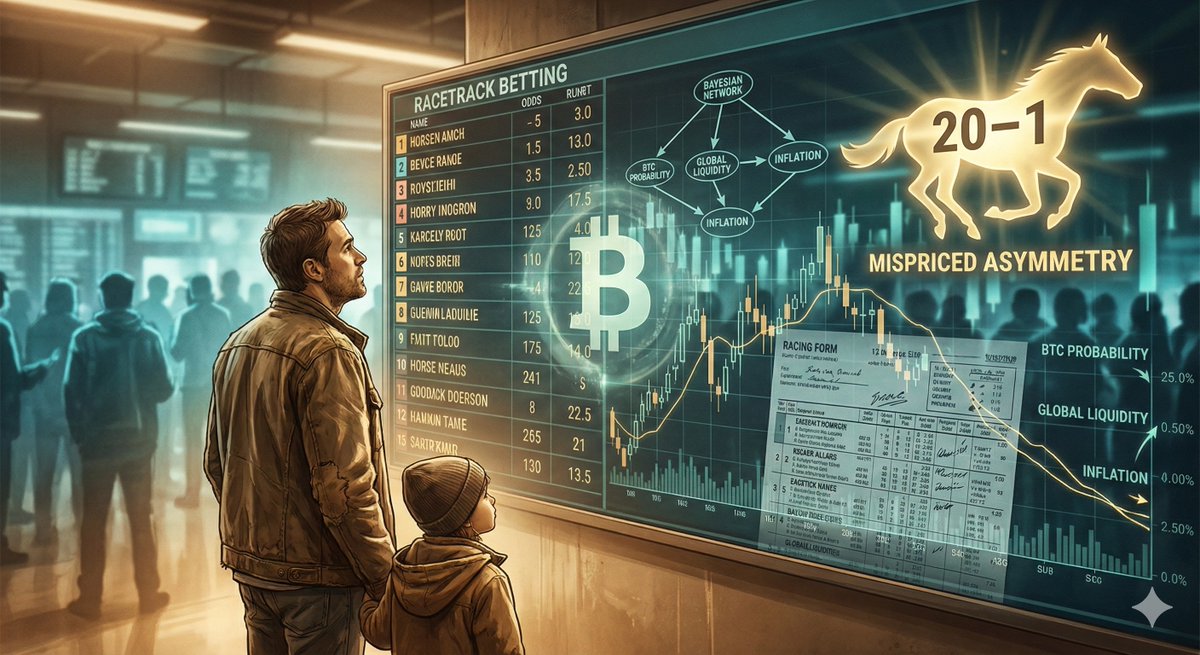
I’ve spent 30 years handicapping markets the way my father taught me to handicap horses.
Do the work. Ignore the crowd. Bet big only when the odds are mispriced.
After applying that same framework to Bitcoin, I’ve come to a simple conclusion:
This is the most asymmetric bet of my career.
Not because of hype, because of positioning.
The wealthiest allocators still treat it like a 100–1 longshot.
My paper explains why I think they’re wrong.
👇
https://t.co/dFtI6ISzhl
I’ve been thinking a lot about what the net benefit of the AI platform wave is. The real question is how to empower every company out there to get more out of this platform shift and build their own AI native capabilities and enterprise value (vs inadvertently just transfer their unique value to the tech sector!!).
Bill famously said a platform is when the economic value of everybody that uses it exceeds the value of the company that creates it. That’s the essence of the positive-sum future.
Even in our somewhat zero-sum mindset industry, we can create partnerships that create value for all parties involved. Our partnership with OpenAI is a great example. Our investment helped them scale; their research accelerated our own innovation. That’s what healthy platforms and partners do—they catalyze and compound progress.
There’s no better proof than what we announced just this week. The world’s first AI superfactory was co-designed with OpenAI and informed by three generations of AI supercomputers we built for frontier model training and inference. It was also a result of working closely with Nvidia and getting better at the full stack optimization from model architecture to micro-architecture of the chip and everything between three companies!
We also did the work to bring AMD into the fleet doing inference of GPT models, which enabled them to get up to speed on their own software stack for AI.
And now all this infrastructure will scale to support every startup to enterprise doing their own training to inference.
You can see the same dynamic in coding. Thanks to AI, the category itself has expanded and may ultimately become one of the largest software categories. I don’t ever recall any analyst ever asking me about how much revenue Visual Studio makes! But now everyone is excited about AI coding tools. This is another aspect of positive sum, when the category itself is redefined and the pie becomes 10x what it was! With GitHub Copilot we compete for our share and with GitHub and Agent HQ we also provide a platform for others.
Of course, the real test of this era won’t be when another tech company breaks a valuation record. It will be when the overall economy and society themselves reach new heights.
When a pharma company uses AI in silico to bring a new therapy to market in one year instead of twelve. When a manufacturer uses AI to redesign a supply chain overnight. When a teacher personalizes lessons for every student. When a farmer predicts and prevents crop failure. That’s when we’ll know the system is working.
Let us move beyond zero-sum thinking and the winner-take-all hype and focus instead on building broad capabilities that harness the power of this technology to achieve local success in each firm, which then leads to broad economic growth and societal benefits. And every firm needs to make sure they have control of their own destiny and sovereignty vs just a press release with a Tech/AI company or worse leak all their value through what may seem like a partnership, except it's extractive in terms of value exchange in the long run.
We know that the Internet wave had tremendous positive sum impact in the world, and yet we also had some sectors that got hollowed out like local media. This time around we have the opportunity to ensure broad diffusion of this tech with choice and control that is distributed to ensure positive sum outcomes across the board.
At the end of the day, this new technological wave gives us the opportunity to dream bigger and set higher ambitions for what we can collectively achieve. Each of us will need to play our part!
WSOP Main Event players:
Normalize calling the clock. It’s not personal, it is within your right as a player in the tourney.
I would suggest being quicker to call it on those that are excessively slow on every action pre/post flop and more lenient on players who act quickly but need some time on a big river decision.
And it’s ok to tell certain players who are habitually slow that they will get no more than 2 minutes on any decision before a clock will be called.
They have a right to play slowly, and it is within your right to call clock.
It’s not personal.
It’s just business.
We moved to Canada in 1975. Future historians will marvel at how quickly a country can be destroyed from within (because of the faulty parasitized minds of its politicians). The Canada of my youth is bafflingly different from the current Canada, and on nearly every possible metric, it is immeasurably worse. I only wish that Canadians would wake up and fight for their nearly fully lost society.
BREAKING: Mark Carney's platform was written by Justin Trudeau and his team weeks before Carney became Liberal leader.
The only “tweaks” Carney made were to increase inflationary spending even higher.
Canada can't afford a 4th Liberal term of the same Liberals pushing higher taxes, higher spending, and higher inflation.
So Chrystia Freeland QUIT out of protest because Justin Trudeau's budget was too costly
but then
They parachuted in a Central Banker from the UK who is her son's godfather
and suddenly she's okay with a budget that has DOUBLE the deficit?