System Design Series - Finale 🎉
First, a big thank you.
4 months ago, Started sharing
Tech content from my learning and work experience.
In mid March, I started this series with just over 1000 followers.
Today, as we close Week 10,
we’ve crossed 4,700+ followers 🚀
What started as a simple idea, sharing one
System Design topic every day turned into something much bigger.
10 weeks. 10 topics. 40+ posts.
One complete Backend System Design series Production Ready.
Here’s everything we covered the foundation every backend engineer needs:
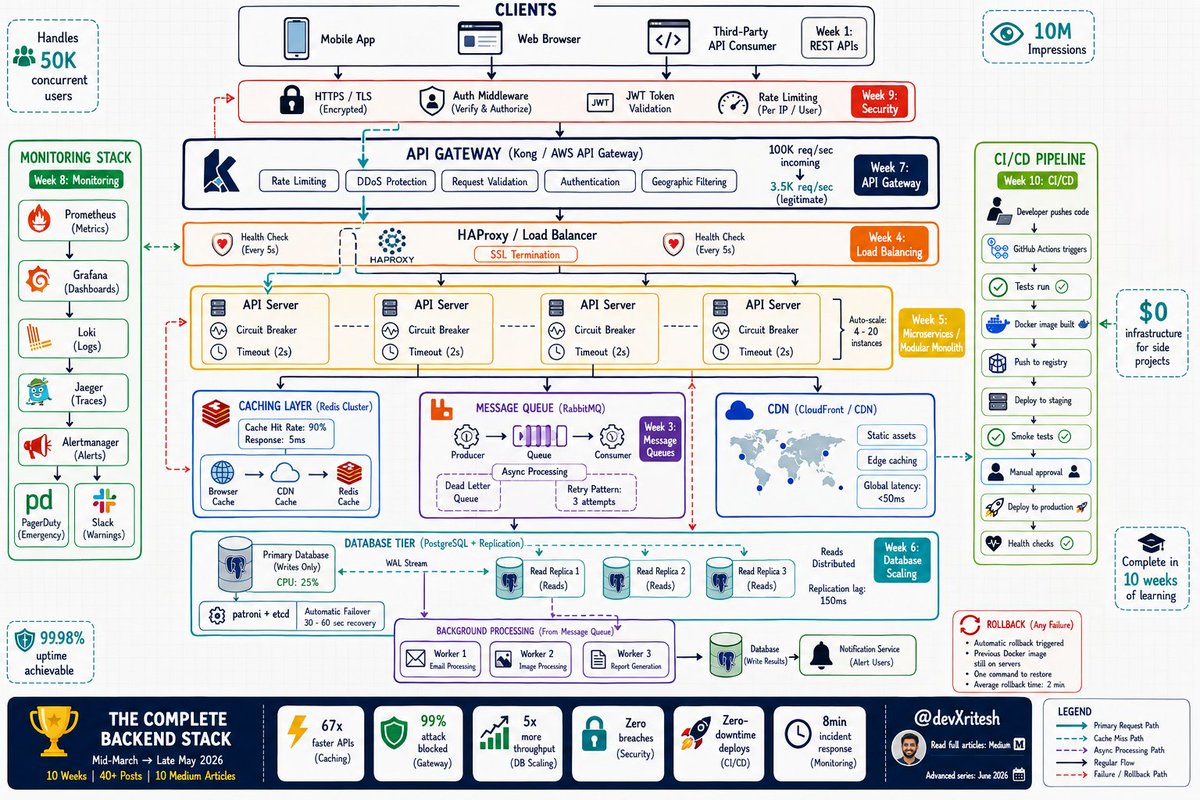
Week 1: APIs & Databases — REST, SQL vs NoSQL, indexes, pagination
Week 2: Caching — Redis, cache invalidation, CDN, multi-layer caching
Week 3: Message Queues — RabbitMQ, async processing, retry patterns
Week 4: Load Balancing — Algorithms, horizontal scaling, stateless design
Week 5: Microservices — Monolith vs microservices vs modular monolith
Week 6: Database Scaling — Read replicas, replication lag, failover with Patroni
Week 7: API Gateway & Rate Limiting — DDoS protection, circuit breakers, strategies
Week 8: Monitoring & Observability — Metrics, logs, traces, alerting
Week 9: Security — OWASP, authentication, encryption, common vulnerabilities
Week 10: CI/CD & Deployment — GitHub Actions, Docker, deployment strategies
Every topic has a full deep-dive article on Medium 📝
Check the Highlights section on my profile for all Post in one place and Bio Link for medium deep dive articles.
Thank you for every reply, bookmark, and follow.
10 weeks.
Completed.
#SystemDesign #Backend
Introducing Hallmark!
An open source design skill to make beautiful UIs and landing pages by default.
Works in Claude Code, Cursor, and Codex.
npx skills add nutlope/hallmark
Here are 10 GitHub repos that quietly print money while you sleep.
1. Cal. com
Open-source Calendly. Fork it, white-label it, sell to dentists and lawyers for $200/month. The founders hit $5M ARR in 3 years doing exactly this.
Repo → https://t.co/haz8ihRsHm
2. Plausible Analytics
Privacy-first Google Analytics. Self-host it, resell to agencies for $50/month per client. Two founders bootstrapped this to 7 figures.
Repo → https://t.co/RFrcpqTBQ7
3. Ghost
Open-source Substack with 100% margin. 1,000 readers at $5/month equals $60,000 a year. Forever.
Repo → https://t.co/Z1MdZ5Zapg
4. n8n
Open-source Zapier. Sell automation services for $500-$2,000 per setup. n8n raised $14M because the agency model behind it works.
Repo → https://t.co/hdycABGGc1
5. Supabase
Free Firebase replacement. Build a SaaS in a weekend, charge $29-$99/month. They raised $116M for a reason.
Repo → https://t.co/dFB2QvafA7
6. Medusa
Open-source Shopify. Take 5% on every sale forever. Zero rev share to Shopify.
Repo → https://t.co/uEuCK6zuZO
7. AppFlowy
Open-source Notion. Sell self-hosted to enterprises worried about data privacy. They raised $30M because this market is massive.
Repo → https://t.co/IDMykTCkMU
8. Coolify
Open-source Vercel and Heroku. Charge developers $20/month to manage their deployments. Replace their $200 Vercel bill.
Repo → https://t.co/N5Fk22qraT
9. Listmonk
Open-source Mailchimp. Send unlimited emails for the cost of an AWS bill. Resell to agencies at 10x markup.
Repo → https://t.co/NS6Uukcklw
10. Penpot
Open-source Figma. Sell self-hosted design tools to agencies who refuse to upload client files to the cloud.
Repo → https://t.co/Lx1CYUP4p4
The difference between developers who build features and developers who build businesses is one decision.
Pick one of these. Fork it this weekend. Ship it next week.
The founders behind these repos already proved the model.
Save this. Share it with the developer in your life who deserves to break free.
100% free. 100% open source.
Holy shit. An Indian solo dev built the one terminal tool every developer has been missing for 20 years.
It's called witr. It answers one question your OS refuses to answer:
Why is this running?
You see a weird process eating your RAM. You see a port that should not be open. You see a service you do not remember installing. Every tool tells you it exists. None of them tell you why it exists.
ps shows you the process. lsof shows you the port. systemctl shows you the service. But none of them show you the chain. The shell that spawned the supervisor that started the daemon that opened the socket.
witr does.
You type one command. It traces the whole causality. From kernel to PID to parent process to the launchd job or systemd unit that started it. From the open port back to the binary that bound it. From the service back to the user shell that triggered it.
The thing your OS hides, witr surfaces in plain English.
Here is what makes it different from every "process viewer" before this:
→ Traces full causality chains, not just PIDs and ports
→ Interactive TUI dashboard, not a wall of text
→ Single static Go binary, installs in 5 seconds
→ Works on Linux, macOS, Windows, and FreeBSD natively
→ Already packaged on brew, conda, AUR, winget, npm, scoop, chocolatey, FreeBSD ports, and 6 more
→ Detects supervisor chains, container parents, and systemd unit ancestry
→ Flags processes listening on public interfaces or running from suspicious working directories
→ Spots memory hogs and processes that have been running silently for months
Killed: every "what is this process" Stack Overflow rabbit hole, every Reddit thread asking "why is my Mac running this", and every PowerShell one-liner you copied from a 2014 forum post.
15,104 stars in 5 months. 401 forks. 34 contributors. 18 releases. Apache-2.0.
Pranshu Parmar shipped this from his laptop. No VC. No team. No accelerator.
Your OS finally tells you the truth.
(Link in the comments)
@AkitaOnRails Acho que isso vai é aumentar a mão de obra.
O tanto de empresa que pode decidir contratar alguém por conta e meter mão na massa. Ter controle sob o que constrói.
Talvez esteja errado
Brazilian scientist Tatiana Sampaio discovers a protein, Polylaminin, that can regenerate spinal cord.
This substance aims to create a supportive matrix that encourages damaged neurons to regenerate connections, potentially restoring motor function after severe injuries.
@acfilho_dev@brunomicrosaas Sim, verdade, está mais simples desenvolver software. Mas colocaram em cima de produtos, camadas e mais camadas de funções e necessidades que não são necessárias.
E o software não é esta camada. Temos inúmeras preocupações antes disso e já era isso antes da IA.
IA é uma fonte.