Kazakhstan is a country to watch:
Second largest uranium reserves.
New home to Balaji's Network School.
Telegram and Nvidia are building data centers there.
Above replacement TFR (one of the highest outside Africa).
To date, we've raised over $6.6M across 4 rounds.
Investors include: @KuCoinVentures, founder of @lisskins, @oddiyana_vc, founder of @tradyxyz, @venturevaultvc, as well as several angels.
Full list of investors and rounds will be disclosed 2 weeks prior to the TGE.
TGE is expected to commence in the fall of 2026.
More updates to follow in September.
Introducing Atom Finance.
Today, we’re announcing a new identity that better reflects the business we’re building.
Institutional-grade financial infrastructure connecting global capital with strategic commodity financing through blockchain technology.🧵👇
I’ll be in Bali during CoinFest Week, August 19-21 🇮🇩🌴
If you’re around, let’s meet and catch up.
This time, I’m especially looking to connect with HNWI, FOs, funds, founders and operators working around:
→ Tokenization & RWAs
→ Trade Finance
→ Capital Markets
→ On-chain financial infrastructure
I’d love to exchange ideas, explore potential opportunities, and see where there’s room to collaborate.
DM me if you’ll be around – let’s grab a coffee or a drink.
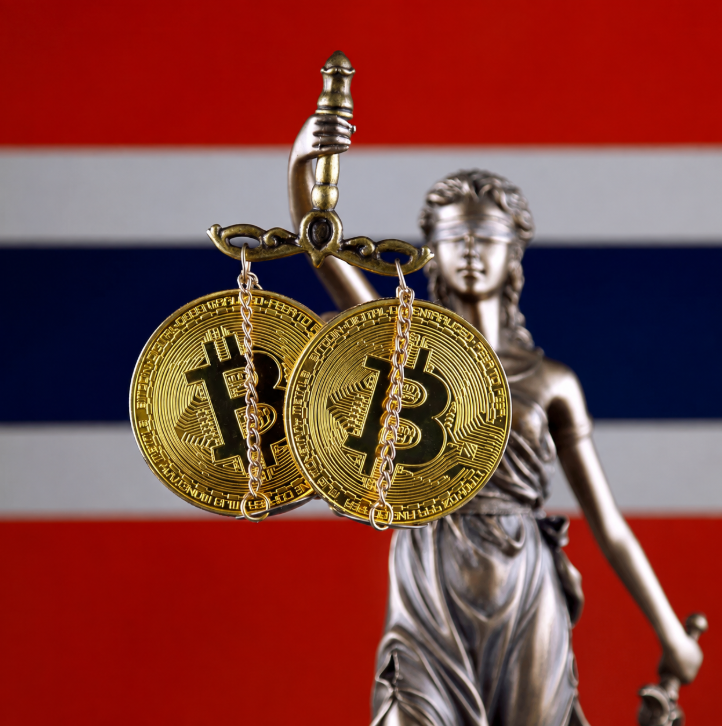
🚨HUGE: Thailand officially confirms 0% capital gains tax on Bitcoin and crypto for trades through licensed exchanges.
The Finance Ministry confirmed the exemption earlier this week.
CZ says it positions the country as a digital asset hub.
I am pleased to announce that a memorandum of understanding has been signed between the Republic of Kazakhstan and Network School.
Our new campus will become a haven for global techno-optimism, with expedited visas, streamlined redomiciliation, and active recruitment of talent.
DeFi promised financial freedom. In many ways, it delivered.
But when it comes to sustainable yield, the conversation is evolving fast.
Here’s the reality 👇
For the past few cycles, most DeFi yields have been driven by:
• Token emissions (inflation disguised as APY)
• Leverage loops (recursive risk)
• Market-dependent volatility
Let’s look at where we stand today:
🔹 Aave / Compound
Typical yields: ~2–6%
Risk: Low–moderate
Driver: Borrow demand
➡️ Stable, but limited upside
🔹 Curve / Convex
Typical yields: ~5–12%
Risk: Moderate
Driver: Incentives + liquidity wars
➡️ Attractive, but heavily dependent on tokenomics
🔹 Restaking (EigenLayer ecosystem)
Typical yields: ~8–20% (variable)
Risk: Smart contract + systemic risk
➡️ Promising, but still early and reflexive
🔹 DeFi structured products / leverage vaults
Typical yields: 15–40%+
Risk: High (liquidations, volatility)
➡️ Great in bull markets, brutal in downturns
Now compare this with RWA yield products:
🔹 Tokenized T-Bills / Credit / Private Debt
Typical yields: ~6–15%
Risk: Low–moderate
Driver: Real-world cash flows
➡️ Not dependent on token inflation or hype cycles
🔹 Commodity-backed strategies (e.g. minerals, energy, carbon)
Typical yields: ~10–25%
Risk: Moderate (execution + macro)
➡️ Backed by tangible assets with structural demand – this is where Atom Real Tokens comes into play!
💡 The key shift:
DeFi yields are market-driven.
RWA yields are cashflow-driven.
🧠 My verdict:
If your strategy is:
• Capital preservation + stable yield → RWA credit / T-Bills
• Balanced portfolio (risk + upside) → Blend of RWA + blue-chip DeFi
• High-risk, high-reward → Select DeFi (restaking / structured products)
Personally, I’m increasingly allocating toward RWA-backed yield as a core layer, and using DeFi as a satellite strategy for upside.
Because in the end, the most powerful yield isn’t the highest APY.
It’s the one that actually lasts.
Curious how others are allocating between DeFi and RWAs right now. Let me know in the comments.
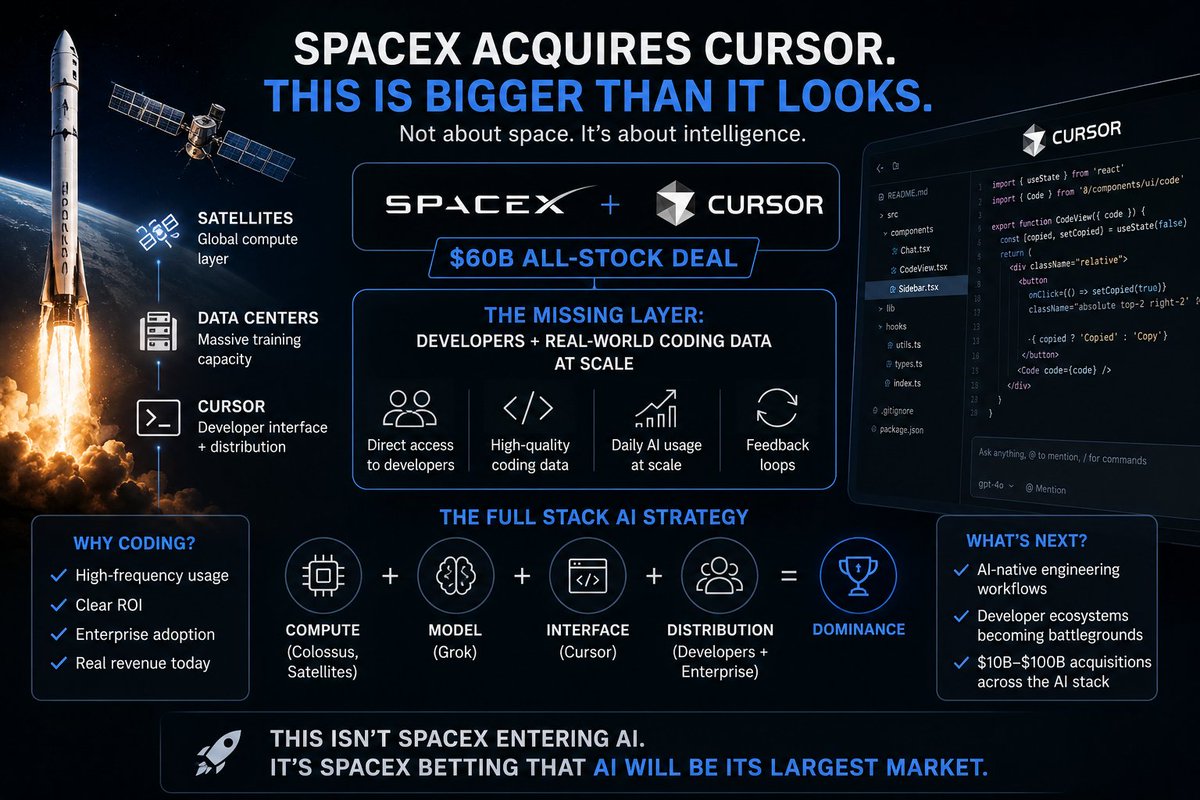
SpaceX acquiring Cursor is strategic.
A space company buying an AI coding startup signals one thing:
the real race is no longer space – it’s intelligence.
Cursor gives @SpaceX immediate access to:
> Developers
> High-quality coding data
> Daily AI usage at scale
This is the missing layer most infra players lack:
👉 distribution + feedback loops
Coding is the most valuable AI wedge today:
> Clear ROI
> Sticky usage
> Enterprise adoption
Meaning @cursor_ai isn’t just a tool, it’s a revenue engine + data moat.
For SpaceX, this solves multiple problems overnight:
Weak AI positioning → upgraded
No dev ecosystem → acquired
Limited product surface → expanded
This is vertical integration in action:
compute + models + interface + users
We’re seeing a clear pattern:
👉 Infrastructure giants are buying application-layer winners
Because in AI, owning the user > owning the model.
What’s next:
AI-native engineering workflows
Developer ecosystems are becoming battlegrounds
Consolidation across the AI stack ($10B–$100B deals)
Bottom line:
SpaceX isn’t entering AI.
It’s positioning to compete for the largest market of the next decade.
Just got back from Paris after attending @proofoftalk – and honestly, one of the highest-quality conferences I’ve been to in a while.
Huge respect to @XVentures_Fund for bringing together such a strong crowd. The level of conversations was genuinely top-tier, with a clear focus on where the space is heading: tokenization and institutional adoption.
Despite a delayed flight, I managed to pack Day 1 and Day 2 with back-to-back meetings and it was absolutely worth it.
Grateful for the opportunity to connect with such sharp builders, investors, and operators across the space. From top-tier VCs and asset managers to emerging RWA infrastructure players the signal was strong and very promising for @atomrealtokens.
Leaving Paris energized, with strong follow-ups in motion and a clear direction on what needs to be done next.
To everyone I met – great connecting. Let’s keep the conversations flowing 🤝
Can't wait to see what we can create together!
Excited to announce I'll be attending @proofoftalk 2026 at the Louvre Palace, Paris, on June 2 & 3 🇫🇷
As Chief Business Officer at Atom Real Tokens, I'm heading to Paris with a clear mission: connecting institutional capital with the critical minerals and rare earths powering AI, defense, and clean energy, through compliant, tokenized prepayment agreements.
If you're building or investing at the intersection of tokenization, RWAs, strategic commodities, and institutional capital markets, I'd love to connect in person.
Specifically looking to meet:
→ Institutional allocators exploring real-world assets
→ Sovereign and strategic capital deploying into critical minerals
→ Tokenization infrastructure teams
→ Suppliers and buyers of rare earth minerals
Drop me a message or connect here – let's find time on the sidelines.
See you at the Louvre. 🏛️
#ProofOfTalk #RWA #Tokenization #CriticalMinerals #DigitalSecurities #AtomRealTokens #Paris2026
2024: Sold out.
2025: Sold out.
2,500 leaders representing $18T in AUM don't gather by accident. They come because the room matters as much as the stage.
June 2 & 3, 2026. Louvre Palace, Paris.
Passes are now live. This is your window.
https://t.co/FKAaSC8obo
Applications for @EASYResidency Season 4 are now open.
🇧🇹 The first global incubator to bring a founder cohort inside @gmcbhutan, Bhutan's new sovereign tech city.
→ 5 weeks online · 5 weeks in person
→ Up to $500K funding + housing, meals, and workspace covered
→ For builders in Web3 (with a focus on global payments), AI, Biotech
Apply by June 21: https://t.co/fgSQr6QBWw
87% of critical materials are controlled by geopolitical adversaries.
This is the problem ART is solving: compliant on-chain infrastructure that connects institutional capital to the rare earths and critical minerals powering AI, defense, and energy.
https://t.co/RQxPd9g6xz
The NYSE is going on-chain.
A full-scale move toward tokenized equities with 24/7 trading and instant settlement.
This is a market structure shift and here is what’s actually happening:
• Stocks → becoming blockchain-native tokens
• Settlement → moving from T+1 to near-instant
• Markets → evolving from 9–5 to 24/7
• Funding → increasingly stablecoin-based
Why this matters (especially for VCs & RWAs):
1. Liquidity becomes global by default
Capital doesn’t sleep anymore. This unlocks a massive expansion of participation beyond US trading hours.
2. RWAs just got institutional validation
When the NYSE moves, it’s no longer “crypto narrative”, but core financial infrastructure.
3. Distribution flips
Tokenization = fractional ownership + programmability → entirely new investor bases.
But here’s the nuance:
Pros for retail:
+ Lower barriers to entry
+ Faster execution
+ Access to global markets
Cons (and risks):
- 24/7 markets = 24/7 volatility (retail gets exposed)
- Regulatory fragmentation is still unresolved
- “Tokenized ≠ truly decentralized” (Wall Street still controls rails)
My take:
Tokenization won’t replace traditional markets overnight.
But it will rebuild the plumbing underneath them.
And whoever owns that new infrastructure layer owns the next decade of capital markets.
We’re watching RWAs go from narrative to inevitability.