For the past 6 months, I’ve been using my free time to build Yellowcake Analytics, a free resource about the uranium industry. Everyday it ingests new filings and announcements from dozens of miners.
If you’re getting up to speed on the uranium trade, it’s a great place to start
A) The caricature understanding of a bear market is that prices go down while earnings stay relatively flat because the market becomes depressed and stops wanting to pay up.
B) The reality is that earnings vanish during bear markets. Trailing P/E was 140x at the absolute lows of the Great Depression as the reflexive cycle of depressed valuations, depressed economic activity, and constant losses obliterated the entire market.
Of course, ( A ) does happen to some extent as investors pay much lower midcycle multiples during bear markets, and we are seeing this in tokens where P/S multiples have gone from 980x to 10x.
but ( B ) is really driving the despair in crypto and token markets. The last five years of negative industry P&L have led to financial and human capital flight to the point where there are only a handful of small funds and <1,000 serious people left in the industry. People aren't coming into the industry to build new businesses and existing businesses aren't making a lot of cash flow because economic activity is depressed.
When the situation is reversed, and Internet Finance is going through the S-Curve of secular adoption as all assets come onchain (core assumption for you to believe this is Internet / Semis and not 3D Printing), then we will live through the opposite reflexive loop.
The original defi high flyers from 2020 may never come back (and we both know most of those companies will never recover) but some companies that exist today will generate much, much more cash flow and new breakout companies like Hyperliquid will be created. We typically look at these things through market-cap-weighted indices so failures are removed and new breakout companies get added.
I know you are asking for specifics. I'll lay them out below but these examples won't sound credible outside of the context of a bull market. Imagine for the sake of this response that we are going through a positive reflexive loop as more assets come onchain every month, there are fresh faces coming in from careers in banking / private equity and big tech, aggregate fund performance is good and new capital is flooding in, and public companies are excited to do deals in the space because management believes the world is going onchain.
The claim here is that many companies are cheap if you assume a secular adoption cycle (which is the analogous claim to saying that companies in 1932 were cheap if you assumed the economy recovered). I'll take cash flow > market cap as the metric since companies usually trade at 5 - 30x cash flow.
Illustrative examples of companies that can cash flow > market cap:
- Kamino trades at $200M after earning $50M of run-rate revenue at peak. This was in a world where <20bps of global assets were onchain. Kamino could earn $250M with $25B of AUM (=15bps on global assets).
- Turtle Club is an onchain investment bank that signed a single $30M revenue deal in 2024 when they had 1/10th their current capabilities. The business trades at a $30M valuation today and could easily do twenty of these deals in a year if the economic activity were there.
- Maple trades at $80M and is on track to earn $20M of revenue this year. It's really not so hard to imagine a specialty lender with onchain capabilities scaling from $20M to $80M in the environment described above.
- MetaDAO trades at $60M and could earn cash flow > market cap on cumulative fundraising of $1.2B (versus $25B of historical crypto ICOs with a broken market structure).
- There are a few companies in the market like Collector Crypt literally trading at 2x gross profit.
- BitGo (to bring in a crypto stock) trades at <$250M enterprise value and earned $110M of EBITDA in 2024. A 3-5x increase in Assets on Platform would lead the company to produce more EBITDA than market cap.
- CoinShares (another crypto stock) trades at <$150M enterprise value and earned $115M of net income in 2024. I add these two crypto equities to make the point that you don't even need to imagine a secular adoption cycle for many of these assets to cash flow > market cap, and that we are discussing a widespread crypto issue not limited to tokens.
- Metaplex, to give a token example, trades at a market cap below its 2025 revenue.
- There is a whole world of microcap tokens like Pact, Solomon, P2P, Umbra, Omnipair, Rip Cars (market caps $10M, $5M, $4.5M, $3.5M, $1.6M, $4.8M) that will cash flow > market cap if they see any form of success. Now you may respond "well, of course you can say anything with a small market cap will be cheap in hindsight" and yes that's exactly the point. Success is extremely rare in bear markets but prevalent in bull markets when economic activity is on the up.
I do understand and sympathize with your point. You can make compelling bear cases for all of these assets - that's why they trade where they do, and I don't own all of these. There are few things that seem like good deals if you assume a continuation of the last five years - basically nothing is a bargain if the industry fails. That's why I laid out the bottom six graphs on bear markets that never recovered.
There are, however, many assets that will look extremely cheap in hindsight if we enter any type of positive reflexive loop and our industry fulfills its promise of bringing global assets onchain.
2 out of 4 crypto liquidity measures I track show money exiting the industry over the last 30 days.
A combined $20B have left Stablecoins and ETFs, while RWA and DAT inflows have ground to a halt.
You seriously underestimate how much you can do with time. 1 year is a fucking lifetime. 6 months is enough to go from 0 to 100. Even 1 week of full commitment 14 hours a day is enough to push the needle so far forward you won't even recognize yourself. Just do more. Just do what your heart desires. Just be better.
Earth has already gone through a gray goo event.
For billions of years, the planet was full of anaerobic life. Then cyanobacteria evolved photosynthesis and filled the atmosphere with toxic gas (oxygen).
The market is ugly so I'm using the time to build other things.
You know I love what @DefiLlama does: DeFi data, well digested.
Then I saw @patfscott doing the same for nuclear and uranium with Yellowcake Analytics. A sector I'm bullish on. But I also agree with @0xBobdbldr: the next bull run will be space.
Bull runs feel like they're stacking up. AI, robotics, and under all of it, energy. And once we reach the Moon, a whole new economy starts there, independent from ours.
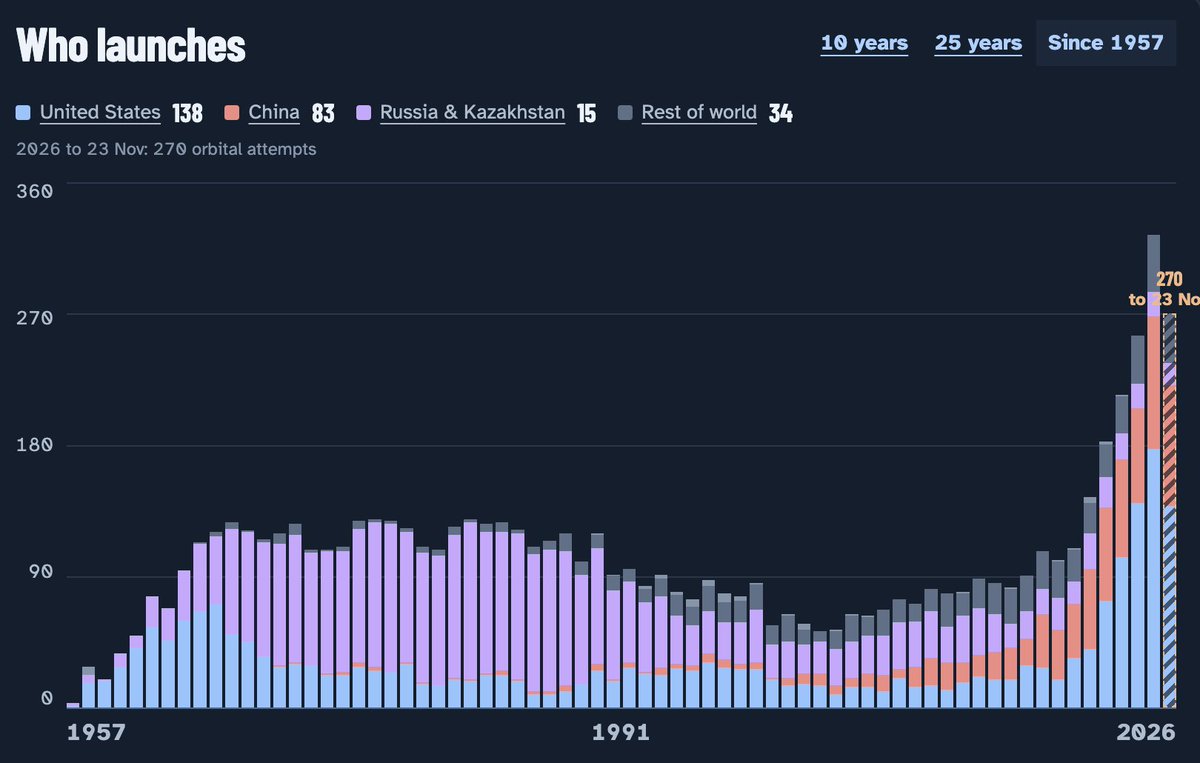
Chart below on how launches are growing. I'm building a page with a lot more data. If you're into space and the space race, drop a comment.
Philly needed to go all in on biotech 15 years ago.
Even today, we have the density of med schools, health networks, pharma and labs to live up to the name “Cellicon Valley” with the right leadership.
Basically, ambitious people from other cities look at Philly and figure that other than in meds & eds, Philly's opportunity ceiling is low. Tiny Austin TX looks more appealing from this point view.
When I was dating in PHL during 2017-19, I was struck by the fact that ambitious women in their late 20s / early 30s were all planning to leave (and as far as I know, all did leave). At this age bracket, even if they were in eds/meds, they werent yet tenured or done with residency, and clearly werent thinking of PHL as their ultimate destination.
Of course the lifestyle in central Philly and a few other neighborhoods is very appealing (food, historical charm, walkability), but "do I want to work for Comcast for the rest of my life to have access to that lifestyle?"
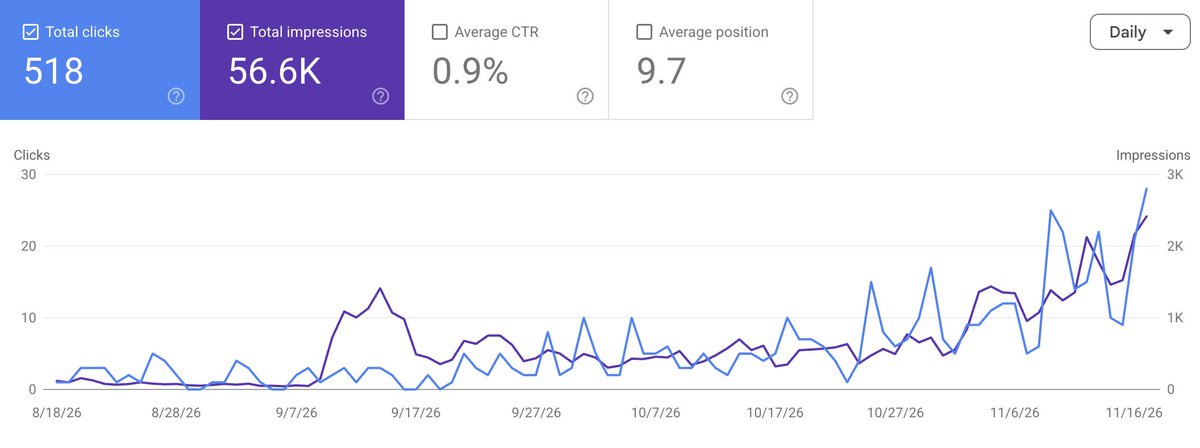
Four weeks ago, I set up a team of Grokbots to monitor and improve SEO for my site, Yellowcake Analytics.
An SEO bot that has access to Google Search Console and DataforSEO to track my site's rankings and generate recommendations.
A copywriting bot that's trained on my style of writing and has guidelines to avoid slop.
A developer bot that writes PRs.
The SEO bot finds keyword gaps, pages that are ranking with low CTR, internal backlink opportunities, and other ways to improve. It then uses the copywriting bot to draft any new copy and passes the copy + recommendations onto the developer bot.
Barely requires any work now that I've set it up and I'm already starting to see results.
if you wanted you stop grey goo, you might create nanomachines with no independent replication but that would hijack runaway replicators to spread before destroying their host. in other words, you’d create viruses
Had a really cool new @DefiLlama product my team's been grinding on that we were going to open a waitlist for today.
Pushing back to next week, because no good to get signups on a day like today. That's life.