Building an AI Agent in 2026 is no longer just about picking an LLM.
The real magic happens in the system around the model. 🤖
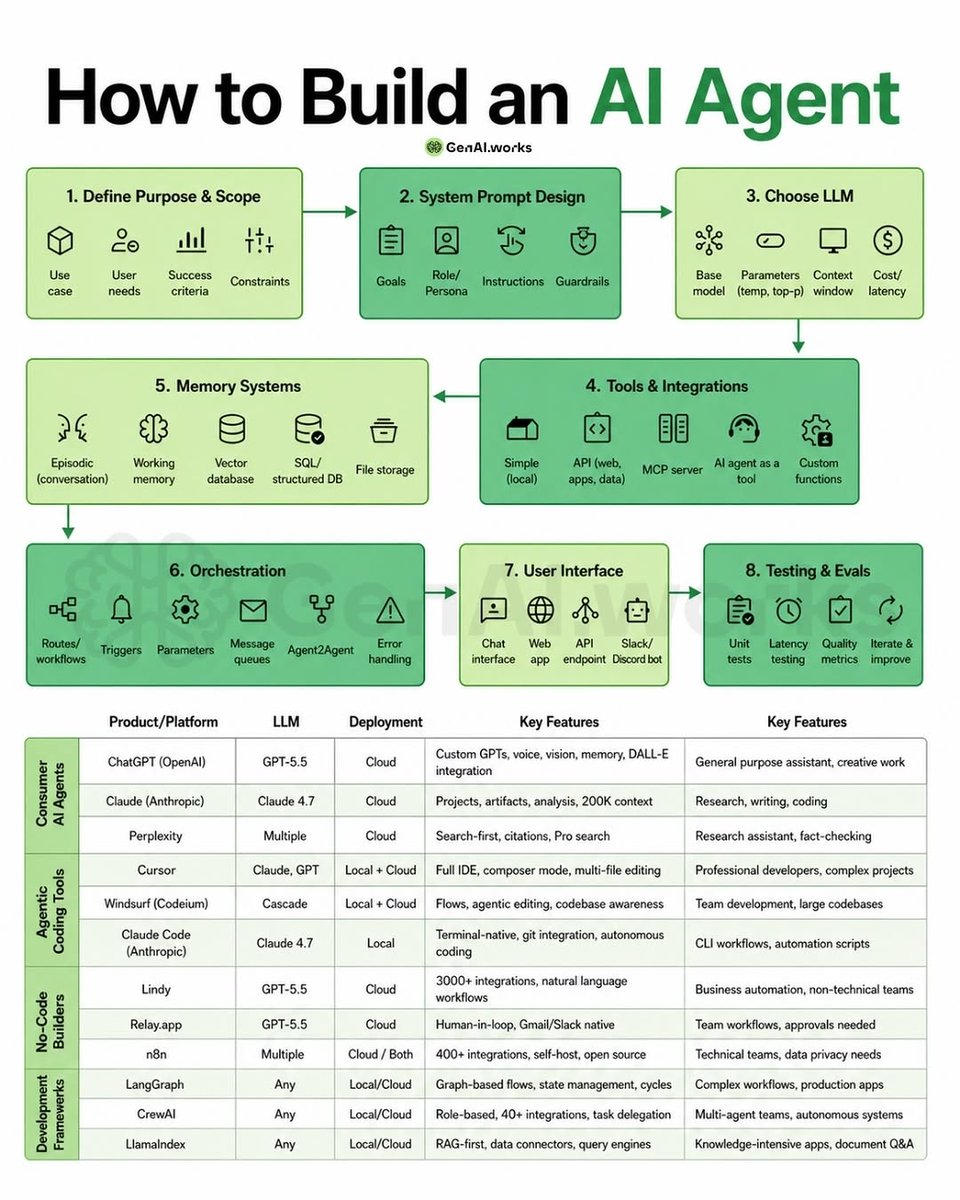
This roadmap perfectly breaks down how modern AI agents are actually built from scratch. 👇
A production-ready AI agent needs 8 core layers:
1️⃣ Define the Purpose
Before writing prompts, define:
• use case
• user needs
• constraints
• success metrics
Most AI projects fail because this step is skipped.
2️⃣ System Prompt Design
Prompts are becoming operating systems for agents.
A strong system prompt defines:
• role/persona
• goals
• instructions
• safety guardrails
3️⃣ Choose the Right LLM
Different models = different strengths.
• GPT-5.5 → versatility & tool usage
• Claude → reasoning & long context
• Perplexity → research & citations
There’s no “best model.”
Only the best model for the task.
4️⃣ Tools & Integrations
This is where AI becomes actionable.
Agents connected to:
• APIs
• MCP servers
• databases
• custom tools
• external apps
Can actually execute workflows instead of just generating text.
5️⃣ Memory Systems
Memory is the difference between:
“a chatbot”
and
“an intelligent assistant.”
Modern agents use:
• working memory
• vector databases
• structured storage
• episodic memory
6️⃣ Orchestration
This is the hidden layer most people ignore.
Workflows, triggers, queues, retries, routing, multi-agent coordination…
This is what turns prompts into systems.
7️⃣ User Interface
The best AI products win on UX, not just intelligence.
Chat apps, APIs, Slack bots, dashboards - interface matters.
8️⃣ Testing & Evaluations
If you don’t measure quality, latency, reliability & hallucinations…
your AI product will eventually break at scale.
The biggest takeaway?
AI Engineering is rapidly becoming a combination of:
Software Engineering + Prompting + Systems Design + Automation.
The engineers who understand orchestration, memory, tools & workflows will dominate the next decade of AI products.
Save this roadmap.
This is basically the blueprint for building AI agents in 2026. 🚀
Follow @elora_khatun for more AI engineering breakdowns, prompts, workflows & agent architectures.
BREAKING: Claude can now build your entire startup from idea to launch like a seasoned entrepreneur — without spending a single dollar.
Here are 7 Claude prompts to validate your idea, build your business, and start making money faster than 99% of beginners:
🚨 𝗕����𝗘𝗔𝗞𝗜𝗡𝗚: Claude can now build your entire mobile app from a screenshot like a $350K senior developer at Apple. (for free)
Here are 8 insane Claude prompts replacing your entire mobile development team before they finish estimating the project cost:👇
(Save this 🔖 thread before it blows up.)
MY FRIEND APPLIED TO 87 REMOTE JOBS ON LINKEDIN. ZERO RESPONSES. ZERO INTERVIEWS.
Then I gave his CV to Claude and he got 7 interview invitations in 11 days.
Here are the 7 prompts and the exact filters we used:
BREAKING: GOODBYE POWERPOINT. 🚨
Claude can now create a full presentation in just 120 seconds.
No slides. No stress.
Use these prompts and watch the magic happen. ❤️🔥
BREAKING: AI can now build you a complete website in 2 hours (for free).
Here are 9 insane Claude Opus 4.6 + Figma Make prompts that create $5,000 websites in 2 hours:
(Save this before your competitors do)
🚨BREAKING: Claude can now build you a full AI YouTube channel like a $10,000/month creator agency.
For free.
Here are 7 prompts to go from 0 → monetized AI channel in 90 days:
Save this before it disappears.
🚨 𝗕𝗥𝗘𝗔𝗞𝗜���𝗚: Claude can now build your entire mobile app from a screenshot like a $350K senior developer at Apple. (for free)
Here are 8 insane Claude prompts replacing your entire mobile development team before they finish estimating the project cost:👇
(Save this 🔖 thread before it blows up.)
🚨 BREAKING: Passive studying is dead!
Claude can train your brain harder than most professors ever will.
Here are 10 Claude prompts to learn anything 10× faster
BREAKING: AI can now analyze any stock like a Wall Street analyst (for free).
Here are 10 insane Claude prompts that replace $2,000/month Bloomberg terminals:(Save for later)
Ever feel like you just *get* someone? Here's the science of what's going on.
When you vibe effortlessly in conversation, it’s not just shared interests—your brains might be in sync. Neuroscientist Ben Rein notes that close friends often share similar brain structures in social regions, a concept called homophily, where neurologically similar people bond easily. This similarity makes conversations flow smoothly, as your brains operate on the same wavelength.
Beyond this structural overlap, there’s something even more sci-fi: interbrain synchrony.
This occurs when two people interacting—especially during teamwork or storytelling—exhibit nearly identical patterns of brain activity in certain regions. It’s not magic or telepathy, just the brain’s natural ability to mirror and connect. So if you’ve ever walked away from a great conversation feeling unusually understood, there’s a good chance your brain was quite literally in sync with theirs.
[Thomson, J. (2024). The sci-fi hypothesis that explains why you click with certain people. Big Think]
College students—want to spend this summer working at NASA?
Now’s your chance to gain out-of-this-world work experience alongside agency professionals as a NASA intern! Applications for the 2026 summer session close on Feb. 27. Explore our opportunities: https://t.co/xmq93hoBql
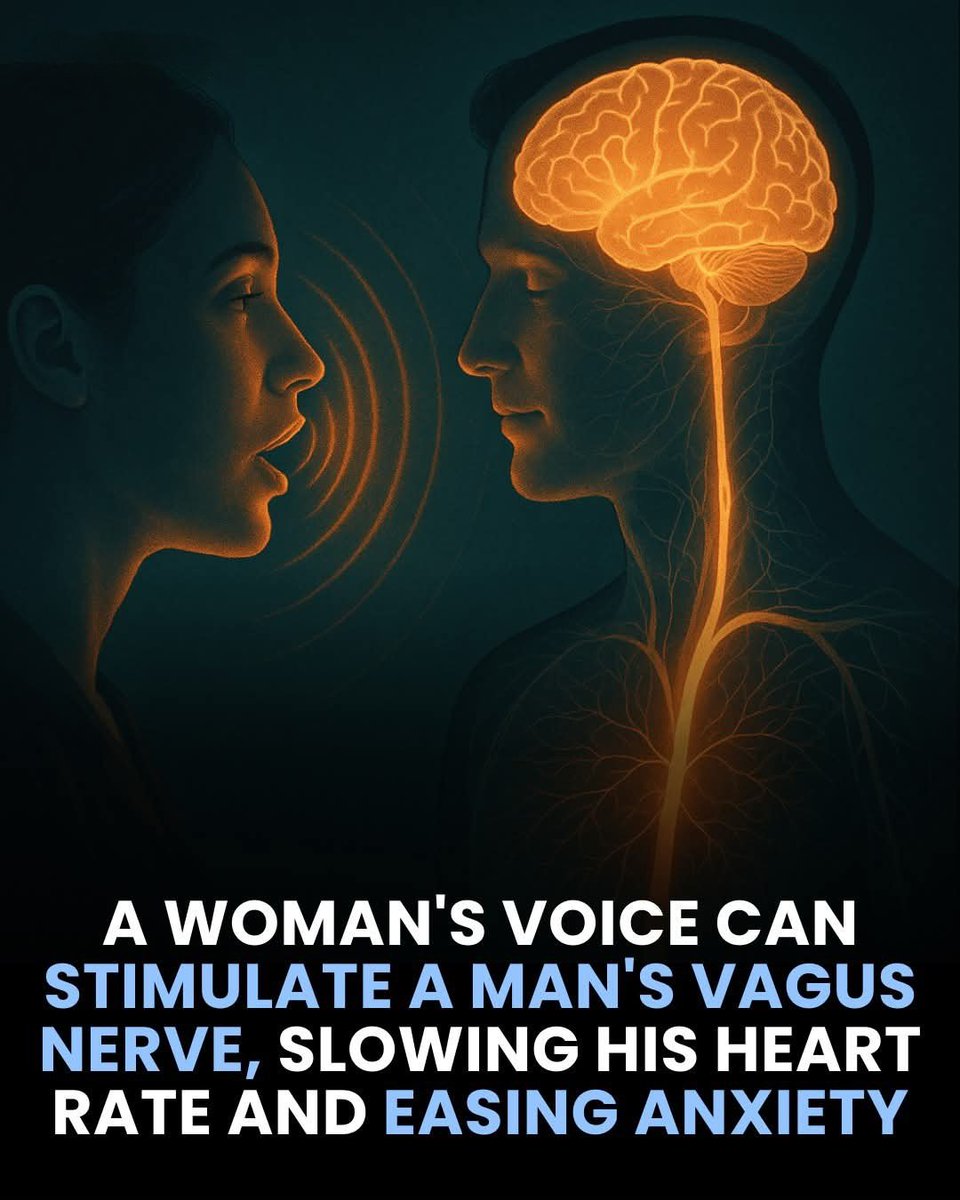
A woman’s voice can have a profound effect on a man’s physiological response, especially when it comes to easing anxiety and calming the nervous system. Studies show that the sound of a woman’s voice can stimulate a man’s vagus nerve, the nerve responsible for regulating heart rate and the body’s stress response. This unique connection between the voice and the body highlights the powerful role that human interaction and communication play in regulating our emotions and physical states.
This phenomenon is a reminder of the profound impact our voices have on one another. In moments of stress or anxiety, the calming influence of a kind, soothing voice can create a sense of safety and comfort. The vagus nerve, which is involved in calming the body’s fight-or-flight response, is activated through this auditory connection, helping to slow a racing heart and calm an anxious mind.
The effect of a woman’s voice on a man’s heart rate also speaks to the deeper connection between humans. It reflects how we, as social beings, are wired to respond to the presence and words of others—how we are shaped by our interactions and relationships. The tone, pitch, and cadence of a voice can convey more than just words; they can carry a sense of reassurance, care, and support.
This study also invites us to reflect on the ways in which we communicate with one another, not only in moments of stress but in everyday life. How can we use our voices to offer comfort and understanding to those around us? How can we be more mindful of the ways our words and tones affect the people in our lives?
As we consider the power of the human voice, we are reminded that we are not solitary creatures but deeply interconnected through our words and presence. Our voices hold the power to heal, to comfort, and to strengthen the bonds we share with others.
What impact does the sound of a voice have on you? How do you use your voice to support those around you? Let’s reflect on the power of communication and its role in shaping our emotional experiences.
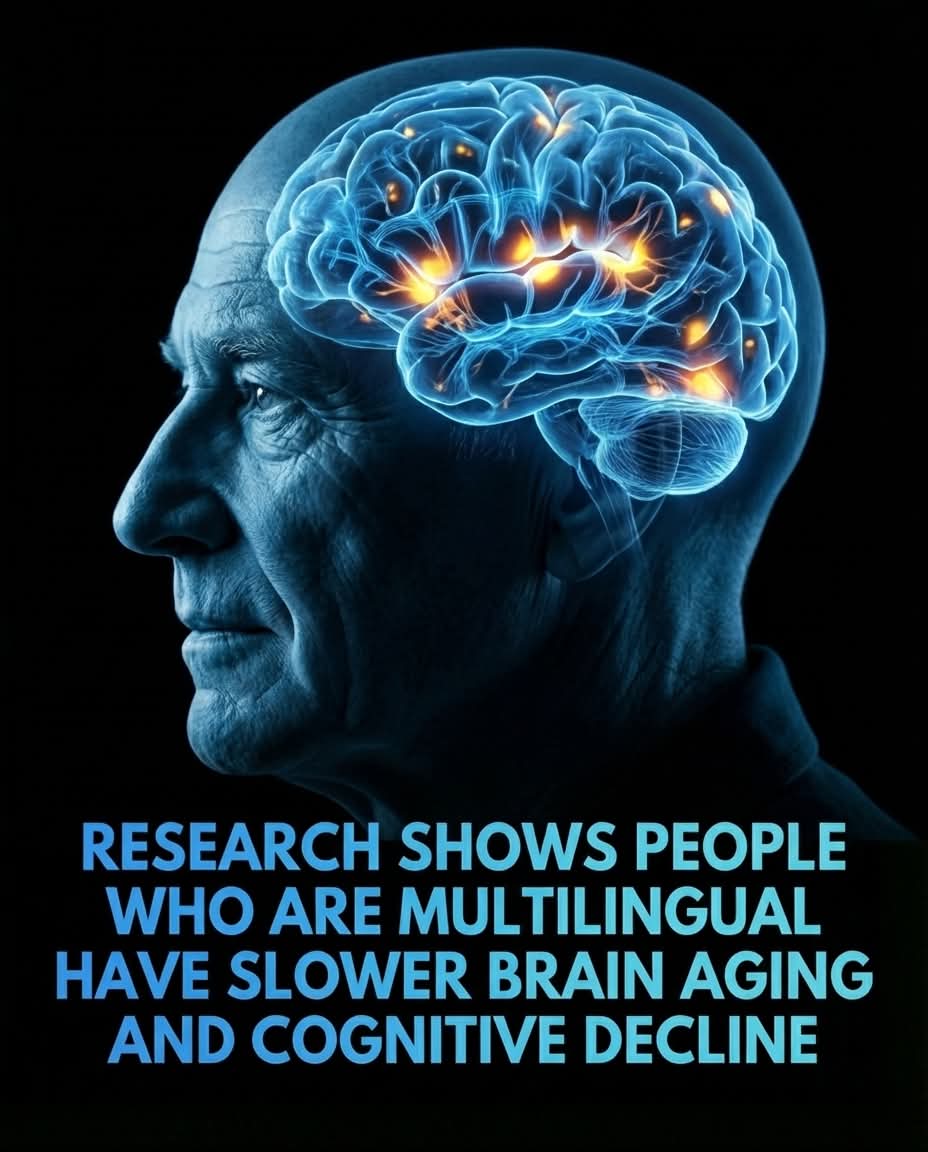
🧠 Speaking more than one language slows cognitive decline.
Children (and adults) who speak and use multiple languages throughout life may give their brains a powerful form of mental exercise — potentially slowing brain aging and reducing risk of cognitive decline.
A major recent study of over 86,000 older adults across 27 European countries found that multilingual individuals were significantly less likely to show signs of accelerated “biobehavioral aging” compared to monolingual peers.
The researchers propose that the constant mental juggling required by switching between languages — selecting one language, suppressing interference from others, and managing shifting vocabularies — strengthens neural networks involved in memory, attention, and executive control.
Over time, these reinforced pathways may build what scientists call “cognitive reserve,” helping the brain remain resilient in the face of age-related change.
Source: Amoruso, L. et al. (2025). “Multilingualism protects against accelerated aging in cross‑sectional and longitudinal analyses of 27 European countries.” Nature Aging.


![powerbeastt's tweet photo. How to Be Consistent
[ 7 Rules That Never Fail ] https://t.co/I77in2hSOX](https://pbs.twimg.com/media/HAd3BsraEAADkvR.jpg)









![Rainmaker1973's tweet photo. Ever feel like you just *get* someone? Here's the science of what's going on.
When you vibe effortlessly in conversation, it’s not just shared interests—your brains might be in sync. Neuroscientist Ben Rein notes that close friends often share similar brain structures in social regions, a concept called homophily, where neurologically similar people bond easily. This similarity makes conversations flow smoothly, as your brains operate on the same wavelength.
Beyond this structural overlap, there’s something even more sci-fi: interbrain synchrony.
This occurs when two people interacting—especially during teamwork or storytelling—exhibit nearly identical patterns of brain activity in certain regions. It’s not magic or telepathy, just the brain’s natural ability to mirror and connect. So if you’ve ever walked away from a great conversation feeling unusually understood, there’s a good chance your brain was quite literally in sync with theirs.
[Thomson, J. (2024). The sci-fi hypothesis that explains why you click with certain people. Big Think]](https://pbs.twimg.com/media/HAzCYS_WkAAFPKR.png)