Hi, i just built "filtre" a productivity tool that crushes distractions using custom focus profiles. Created the whole thing with antigravity in ~1.5 hours ✨
You can install it via HomeBrew:
` brew install --cask filtre `
7000+ mikroservis, 14 bölge, 200+ ekip, 2000+ mühendis…
Trendyol’daki developer deneyimini kolaylaştırmak için yola çıktık, ortaya TBP çıktı.
PlatformCon 2025'te Eren ve Mustafa TBP deneyimlerini anlattı:
🔍Bilişsel yükü nasıl azalttık
🔍Kullandığımız araçlar ve mimari
🔍Öğrendiğimiz dersler
📹İzlemek için: https://t.co/p3ljPihvBQ
BREAKING: MIT just completed the first brain scan study of ChatGPT users & the results are terrifying.
Turns out, AI isn't making us more productive. It's making us cognitively bankrupt.
Here's what 4 months of data revealed:
(hint: we've been measuring productivity all wrong)
We're trying to push Kubernetes clusters beyond 5,000 nodes for the first time in our bare metal setup. While nothing in Kubernetes has a hardcoded limit of 5000, turns out Flanneld actually does. Things you live to learn the hard way.🫠 https://t.co/NI1sB1rAVa
𝗪𝗵𝘆 𝗱𝗼𝗲𝘀 𝗚𝗼𝗼𝗴𝗹𝗲 𝗿𝗲𝗰𝗼𝗺𝗺𝗲𝗻𝗱 𝗠𝗼𝗱𝘂𝗹𝗮𝗿 𝗠𝗼𝗻𝗼𝗹𝗶𝘁𝗵𝘀 𝗶𝗻𝘀𝘁𝗲𝗮𝗱 𝗼𝗳 𝗠𝗶𝗰𝗿𝗼𝘀𝗲𝗿𝘃𝗶𝗰𝗲𝘀?
Over the last decade, we have witnessed a significant trend of utilizing microservices across various industries. We were building systems for a few hundred or thousand users and wanted to know how to make a system for millions of users. This was over-engineering and needed to be corrected.
Why was it wrong? Because the development lasted a long time, we created incredibly complex systems, which are hard to maintain. This is especially true for startups that must go fast and stay simple.
A recent paper by authors from Google found that most of their developers split binaries for one of the following reasons: to improve performance, enhance fault tolerance, and establish abstraction boundaries, allowing for flexible rollouts.
Yet, splitting applications into microservices has its challenges:
🔹 𝗜𝘁 𝗵𝘂𝗿𝘁𝘀 𝗽𝗲𝗿𝗳𝗼𝗿𝗺𝗮𝗻𝗰𝗲. The overhead of serializing data and sending it across the network is becoming an increasingly significant bottleneck.
🔹 𝗜𝘁 𝗵𝘂𝗿𝘁𝘀 𝗰𝗼𝗿𝗿𝗲𝗰𝘁𝗻𝗲𝘀𝘀. It is incredibly challenging to reason about the interactions between every deployed version of every microservice.
🔹 𝗜𝘁 𝘁𝗮𝗸𝗲𝘀 𝘄𝗼𝗿𝗸 𝘁𝗼 𝗺𝗮𝗻𝗮𝗴𝗲. Rather than having a single binary to build, test, and deploy, developers must manage n different binaries, each on its release schedule.
🔹 𝗜𝘁 𝗳𝗿𝗲𝗲𝘇𝗲𝘀 𝗔𝗣𝗜𝘀. Once a microservice establishes an API, it becomes easier to change by breaking the other services that consume the API.
So, they proposed the following approach:
𝟭. 𝗪𝗿𝗶𝘁𝗲 𝗺𝗼𝗻𝗼𝗹𝗶𝘁𝗵𝗶𝗰 𝗮𝗽𝗽𝗹𝗶𝗰𝗮𝘁𝗶𝗼𝗻𝘀 that are modularized into logically distinct components. A component is a long-lived agent, similar to an actor.
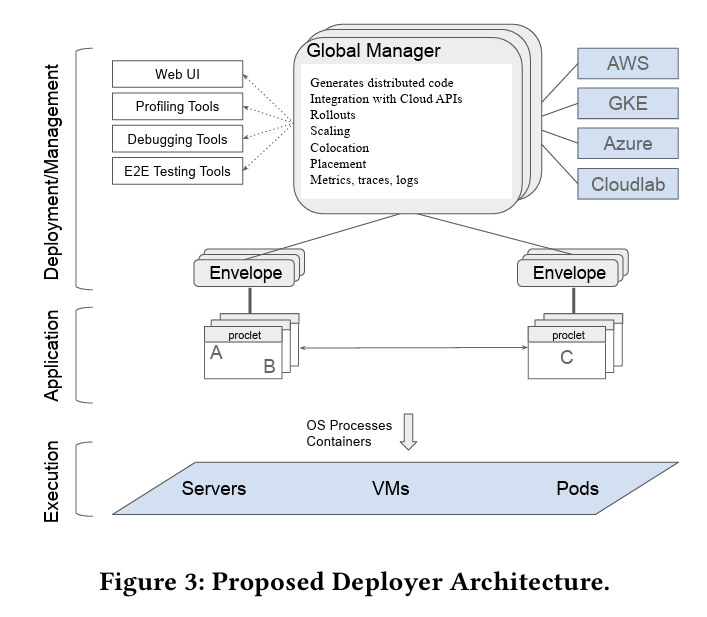
𝟮. 𝗟𝗲𝘃𝗲𝗿𝗮𝗴𝗲 𝗮 𝗿𝘂𝗻𝘁𝗶𝗺𝗲 𝘁𝗼 𝗱𝘆𝗻𝗮𝗺𝗶𝗰𝗮𝗹𝗹𝘆 and automatically assign logistical components to physical processes based on execution characteristics. Therefore, if both components are in the same OS process, they are referred to as regular method calls. However, if they are co-located, calls are executed as remote procedure calls (RPCs) over the network. Runtime decides whether these modules should be collocated or moved to different machines (and scaled, etc.).
𝟯. 𝗗𝗲𝗽𝗹𝗼𝘆 𝗮𝗽𝗽𝗹𝗶𝗰𝗮𝘁𝗶𝗼𝗻𝘀 𝗮𝘁𝗼𝗺𝗶𝗰𝗮𝗹𝗹𝘆, preventing different versions of an application from interacting.
This approach consists of two main parts: a programming model with abstraction that allows developers to write modularized applications and a runtime for building, deploying, and optimizing these applications. They claim that it reduces application latency by up to 15 times and costs by up to 9 times by simplifying application management and deployment.
If you want to check the framework that implements the approach from the paper, please visit https:// serviceweaver. dev/.
What do you think about this approach? Does it look like EJBs or CORBA?
Hello, I wrote an article on @trendyoltech about the JSON library migration that our team uses in our Go services. Enjoy reading, you can reach me for your questions 👋
https://t.co/82r3pUvEv5
This paper shows the same effect as other studies of "cheating" with AI - if you use AI to do the work (as opposed to using it as a tutor), you don't learn as much.
But note: the results are specific to the essay task - not a generalized statement about LLMs making people dumb.