Imagine registering ownership of a property today.
Would you expect that record to remain trustworthy 20 or 30 years from now?
That's the kind of long term question @dac_chain recently raised.
Real-world asset tokenisation isn't just about moving ownership records onto a blockchain. It also requires thinking about the durability, integrity and security of the infrastructure protecting those records.
If blockchain technology is going to support assets with long lifecycles, its security assumptions must be considered with the same long term perspective.
Digital ownership needs infrastructure built to last.
That's an important part of the DAC vision.
A NEW PARTNER CRATE LANDED IN INTERSTELLAR.
The @trybacked Crate is open, with $500,000 in Backed prop firm evaluation accounts up for grabs.
Open it → https://t.co/zuuezllHGW
Quantum security is no longer just a distant theoretical discussion.
Recently, @dac_chain highlighted how major industry players are beginning to take the subject seriously, from Coinbase's discussion of long term quantum risks to post quantum signature research and hardware security developments.
The important point is that blockchain networks cannot simply migrate overnight.
Wallets, cryptographic systems and infrastructure need preparation long before quantum computers become a practical threat.
That's why dac's focus on quantum resistant infrastructure deserves attention.
The smartest time to prepare for a security challenge is before it becomes an emergency.
Looking at @dac_chain's recent updates, I see three connected themes.
First, Interstellar is creating a community platform with Launch Codes, Quantum Crates, badges and Chip Entropico.
Second, the project is introducing people to quantum entropy through interactive experiences and verifiable outcomes.
Third, its participation in discussions around digital sovereignty and cryptographic resilience connects those experiences to a broader infrastructure challenge.
These elements serve different purposes, but together they provide a clearer picture of DAC's ambitions.
The real test is whether the platform can translate community engagement into deeper understanding, useful applications and lasting adoption.
Launch Codes, Quantum Crates, badges and games give @dac_chain's Interstellar platform several ways to bring people into its ecosystem.
That's useful for discovery and community participation.
But I think the bigger question is what happens after someone finishes the tasks and explores the features.
Do they understand the technology better? Do developers find useful tools? Do applications create reasons to return? Does the network deliver reliable performance?
These are the questions that separate temporary campaign activity from long term ecosystem growth.
Interstellar has created a community-facing layer around DAC's broader quantum security thesis.
Now the opportunity is to connect that engagement with lasting utility.
Attention opens the door. Real value gives people a reason to stay.
The quantum security conversation shouldn't begin only when quantum computers become powerful enough to threaten today's cryptography.
Cryptographic systems take time to assess, replace and migrate. Blockchain ecosystems also have to coordinate developers, applications and users.
That's why @dac_chain's focus on cryptographic resilience deserves attention beyond the usual quantum headlines.
The important distinction is between preparing for a potential future threat and claiming that the threat is already happening.
Responsible engineering requires understanding the risks, testing proposed solutions and communicating limitations clearly.
Digital sovereignty is becoming an increasingly important conversation in a world that depends on digital infrastructure.
On October 23, @dac_chain shared its participation in Lugano's Plan ₿ Forum, where discussions included cryptographic resilience, digital sovereignty and real-world adoption.
These topics connect directly with the broader question DAC is trying to address: how can decentralised infrastructure remain reliable as technology and security requirements evolve?
Quantum readiness is one part of that discussion, but implementation, interoperability and adoption matter too.
The most valuable conversations happen when technical ambitions meet the practical needs of builders, institutions and users.
A blockchain community can attract plenty of attention on launch day. Keeping people engaged afterward is much harder.
@dac_chain's Interstellar platform introduces daily check-ins and weekly badges to encourage consistent participation.
According to its documentation, seven consecutive days unlock a weekly badge and a Quantum Energy bonus, with multiple weekly badges available to collect.
One of the more unusual parts of @dac_chain's Interstellar ecosystem is Chip Entropico.
It's a strategy game built around a chip on a motherboard, where players spend Quantum Energy, compete for control and progress through different milestones.
But there's a technical idea behind the gameplay: the experience introduces why predictable randomness can create problems and why quantum entropy matters.
That's an interesting approach to education.
Instead of expecting everyone to understand cryptographic concepts immediately, a game can give people an intuitive starting point and encourage them to explore further.
The real value will depend on how effectively that learning translates beyond the game.
Still, making complex technology approachable is a worthwhile challenge for any blockchain ecosystem.
Randomness matters more in blockchain than many people realise.
It can influence selections, game outcomes, allocations and other processes where predictability could create an unfair advantage.
@dac_chain's Interstellar documentation describes premium Quantum Crate draws that use a committed seed, allowing users to re check an outcome in their browser.
That's an important design principle: users should have a way to examine how an outcome was produced instead of relying entirely on a platform's word.
The broader conversation around quantum entropy is especially interesting when paired with verifiability.
Of course, each implementation still needs to be evaluated on its actual security properties.
But the direction is worth exploring: randomness becomes more useful when its integrity can be checked.
Quantum entropy can sound like an abstract technical concept until people get a chance to interact with it.
That's what caught my attention about @dac_chain's Interstellar platform.
Its Quantum Crates introduce quantum entropy into a community experience, with certain prizes involving Source Fragments described as bytes of quantum entropy accompanied by proof of origin.
This creates a more tangible way to introduce a difficult subject: users can explore an experience while learning about the underlying technology.
The next important question is how these capabilities can support broader applications beyond community engagement.
Education can be a useful first step, but practical utility is what will make the technology matter in the long run.
Make the technology understandable, then make it useful.
Can quantum hardware contribute useful work to real optimisation problems?
@quipnetwork previously published results from 1,930 portfolio optimisation comparisons between a D Wave quantum annealer and a classical solver.
Its new QVM announcement points back to those experiments, reporting that the quantum solver matched or beat the classical solver across all 1,930 races.
The key is to read the result carefully: a specific benchmark is not proof that quantum computers outperform classical systems in every task.
But it demonstrates why real workloads and transparent comparisons matter.
The industry needs more experiments with defined methods, measurable outcomes and honest limitations.
Quantum progress should be evaluated through evidence, not assumptions.
We’re in the final stretch to mainnet 🦋
Accounts, swaps, points, compute subnets, and QVM are live on testnet, and coming together in one app.
One step left: an external chain audit.
Thanks to everyone who’s been a part of this.
Full update ↓
https://t.co/rpwOItM0ws
Not every blockchain onboarding experience needs to begin with a technical document.
@dac_chain is using Launch Codes to let admitted users invite others into Interstellar.
It's a straightforward concept, but it creates a community-driven path into the ecosystem: existing participants can introduce new users rather than leaving everyone to discover the platform independently.
The important thing is what happens after someone joins.
A good onboarding experience should help people understand the network, explore its features and learn why the technology matters.
Launch Codes provide the entry point. The quality of the experience inside Interstellar will determine whether newcomers have a reason to stay.
Web3 needs more than sign-ups. It needs meaningful participation.
The Bus Guardian is standing on your board.
Take it on. A loss costs nothing. Beat it and you unlock the Starter Die and a shot at DAC's Firewall.
https://t.co/jMHQhh8Gxu
The transition from Inception to Interstellar is an important moment for @dac_chain.
What makes Interstellar interesting is that it gives the community a place to engage with the ecosystem beyond simply watching announcements.
Daily check-ins, weekly badges, Quantum Crates and community activities create different ways to explore the platform and follow its development.
But the most interesting part is the technology behind the experience: DAC is using these interactions to introduce people to quantum entropy and its potential role in blockchain applications.
A mainnet launch is a milestone. Making the technology understandable and useful to the community is another challenge entirely.
Interstellar is where that next chapter unfolds.
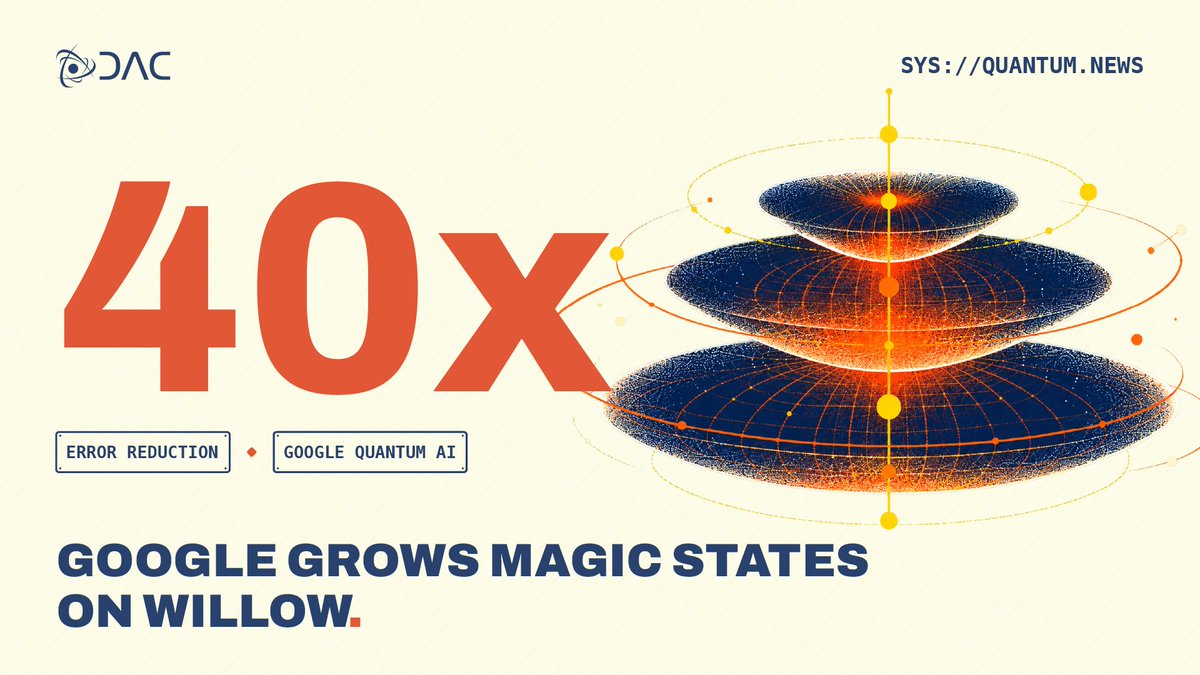
Magic states have long been a bottleneck for useful quantum computers.
Google just showed a way to grow them on Willow with far fewer errors.
The runway keeps getting shorter.
Quantum computing has another challenge beyond the hardware itself: connecting the people who need computation with the providers who can supply it.
@quipnetwork is building towards a decentralised marketplace where users submit workloads and quantum or classical operators provide computing resources.
QVM adds a programming layer on top of that vision, helping developers work across supported architectures through a shared interface.
Together, these pieces address different barriers: access, programming and execution.
The bigger opportunity is to make specialised computation available through practical workflows instead of isolated, difficult to access systems.
The technology still needs to prove itself through adoption and useful workloads but the infrastructure problem is worth solving.
Advanced computing becomes more valuable when more people can use it.
We’re in the final stretch to mainnet 🦋
Accounts, swaps, points, compute subnets, and QVM are live on testnet, and coming together in one app.
One step left: an external chain audit.
Thanks to everyone who’s been a part of this.
Full update ↓
https://t.co/rpwOItM0ws
Looking at @dac_chain's recent journey, three themes stand out to me.
First, the move from Inception to Interstellar Mainnet marks the transition into a new phase.
Second, quantum resistant security remains central to the project's identity.
Third, the focus on RWA, defi, ai and secure data validation points towards a broader infrastructure ambition.
These pieces need to work together. Security without adoption has limited reach, while adoption without reliable infrastructure creates its own risks.
DAC now has an opportunity to demonstrate how its technical thesis translates into real usage.
Prepare for the future. Build for practical needs. Prove it through execution. That's the journey worth following.
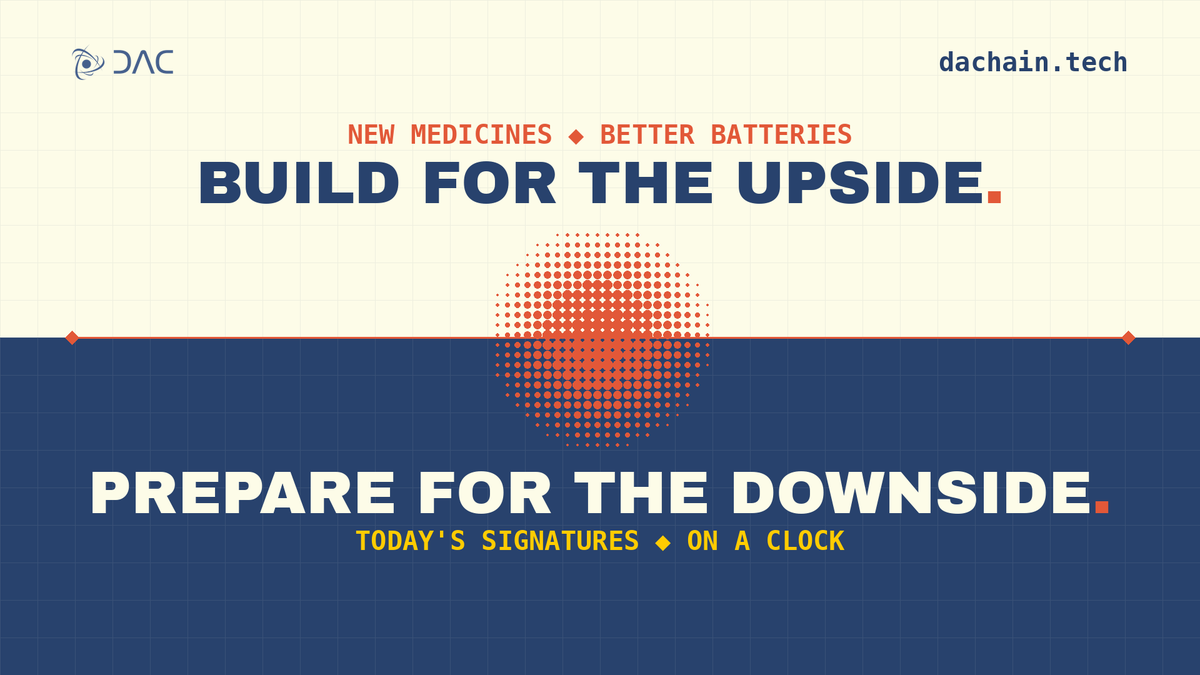
Quantum computers won't pick a side.
The same progress that speeds up drug discovery will also reach the signatures securing your wallet.
That's why DAC is being built quantum-resistant.
One of the most important points in @quipnetwork's recent quantum security explainers is the harvest now, decrypt later threat.
An attacker can collect encrypted information today and store it, waiting for future quantum capabilities that might make the data readable.
That creates a timing problem: the information may need protection long before a sufficiently powerful quantum computer exists.
This is especially relevant for secrets that must remain confidential for many years.
Post quantum migration takes planning, engineering and coordination. Waiting until the threat becomes immediate could leave too little time to respond properly.
The lesson is simple:
The deadline for protecting long lived data can arrive before the machine does.
As tokenisation expands, blockchain security becomes increasingly important.
An on-chain record may represent ownership, financial positions or other valuable information. Protecting that record requires thinking beyond the next market cycle.
@dac_chain is approaching this space with a quantum resistant Layer 1 thesis and a focus on real world assets alongside DeFi and other applications.
That doesn't mean every quantum related risk is already solved. The architecture still needs to stand up to implementation, testing and scrutiny.
But connecting long term asset infrastructure with forward looking security is a worthwhile direction.
The future of tokenisation depends on both usability today and resilience tomorrow.
Quantum security is too important to remain a collection of vague promises.
On October 15, @quipnetwork's team, Postquant Labs, announced that it had joined the Quantum Alliance as a founding contributor.
The initiative brings blockchain organisations together to work on standards defining what post quantum readiness should mean for the industry.
That's a meaningful conversation to have now.
Projects need clear ways to evaluate cryptographic choices, communicate risks and prepare migration paths not simply add quantum resistant to their marketing.
No single project can settle every question about the industry's transition.
Shared standards can help make the discussion more concrete, transparent and technically grounded.
Readiness should be measurable, not just claimed.
A mainnet launch is exciting, but it isn't the final measure of a blockchain's success.
For @dac_chain, Interstellar opens the next stage of its journey after Inception.
The important milestones from here will be practical ones: network reliability, developer participation, useful applications, security validation and sustainable ecosystem growth.
A quantum resistant vision gives DAC a distinct direction. Turning that direction into infrastructure people can depend on is the bigger task.
That's why I'm watching what comes after the launch, not just the launch itself.
A roadmap creates expectations. Consistent execution creates credibility.