Welp, that happened faster than I predicted. Thought it would be end of 2027, then early 2027, but agentic traffic growing so fast that bots have now passed human traffic online for the first time in the Internet's history. https://t.co/2zX5bHdhsa
Introducing model routing to Factory.
Factory Router picks the right model for every task, automatically.
Maintain frontier performance while cutting costs by 25%.
Today we are launching the Kapso CLI:
WhatsApp numbers for agents.
1️⃣ npm install -g @kapso/cli
2️⃣ kapso setup
Done, your agent has a WhatsApp number.
Wow. @imagine This looks amazing! Simple cutout from a screenshot of the original C&C. (VGA) Tried a few prompts. @grok@elonmusk Renders so fast too. No waiting. 👏👏
Wild what's possible now: I can ship a 3D experience prototype to a museum in a single afternoon.
Everything coded and generated with Omma, leveraging AI to iterate fast.
3D models generated in Omma. Scene built on top of Three.js. Prompted for dissolving shaders + particle systems?
Ever wonder what a nervous system would look like if it self-assembled inside a novel being that hadn't faced a history of selection for its organism-level form and function? Or, perhaps you wondered how #Xenobots would look and act, or what their transcriptome would be like, if they had nervous systems?
Well, here's the first step: https://t.co/MVtFw0RcQg
"Engineered Living Systems With Self-Organizing NeuralNetworks: From Anatomy to Behavior and Gene Expression"
Our awesome team: led by @halehf: @LaurieONeill99, @mmsperry, @LPiolopez, @DrPatrickE, and Tiffany Lin.
The @TuftsUniversity and @wyssinstitute press releases are here, for summaries:
https://t.co/PQkBfUFZS5
https://t.co/LPwoLPeBqN
Ever wonder what a nervous system would look like if it self-assembled inside a novel being that hadn't faced a history of selection for its organism-level form and function? Or, perhaps you wondered how #Xenobots would look and act, or what their transcriptome would be like, if they had nervous systems?
Well, here's the first step: https://t.co/MVtFw0RcQg
"Engineered Living Systems With Self-Organizing NeuralNetworks: From Anatomy to Behavior and Gene Expression"
Our awesome team: led by @halehf: @LaurieONeill99, @mmsperry, @LPiolopez, @DrPatrickE, and Tiffany Lin.
The @TuftsUniversity and @wyssinstitute press releases are here, for summaries:
https://t.co/PQkBfUFZS5
https://t.co/LPwoLPeBqN
This has been said a thousand times before, but allow me to add my own voice: the era of humans writing code is over. Disturbing for those of us who identify as SWEs, but no less true. That's not to say SWEs don't have work to do, but writing syntax directly is not it.
Oxford researchers just confirmed what we feared:
The internet as we knew it is dying.
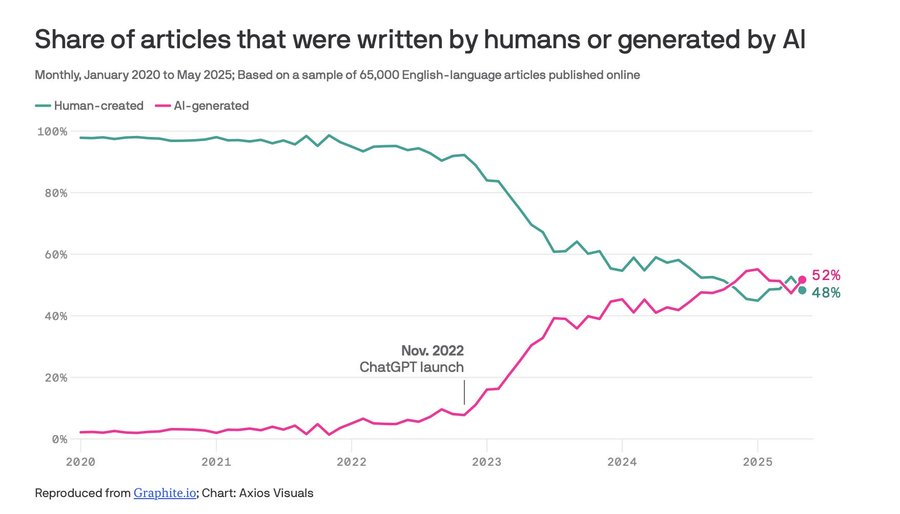
AI content went from ~5% in 2020 to 48% by May 2025. Projections say 90%+ by next year.
Why? AI articles cost <$0.01. Human writers cost $10-100.
But the real crisis is model collapse. When AI trains on AI-generated content, quality degrades like photocopying a photocopy. Rare ideas disappear. Everything converges to generic sameness.
It's recursive. Today's AI slop becomes tomorrow's training data, producing worse output, which becomes training data again.