My reading of the recent literature on AI writing:
People generally cannot reliably tell AI from human writing. Under blind conditions, they often actually prefer the AI writing. But tell them something was written by AI, and suddenly they prefer the “human” version.
1/
🚨New paper alert🚨
🤔 Ever wondered how the way you write a persona prompt affects how well an LLM simulates people?
In our #EMNLP2025 paper, we find that using interview-style persona prompts makes LLM social simulations less biased and more aligned with human opinions.
🧵1/7
This @icwsm paper fine-tunes Temporal Adapters for Llama 3 8B on full timelines from a panel of British Twitter users, finding that the fine-tuned LLMs retrieve collective emotions! Cool extension of simulation work to the longitudinal scenario:
https://t.co/DiBmjM4X0W
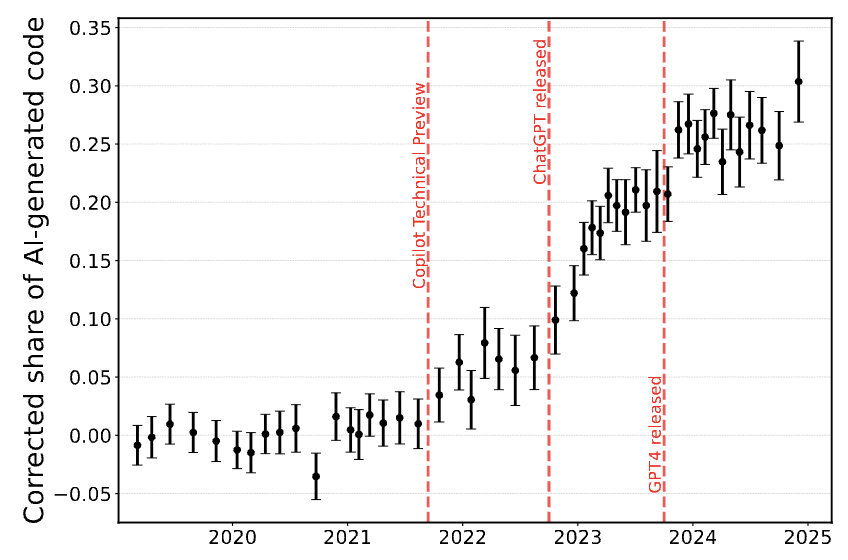
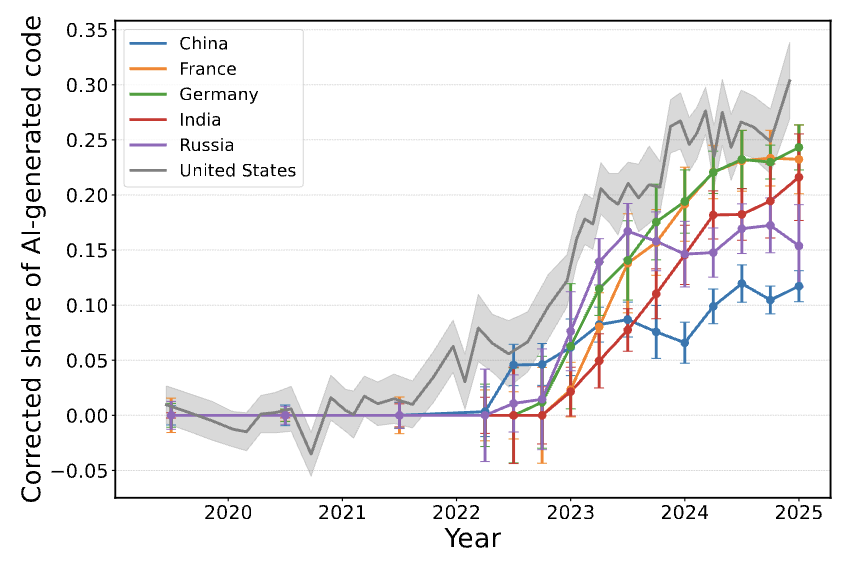
How much code now comes from AI? In new work with @simone_daniotti, @xiangnan_feng & @FrankNeffke we estimate that by end-2024 about 30% of Python functions pushed by US devs on GitHub are AI- generated. Adoption is rapid but diffusion lags globally. How did we do it?
Proud to present the first benchmark for representational similarity measures today at @iclr_conf!
If you also attend #ICLR, come see us this afternoon, Hall 3 #456!
Otherwise, you can check out our paper here:
https://t.co/RqQwCGQrxq
Update: our survey on functional and representational similarity measures for neural networks has just been accepted to ACM CSUR!
We present & categorize 53 measures, discuss their properties & application, but also identify key research gaps:
https://t.co/pgsPwkhTp9
Excited to share the materials for our course on open LLMs for science of science research @ZakASHussain
and I offered at the recent meeting of @euroscisci
at @LMU_Muenchen.
https://t.co/7XqejupoBs
Want to learn about computational social science *for free* and launch interdisciplinary research projects? We are so excited to announce there will be *26* Summer Institutes in Computational Social Science this year! Apply to one of them here: https://t.co/trE4O9OhCc
Job announcement: Junior Professorship in Computational Social Science at the University of Konstanz.
Join us at the Center for Data and Methods! Feel free to reach out if you have questions.
https://t.co/O8yxogBbGq
Two exciting positions as postdoc / senior researcher with tenure option at KTS @gesis_org (https://t.co/nPIt0Ya3L7) on computational social science and #NLP. Details at: https://t.co/9hM6Q20Fwe and
https://t.co/bG9TRlMAbN.
"The increasing reliance on AI tools for social and emotional tasks heightens the risk of #autonomy#loss. As synthetic relationships become more prevalent, companies that operate these AI systems may gain substantial influence over users’ lives. "
from Nature Human Behaviour
We’re hiring a Team Lead @gesis_org Computational Social Science department! 🌐
Passionate about open science & innovative methods for digital behavioral data?
👉 Link: https://t.co/t0usJZvO4d
❓ Questions? Contact me via DM or mail
Do you need to copy art to make art?
That question is the core of the tension between generative AI and copyright.
Check out @rhfeiyang and @materzynska's new work that avoids slurping up art.
Their Art-Free Diffusion & Art-Free data let you make "imitation-free" AI art🧵
We just opened a new team leader position at the Computational Social Science department at @gesis_org please spread the news and contact me or @SebStier for questions https://t.co/dpr853QUel
Where does gender bias manifest in model parameters? 🤔 Excited to present our work on Local Contrastive Editing of Gender Stereotypes at @emnlpmeeting on Thursday at 10:30am! Drop by our poster to chat about new insights into bias control. #EMNLP2024
In the beginning of 2023 I expressed my fear that AI would deforest the knowledge’s ecosystem https://t.co/nW9oRtrqGx. Now a PNAS Nexus paper shows that large language models reduce public knowledge sharing on online Q&A platforms (StackOverflow) https://t.co/8TbpmUjrvP