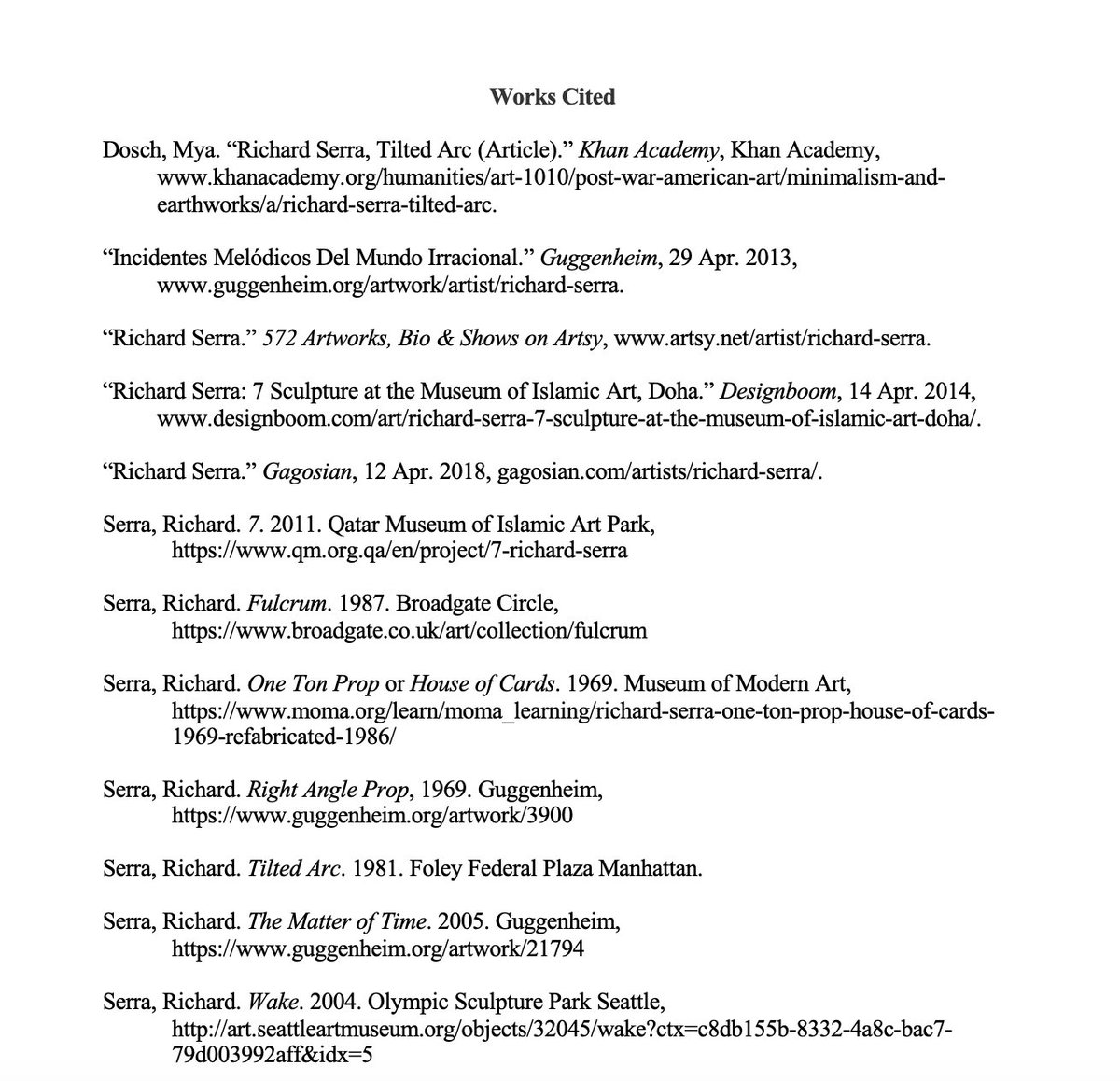
I hope you enjoyed my Individual Research Project on Richard Serra and a few of his great works. He is an interesting post modern, minimalist artist. In this tweet, I have provided my Works Cited. Thank you!
The pentagonal shape is to prompt a unique physicality when compared to the surrounding architecture in the Broadgate Circle. This interpretation provides a sense of movement when viewers move it around it and compare it to the fulcrum’s surroundings.
Fulcrum is located in Broadgate Circle in the United Kingdom and was finalized in 1987. Richard Serra created the structure with use of the weatherproof steel, five in total, positioned to lean on one another (like “House of Cards”).
Viewers are supposed to interact with the sculpture in order to access its full potential. Like his others, viewers are to interpret the space and volume of the work created when taken into evaluation.
Serra emphasizes again how the viewer must physically interact with the sculpture by walking around it, looking into it, looking in-between to gain new perspectives on the interpretation of space.
This work is also in response to his infinitive series “to prop” like “Right-Angle Prop”. Serra is quoted in response to this work by noting how even though the structure seems as though it could collapse, it simply stands freely.
To truly acquire and embody the work, it must be seen altogether in a progressive sense, as the structures shape provides a sense of movement throughout each section.
Richard Serra crafted “Wake” in 2004 using curved steel in a progressive pattern movement. Alike his other steel-shaped works, the viewer must physically be within the space to truly recognize the consciousness of meaning and space.
With the assistance of computer imaging and a demilitarized machine, Serra produced five s-shaped curves all identical to one another. To enforce the industrial effect, Serra would acid wash the structures.
There was also great controversy spawned by the work’s placement and ultimate meaning, leading to several court disputes pertaining to whether the work should be left where it is. The work was removed in 1989 but is still brought into discussion to this day.
In 1981, Richard Serra stationed a 12-foot tall, 15, ton, and 120-foot long steel metal slab in the Federal Plaza in Lower Manhattan, New York. Serra’s focus was to have the viewers connect with the work on a physical level as a means to engage with the work more personally.
“7” is appreciated among those who view, not only for its sentimental meaning, but also as a form of appreciation as the community welcomes such extravagant cultural art.
Richard Serra unveiled the work titled “7” in 2011 outside of Qatar’s Museum of Islamic Art. The piece stands on a man-built extension about 250 feet from the mainland.
The 80-foot structure stands alone, surrounded by a water. Serra was commissioned and came up with the heptagonal sculpture based upon the historical and scientific value Islamic traditions hold valuably.
Serra approaches his work in an unconventional manner by using basic conventional mediums. This ultimately allows the works to engage in a fundamental form of thinking combined with the complexity of its meaning.
Richard Serra developed a work titled “Right Angle Prop” in the year 1969. The work has a lead antimony medium as it is postured up against the museum’s wall.
In the days between 1967-1968, Serra compiled a list of infinities such as “to hurl” or “to roll” to serve as basis for his following works. He finally landed on “to prop” which ultimately formed the idea for the right-angle lead prop.