🚨🌍 THE GLOBAL LNG BUFFER IS RUNNING OUT
Nearly 5 months into the Iran war, fighting has removed around 20% of global LNG production, mostly through lost Persian Gulf exports.
The market survived better than expected because other producers increased supply and replaced roughly 70% of the missing volumes, according to the IEA.
But that rescue came mainly in the first half of 2026.
From here, spare supply is thinner, production growth options are more limited, and the market has fewer ways to absorb another disruption.
LNG benchmarks have already surged more than 50% in recent weeks.
The first shock was cushioned. The next one may not be.
https://t.co/igMytt011l
🇮🇶Iraq exports 3.4 million barrels of oil per day 🛢️
⚠️When Hormuz closed, 95% of that had nowhere to go.
So Baghdad sent convoys of tanker trucks through Syria🇸🇾
Starting late April 2026, Iraq began routing fuel oil overland to Syria's Baniyas terminal on the Mediterranean thousands of trucks, crossing at Al-Waleed and Rabia-Yarubiyah, loading onto ships that Hormuz couldn't touch.
SOMO contracted 650,000 tonnes per month of fuel oil via this route from April to June.
The latest data put Baniyas fuel oil exports at 122,000 b/d in May, 140,000 b/d in early June.
🚛Hundreds of trucks per day.
Multi-million barrels already moved.
Iraq plans to export 50,000 b/d of crude via Syria from July, expanding beyond fuel oil into crude and naphtha.
Syria is building out Baniyas capacity to handle up to 900 tanker trucks per day to absorb both streams.
50,000 b/d is small relative to Iraq's total export base.
But the direction matters more than the volume right now.
Iraq's normal export infrastructure runs almost entirely through the Gulf and Hormuz.
When that chokepoint became a war zone, Baghdad had no real bypass ready.
The Syria corridor is slow, expensive and logistically complex.
It is also the fastest alternative Iraq could actually activate.
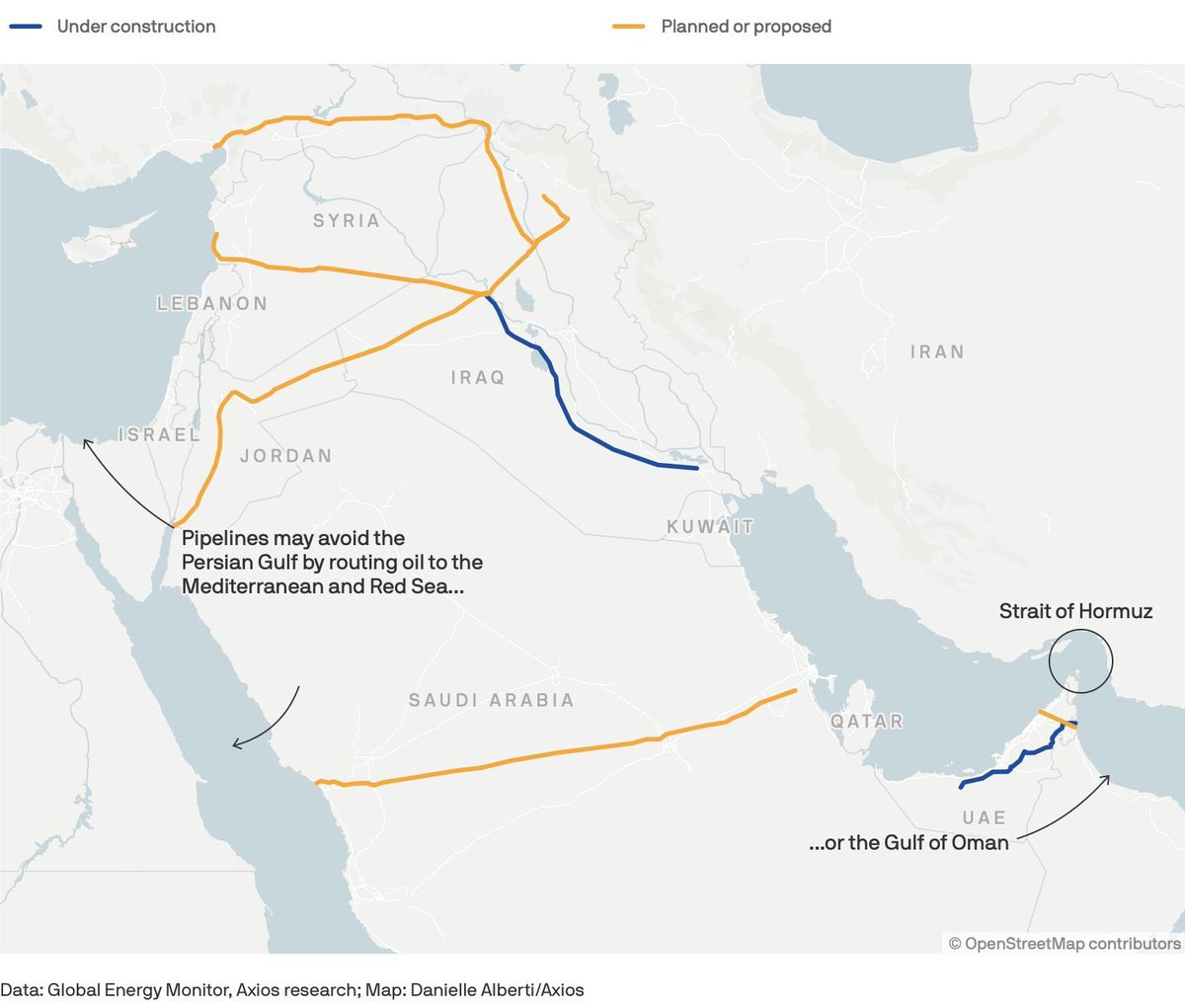
The same logic explains why the US is now backing revival of the historic Kirkuk–Baniyas pipeline designed for 300,000 b/d as a permanent corridor independent of the Gulf.
Every major oil producer in the Gulf is running the same calculation right now: how exposed am I to a single chokepoint?
Iraq is answering that question with truck convoys while it builds something more permanent.
🇺🇸Natural gas went from 20% of US energy production in 1950 to 47% today.
Every energy transition in this data has a trigger.
1950s, nuclear energy begins
1973 and 1979, 2 oil shocks reshape the mix
2008, the shale revolution flips gas and oil into structural growth
2010s, solar and wind expansion begins
2020, a pandemic shock barely dents the trend
Coal fell from 40% to 10% over the same window.
Natural gas is now half of everything America produces.
This is the base the entire LNG weapon thesis sits on top of.
https://t.co/xGGtjqI252
Really useful factsheet on the EU's China shock 2.0 from my talented colleagues on our design desk and those running the SCMP Plus subscriber product
https://t.co/7ypRPzogDj
The world is not waiting to find out who controls Hormuz. It is building around it.
Goldman Sachs tracked 7 pipeline and export projects now under construction or planned across the Gulf.
1. By end of 2027, over 45% of pre-war Gulf exports could bypass Hormuz entirely.
2. By end of 2028, that rises past 60%.
3. Median Gulf pipeline construction time: 2.5 years, faster for disruption driven projects.
7 to 9 million barrels a day will still need Hormuz no matter what gets built. Qatar's LNG has no alternative route at all.
The era of Hormuz as irreplaceable is ending. It is not ending fast enough to matter this year.
source @MarioNawfal
JUST IN: A source close to Iranian officials says Tehran is deliberately holding back its full military firepower while tightening control over the Strait of Hormuz — because time and oil are on Iran's side, per some Iranian outlets.
The source explained that Trump's window to avoid a global economic crisis is shrinking fast. The U.S. Strategic Petroleum Reserve is now just 19 million barrels above its minimum operating level — the cushion the U.S. has been using to keep oil prices artificially low amid escalating tensions. At current drawdown rates, that floor could be hit by early August. Meanwhile, Iran is exporting oil freely with the blockade lifted, steadily draining the U.S. safety net while Tehran builds its leverage.
The source also confirmed that Iran has adopted a new doctrine: any fresh U.S. strike will trigger the immediate and complete closure of the Strait of Hormuz, with retaliation at a minimum 2:1 ratio. The Strait is one decision away from shutdown, and the SPR safety net is nearly gone. Trump is escalating while the U.S. has no cushion left — and if the Strait closes, $150+ oil is not unrealistic.
He emphasized that the chokepoint remains the ultimate leverage — and Tehran knows it.
この調査の元のデータで、一番衝撃だったのが「アメリカ人は、国を正しい軌道に戻すために、暴力に訴えざるを得なくなるかもしれない」という主張に対して、全体では37%が同意(strongly agreeとagreeを足した数)なのですが、記事にはかかれてませんが、30歳以下の若者については58%に至っていること。
Poll: Most Americans think the U.S. has strayed from its founding principles https://t.co/lS2EzaYLBS
China's electricity transition is often portrayed as coal vs renewables. Reality is far more interesting: In 2000, fossils ~75% of installed capacity. By 2025, that fell down dramatically to 34% — not from shutting coal plants, but adding massive new renewables alongside them.
Over the past 25 years, China's total electricity system expanded from 0.36 TW to 3.88 TW by the end of 2025 (already exceeding 4.1 TW by May 2026), making it by far the largest power system ever constructed.
During that time:
• Renewable capacity grew to 2.50 TW, or 64% of total capacity.
• Solar and wind alone reached 1.99 TW, accounting for 51% of the entire system.
• Fossil capacity grew much more slowly, reaching 1.32 TW, while its share of the system steadily declined.
• Nuclear capacity, despite one of the world's largest construction pipelines, remains just 0.06 TW — around 1.5% of total capacity.
The most important takeaway isn't that coal disappeared. It didn't.
It's that China built an electricity system so vast that fossil fuels became progressively smaller within it. Even nuclear, despite decades of investment and an enormous build program, remains little more than a rounding error compared with the scale of growth in solar, wind and the overall electricity system.
Whatever your views on energy policy, the scale of China's electricity expansion over the past two decades is unprecedented. And if current trends continue, the world's largest electricity system may still be in the early stages of its transformation.
And before anyone asks: no, I'm not paid by China to post this. I simply report the data and draw my own conclusions. Every figure shown here is publicly available, independently verifiable, and sourced from official statistics and international energy datasets.