The most extensive and comprehensive paper explaining what exactly MLOps is. The read is not only worth it, it is absolutely necessary if you want to see the bigger picture
https://t.co/rhudD7le1y
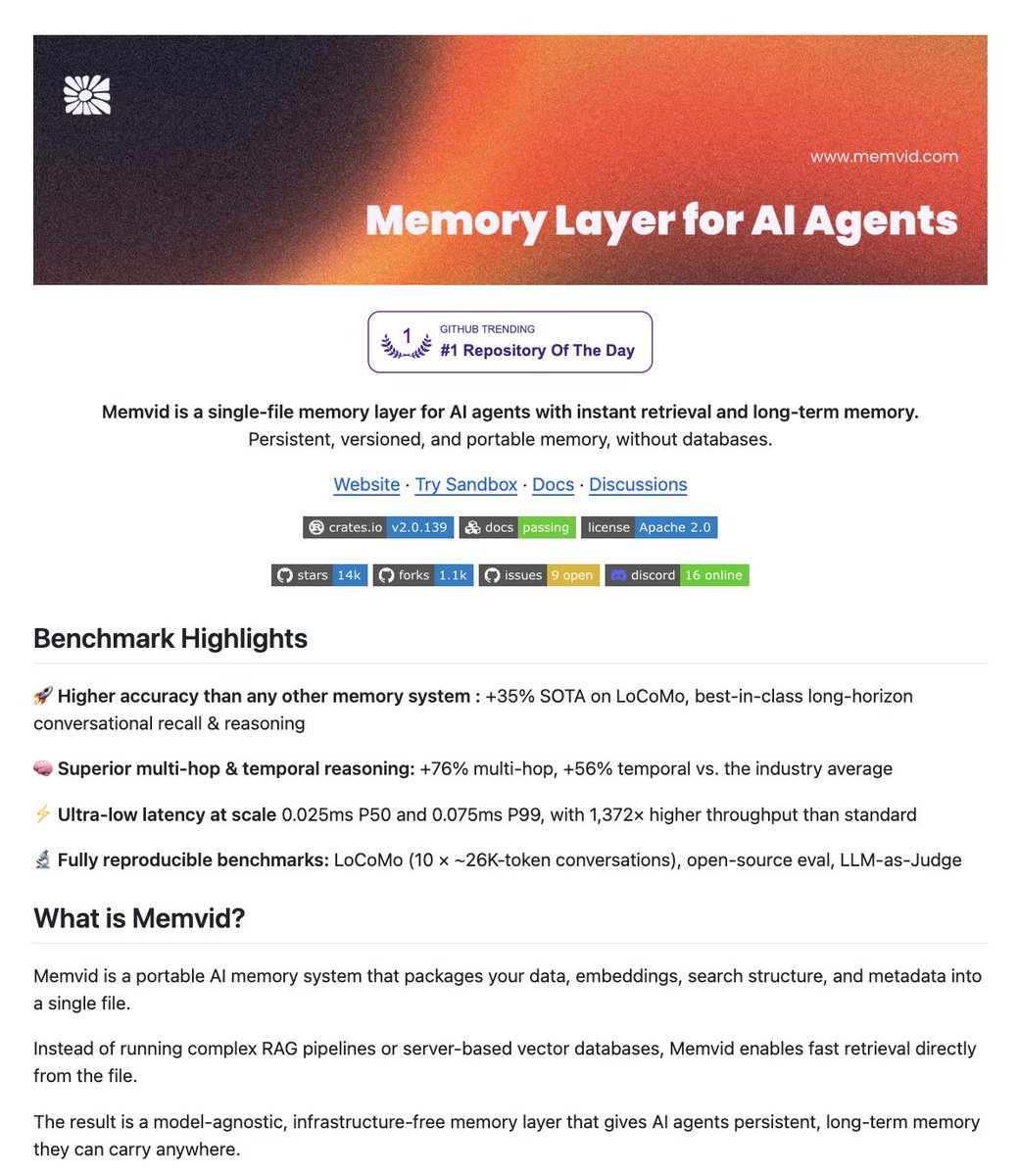
🚨 BREAKING: Vector databases for AI memory just got replaced by MP4 files.
Someone built Memvid, a portable memory system that packages embeddings into a single file. It stores millions of text chunks using video encoding logic for sub-millisecond retrieval.
→ Replace expensive vector databases with single file.
→ Lightning-fast semantic search without a server.
→ Portable, versioned, and crash-safe AI memory.
100% open source.
Imagine trying to teach someone how to swim just by letting them read books about water.
That is how we have been training AI on physics, using text descriptions.
To really learn, you need to get in the water.
"The Well" is that water.
Polymathic AI has released a massive 15TB open-source library of physics simulations. It allows AI models to experience physical phenomena directly.
Instead of reading about a supernova, the model processes the actual data of the explosion. Instead of reading about aerodynamics, it analyzes the fluid flow.
This moves us from [Generative AI] (making things up) to [Scientific AI] (discovering truth).
A huge step forward for open science.
GitHub Repo: https://t.co/xgUdqncyRH
@ColizEdgar@SofiaSici Desde luego, de todo hay. Yo he tenido jefes de todo tipo, buenos, malos y terroríficos. Pero vamos, de estos muchos hay muchos, y no se les pueden hacer concesiones porque te pisan cuando pueden. A esos no se les coge el teléfono por la noche
@ColizEdgar@SofiaSici Jajaja pocas veces pasa eso. Al que pueden exprimir lo exprimen, pero no lo ascienden. El que sube suele ser el que tiene buen enchufe o el que mejor lame culos, no el que más trabaja
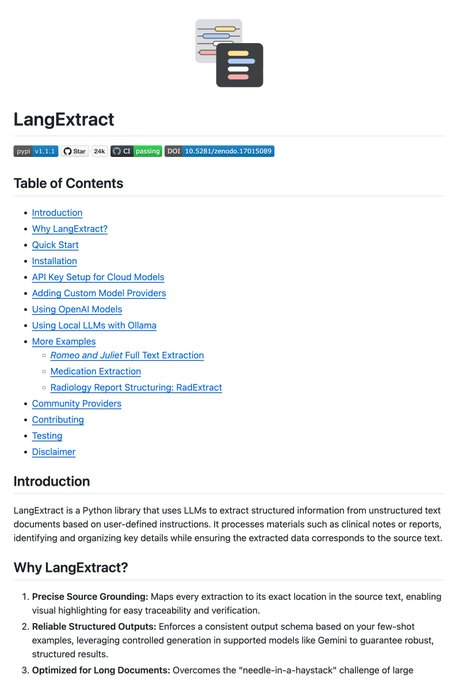
🚨 Google acaba de cargarse la industria de la extracción de documentos.
Ha lanzado LangExtract, una librería que convierte texto desordenado en datos estructurados y verificables, incluso en documentos enormes.
Es gratis y open-source 👇
We are also releasing self-contained lecture notes that explain flow matching and diffusion models from scratch. This goes from "zero" to the state-of-the-art in modern Generative AI.
📖 Read the notes here: https://t.co/RULWDgn9pm
Joint work with @EErives40101.
[Download 698-page PDF eBook]
Everything You Always Wanted To Know About #Mathematics* (*But didn’t even know to ask)
A Guided Journey Into the World of Abstract Mathematics, Theorems, and the Writing of Proofs: https://t.co/JLsDOmpP1q
Be careful what you put in your AGENTS dot md files.
This new research evaluates AGENTS dot md files for coding agents.
Everyone uses these context files in their repos to help AI coding agents. More context should mean better performance, right?
Not quite. This study tested Claude Code (Sonnet-4.5), Codex (GPT-5.2/5.1 mini), and Qwen Code across SWE-bench and a new benchmark called AGENTbench with 138 real-world instances.
LLM-generated context files actually decreased task success rates by 0.5-2% while increasing inference costs by over 20%.
Agents followed the instructions, using the mentioned tools 1.6-2.5x more often, but that instruction-following paradoxically hurt performance and required 22% more reasoning tokens.
Developer-written context files performed better, improving success by about 4%, but still came with higher costs and additional steps per task. The broader pattern is that context files encourage more exploration without helping agents locate relevant files any faster. They largely duplicate what already exists in repo documentation.
The recommendation is clear. Omit LLM-generated context files entirely. Keep developer-written ones minimal and focused on task-specific requirements rather than comprehensive overviews.
I featured a paper last week that showed that LLM-generated Skills also don't work so well. Self-improving agents are exciting, but be careful of context rot and of unnecessarily overloading your context window.
Paper: https://t.co/agxvRbW26N
Learn to build effective AI agents in our academy: https://t.co/1e8RZKrwFp
🎓 Second lecture is live on YouTube! ▶️
Introduction to Deep Learning Research 🔬
Lesson 02: Programming a neural network 💻🧠
Behaviour by design using weights computed with maths 📐🧠
https://t.co/DTtlbdZUdu




![techNmak's tweet photo. Imagine trying to teach someone how to swim just by letting them read books about water.
That is how we have been training AI on physics, using text descriptions.
To really learn, you need to get in the water.
"The Well" is that water.
Polymathic AI has released a massive 15TB open-source library of physics simulations. It allows AI models to experience physical phenomena directly.
Instead of reading about a supernova, the model processes the actual data of the explosion. Instead of reading about aerodynamics, it analyzes the fluid flow.
This moves us from [Generative AI] (making things up) to [Scientific AI] (discovering truth).
A huge step forward for open science.
GitHub Repo: https://t.co/xgUdqncyRH](https://pbs.twimg.com/media/HFC1ZQbaYAE9qoA.jpg)
![KirkDBorne's tweet photo. [Download 698-page PDF eBook]
Everything You Always Wanted To Know About #Mathematics* (*But didn’t even know to ask)
A Guided Journey Into the World of Abstract Mathematics, Theorems, and the Writing of Proofs: https://t.co/JLsDOmpP1q https://t.co/f7JEHmYkdO](https://pbs.twimg.com/media/HB7SWhKWEAAYtKK.jpg)


